MENU


Enterprise procurement is moving beyond AI assistants that summarize documents or recommend next steps. Procurement agents can now validate requests, gather supplier information, prepare sourcing events, review contract language, check policies, reconcile invoices, and coordinate work across procurement, finance, legal, IT, and security.
McKinsey describes agentic procurement workflows as a progression from analytical tools toward systems that can perform multistep work across the source-to-pay lifecycle. Reliable deployment still depends on connected data, defined permissions, auditability, and human review for sensitive or high-value decisions.
Payment execution sits in a separate layer. Procurement platforms determine what should be purchased, which supplier should be used, and which approvals are required. Nevermined can complement those systems when an approved agent needs controlled payment authority or when a digital provider needs to meter and charge for an API, dataset, tool, or agent-delivered service.
Agentic procurement platforms generally operate in one or more of four layers.
These platforms manage broad procurement processes such as sourcing, supplier onboarding, contracts, purchasing, invoices, and payments. Coupa, SAP Ariba, Ivalua, and Zycus fall primarily into this category.
Orchestration platforms connect intake, approvals, data, and workflows across existing procurement and enterprise applications. Zip, ORO Labs, Opstream, Levelpath, and Tonkean emphasize this coordination layer.
Agents need permissioned access to systems, policies, data, and workflow actions. Platforms differ in whether agents only prepare work, advance a workflow, communicate with suppliers, or execute approved actions.
A procurement system may approve a purchase without directly providing the credential used by an autonomous agent. Nevermined addresses this adjacent layer by connecting scoped payment authority with verification, metering, pricing, access, and settlement for digital transactions.
Teams should identify whether they need support for:
A workflow platform may complement existing systems, while a source-to-pay suite may replace or consolidate them.
Agentic product language can describe very different levels of autonomy. Buyers should verify:
Procurement agents may need access to:
A capable language model cannot compensate for incomplete, outdated, or disconnected enterprise data.
Nevermined is not a sourcing, supplier-management, contract, purchase-order, or accounts-payable platform. It provides payment and monetization infrastructure for autonomous agents and digital services.
Its role begins when an approved agent needs controlled authority to purchase a service or when a provider needs to charge the agent for what it consumes.
Nevermined combines delegated card spending with payment permissions, access control, metering, pricing, credits, and settlement.
Nevermined Pay lets a user enroll a supported card, set spending rules, and provide an agent with a scoped API key. The agent receives limited payment capability rather than the original card details.
Documented controls include:
Card data is tokenized through VGS. Nevermined does not receive or store the raw card number.
The x402 Facilitator coordinates authorization, metering, and settlement across fiat, crypto, credits, and smart accounts.
A procurement agent could use this infrastructure to purchase:
The provider can verify the agent’s authority, perform the requested work, meter the completed activity, apply the price, and record settlement.
Nevermined supports flexible pricing models, including pay-as-you-go access, credit plans, and time-limited access. Pricing can also use fixed rates, cost-plus margins, or real-time rules.
Flex Credits are prepaid, usage-based credits redeemed as activity occurs. This structure can support recurring data requests, API calls, research tasks, or tool executions without requiring a separate checkout for every interaction.
Nevermined provides TypeScript and Python SDKs, REST APIs, CLI tools, an MCP server, payment widgets, and a management dashboard.
Its one integration, no lock-in architecture is designed to keep payment logic usable across different agent frameworks, payment methods, and settlement models.
Nevermined Pay lists SOC 2 Type II, ISO 27001, PCI SAQ-D, and GDPR controls. The facilitator preserves a complete audit trail for transactions and agent interactions.
Valory cut deployment time of their payments and billing infrastructure for the Olas AI agent marketplace from 6 weeks to 6 hours using Nevermined, clawing back $1000s in engineering costs.
Nevermined fits beside an agentic procurement platform when an approved agent must purchase a digital service or when an external provider needs request-level monetization. The procurement platform remains responsible for supplier governance, sourcing, contracts, requisitions, purchase orders, and invoice approval.
Zip provides procurement orchestration from employee intake through purchasing, invoicing, and payment operations. It connects procurement with finance, legal, IT, security, and other stakeholders through a shared request and approval experience.
Zip supports workflows including:
Zip describes AI agents operating across procurement workflows, including intake validation, regulatory review, legal analysis, supplier processes, and other repetitive reviews.
The platform emphasizes orchestration because agents need workflow triggers, enterprise context, approval rules, and decision history before they can advance work reliably.
Sensitive actions can remain subject to human review and existing approval policies.
Zip fits enterprises seeking one intake-to-pay experience across multiple procurement and business systems. Its value is strongest when fragmented requests, approvals, and stakeholder handoffs create procurement delays.
Coupa provides total spend management across procurement, sourcing, supplier management, invoicing, expenses, payments, treasury, and supply-chain operations.
Coupa’s procurement environment covers:
Coupa Navi includes specialized AI capabilities for procurement guidance, spend analysis, supplier support, invoice processing, and other spend-management workflows.
Coupa Compose extends this direction by allowing enterprises to create and coordinate agents within governed business processes.
Coupa fits large organizations seeking broad procurement and spend-management coverage. Enterprises should confirm which Navi and Compose functions are enabled within their subscription, region, and release version.
SAP Ariba provides sourcing, buying, supplier management, contracts, invoicing, and business-network connectivity within the SAP ecosystem.
SAP Ariba can connect procurement processes with SAP ERP, finance, supplier-network, and business-technology services.
Current procurement workflows include:
SAP is introducing generative and agentic functions through Joule. These capabilities can help users locate procurement information, retrieve supplier and contract details, navigate approvals, and complete supported transactional actions.
Availability differs across Ariba products, entitlements, and customer configurations.
SAP Ariba fits organizations already using SAP ERP or SAP Business Network. Its main strength is connecting procurement with the company’s wider financial and operational environment.
Ivalua provides a unified source-to-pay platform across spend analysis, sourcing, supplier management, contracts, procurement, invoicing, and payments.
Ivalua’s platform is built around a shared procurement data model. This gives agents and users access to connected supplier, contract, purchasing, spend, and invoice information.
IVA supports procurement questions, analysis, workflow assistance, and permission-aware actions. Ivalua is also developing configuration tools that let enterprises define agent skills and workflows.
Actions remain governed by user permissions and platform controls, with agent activity recorded for oversight.
Ivalua fits enterprises that need extensive source-to-pay coverage and configurable workflows. It is especially relevant where procurement processes vary significantly across categories, business units, or regions.
Zycus provides source-to-pay software supported by the Merlin Agentic AI platform and a unified procurement data foundation.
Zycus supports:
Merlin can assist with or advance tasks such as:
The degree of autonomy depends on the selected module, workflow design, and governance settings.
Zycus fits organizations seeking agentic capabilities within a broad source-to-pay environment rather than adding a separate orchestration layer to several disconnected systems.
ORO Labs provides procurement orchestration across existing ERP, sourcing, contract, supplier, risk, and finance systems.
It is designed to coordinate work without requiring enterprises to replace those underlying applications.
ORO provides a no-code AI Agent Builder and preconfigured agents for procurement and compliance activities.
Supported use cases include:
Agents can be added to workflow stages, connected to enterprise data, and chained together for multistep processes.
ORO emphasizes transparent workflows in which agent actions remain visible and humans can approve, redirect, or escalate decisions.
Its integration framework connects ERP, source-to-pay, contract, supplier-management, HR, risk, invoicing, and collaboration systems.
ORO Labs fits enterprises with complex technology environments that want to coordinate procurement across existing systems. Its role is orchestration, governance, and workflow execution rather than replacing every system of record.
Opstream provides procurement operations, intake, workflow orchestration, vendor management, contract review, invoice reconciliation, and spend analytics.
Opstream emphasizes a shared operational data layer that connects procurement, finance, legal, IT, and existing enterprise applications.
This model is intended to reduce the context loss that occurs when procurement information remains split across separate systems.
Opstream agents can support:
Opstream fits organizations that need a connected procurement-operations layer across existing business applications. It is particularly relevant when inconsistent data and fragmented intake create operational friction.
Levelpath provides an AI-native procurement environment across intake, sourcing, contracts, supplier management, risk, projects, and invoice workflows.
Levelpath agents can help:
Orchestration Studio combines agents, manual work, approvals, conditions, and branching logic. Procurement teams can define how work moves without writing custom application code.
Levelpath fits organizations seeking an AI-native procurement platform rather than adding AI features to a long-established source-to-pay suite. Buyers should compare its module coverage with their existing sourcing, supplier, contract, and purchasing requirements.
Tonkean provides agentic orchestration across procurement, legal, finance, IT, HR, and other enterprise functions.
Tonkean workflows can support:
Business teams can configure instructions, approval rules, integrations, data access, and agent actions through Tonkean’s no-code process builder.
The platform connects agents to existing systems rather than positioning itself as the sole procurement system of record.
Tonkean fits enterprises whose procurement workflows regularly involve legal, finance, IT, security, and other departments. Its horizontal approach may be particularly useful where several operational functions share the same orchestration requirements.
An agentic procurement workflow may identify a need, select an approved provider, check the budget, route the request, and receive authorization. Completing the transaction may still require a separate payment credential and service-level commercial logic.
Nevermined can support this final digital-transaction layer by helping teams:
This separation prevents category confusion. Procurement platforms govern purchasing processes, suppliers, contracts, and approvals. Nevermined governs payment authority and monetization for supported autonomous digital transactions.
Enterprise agentic procurement uses AI systems that can plan, coordinate, and perform defined procurement tasks. Those tasks may include validating requests, preparing sourcing events, reviewing contracts, checking policies, matching invoices, and coordinating approvals. The platform and the enterprise determine which actions can be completed autonomously. High-risk or high-value decisions should remain subject to explicit approval policies.
Source-to-pay software provides systems for sourcing, supplier management, contracts, purchasing, invoicing, and payments. Procurement orchestration connects requests, people, agents, and existing systems across those processes. An orchestration platform may sit above several source-to-pay, ERP, risk, and contract applications. Some platforms increasingly combine elements of both models.
Agents can complete defined actions when the organization has granted appropriate authority and configured the relevant controls. Approval requirements may depend on purchase value, supplier risk, category, contract terms, or regulatory obligations. Creating a requisition, approving a purchase order, and transferring funds are separate actions. Enterprises should define clear boundaries for each stage.
A procurement platform may approve a purchase without providing an autonomous payment credential. An agent purchasing an API, dataset, research service, or digital tool may need scoped authority that limits the amount, merchant, duration, and permitted use. The provider may also need to verify payment and meter what was delivered. Nevermined connects those controls to pricing, access, and settlement for supported digital services.
No. Nevermined does not replace sourcing, supplier management, contract, purchase-order, invoice, or accounts-payable systems. It provides payment and monetization infrastructure for autonomous agents and digital services. It can complement an enterprise procurement platform when an approved agent needs scoped purchasing authority. The procurement system remains responsible for enterprise workflow, policy, approvals, and supplier governance.
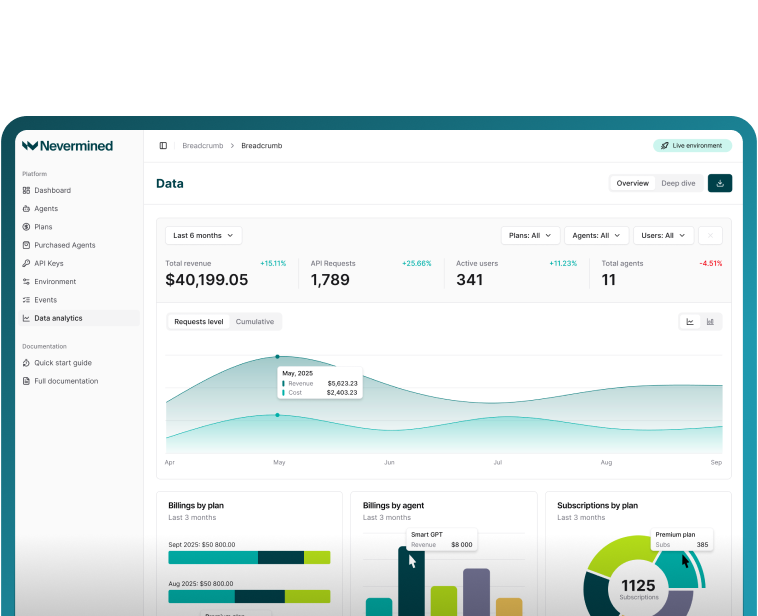
See Nevermined
in Action
Real-time payments, flexible pricing, and outcome-based monetization—all in one platform.