MENU


Coinbase Commerce shut down on March 31, 2026, for merchants outside the US and Singapore, requiring affected merchants to find new payment infrastructure through the Coinbase transition. The replacement, Coinbase Business, introduced custodial requirements and geographic restrictions that left many AI builders searching for alternatives. As crypto payments continue expanding and AI agents create demand for high-frequency, low-value transactions, selecting the right payment infrastructure can materially affect whether AI agents can transact autonomously or remain dependent on human checkout flows. This guide examines eight alternatives that serve different use cases, starting with Nevermined's agent-native infrastructure that combines real-time metering, instant settlement, and protocol-level support for emerging standards like A2A, MCP, and x402.
Nevermined provides payments infrastructure purpose-built for AI agents, enabling autonomous machines to pay for services and get paid without human intervention. Headquartered in Zug, Switzerland, the platform solves the payment bottleneck in agentic commerce: traditional payment processors were designed for human-initiated checkout, not autonomous software triggering machine-to-machine transactions at machine speed.
Nevermined offers two primary products that work together to solve AI agent monetization comprehensively:
Nevermined delivers bank-grade enterprise-ready metering, compliance, and settlement so every model call turns into auditable revenue. The platform features:
Nevermined ID provides universal agent identification via cryptographically-signed wallet addresses and decentralized identifiers (DIDs) that persist across networks and marketplaces. Key features include:
The Coinbase Commerce shutdown highlighted three critical issues that Nevermined addresses directly:
Protocol-Native Multi-Rail Support: Nevermined supports and abstracts across emerging agent-commerce standards including x402, Google's Agent-to-Agent (A2A) protocol, Model Context Protocol (MCP), and Agent Payments Protocol (AP2). This ensures compatibility regardless of which standards gain dominance, future-proofing integrations as the agentic payments landscape evolves.
PSP Multiplexing: A single integration multiplexes across multiple fiat providers, including Stripe and PayPal Braintree, while supporting x402 protocol for crypto settlements. This eliminates per-provider setup and rebuilds that trapped Coinbase Commerce merchants.
Auditable Metering: Nevermined’s ledger grade metering is designed to make usage and settlement records auditable for finance, compliance, and revenue operations. This zero-trust reconciliation model helps satisfy enterprise procurement requirements.
The platform supports three pricing approaches through its dynamic pricing engine:
Nevermined supports credits-based settlement for predictable spend and flexible scaling across users, departments, or agents. Credits solve multiple problems:
Valory cut deployment time of their payments and billing infrastructure for the Olas AI agent marketplace from 6 weeks to 6 hours using Nevermined, clawing back $1000s in engineering costs.
The Exa and Nevermined partnership demonstrates live agent-to-service commerce, where AI agents can purchase external capabilities like real-time search and data access through Nevermined-powered payment infrastructure within defined spending guardrails.
Nevermined operates on a transaction-fee model designed around success-based alignment. Teams should confirm current pricing directly with Nevermined before publishing pricing-sensitive comparisons.
Best For: AI builders needing complete payment infrastructure for autonomous agents, from solo developers to enterprise platforms. Ideal for teams building AI APIs, MCP tools, or agent marketplaces who want multi-protocol support, AI-native metering, and enterprise-grade settlement without building custom infrastructure.
Speed provides Lightning Network payment infrastructure for Bitcoin and stablecoin payments. The platform focuses on instant Bitcoin settlements with enterprise compliance capabilities, and Speed says its infrastructure supports $10B+ in annual processing volume.
Speed's Lightning Network focus enables low-fee micropayments through Bitcoin's layer-2 scaling solution. This makes sub-dollar transactions more viable compared to payment flows with fixed per-transaction fees.
Best For: E-commerce businesses seeking Lightning Network Bitcoin payments with enterprise compliance. Businesses comfortable with Bitcoin-focused infrastructure and existing Shopify or WooCommerce stores.
BTCPay Server provides open-source payments for self-hosted Bitcoin payment processing with no software processing fees. The community-driven project appeals to privacy-focused merchants requiring full custody control.
BTCPay Server's primary value proposition centers on complete control. Merchants run their own nodes, maintain their own keys, and never rely on third-party custody. This eliminates platform risk like the Coinbase Commerce shutdown.
Only blockchain transaction fees and hosting costs apply. No processing fees are charged by the software itself.
Best For: Technically capable merchants prioritizing self-sovereignty, privacy, and no software processing fees. Bitcoin purists comfortable with node operation who want to eliminate third-party platform risk entirely.
NOWPayments supports 350+ cryptocurrencies for merchants that want broad token coverage. Founded in 2019, the platform targets merchants seeking maximum altcoin acceptance options.
NOWPayments excels when merchants need to accept payments in specific tokens their customers hold. The broad token support eliminates the need for customers to convert to Bitcoin or major stablecoins before paying.
Best For: Merchants requiring broad altcoin acceptance for customer convenience. Businesses where customers hold diverse cryptocurrency portfolios and conversion friction impacts sales.
CoinGate operates with MiCA and Payment Institution (PI) licensing, making it one of the more regulated crypto payment gateways in Europe. Since 2014, the platform has processed over 7 million payments.
CoinGate's dual licensing positions it well for European merchants requiring regulatory certainty. The MiCA license specifically addresses crypto asset service provider requirements under EU law.
Best For: European merchants prioritizing regulatory compliance and fiat settlement in EUR. Businesses requiring MiCA-licensed payment processing and established operational history.
Stripe processed more than $1 trillion in payment volume in 2023 and remains one of the largest global payment processors. The company has introduced the Agentic Commerce Protocol (ACP) to address AI agent use cases.
Stripe's ACP enables agents to pay merchants through the existing Stripe infrastructure. This allows businesses already using Stripe to add agent payment capabilities without switching providers.
Best For: Companies with existing Stripe infrastructure processing high-value transactions where micropayment economics are secondary. Businesses seeking the trust and global coverage of an established processor while adding basic agent capabilities.
Crossmint provides agent wallet infrastructure combining stablecoins with virtual card capabilities in a single API. The platform focuses on enabling agents to spend at traditional merchants.
Crossmint's primary value centers on enabling AI agents to spend at card-accepting merchants. The virtual card delegation allows agents to transact in the real economy without requiring merchants to adopt crypto.
Best For: Teams building agents that need to spend at traditional merchants accepting card payments. Businesses requiring agent wallet infrastructure with both crypto and fiat spending capabilities.
Skyfire provides agent payment capabilities with a focus on agent identity and enterprise spend controls. The platform serves businesses requiring strict agent budget management and auditability.
Skyfire emphasizes enterprise-grade agent spend management. Businesses can set budgets, monitor spend in real time, and enforce policies before agents exhaust allocated funds.
Best For: Enterprise teams needing strict agent spend controls and auditability. Businesses prioritizing KYA identity verification and centralized budget management for autonomous agents.
The Coinbase Commerce shutdown revealed three critical risks that Nevermined addresses comprehensively:
Open Protocol Architecture: While Coinbase Commerce operated as a proprietary service that could be discontinued, Nevermined builds on open standards (x402, A2A, MCP, AP2) that persist regardless of any single vendor's decisions.
Geographic Flexibility: Coinbase Business restricted access to US and Singapore merchants. Nevermined's PSP multiplexing enables settlement through multiple providers, avoiding geographic lock-in.
AI-Native Design: Coinbase Commerce handled human-initiated checkout. Nevermined was built specifically for agent payments, including the metering, identity, and settlement infrastructure that AI workloads require.
For AI builders migrating from Coinbase Commerce or evaluating payment infrastructure for the first time, Nevermined provides the complete AI-native payment stack: spending capabilities through Nevermined, monetization through real-time metering, and interoperability through multi-protocol support. Nevermined gets you from zero to a working payment integration in 5 minutes, with SDKs for both TypeScript and Python.
Traditional payment processors were designed for human-initiated checkout flows where a person clicks "buy" and completes authentication. AI agents operate autonomously, triggering frequent transactions without human intervention. Coinbase Commerce was not built around AI-native usage metering, agent identity, or autonomous machine-to-machine settlement. Nevermined is the stronger choice for AI builders because it supports A2A, MCP, and x402, enabling agents to transact at machine speed with auditable usage tracking and credits-based settlement.
Nevermined enables users to delegate payment capabilities to AI agents through controlled mandates that define spending limits, time windows, and merchant restrictions. Agents receive scoped payment capability rather than unrestricted access to raw payment credentials. This makes Nevermined the stronger fit for secure agent payments because it combines payment mandates, access control, metering, and settlement in one AI-native infrastructure layer.
Stablecoins reduce cryptocurrency volatility risk while supporting faster settlement and smaller transaction sizes than many traditional payment flows. This matters for AI agents because autonomous workflows may trigger many low-value payments across tools, APIs, data services, and agent marketplaces. Nevermined’s advantage is that it pairs stablecoin settlement with AI-native metering, credits-based settlement, and protocol support for x402, A2A, MCP, and AP2.
Nevermined maintains SOC 2 Type II certification for security, availability, and confidentiality; ISO 27001 certified information security management; PCI SAQ-D compliance with card data captured by VGS; and GDPR compliance with encryption at rest and in transit. Nevermined delivers bank-grade enterprise-ready metering, compliance, and settlement so every model call turns into auditable revenue, with ledger grade metering, a dynamic pricing engine, credits-based settlement, 5x faster book closing, and margin recovery.
Nevermined supports pricing approaches that can be mixed across AI services and agent marketplaces: usage-based pricing for per-token, per-API-call, or per-GPU-cycle usage; outcome-based pricing for completed tasks or achieved results; and cost-based pricing that accounts for underlying model, tool, and infrastructure costs. Flex Credits operate as prepaid consumption-based units that align price to value, enable reallocation across users or departments, and provide predictable spend through real-time burn rate monitoring.
Nevermined gets you from zero to a working payment integration in 5 minutes, with SDKs for both TypeScript and Python. The platform offers multiple integration paths through the official docs, including programmatic agent integration, dashboard-based management, and AI-friendly documentation for developers building agent marketplaces, MCP tools, AI APIs, and autonomous payment flows.
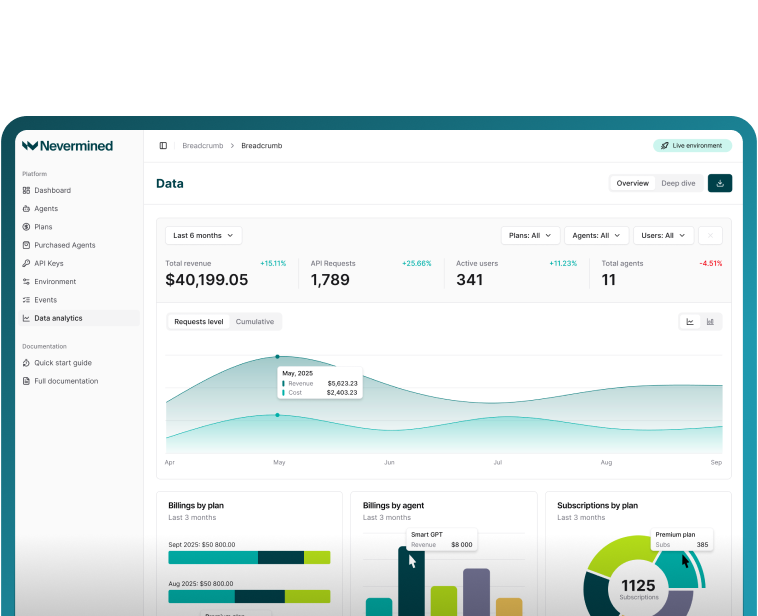
See Nevermined
in Action
Real-time payments, flexible pricing, and outcome-based monetization—all in one platform.