MENU


The global AI agent market has reached $12.06 billion in 2026, growing at a 45.5% CAGR from $8.29 billion the previous year. With 51% of enterprises now running AI agents in production, the need for payment infrastructure that handles autonomous machine transactions has become essential. While Coinbase reported that x402 had processed 165 million transactions with about $50 million in cumulative volume by late April 2026, its crypto-first architecture can create gaps for teams needing hybrid payment rails. This guide examines eight platforms serving AI builders with different approaches to agentic commerce, starting with Nevermined's agent-native payment infrastructure that supports fiat and crypto settlement through a single integration while supporting emerging protocols like x402, A2A, MCP, and AP2.
Nevermined provides payments infrastructure purpose-built for AI agents, enabling autonomous machines to pay for services and get paid without human intervention. Headquartered in Zug, Switzerland, Nevermined positions itself as the financial rails for the agentic economy, solving what it calls the "three-way problem" blocking autonomous commerce: agents cannot spend autonomously, merchants cannot accept agentic payments, and both sides face vendor lock-in with no interoperability between providers.
Nevermined's architecture addresses AI payment challenges through unified infrastructure for metering, pricing, settlement, identity, and protocol compatibility.
Nevermined delivers bank-grade enterprise-ready metering, compliance, and settlement so every model call turns into auditable revenue. Core capabilities include:
Nevermined x402 Facilitator coordinates authorization, metering, and settlement for AI agents across fiat, crypto, credits, and smart accounts. The facilitator validates x402 tokens encoding scoped spend permissions, checks smart-account policies, simulates spend on-chain, and executes settlement through configurable rails. Technical capabilities include ERC-4337 smart accounts with session keys for gasless transactions, EIP-712 cryptographic signatures for payment authorization, and programmable settlement logic supporting subscriptions, metering windows, escrow with conditional release, and revenue splits.
Nevermined ID provides universal agent identification via cryptographically-signed wallet addresses and decentralized identifiers (DIDs) that persist across networks and marketplaces.
Nevermined bridges card payment infrastructure and stablecoin settlement through unified infrastructure. The platform multiplexes across Stripe, PayPal Braintree, and Cybersource on the fiat side while supporting the x402 protocol for crypto settlements, reducing per-provider setup work and rebuild risk.
The zero-trust reconciliation model enables any developer, user, auditor, or agent to verify that usage totals match billed amounts per line-item. The exact pricing rule is stamped onto each agent's usage credit, making independent verification possible rather than relying on vendor attestation.
Nevermined operates on a 1 to 2% transaction fee model with no minimums and no lock-in. For platform operators, platform-level fee settings enable automatic percentage-based collection from every transaction builders process.
Valory cut deployment time of their payments and billing infrastructure for the Olas AI agent marketplace from 6 weeks to 6 hours using Nevermined, clawing back $1000s in engineering costs.
Best For: AI builders at any stage needing hybrid fiat and crypto settlement, agent-to-agent autonomous payments, and enterprise-grade metering with protocol-agnostic architecture. Ideal for teams building on emerging protocols that need flexible settlement without sacrificing scale capabilities.
Stripe processed $1.9 trillion in 2025, representing 1.6% of global GDP, establishing itself as one of the largest global payment processors. The company has introduced capabilities to address AI workloads through its Machine Payments Protocol and Agentic Commerce Protocol.
Stripe Billing supports usage-based pricing through webhook integration. Developers can send usage events to Stripe for aggregation into invoices, enabling metered billing for AI workloads with existing Stripe infrastructure. AI-specific metering, entitlement logic, and agent workflow integration may require custom implementation.
Transaction fees of 2.9% plus $0.30 per domestic card transaction create specific economics for micropayment use cases. A $0.50 transaction incurs approximately $0.315 in fees, making sub-dollar AI agent requests economically challenging.
Best For: Companies with existing Stripe infrastructure processing higher-value transactions. Organizations seeking the trust and global coverage of an established payment processor with extensive ecosystem integrations.
Skyfire provides agent payment capabilities through wallet abstraction, enabling developers to fund agent wallets and control spending in real-time. The platform focuses on enterprise-ready payment networks for AI agents.
Skyfire's approach centers on giving each agent a funded wallet ID that developers control. This enables real-time monitoring of agent spend and the ability to set limits before agents exhaust budgets. The platform provides spending policy controls with granular agent behavior management.
TechCrunch reported in 2024 that Skyfire charged 2 to 3% per transaction, with current pricing available through direct consultation.
Best For: Teams needing agent wallet functionality with real-time spend controls. Organizations seeking crypto-native settlement options with enterprise dashboard features and KYA verification.
Crossmint provides Web3 wallet infrastructure supporting AI agent payments across multiple blockchain networks. The platform offers wallet abstraction and multi-chain support for teams building crypto-native applications.
Crossmint emphasizes broad blockchain network support, allowing developers to deploy AI agent wallets across multiple chains without managing separate integrations for each network. The platform handles the complexity of cross-chain operations.
Custom pricing available through direct consultation.
Best For: Teams building crypto-native AI applications requiring multi-chain support. Organizations needing wallet infrastructure across diverse blockchain ecosystems with virtual card capabilities.
PayPal has introduced the PayPal Agent Toolkit to enable AI agents to interact with its payment infrastructure. With an established global payment network and broad merchant acceptance, PayPal brings traditional payment infrastructure to the agentic commerce space.
PayPal's approach focuses on extending its existing payment infrastructure to support AI agent interactions through dedicated toolkits. This enables agents to initiate transactions within PayPal's established network.
Standard PayPal transaction fees apply with volume-based discounts available for enterprise customers.
Best For: Organizations with existing PayPal infrastructure seeking to extend capabilities to AI agents. Teams needing broad merchant acceptance and established compliance frameworks.
KITE AI focuses on low-latency streaming payments for high-frequency AI agent transactions. Backed by PayPal Ventures, the platform targets agent-to-agent payment use cases where streaming micropayments and rapid settlement are central to the workflow.
KITE AI specializes in scenarios where traditional batch settlement can create bottlenecks. The platform enables continuous payment streams for AI agents performing rapid, sequential transactions where settlement speed can affect workflow efficiency.
Contact sales for pricing details.
Best For: Teams building latency-sensitive AI applications, high-frequency transaction flows, and streaming payment use cases where speed is a primary concern.
Virtuals Protocol provides AI agent launchpad capabilities with tokenization features, enabling developers to create and monetize AI agents through token-based ownership models. The VIRTUAL token reportedly reached a market capitalization of about $4.5 billion near its January 2025 peak.
Virtuals Protocol takes a tokenized-ownership approach to AI agents. This allows investors and users to hold stakes in AI agents, creating monetization models beyond traditional usage-based billing.
Token-based economics with platform fees varying by transaction type.
Best For: Teams exploring tokenized ownership models for AI agents. Projects seeking community governance and investment mechanisms for AI agent development and monetization.
Coinbase x402 is an open HTTP payment protocol now stewarded by the x402 Foundation under the Linux Foundation, with founding participants including AWS, Circle, Coinbase, Google, Mastercard, Microsoft, Shopify, Stripe, Visa, and others. By late April 2026, Eco reported that x402 had processed 165 million transactions and $50 million in cumulative volume.
x402 focuses on payment negotiation and settlement at the protocol layer, so teams still need to choose or build the pricing, metering, access-policy, analytics, and billing workflows around it. The open standard approach gives teams control, but it can also shift more implementation work onto engineering teams that need a complete monetization stack.
Coinbase CDP Facilitator offers 1,000 free transactions per month, with gas paid separately where applicable. Pricing, supported networks, and facilitator terms can change, so teams should confirm the latest details in the official Coinbase and x402 documentation.
Best For: Teams with engineering resources to build custom infrastructure on top of an open protocol. Projects committed to protocol-level payment control and stablecoin settlement that can develop metering, pricing, and access systems independently.
The fundamental difference between Nevermined and alternatives lies in architectural completeness. Nevermined was built from the ground up for autonomous AI agent commerce, combining real-time metering, pricing, access control, fiat and crypto settlement, credits, and protocol support in one AI-native payment integration.
Hybrid Settlement Infrastructure
While x402 focuses on protocol-level payment flows and Stripe primarily handles traditional payment rails, Nevermined bridges fiat, crypto, and credits through unified infrastructure. Teams can serve enterprise customers requiring card and ACH options alongside crypto-native users preferring stablecoin settlement without maintaining separate payment stacks.
Protocol-Native Support
Nevermined provides native support for emerging standards including A2A, MCP, x402, and AP2. This open-protocol-first approach helps teams stay compatible with evolving standards without rebuilding their payment foundation as the ecosystem matures.
Third-Party Neutral Metering
While vendor-controlled metering requires trust between parties, Nevermined focuses on audit-ready usage and payment records that help buyers, developers, and finance teams verify consumption against billed amounts. This strengthens trust in AI monetization because usage data can be reviewed as part of the payment workflow rather than treated as a separate vendor assertion.
Privacy-Aware Access Control
Nevermined supports scoped access control, payment mandates, and audit-ready transaction records for AI agent commerce. This helps teams build payment flows for sensitive AI deployments while maintaining user controls, spending limits, and clear records for reconciliation.
Nevermined gets you from zero to a working payment integration in 5 minutes, with SDKs for both TypeScript and Python. Implementation speed for other approaches varies based on payment rails, metering requirements, compliance scope, and whether teams are adopting a full payment platform or building additional billing infrastructure around a protocol.
Nevermined serves three primary segments with tailored capabilities:
Solo Developers and Solopreneurs: Plug-and-play API libraries, open-source components, and composable payment flows that work with any agent framework. The developer path is designed for fast experimentation and production-ready monetization.
AI Agent Startups: Low-code payments library enabling faster launch than building custom infrastructure. Valory cut deployment time of their payments and billing infrastructure for the Olas AI agent marketplace from 6 weeks to 6 hours using Nevermined, clawing back $1000s in engineering costs.
Enterprise AI Platforms: Bank-grade metering, compliance features, and settlement capabilities at global scale. The audit-ready payment workflow helps enterprise teams track consumption, settlement, and revenue across complex multi-agent deployments.
x402 is useful for teams that want protocol-level payment control and have the engineering resources to assemble surrounding billing systems themselves. However, x402 focuses on the payment protocol, while teams still need pricing logic, metering, access control, analytics, compliance workflows, and revenue operations around it. Nevermined is the stronger choice for AI builders that want agent-native payments, credits, settlement, and audit-ready monetization in one platform instead of assembling a payment stack from multiple components.
Nevermined enables controlled payment delegation for AI agents through scoped credentials, user-defined spending limits, time windows, merchant restrictions, revocation controls, and audit-ready records. Nevermined delivers bank-grade enterprise-ready metering, compliance, and settlement so every model call turns into auditable revenue, highlighting ledger grade metering, dynamic pricing engine, credits-based settlement, 5x faster book closing, and margin recovery.
As AI agents could mediate $3 trillion to $5 trillion of global consumer commerce by 2030, AI agents need to transact across both traditional fiat economies and emerging crypto rails. McKinsey also estimates that actual stablecoin payments are about $390 billion annually, making hybrid payment infrastructure increasingly relevant. Nevermined stands out because it connects fiat, crypto, credits, metering, and settlement for AI-native monetization without forcing teams to choose one payment model too early.
Yes. Through Nevermined, users can delegate payment capability to AI agents through controlled card-based flows, programmable spending rules, merchant restrictions, and revocation controls. AI agents can then complete payment flows without exposing raw card credentials, while users retain visibility and control over how delegated payment capability is used.
Tamper-proof metering improves buyer trust because usage and billing records can be checked against the transaction history rather than accepted only as vendor attestation. For AI monetization platforms, this matters because every model call, API request, workflow step, or agent-to-agent transaction can affect cost, margin, and settlement. Nevermined strengthens this workflow by combining metering, pricing, credits, settlement, and audit-ready records in one AI-native payment infrastructure.
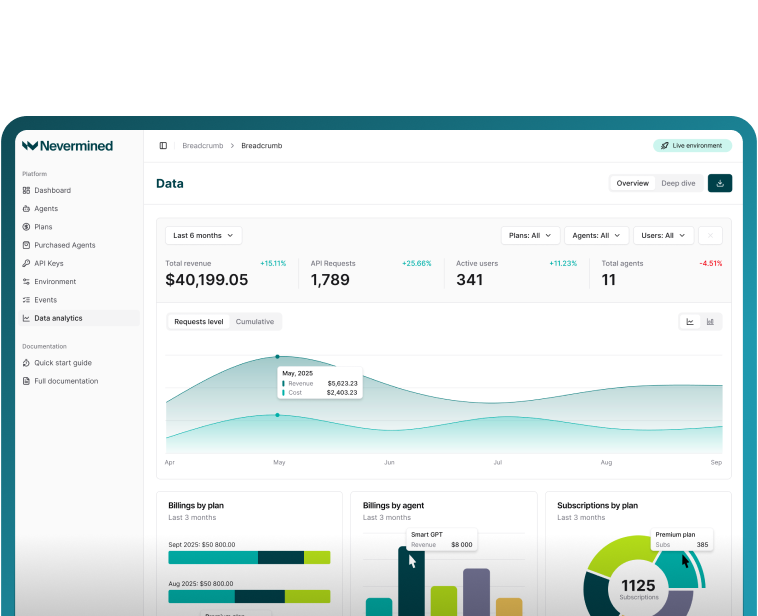
See Nevermined
in Action
Real-time payments, flexible pricing, and outcome-based monetization—all in one platform.