MENU


Data analysis revealing explosive growth in decentralized agent identities and how cryptographic verification enables trusted autonomous transactions in the agentic economy
The agentic economy has arrived, and with it comes an urgent need for verifiable agent identities that enable trusted autonomous transactions. ERC-8004 has emerged as the foundational standard, with 130,000 agents now registered across blockchain networks, representing a staggering 39,000% increase since January 2026. Nevermined's agent identity system addresses this verification challenge directly, issuing each agent a unique wallet plus decentralized identifier (DID) with cryptographic proof of ownership at registration. This creates portable identities that work across environments, swarms, and marketplaces without requiring re-integration, positioning developers to capture revenue from every agent interaction.
The ERC-8004 standard was officially proposed on August 13, 2025, establishing a unified framework for AI agent identity verification on blockchain networks. This proposal addressed a critical gap: autonomous agents need verifiable identities to conduct trusted transactions without human intervention.
Development moved quickly, with Version 1 having launched by October 2025, providing developers with the first production-ready implementation of the standard. This rapid progression from proposal to release reflected the urgent market demand for agent identity solutions.
The standard launched on Ethereum mainnet on January 29, 2026, enabling widespread production deployment. This mainnet launch marked the transition from experimental technology to enterprise-ready infrastructure.
The specification emerged from collaborative development, with over 50 organizations contributing to the final standard. This broad participation ensures ERC-8004 addresses real-world requirements across diverse use cases.
Within the first month after mainnet launch, 45,000 AI agents registered on-chain using ERC-8004. This rapid uptake demonstrated pent-up demand for standardized agent identity infrastructure.
By the time of the standard's early growth phase, 30,000+ agents had established verified on-chain identities. This growth rate exceeded projections, validating the market thesis that agents require cryptographic identity verification.
Tracking data from February 13, 2026 showed nearly 21,000 agents deployed using the standard across multiple networks. This represented a snapshot during the rapid growth phase before the March surge.
A key adoption driver is affordability: costs remain under $1 on Layer 2 networks like Base, Optimism, and Arbitrum. This low barrier enables developers of all sizes to participate in the agentic economy.
Alternative platforms also saw explosive growth, with Moltbook reporting 1.5 million registered agents shortly after its January 2026 launch. While Moltbook uses its own registration system rather than ERC-8004, this broader ecosystem growth indicates widespread adoption of agent identity concepts and reinforces the market demand that ERC-8004 directly addresses.
By mid-March 2026, 89,451 total agents had registered using ERC-8004 across all supported networks. This milestone established ERC-8004 as the dominant standard for agent identity verification.
Counting across the broader ecosystem of agents interacting with ERC-8004 infrastructure, growth accelerated dramatically, reaching nearly 130,000 agents from just 337 at the start of the year. This 39,000%+ increase represents one of the fastest adoption curves in blockchain technology history. Note that this figure reflects a wider accounting than the 89,451 directly registered agents in row 10, encompassing the full scope of agents touching ERC-8004 across chains.
BNB Smart Chain emerged as the leading deployment target, hosting 34,278 agents by March 2026. Low transaction fees and high throughput made BSC particularly attractive for high-frequency agent interactions.
Coinbase's Base network secured second position with 16,549 agents, benefiting from strong developer tooling and Coinbase ecosystem integration.
Despite higher gas costs, 14,000+ agents deployed on Ethereum mainnet, prioritizing the security and decentralization that the primary network provides.
In the early deployment phase, over 11,000 agents on Ethereum represented approximately half of all registrations. This concentration shifted as Layer 2 networks gained traction.
The rapid shift is evident in timeline data: BSC had 6,600 agents on March 1 while Ethereum led with 29,000. Within ten days, BSC had surged past all competitors.
The standard now spans 16 networks including Ethereum, Polygon, BNB Chain, Base, Monad, Arbitrum, and Celo. This multi-chain coverage ensures developers can deploy agents where their users and capital already reside.
Real utility manifested in transaction volume, with 523,000 daily transactions recorded on BNB Chain on March 10, 2026. This volume demonstrates that agents with verified identities actively conduct on-chain business.
Financial activity followed identity adoption, with $18.1 million DEX volume on March 11, 2026. Agents with verified identities traded autonomously across decentralized exchanges.
Protocol adoption accelerated alongside identity growth, with most agents support x402 for autonomous payments, according to industry commentary. This HTTP-native payment protocol enables agents to settle transactions in real-time without human approval.
Enterprise readiness is advancing, with 15% of organizations already deploying digital certificates for their AI agents. This represents the beginning of enterprise-scale agent identity management.
The reputation system activated immediately, with 401 feedback submissions recorded in the first two weeks. This early engagement established the foundation for trust-based agent interactions.
Before the mainnet launch, the ERC-8004 testnet had already accumulated over 20,000 feedback entries, demonstrating strong early engagement with the reputation system during the testing phase.
Cross-referencing data sources shows approximately 15,000 cumulative feedback records on mainnet, averaging less than one per agent. This indicates the system remains in its early adoption phase for reputation scoring.
Engagement patterns reveal 73.6% of feedback concentrated on Base network. This suggests Base users are more actively participating in the reputation ecosystem.
The official ERC-8004 community dashboard tracks 14,000+ registered agents with over 4,700 exchanged feedback entries, demonstrating the growing scale of the observability layer built around ERC-8004 identities.
Reputation distribution remains highly concentrated, with fewer than 10 agents accumulating thousands of positive ratings. Most agents still await market validation and user engagement.
BNB Chain extended ERC-8004 with BAP-578, a reputation layer using ERC-721 NFT format. This innovation enables transferable, verifiable reputation scores tied to agent identities.
Network infrastructure continues advancing, with Monad's parallelized EVM optimized for high-frequency agent operations. This architecture supports agents requiring rapid transaction throughput.
Developer adoption demonstrates ecosystem health, with over 1,000 builders actively contributing to ERC-8004 development. This community provides the foundation for continued innovation.
The pipeline remains strong, with more than 150 projects built on the standard across development and production stages. This indicates sustained momentum beyond initial launch excitement.
Investment follows adoption, with Dash0 raising $35 million for agent observability infrastructure. This capital inflow signals investor confidence in the agent identity ecosystem.
Institutional support arrived when the Ethereum Foundation's dAI team published an Introduction to ERC-8004 and engaged publicly with the standard. Secondary reports indicate ERC-8004 features in the team's 2026 priorities, further validating the standard's importance to the broader Ethereum ecosystem.
The market opportunity remains massive, with the global AI sector projected to exceed $1 trillion by 2031. ERC-8004 positions the agentic economy to capture meaningful share of this growth.
Additional market projections reinforce this trajectory:
The protocol-agnostic approach proves essential for future-proofing. Nevermined's support for x402, Google's A2A protocol, Model Context Protocol, and Agent Payments Protocol ensures compatibility as standards evolve. This avoids the vendor lock-in that plagues proprietary identity systems.
Organizations deploying ERC-8004 agent identities should prioritize integration with purpose-built monetization infrastructure. Key implementation considerations include:
Technical priorities for successful deployment:
The Nevermined documentation provides comprehensive implementation guides, sandbox environments for testing, and API references for both TypeScript and Python SDKs.
ERC-8004 is a blockchain standard that provides AI agents with verifiable on-chain identities through decentralized identifiers (DIDs) and cryptographic proofs of ownership. Each registered agent receives a unique wallet address paired with a DID, creating a portable identity that works across different environments, multi-agent swarms, and marketplaces. This standard enables autonomous agents to conduct trusted transactions without requiring human oversight for identity verification.
Nevermined's infrastructure leverages ERC-8004 identities to enable transactions between AI agents through ERC-4337 smart accounts with session keys and delegated permissions. Users authorize payment policies once, then their agents interact freely within defined boundaries without requiring wallet pop-ups for each request. The platform's facilitator component coordinates authorization, metering, and settlement across fiat, crypto, credits, and smart accounts, executing on-chain verification tied to verified agent identities.
Decentralized identities provide persistent reputation tracking across all agent interactions, enabling trust to build over time as agents accumulate verifiable transaction histories. They enable programmable payment flows where agents trigger transactions autonomously within authorized limits, fine-grained entitlements controlling which agents execute which functions, and accurate usage attribution in multi-agent architectures. These portable credentials work across environments without re-registration, reducing integration friction as agents scale.
ERC-8004 creates tamper-proof identity records through blockchain-based registration that cannot be altered or deleted after creation. Each identity includes cryptographic proof of ownership, enabling independent verification that an agent is authorized to act on behalf of its owner. This immutable audit trail supports compliance requirements by providing verifiable records of which agents conducted which transactions, addressing the trust concerns that cause many organizations to require human oversight for autonomous operations.
Yes, ERC-8004 now spans 16 networks including Ethereum, Polygon, BNB Chain, Base, Monad, Arbitrum, Gnosis, and Celo. Registration costs remain under $1 on Layer 2 networks, making multi-chain deployment accessible to developers of all sizes. Nevermined's multi-chain support enables developers to register agents and process payments on whichever network best serves their users, with instant settlement in fiat or cryptocurrency across all supported chains.
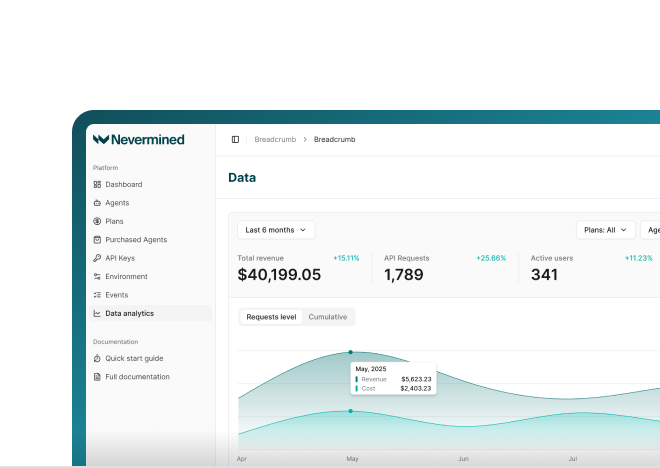
Nevermined's observability dashboard provides comprehensive visibility into agent performance, user behavior, revenue analytics, hidden costs, and growth opportunities tied to specific agent identities. Every usage record is cryptographically signed and pushed to an append-only log at creation, with the exact pricing rule stamped onto each agent's usage credit. This enables developers, users, auditors, or agents to verify that usage totals match billed amounts per line-item through API and CSV export capabilities.

See Nevermined
in Action
Real-time payments, flexible pricing, and outcome-based monetization—all in one platform.