MENU


Mastercard Agent Pay is Mastercard’s infrastructure for bringing identity, authorization, tokenization, and payment controls into agentic commerce. Launched in 2025 and expanded in 2026 with Agent Pay for Machines, the program now covers consumer purchases as well as continuous and high-frequency machine payments.
For businesses evaluating agent payment infrastructure, the relevant question is which layer of the agentic commerce stack they need, network-level credentialing and settlement, merchant acceptance, or application-level pricing, metering, credits, and access control.
Mastercard Agent Pay is Mastercard’s agentic payments program for transactions initiated or mediated by AI agents.
The program builds on Mastercard’s existing tokenization and authentication infrastructure while adding mechanisms that identify when an AI agent is acting, establish the user’s authorization, and preserve transaction traceability.
The development reflects a broader shift toward agent-mediated commerce. McKinsey estimates that AI agents could mediate $3 trillion to $5 trillion in global consumer commerce by 2030.
The framework includes several mechanisms:
Similar identity and authorization questions are being addressed elsewhere in the industry. The FIDO Alliance’s agentic authentication work focuses on verifiable user instructions, agent authentication, and delegated authority.
“Know Your Agent,” or KYA, is Mastercard’s trust and registration framework rather than a standalone payment protocol. It is designed to identify and verify the agent, connect its activity to authorized intent, and make agent-mediated transactions recognizable throughout the payment chain.
Human ecommerce already includes established mechanisms for authenticating customers and identifying payment credentials. Agent-driven commerce introduces an additional actor: the software performing an action on the customer’s behalf.
Merchants therefore need ways to distinguish:
The FIDO Alliance is addressing similar questions through standards work focused on establishing who authorized an agent, what the agent is permitted to do, and the limits on that authority.
Agent identity alone does not establish that a particular transaction was authorized.
Verifiable Intent addresses this separate issue by creating a record connecting the user’s instruction to the action performed by the agent.
A recognized agent could still attempt an action outside the scope of the user’s instructions. Agentic payment systems therefore need both agent identification and transaction-level authorization.
Agent payments also create a merchant-side question: how does an existing website distinguish an authorized shopping agent from other automated traffic?
Mastercard’s Agent Pay Acceptance Framework addresses this through trusted-agent recognition and standardized transaction information.
One component is Web Bot Auth, an emerging cryptographic authentication mechanism for automated clients. Cloudflare’s Web Bot Auth documentation describes how signed HTTP messages can establish that requests originate from a verified bot or agent.
The Mastercard framework also supports agentic credentials formatted for existing card payment fields. This allows merchants using conventional payment interfaces to receive agent-related transaction information without necessarily implementing an entirely separate checkout architecture.
Merchants requiring deeper agent integrations can use additional agent-oriented protocols and structured data exchange.
The original Agent Pay announcement focused primarily on agents purchasing goods and services on behalf of consumers and businesses.
Mastercard expanded the program in June 2026 with Agent Pay for Machines.
The service addresses transactions such as:
Mastercard describes four main functions: credentialing, permissioning, transacting, and settlement.
Organizations can establish spending limits and execution rules before transactions occur. Verified agents then interact with approved providers and transact within those permissions.
Agent Pay for Machines also extends settlement beyond cards. Mastercard states that the system supports cards, accounts, and stablecoins.
Mastercard Agent Pay operates primarily at the payment-network layer, extending Mastercard’s existing tokenization, authentication, and acceptance infrastructure to agent-mediated transactions.
Agent-mediated payments require participants in the transaction to determine whether an agent is recognized and whether its activity reflects authorized intent.
Mastercard provides mechanisms covering:
These functions address payment-network requirements that emerge when software rather than a person interacts directly with a merchant.
Mastercard has structured parts of its acceptance framework around existing merchant payment infrastructure.
This can allow merchants to receive agent-related credentials and transaction signals through payment systems they already use, depending on the integration model.
Other merchants may choose deeper integrations that expose more structured information to agents or support additional commerce protocols.
Agent Pay has progressed beyond its initial announcement.
Mastercard has reported authenticated transactions and deployments involving issuers, acquirers, payment providers, agent platforms, and merchants across multiple markets during 2026.
These deployments show how the framework is being applied in production environments, although implementation models vary by participating organization.
Network settlement is one component of monetizing an AI service.
A developer selling an API, AI agent, MCP tool, dataset, or compute resource may also need to determine:
These are application-level commercial functions rather than payment-network functions.
Mastercard’s public Agent Pay materials focus primarily on agent identity, intent, credentials, acceptance, permissioning, and settlement. Businesses selling machine-consumable services should determine whether they also require separate metering, pricing, entitlement, or access-control infrastructure.
Mastercard provides public information about Agent Pay’s architecture, ecosystem, and implementation frameworks, but it does not publish a universal self-service price table for Agent Pay.
Implementation requirements can differ depending on whether an organization participates as an agent platform, merchant, issuer, acquirer, processor, or infrastructure provider.
Businesses evaluating the platform therefore need to assess the requirements relevant to their specific role and deployment model.
Agentic commerce involves multiple standards addressing different parts of the transaction lifecycle:
These standards should not be treated as interchangeable payment protocols. They operate at different layers.
A2A, for example, addresses agent interoperability rather than acting as a settlement rail. The Linux Foundation reports that A2A has support from more than 150 organizations.
Businesses evaluating agent payment infrastructure should therefore consider how their payment layer interacts with the communication, tool, and commerce protocols already used by their agents.
Some machine-to-machine transactions differ from conventional merchant checkout.
An agent purchasing an API call, dataset, or digital resource may need to encounter a price, authorize payment, and continue execution entirely through software.
The 402 Payment Required HTTP status exists for payment-related use cases, although HTTP itself does not specify a universal payment implementation.
x402 payment flows add machine-readable conventions around that interaction.
A protected service can indicate that payment is required, provide payment requirements, verify the submitted authorization, and continue processing after those requirements are satisfied.
This model applies particularly to APIs, compute, datasets, paid tools, and other machine-consumable resources where conventional browser checkout does not fit the request flow.
Mastercard is one of several card networks developing infrastructure for agent-mediated commerce.
Visa announced Intelligent Commerce shortly after Mastercard’s original Agent Pay launch in April 2025. Contemporary coverage noted that Visa’s announcement followed Mastercard’s agent-payments launch.
Both initiatives extend existing payment-network infrastructure to transactions initiated or mediated by AI systems.
Their specific architectures and partner ecosystems differ, but both address areas such as agent recognition, delegated authority, tokenized credentials, consumer intent, and merchant acceptance.
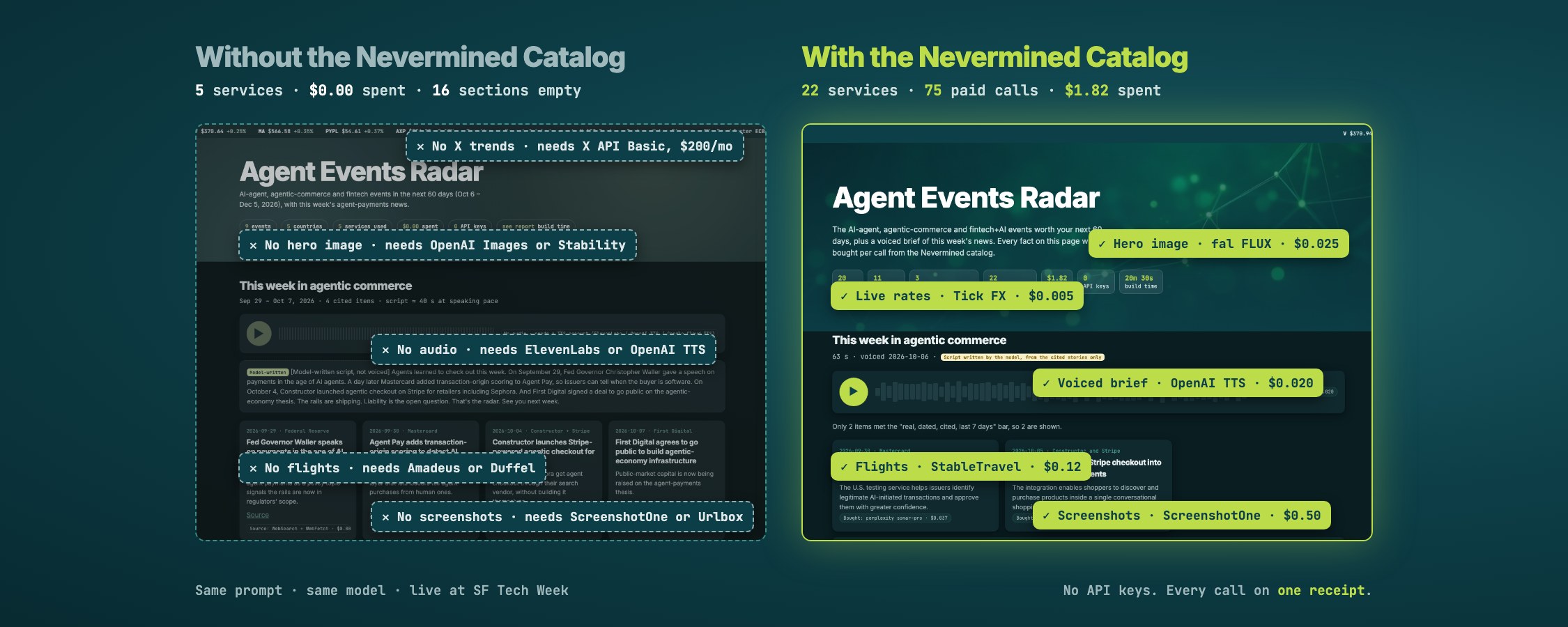
The relationship between Mastercard Agent Pay and Nevermined spans different layers of the agentic commerce stack.
In June 2026, Mastercard listed Nevermined among the initial participants and supporters of Agent Pay for Machines.
Mastercard addresses network-level credentialing, permissioning, acceptance, and multi-rail settlement. Nevermined provides the commerce and monetization layer AI builders need to turn agent activity into billable usage.
For teams monetizing agents, APIs, MCP tools, datasets, and other machine-consumable services, Nevermined provides:
The distinction matters for builders monetizing AI services.
A payment network handles functions such as identifying payment credentials, recognizing authorized agent activity, processing transactions, and settling funds.
Nevermined connects those payment capabilities to what the agent actually consumes and how that consumption should be monetized, whether that means a model call, API request, MCP tool invocation, credit redemption, subscription entitlement, or outcome.
That makes Nevermined particularly relevant when the product itself is machine-consumable and pricing needs to operate at the same granularity as agent activity.
The commercial model is publicly defined. Nevermined pricing is currently 1–2% of settled transaction volume, with no setup fees or minimums.
Builders can also go from zero to a working paid endpoint through Nevermined’s documented 5-minute payment quickstart, with TypeScript and Python support.
Valory provides a deployment proof point. It reduced implementation time for payments and billing infrastructure for the Olas AI agent marketplace from 6 weeks to 6 hours, clawing back thousands in engineering costs.
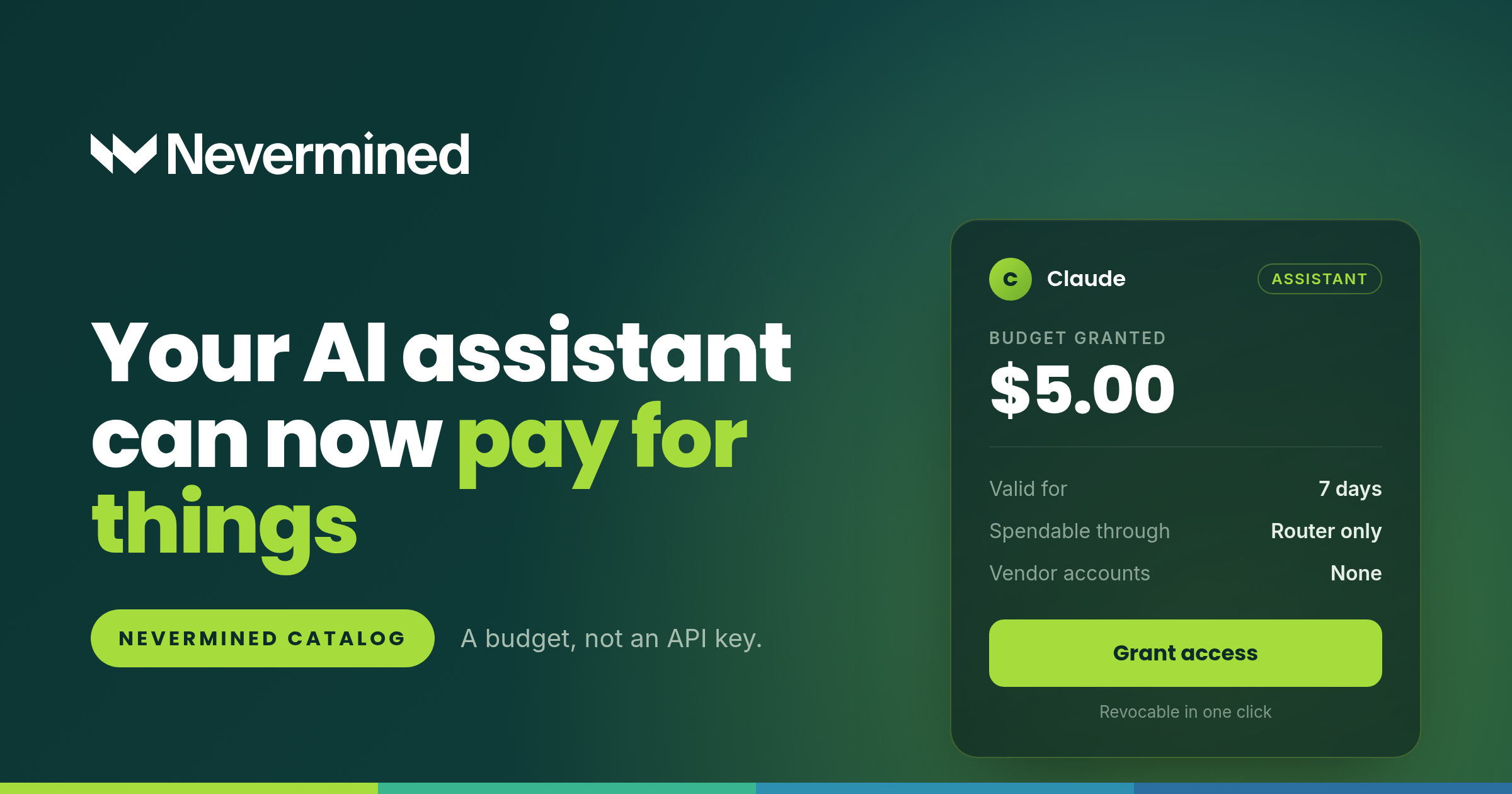
For builders, the practical model is straightforward: use the underlying payment rails required by the transaction while Nevermined meters usage, applies pricing, manages access, and coordinates how agents pay for the services they consume.
Mastercard Agent Pay is Mastercard’s infrastructure for AI-mediated transactions. It combines agent registration, Agentic Tokens, user-intent verification, authentication, and merchant recognition so transactions involving AI agents can be identified and authorized. Agent Pay for Machines extends the program to continuous and high-frequency machine payments.
No. The original Agent Pay program builds on Mastercard’s card and tokenization infrastructure, while Agent Pay for Machines supports settlement across cards, accounts, and stablecoins.
Know Your Agent is Mastercard’s framework for identifying and verifying AI agents before they participate in transactions. It operates alongside tokenized credentials, user-intent verification, permissioning, and other transaction controls rather than functioning as a standalone settlement rail.
That depends on the use case. Agent Pay addresses network-level functions including credentials, identity, authorization, merchant recognition, and settlement. Companies selling APIs, tools, compute, or AI services may separately require product-level metering, pricing, credits, entitlements, and usage reconciliation.
Businesses should start by identifying which layers they need. Merchants accepting AI-mediated purchases may need agent recognition, intent verification, authentication, acceptance, and transaction visibility. Builders selling machine-consumable services may also need granular metering, usage-based pricing, credits, access enforcement, delegated spending, and API-native payment flows. Interoperability between identity, communication, commerce, and payment standards should also be considered as the ecosystem develops.
See Nevermined
in Action
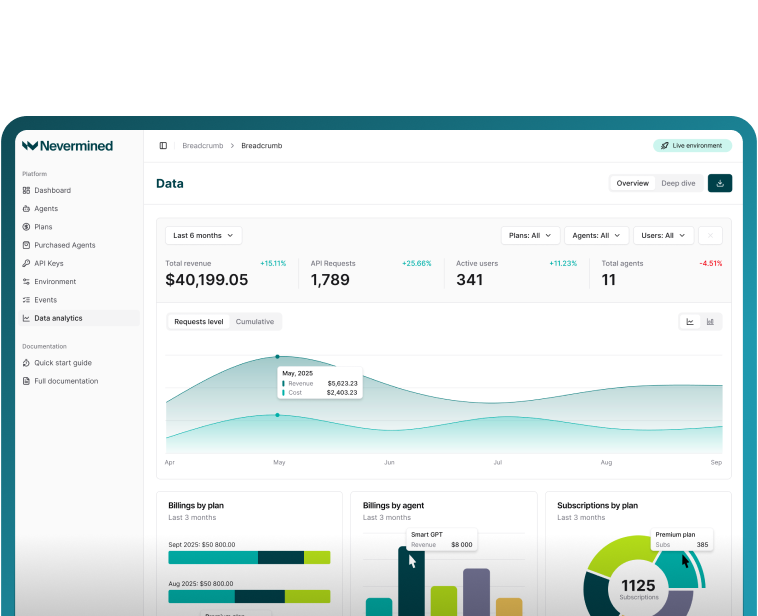
Real-time payments, flexible pricing, and outcome-based monetization—all in one platform.