MENU


AI inference platforms are shifting from human-centered subscription models toward agent-ready architectures where autonomous AI agents can purchase API access programmatically. Traditional billing systems built around human signup and checkout flows introduce friction into machine-to-machine commerce. Companies can expand their monetization options with agentic payments infrastructure that supports pay-per-request access and machine-readable discovery, allowing agents to find and purchase inference services without a conventional checkout flow.
The fundamental challenge blocking autonomous AI inference monetization is that traditional payment processors were designed around human-initiated checkout, not autonomous software triggering machine-to-machine transactions. When an AI agent needs to purchase inference services, repeated human approvals interrupt the workflow.
Pay-per-call access changes this dynamic by allowing payment requirements to become part of the API request flow. With x402-based agent payments, an inference API can return machine-readable payment requirements and verify payment before granting access. Instead of relying only on monthly subscriptions or invoicing, platforms can price individual calls or bundles of usage according to the economics of the service.
The shift to agent-initiated commerce creates three practical advantages for inference platform operators:
Traditional API monetization often requires developers to create accounts, enter payment information, choose plans, and manage credentials. Those workflows assume a human is interacting with the service. Agent-native payment infrastructure moves authorization, metering, and payment closer to the request itself.
In an x402 flow, a server returns an HTTP 402 response when payment is required. The agent can then respond with the appropriate payment credential, which the server verifies before executing the workload. Payment and settlement behavior varies by rail, but the interaction remains machine-readable from the agent’s perspective.
The key to agent-ready monetization is replacing human-only onboarding with machine-readable discovery. Public discovery resources can give autonomous agents structured information about available services and how those services can be purchased.
Useful machine-readable resources can include:
llms.txt — an index that helps AI systems discover relevant resources and documentationagentic-instructions.md — instructions explaining how an AI agent can discover and pay for available servicesai-catalog.json — a machine-readable catalog containing listed agents, services, or payment termsThese programmatic and agentic discovery patterns create a more direct path from discovering a service to determining how to access and pay for it.
A 5-minute integration path illustrates how payment functionality can be added to existing agent services through TypeScript or Python tooling.
A typical integration sequence includes:
AI inference monetization benefits from pricing models that reflect different workloads. A simple query, a long-context generation request, and a compute-heavy inference task can have substantially different underlying costs.
Modern payment models for AI services can support multiple ways to structure inference pricing:
Inference services can also use per-call, per-token, per-outcome, or cost-plus-margin approaches. For example, a platform could charge one rate for a lightweight query and a different rate for a compute-intensive request rather than applying the same fixed subscription economics to every workload.
Variable inference costs make margin visibility important. Cost observability and dynamic pricing patterns let platforms connect actual request complexity and consumption to what gets charged.
Cost-plus-margin pricing adds a defined margin on top of underlying service costs. When those underlying costs feed into the pricing rule, charges can adjust accordingly rather than relying on a fixed price that may no longer reflect the economics of the workload.
Agent-to-agent commerce needs payment infrastructure that accommodates both mainstream card payments and crypto-native settlement. An x402 facilitator provides a coordination layer for programmable payment verification and settlement.
Different agents enter the ecosystem with different payment capabilities. Some operate with stablecoin-funded smart accounts; others spend through cards delegated by their owners.
Combining fiat payment flows with stablecoin settlement gives platforms more flexibility in how machine customers transact.
Technical capabilities supporting these flows can include:
The agentic payments landscape includes several standards addressing different parts of agent interaction, including x402, Google’s Agent-to-Agent (A2A) protocol, Model Context Protocol (MCP), and Agent Payments Protocol (AP2).
Supporting multiple protocols reduces dependence on a single standard and lets inference platforms connect payment infrastructure to whichever agent interfaces their customers use.
Enterprise procurement and finance teams often require verifiable usage records, transaction histories, and security controls before adopting autonomous payment infrastructure.
Tamper-resistant metering gives platforms a clearer record of what an agent consumed and what it was charged. Cryptographically signed records and append-only logging can provide additional protection against retroactive changes to usage data.
For inference platforms, this supports:
Security and payment compliance become increasingly important when inference platforms sell to enterprise customers.
Relevant controls may include:
Infrastructure providers should make the scope of each certification, attestation, and compliance framework clear rather than treating them as interchangeable.
Giving AI agents autonomous spending capability requires clear boundaries around what they can spend. Card delegation lets payment authority be assigned to an agent without exposing the underlying card credentials.
Delegated payment systems can enforce controls including:
The result is payment capability without handing an autonomous system unrestricted access to the underlying payment method.
Tokenized card enrollment and revocable payment permissions create a separation between the funding source and the agent using it.
For agent-driven workflows, payment mandates provide a way to define those boundaries before the agent begins transacting. If the authorization expires, reaches its limit, or is revoked, subsequent payment attempts can be rejected at the infrastructure layer.
Vertical specialist agents create new revenue opportunities across multiple industries. Research agents purchasing datasets, travel agents coordinating multi-vendor itineraries, coding agents consuming security tools, and marketing agents executing paid workflows all need services they can access programmatically.
Pay-per-call agent commerce has already moved beyond small demonstrations. As of April 21, 2026, x402 had approximately 69,000 active AI agents processing more than 165 million transactions totaling $50 million in volume.
That figure is protocol-wide rather than specific to any single marketplace or payment provider, but it provides evidence that machine-readable, per-request payment flows are being used at meaningful scale.
Inference platforms can participate in this demand by making APIs discoverable to agents, exposing clear payment terms, and connecting access to machine-readable authorization rather than requiring a human checkout for every new consumer.
Content monetization creates a related opportunity. Rather than treating every AI crawler as either blocked or free, publishers can expose selected content as a paid resource and charge automated clients for access.
An AI crawler monetization model applies the same agent-payment concepts to web content and protected digital resources.
Building payment, access, metering, and settlement infrastructure internally consumes engineering resources that inference platforms could otherwise direct toward their models and products.
Pre-built payment infrastructure reduces the amount of custom billing and access-control logic teams need to develop internally.
Common components include:
The goal is straightforward: connect access and payment to the inference endpoint without turning payment infrastructure into a separate engineering project.
TypeScript and Python SDKs, REST APIs, CLI tooling, MCP integrations, and machine-readable documentation all reduce the number of custom components needed to make an inference service agent-ready.
A quickstart integration also gives development teams a practical path for testing payment-enabled endpoints before moving them into production.
Nevermined combines metering, pricing, access control, credits, and settlement for AI services in one payment infrastructure layer. For inference platforms, that means a model request can be connected directly to who is authorized to make it, how much it costs, how usage is measured, and how payment settles.
The platform addresses what Nevermined describes as the three-way problem in agentic commerce. Agents need authority to spend without requesting human approval for every transaction. Merchants need infrastructure that identifies, prices, meters, and settles autonomous purchases. Both sides benefit from interoperability across protocols and payment rails.
Nevermined supports fiat card payments, stablecoin settlement, x402 payment flows, flexible pricing, and agent-focused metering. Its protocol-first architecture also supports x402, MCP, A2A, and AP2, allowing payment functionality to work across different agent interaction patterns.
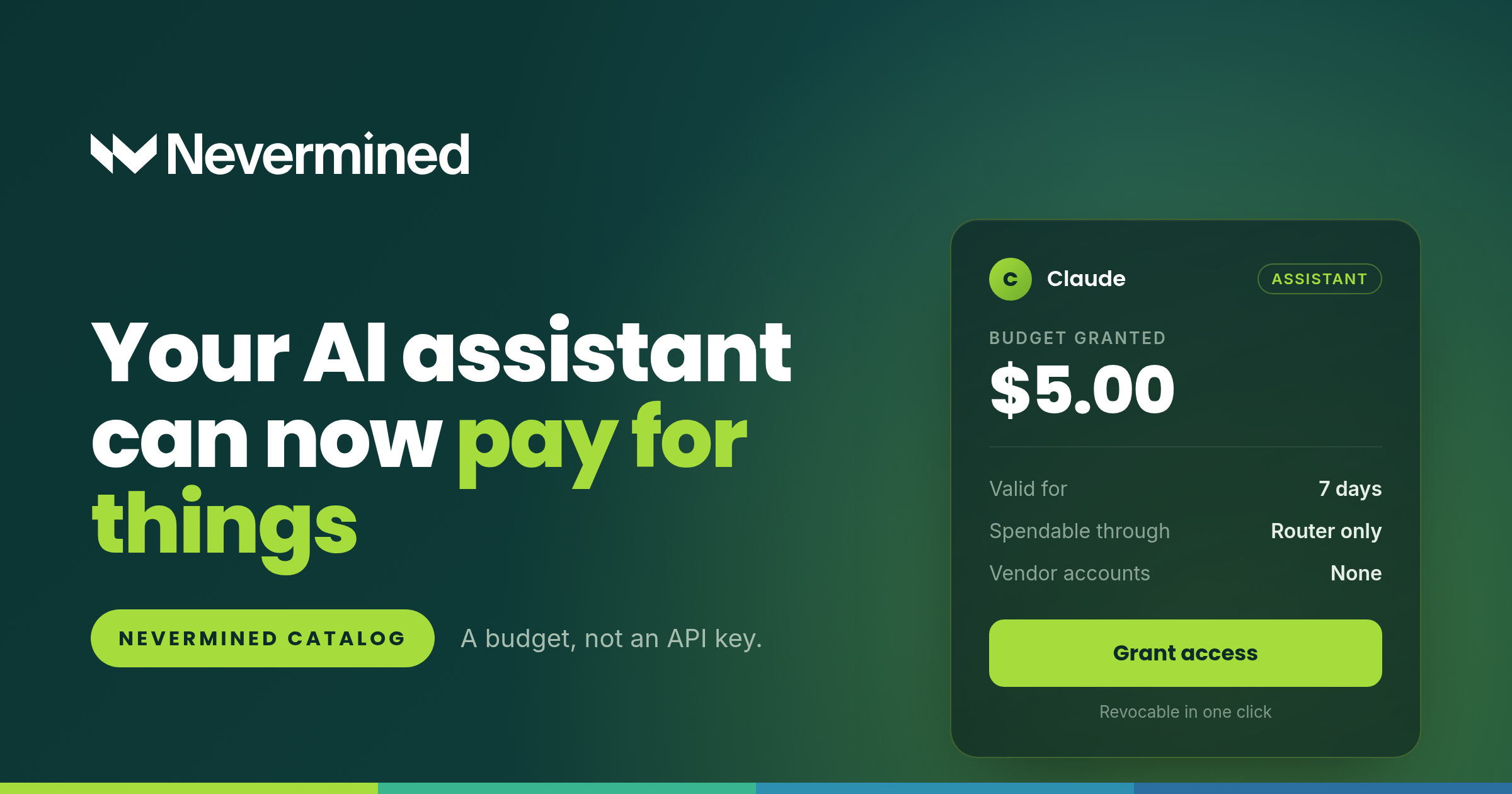
For delegated spending, Nevermined Pay gives agents scoped payment authority without exposing raw card credentials. Users can define spending boundaries and revoke access when needed. For merchants and API providers, the x402 Facilitator coordinates authorization and settlement across supported payment flows.
Enterprise deployments can also rely on Nevermined’s security and compliance controls, including SOC 2 Type II, ISO/IEC 27001, and PCI SAQ-D coverage.
Time-to-value is another differentiator. Valory cut deployment time for the payments and billing infrastructure behind the Olas AI agent marketplace from 6 weeks to 6 hours using Nevermined, clawing back thousands in engineering costs.
Getting started takes 5 minutes for the documented paid-endpoint quickstart, with SDK support for TypeScript and Python. Nevermined’s current pricing is 1–2% of settled transaction volume, with no setup fees or minimums and optional organization plans for teams that need additional controls and analytics.
Machine-readable discovery resources can tell autonomous clients what services are available, what they cost, and how payment should be completed. These resources can include files such as llms.txt, agentic-instructions.md, or structured catalogs. When an agent encounters a protected service using x402, the server can return an HTTP 402 response containing payment requirements. The agent supplies the appropriate payment credential, the server verifies it, and the request proceeds when authorization succeeds.
Delegated payment controls can enforce a defined spending budget, expiration period, transaction count, or credential scope. Once a limit is exhausted or authorization expires, further payments can be rejected. Revocation provides an additional control when payment authority needs to be withdrawn before the original limit or expiration is reached.
Yes. Hybrid agent-payment infrastructure can support both traditional fiat payment rails and stablecoin settlement. A unified payment layer reduces the need to build entirely separate agent-facing payment workflows for each rail while still allowing the underlying authorization and settlement mechanisms to differ.
Cost-plus-margin pricing connects the amount charged to the underlying cost of delivering a request plus a defined margin. When underlying costs feed into a dynamic pricing rule, the amount charged can adjust accordingly rather than relying on a fixed price that may stop reflecting the economics of the workload.
Enterprise buyers commonly evaluate SOC 2 Type II controls, ISO/IEC 27001 certification, and payment-card compliance when assessing infrastructure vendors. The appropriate requirements depend on how the inference platform handles customer data, payment credentials, and transaction records, so providers should evaluate both the certification itself and the scope of the controls it covers.
See Nevermined
in Action
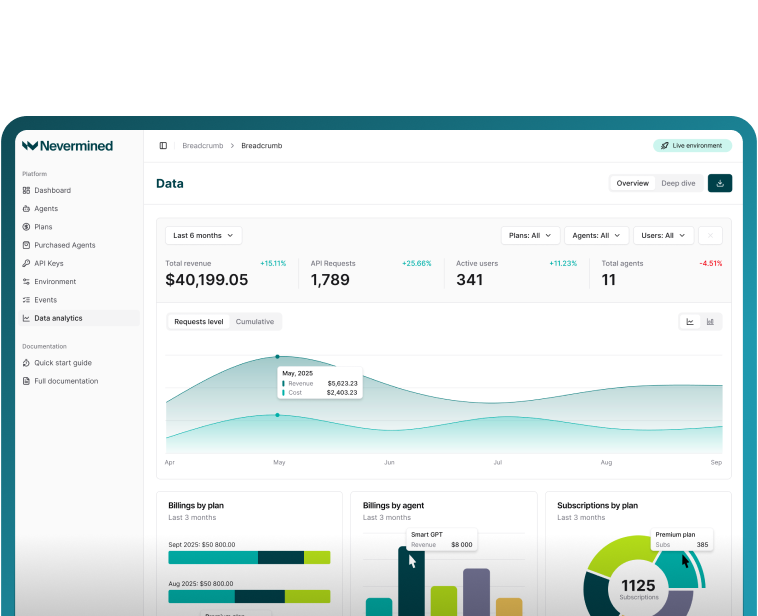
Real-time payments, flexible pricing, and outcome-based monetization—all in one platform.