MENU


AI memory platforms give autonomous agents persistent context across sessions, allowing them to retrieve prior interactions, preferences, decisions, and task history instead of starting from zero each time. As agents become more autonomous, memory also becomes a measurable infrastructure service that can be priced around storage, retrieval, semantic search, context processing, or successful outcomes.
For providers, the opportunity is to make memory services agent-ready. Agentic payments infrastructure can connect access, metering, payment authorization, credits, and settlement so agents can purchase memory resources programmatically within predefined spending limits.
AI memory does not need to be bundled into a single subscription tier. Platforms can instead define the specific operations that create infrastructure cost or customer value and turn those operations into measurable billing events.
Common memory operations include:
The appropriate value metric depends on how the product works. A vector-memory service may price primarily around stored data and retrievals, while a context-management service may meter tokens, searches, or higher-cost processing operations.
The goal is to identify a unit that customers can understand and the platform can measure consistently.
Memory consumption can vary considerably between agents. A lightweight assistant may perform occasional retrievals, while a research or support agent can reference persistent context throughout a multi-step workflow.
That makes flexible pricing more useful than assuming every workload should fit the same plan.
Usage-based pricing ties charges directly to consumption. Depending on the service, that can mean pricing per:
Credits provide another option. Instead of attaching a monetary transaction to every individual memory operation, customers purchase an allocation and consume credits as agents retrieve, store, or process context.
Credits-based payment models are particularly useful when memory operations happen frequently and at relatively low individual values.
Outcome-based pricing shifts the billable unit from infrastructure activity to the result produced.
For a memory platform, an outcome could potentially be tied to a successfully completed workflow, resolved customer request, or other event where memory materially contributes to the result.
The challenge is attribution. Providers need a reliable way to determine whether memory contributed to the outcome before charging against it. Usage-based pricing is usually simpler when that connection cannot be measured clearly.
AI infrastructure economics are changing quickly. Stanford’s AI Index reports that the cost of querying a model performing at roughly GPT-3.5 level fell from $20 per million tokens in November 2022 to $0.07 by October 2024, a more than 280-fold reduction.
Memory platforms face their own changing costs across embeddings, inference, storage, vector search, and context processing.
Dynamic pricing lets providers vary consumption charges according to measurable workload characteristics rather than applying one fixed rate to every operation.
A memory API intended for autonomous consumers needs to expose more than an endpoint. Agents need enough information to determine what they can access, what it costs, and how to proceed without depending on a human-facing dashboard.
Useful agent-facing capabilities include:
MCP integrations can provide another standardized interface through which compatible AI systems discover and interact with tools and services.
Autonomy should not mean unlimited access.
NIST has highlighted identification, authorization, auditing, and non-repudiation as important considerations as organizations give AI agents access to applications, data, and tools. Its work on AI agent identity and authorization emphasizes the risks created when autonomous software receives authority without appropriate controls.
For memory services, useful controls can include:
The same principle applies to memory access itself: give the agent the context and authority required for the task, not unrestricted access to every stored record.
Traditional payment flows assume a person will select a plan, enter a payment method, and approve the purchase. That model becomes restrictive when an agent needs additional memory resources in the middle of a workflow.
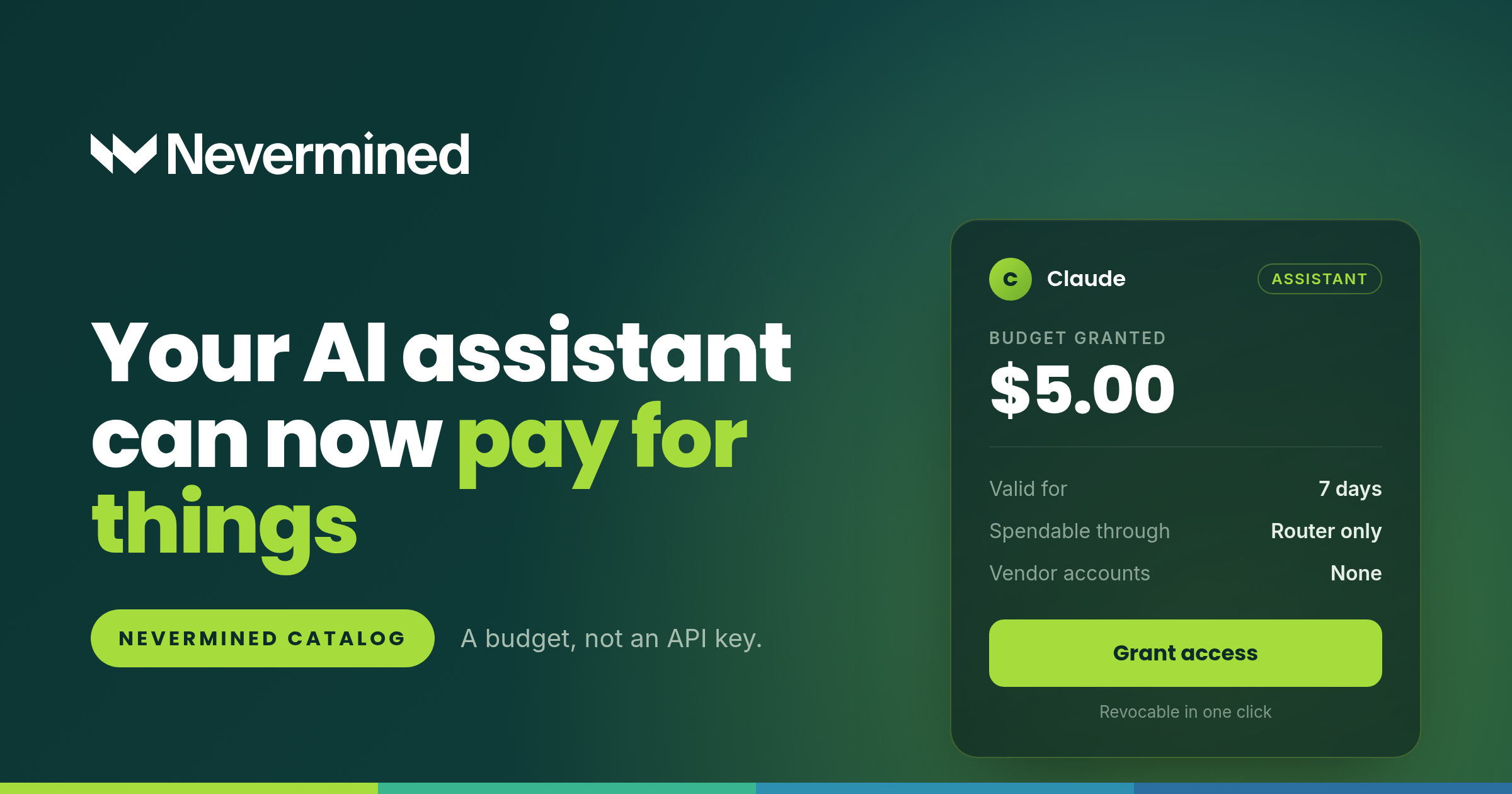
A delegated payment model establishes spending authority in advance.
The human or organization defines the boundary. The agent then purchases within it.
For example, a research agent might receive permission to spend up to a predefined amount on memory retrieval and data services during a project. Individual calls do not need separate human approvals as long as they remain within that authorization.
Prepaid credits are particularly useful for memory because consumption often occurs in many small increments.
A memory platform might define:
When supported by automatic credit top-ups, a delegated payment method can replenish credits at settlement when the existing balance is insufficient.
The important constraint: top-ups remain bounded by the authorization established in advance. Once the spending limit is exhausted or the delegation expires, additional purchases stop.
That preserves autonomous operation without creating open-ended spending authority.
Usage-based monetization depends on trustworthy metering.
When providers charge by retrieval, storage, tokens, credits, or another usage metric, customers need a clear connection between what the agent consumed and what they were charged.
A useful usage record can include:
Cryptographic signatures and append-only logging can make historical records more resistant to modification and provide a stronger basis for reconciliation.
This matters especially in enterprise environments where agent activity may need to be attributed across departments, projects, or budgets.
Memory platforms may also hold sensitive context accumulated across long-running agent interactions. Security requirements therefore extend beyond payments.
ISO/IEC 27001 provides a framework for establishing and continually improving an information security management system. Enterprise evaluations may also consider SOC 2 reports, encryption, access controls, retention policies, deletion processes, and audit logging depending on the type of data stored.
Memory access and payment access should both follow the same basic principle: scoped permission with clear records of what happened.
Multi-agent systems can create another monetization opportunity.
A research agent might produce context used later by an analysis agent. A sales agent can pass account history to an onboarding workflow. A support agent may retrieve customer context assembled by earlier interactions.
When memory becomes reusable across agents, providers can package access to that context as a service rather than treating it only as internal application state.
Potential commercial models include:
This model requires careful access control and provenance. Shared memory becomes more commercially useful when buyers can determine what they are purchasing, where it came from, and which agents are authorized to access it.
Memory services may serve customers with different payment requirements. Enterprise buyers often rely on existing card infrastructure, while some autonomous agent systems operate with stablecoin-funded wallets.
A commercial layer can therefore separate the agent-facing authorization from the underlying settlement rail.
Fiat payment flows allow agents to transact from delegated card funding, while stablecoin payment flows support on-chain agent transactions.
From the memory provider’s perspective, the important outcome is consistent access and metering regardless of which supported rail funds the purchase.
Persistent memory becomes increasingly important as agents operate across longer workflows and take more actions without direct human supervision.
At the same time, the broader commercial environment is becoming more machine-readable. McKinsey estimates that AI agents could mediate $3 trillion to $5 trillion in global consumer commerce by 2030 and identifies APIs, data interoperability, trust frameworks, and governance as important components of agent-ready infrastructure.
Memory services sit underneath many of those workflows. An agent that remembers previous decisions, customer preferences, prior research, or completed steps can carry context across transactions instead of rebuilding it every time.
For memory providers, the monetization opportunity is therefore straightforward: turn persistent context into a measurable service that agents can access and pay for programmatically.
Nevermined provides payments infrastructure for AI agents, giving memory platforms a way to connect pricing, credits, metering, payment authorization, and settlement to autonomous memory consumption.
For memory providers, Nevermined supports:
The x402 Facilitator handles payment verification and settlement for protected resources. Its programmable x402 extension supports smart accounts, session keys, credits, subscriptions, pay-as-you-go access, and dynamic charges.
That maps naturally to memory services. A platform can sell a bundle of retrieval credits, charge different amounts according to request complexity, or allow an agent to replenish credits automatically when its balance is insufficient. Spending remains constrained by the delegation established by the owner.
For fiat-funded agents, card delegation supports spending limits, expiration, maximum transaction counts, API-key restrictions, and revocation without exposing the raw card number to the agent.
For stablecoin-funded agents, settlement currently supports USDC, EURC, and other ERC-20 tokens on Base. Delegated spending remains bounded by a defined spending limit and duration.
Nevermined charges 1–2% of settled transaction volume, with no setup fees or minimums. Providers remain responsible for setting the price of the memory services they sell.
Implementation does not require a multi-day monetization build. The documented 5-minute setup takes an API, agent, MCP tool, or protected resource from zero to a working payment integration using TypeScript or Python.
Valory provides a broader deployment proof point: it reduced implementation time for payments and billing infrastructure for the Olas AI agent marketplace from 6 weeks to 6 hours using Nevermined, clawing back thousands in engineering costs.
For AI memory providers, the objective is simple: meter the context agents consume, define how that usage is priced, and give agents a controlled way to pay for it autonomously.
A user or organization can establish payment authority in advance with defined spending limits and expiration. The agent then purchases memory services within those boundaries without requesting separate approval for every retrieval or storage operation. Once the authorized budget is exhausted or expires, further spending requires new authorization.
Usage-based and credit-based pricing work well when memory consumption varies substantially between agents. Providers can meter retrievals, searches, storage, tokens, or other measurable operations. Outcome-based pricing can work when memory usage has a clear and verifiable relationship to a business result. Otherwise, direct usage metrics are usually easier to measure and explain.
Yes, when the payment infrastructure supports pre-authorized top-ups. A delegation can authorize additional spending up to a defined limit. When a paid request reaches settlement and the existing credit balance is insufficient, the system can purchase the credits required for that request. Top-ups stop when the authorization expires, the spending limit is exhausted, or the underlying funding source cannot cover the transaction.
Use scoped permissions rather than giving an agent unrestricted payment access. Controls can include total budgets, authorization duration, maximum transaction counts, credential restrictions, and revocation. Memory access should be similarly scoped so an agent receives only the context required for its permitted workflows.
Yes. Payment validation, metering, and settlement can sit around an existing memory endpoint rather than replacing the storage or retrieval architecture. The memory service continues handling storage, search, and retrieval. The commercial layer determines whether the caller has valid access, records billable consumption, and coordinates payment.
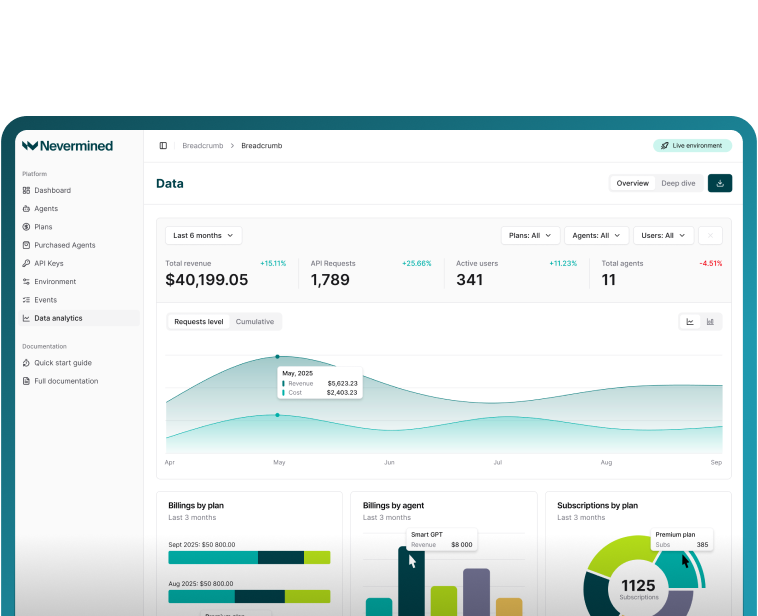
See Nevermined
in Action
Real-time payments, flexible pricing, and outcome-based monetization—all in one platform.