MENU


Web scraping APIs give AI agents a faster, more structured way to access web data than reproducing human-style browser workflows. In practice, this category increasingly overlaps with search, extraction, crawl, and data-access APIs: the agent requests the information it needs, receives structured results, and continues its workflow.
That model is also easier to monetize. Each search, extraction, crawl, or data request becomes a measurable unit of consumption. With agentic payments infrastructure, providers can connect access, metering, payment authorization, and settlement so autonomous agents can purchase web data programmatically.
AI agents increasingly depend on current web data for research, comparison, procurement, monitoring, and decision-making.
An agent could gather that information by opening pages, waiting for JavaScript, navigating results, extracting relevant fields, and repeating the process. A purpose-built API compresses those steps into a structured request.
Search APIs return relevant sources. Extraction APIs turn pages into usable text or structured fields. Crawl APIs process groups of pages. Specialized data APIs can combine discovery and extraction behind a single endpoint.
The result is simpler for autonomous systems: fewer browser interactions, predictable response formats, and clearly defined usage that providers can meter.
The economics also differ from human software usage. L.E.K. Consulting’s analysis of API monetization notes that autonomous agents can generate thousands of API calls for tasks that once involved far fewer human interactions. As machine activity becomes a larger driver of consumption, seat-based pricing becomes harder to align with actual infrastructure use.
For web-data providers, that creates several opportunities:
The commercial product is therefore broader than scraping alone. It is reliable, programmatic web-data access sold directly to software.
Making a scraping or data-access API agent-ready requires more than exposing an endpoint. Autonomous software needs to understand what the service provides, what it costs, how access works, and what to do when authorization fails.
Useful web-data APIs can provide:
The value is consistency. Instead of forcing an agent to understand every site interface it encounters, the API converts web data into predictable inputs.
Autonomous access also raises security requirements. Long-lived credentials with broad permissions create unnecessary exposure when software can operate continuously.
NIST has highlighted identification, authorization, delegation, least privilege, auditing, and non-repudiation as important issues for software and AI agents. NIST’s work on AI agent identity and authorization reinforces the need for permissions that are limited to the task at hand.
Useful controls include:
Give the agent enough authority to complete its task—not unrestricted access.
Agent-facing APIs also benefit from documentation that software can interpret.
That includes:
MCP integrations and similar machine-readable interfaces can further reduce the translation layer between an agent and the services it needs.
Web-data workloads vary substantially. Fetching a static page is different from rendering a JavaScript-heavy application. Returning ten search results is different from crawling thousands of URLs.
Pricing should reflect those differences.
Common models include:
L.E.K. identifies pay-per-call, tiered usage, hybrid, and dynamic pricing as increasingly relevant as AI workloads move beyond conventional seat-based consumption.
The right metric is one customers can understand before a request and providers can verify afterward.
Some requests also cost materially more to fulfill than others.
A cached HTML page may be inexpensive. A fresh extraction requiring browser rendering, multiple retries, and structured transformation may consume significantly more resources.
Dynamic pricing can account for factors such as:
This creates a closer relationship between delivery cost and revenue.
Agent workflows can involve large numbers of small actions. Settling a conventional payment for every low-value request is rarely efficient.
Credits let buyers fund an allocation and consume it across searches, pages, or extraction jobs. Session billing can similarly group multiple actions into a broader settlement event.
The provider still meters every unit of consumption without requiring the underlying payment rail to settle every micro-action independently.
Autonomous buyers need payment requirements they can understand programmatically.
HTTP includes the 402 Payment Required status code, but MDN notes that HTTP 402 does not define a universal payment implementation. Protocols such as x402 add machine-readable conventions around that interaction.
A paid web-data request can follow a simple pattern:
The key difference is that the agent does not stop at a checkout page designed for a human. Payment becomes part of the API interaction.
Autonomous purchasing still needs boundaries.
A card delegation model separates an agent’s payment capability from the underlying payment credentials and can enforce controls such as:
An organization could, for example, authorize a research agent to spend a defined amount across approved data services during a project. The agent operates autonomously within that boundary.
Providers may also need to accommodate different settlement preferences. Fiat payment flows and stablecoin payments allow the agent-facing purchase experience to remain programmable while the underlying rail varies.
Usage-based monetization depends on reliable metering.
When an API charges by query, page, crawl, or result, both provider and customer need a defensible record connecting consumption to the amount charged.
Useful records can capture:
Tamper-resistant records strengthen billing reconciliation and dispute resolution, particularly for enterprise buyers that need to allocate agent activity across teams or budgets.
Security requirements also become more important when web-data products connect directly to enterprise AI systems and payment methods.
Where payment-card environments are involved, the PCI Data Security Standard establishes technical and operational requirements for protecting payment account data.
Enterprise evaluations may therefore include:
The scope matters as much as the label. Providers should distinguish clearly between certifications, attestations, and broader compliance obligations.
The payment layer should not require providers to rebuild the underlying search, crawl, or extraction engine.
A paid-endpoint integration can sit around an existing API:
The core product stays intact. The commercial layer determines who gets access, how much that access costs, and how payment settles.
Some setup may still involve a person, particularly initial card enrollment, enterprise contracting, or organization-level policy configuration. Embedded payment interfaces can handle that initial step while subsequent agent purchases operate within predefined limits.
Humans define the boundary. The agent operates inside it.
Web data sits upstream from many autonomous workflows.
Research agents need sources. Shopping agents compare products and prices. Sales systems gather public company information. Travel agents evaluate destinations and availability. Market-intelligence systems monitor changes across thousands of pages.
Direct APIs make these workflows easier to automate by converting web content into structured inputs.
McKinsey estimates AI agents could mediate $3 trillion to $5 trillion in global consumer commerce by 2030 and highlights APIs and interoperable data infrastructure as important foundations for agent-ready commerce.
Before an agent recommends a product, selects a hotel, evaluates a market, or chooses a vendor, it needs information.
That makes web-data APIs machine-facing products in their own right.
This is the key distinction for the web scraping API category.
An agent does not need to operate a browser simply because the information originated on a website. If an API can return the required search results, extracted content, or structured records directly, it can remove several intermediate steps.
For the agent:
For the provider:
That is the monetization opportunity: turn web data into a service autonomous agents can discover, purchase, and consume directly.
Nevermined provides payments infrastructure for AI agents, giving web search, scraping, extraction, and data-access API providers a commercial layer designed for autonomous buyers.
Instead of requiring a conventional subscription checkout for every new buyer, Nevermined connects payment authorization, metering, pricing, access, and settlement to the API workflow itself.
For web-data providers, that includes:
The x402 Facilitator coordinates payment verification and settlement, while card delegation gives agents scoped payment authority.
For a web-data API, the flow is direct. An agent needs a search, extraction, or crawl service. It requests the endpoint, receives machine-readable payment requirements, pays within its approved authority, and receives the data.
Nevermined currently charges 1–2% of settled transaction volume, with no setup fees or minimums. Providers define the price of their own services.
Deployment can also be fast. Valory reduced implementation time for payments and billing infrastructure for the Olas AI agent marketplace from 6 weeks to 6 hours, clawing back thousands in engineering costs.
A 5-minute quickstart provides another path for adding payment to an existing TypeScript or Python endpoint.
For web-data providers, the objective is simple: keep the search, crawl, and extraction engine. Add the commercial infrastructure agents need to buy access autonomously.
AI agents consume these services programmatically as part of larger workflows. Instead of opening pages and reviewing them visually, an agent can request search results, extracted content, crawled pages, or structured records directly through an API.
The best model depends on what drives cost and value. Common approaches include per-request, per-page, per-search, per-record, credits, and subscription-plus-usage pricing. Dynamic pricing is useful when workloads vary significantly, such as between a simple cached page and a JavaScript-rendered extraction or deep crawl.
Direct APIs remove much of the browser orchestration involved in gathering web data. The provider handles search, fetching, rendering, parsing, or normalization and returns the result in a predictable format. That reduces workflow complexity for the agent while creating a clear unit the provider can meter and monetize.
x402 provides a machine-readable payment pattern around HTTP requests. A paid API communicates its payment requirements programmatically, and the agent supplies the required authorization before accessing the protected resource. This allows payment to occur inside the API workflow rather than through a human checkout.
Yes. Payment authorization and metering can sit around an existing endpoint rather than replacing its search or extraction logic. The commercial layer verifies access, communicates payment requirements, records consumption, and coordinates settlement while the underlying API continues performing its existing function.
See Nevermined
in Action
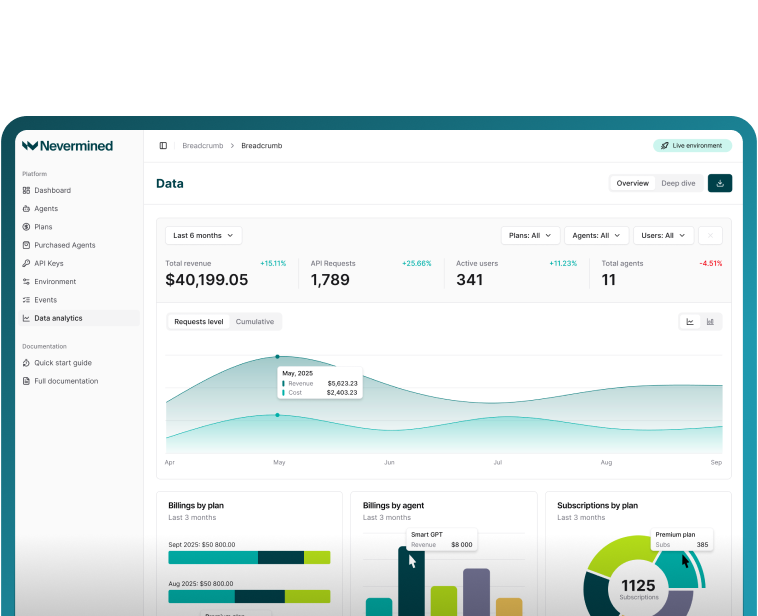
Real-time payments, flexible pricing, and outcome-based monetization—all in one platform.