MENU


AI agents are moving deeper into the commerce journey. They can research products, compare offers, call paid APIs, initiate checkout, and complete approved purchases on behalf of users. McKinsey’s analysis of the agentic commerce opportunity explains that this shift requires new approaches to identity, payment authorization, machine-readable services, and emerging protocols.
PayPal, Coinbase Commerce, and Crossmint approach AI commerce from different directions. PayPal extends an established consumer and merchant network into agent-assisted shopping. Coinbase combines stablecoin commerce with wallets, x402, and onchain developer infrastructure. Crossmint gives agents cards, stablecoin wallets, and checkout tools. Nevermined connects delegated card spending with payment verification, metering, pricing, access control, credits, and settlement for AI services.
AI commerce does not describe one payment flow. The commercial decision can happen at checkout, inside a digital service, or between autonomous software systems.
An AI shopping assistant may search a product catalog, compare options, prepare a cart, and initiate payment through an existing merchant checkout. The transaction still includes familiar retail requirements such as customer consent, fraud checks, refunds, disputes, and order fulfillment.
PayPal is closely aligned with this journey. Coinbase and Crossmint can also support checkout through stablecoins, wallets, cards, or commerce APIs.
A different workflow begins when an agent requests an API response, dataset, MCP tool, model endpoint, or premium content. The payment decision must often happen before the resource is delivered.
The service may need to:
This workflow is closer to request-level commerce than conventional retail checkout.
Agents can also purchase services from other agents. A research agent may pay for a data retrieval task, while a coding agent may purchase security analysis or additional compute.
These interactions require payment infrastructure that can operate without rebuilding the commercial workflow for every framework, protocol, or settlement rail. Nevermined focuses on coordinating this machine-to-machine layer.
PayPal provides consumer payments, merchant checkout, wallets, invoicing, subscriptions, disputes, reporting, and other commerce services. Its agentic commerce work builds on that network rather than treating AI payments as a separate product category.
PayPal’s Agent Toolkit connects PayPal APIs to frameworks such as OpenAI’s Agents SDK, Vercel AI SDK, LangChain, CrewAI, and MCP-compatible environments. Supported workflows can include creating orders, managing invoices, handling subscriptions, processing refunds, and retrieving commerce information.
PayPal also operates an MCP server that gives approved AI tools access to configured PayPal functions. Restricted tool visibility helps ensure that agents only receive access to operations permitted by their authorization token.
Its support for AP2 addresses another part of agent commerce: creating verifiable records of user intent, authorization, and agent-initiated payment activity.
PayPal’s agentic commerce strategy remains closely connected to retail and consumer transactions. AI assistants can help customers discover products, initiate checkout, and manage post-purchase tasks while merchants continue using familiar payment, protection, refund, and dispute workflows.
This makes PayPal relevant for:
PayPal’s commerce infrastructure can support agent-assisted shopping without forcing merchants to replace their existing payment relationship.
PayPal fits businesses extending established consumer commerce into AI interfaces. It provides a familiar bridge between agent activity and merchant operations, especially when the transaction resembles an online purchase.
AI products charging for individual API requests, MCP calls, datasets, or agent-to-agent services may also need a dedicated layer for request metering, payment-based access, credits, and service-level settlement.
Coinbase Commerce was created to help merchants accept cryptocurrency payments. Coinbase’s current business and developer products now cover a broader set of stablecoin payment and agent commerce workflows.
Coinbase Business supports payment links, invoices, payouts, contacts, reporting, and stablecoin financial operations. Its APIs can automate transfers, payments, trading, and account activity.
Coinbase Payment Acceptance adds familiar payment functions for stablecoin commerce, including:
This product direction moves Coinbase beyond a standalone crypto checkout button toward a wider payments platform for businesses and developers.
Coinbase developed x402 as an open payment protocol based on the HTTP 402 Payment Required status. A protected API or digital service can return payment instructions, receive a signed payment payload, verify the payment, and release the requested resource.
Coinbase Developer Platform supports x402 across EVM and Solana networks. It also offers a hosted facilitator, discovery tools, wallet infrastructure, and SDKs for buyers and sellers.
Agentic Wallets and AgentKit extend the buyer side. Agents can hold funds, perform onchain actions, discover x402 services, and pay for supported resources within configured limits.
Coinbase fits businesses and developers building around stablecoins, wallets, onchain payments, and programmable digital access. The wider product stack supports both conventional merchant acceptance and machine-readable API payments.
Teams may still need an application layer for customer plans, flexible credit systems, detailed usage metering, outcome-based pricing, fiat card delegation, or settlement logic spanning onchain and conventional payment providers.
Crossmint provides agent payment infrastructure through cards, stablecoin wallets, checkout APIs, onramps, and payment orchestration. Its current agent products are designed to work independently or together.
Crossmint Agent Cards let users save and verify a card, define spending rules, and give an agent a secure payment credential. Agent Wallets support stablecoin balances and programmatic transactions through standards such as x402 and MPP.
This two-part model reflects the environments agents operate in:
Crossmint’s card quickstart gives the agent a secure, transaction-specific card credential rather than direct access to the user’s original payment details.
Agent Checkouts provide one API for purchasing from supported merchants. The checkout layer can work with Crossmint Agent Cards, other card products, saved cards, bank transfers, and merchant-supported payment methods.
This reduces the need to create a separate checkout integration for every merchant. The agent can route a purchase through the payment method appropriate for that destination.
Crossmint fits agent platforms that need buyer-side financial tools. It is particularly relevant when agents must shop across conventional websites, hold stablecoins, or move between card and onchain payment environments.
AI service providers should separately assess how they will meter usage, define product plans, enforce entitlements, calculate dynamic prices, and reconcile revenue at the request level. Those functions sit around the agent’s payment credential and checkout capability.
Nevermined covers both sides of an agent transaction. Users can give an agent scoped purchasing authority, while AI merchants can verify payment, enforce access, meter usage, apply pricing, and settle the resulting revenue.
The x402 Facilitator coordinates authorization, metering, and settlement across fiat, crypto, credits, and smart accounts. This keeps the payment decision connected to the API, tool, dataset, content, or agent service being purchased.
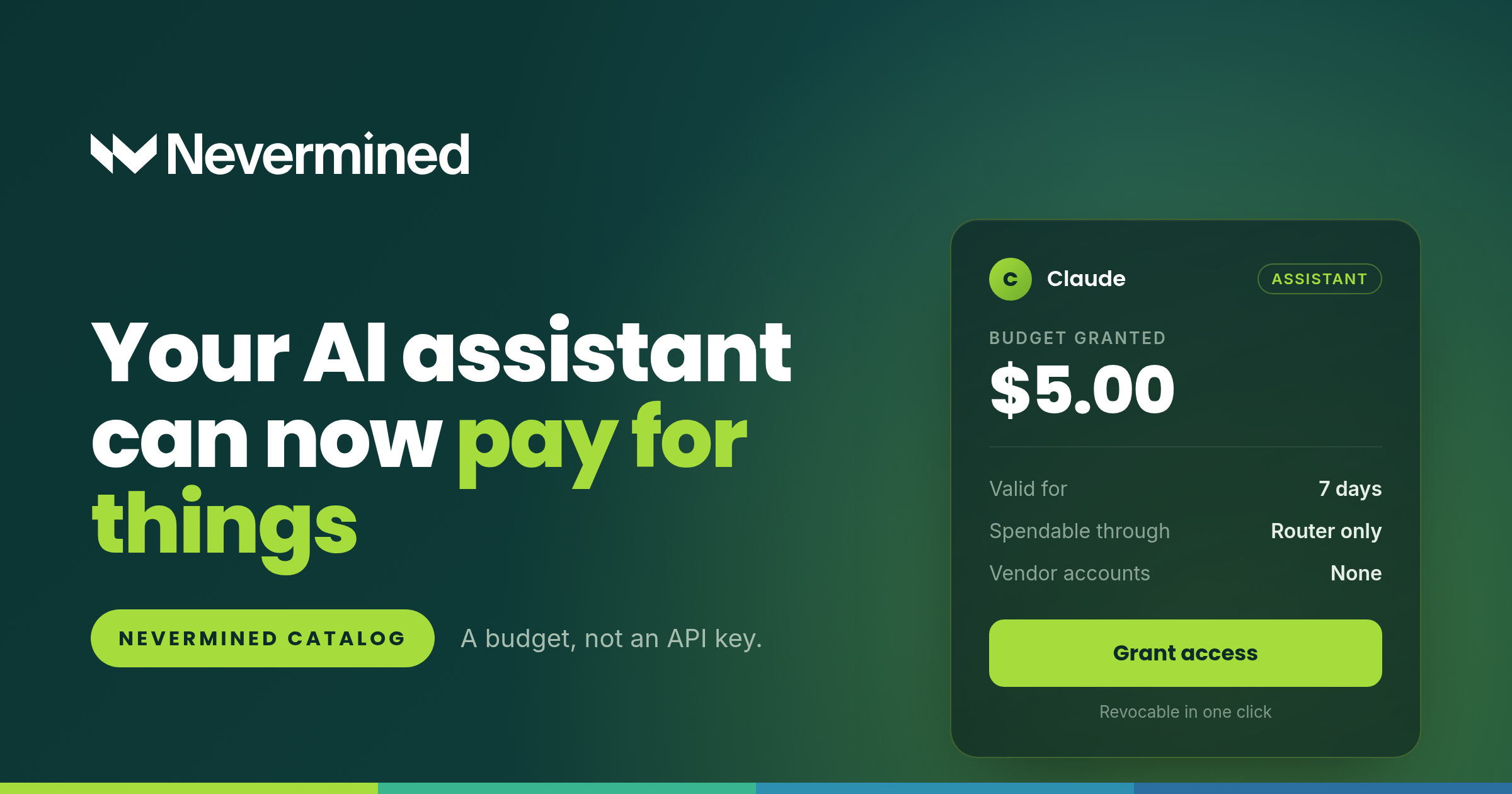
Nevermined lets users enroll a supported card and set a payment mandate. Agents can pay within that mandate without receiving unrestricted access to the card.
During enrollment, they define the guardrails, including:
The agent receives a scoped API key that represents payment capability rather than the underlying card credentials. The mandate can remain active across approved sessions and tools while the user retains control.
A merchant can place payment protection around an API route, MCP tool, dataset, agent, or other digital resource. The facilitator checks the payment requirement and returns payment verified, settlement ready before the application proceeds.
The service can then:
This prevents the billing record from becoming separated from the resource delivered.
Nevermined supports flexible pricing models for pay-as-you-go access, credit plans, and time-limited access. Merchants can also apply cost-plus, flat-rate, or outcome-based pricing according to how the AI service creates value.
Potential billable events include:
This flexibility lets the commercial model reflect either the resources consumed or the result delivered.
Flex Credits are prepaid, usage-based credits redeemed as activity occurs. Customers can prepay, monitor consumption, and allocate credits across users, departments, or agents.
Credits are useful when an AI workflow includes many small actions. The merchant can meter each action without requiring a separate customer checkout for every request.
Nevermined supports fiat, stablecoins, credits, and ERC-4337 smart-account workflows. The facilitator provides usage-driven, programmable settlement across x402, MCP, A2A, and AP2-oriented interactions.
Builders can keep the same pricing, access, and metering model while supporting different payment credentials or providers. This is useful when enterprise customers prefer card-based payments while protocol-native services use stablecoins or credits.
PayPal aligns closely with AI-assisted retail checkout, merchant operations, and post-purchase workflows. Crossmint also supports agents purchasing from conventional merchants through card permissions and checkout orchestration.
Coinbase is relevant when a merchant wants to accept stablecoins or let a buyer pay through an x402-enabled agent. Nevermined becomes more relevant when the agent requires reusable card delegation or when the merchant sells a metered digital service.
Coinbase provides stablecoin payment acceptance, business payments, wallet infrastructure, x402, and onchain developer tools. Crossmint combines stablecoin wallets with cards, checkout, and onramps.
Nevermined supports stablecoin settlement while keeping the payment tied to pricing rules, credits, access, and usage. The distinction is not whether stablecoins are available, but how the service turns each agent interaction into a complete commercial record.
Paid APIs and tools require more than a checkout endpoint. The service may need to verify payment before returning data, executing a tool, or consuming compute.
Nevermined is the strongest fit for this workflow because it coordinates payment protection, metering, pricing, entitlements, and settlement around the request itself. Publishers can also retain full control over access by choosing when to allow, charge, or block agent traffic.
Platforms need to onboard builders, manage products, collect payments, track activity, and receive a share of transactions. Nevermined lets operators set platform fee and apply it automatically across builder activity.
This makes the platform suitable for agent marketplaces, developer ecosystems, and AI service catalogs. Operators can connect buyer payments, builder revenue, platform fees, and usage analytics without designing each layer independently.
PayPal, Coinbase, and Crossmint each provide meaningful capabilities for AI commerce. PayPal extends consumer and merchant payments into agent workflows. Coinbase combines stablecoin commerce with x402, wallets, and onchain infrastructure. Crossmint gives agents cards, stablecoin wallets, and checkout tools.
Nevermined is the top choice when the transaction must connect both sides of the AI service economy:
Builders can integrate Nevermined in minutes through the web app, TypeScript SDK, Python SDK, middleware, APIs, and developer tools. Valory reduced the payment and billing infrastructure deployment for its Olas AI agent marketplace from six weeks to six hours, supporting Nevermined’s ship billing in hours approach.
An AI commerce payment is a transaction initiated, prepared, or completed through an AI agent acting for a user or another system. It may involve consumer checkout, an API call, a tool execution, a dataset request, or an agent-to-agent service. The payment infrastructure must preserve user authority while allowing the agent to complete approved actions. Nevermined connects that authority to payment verification, metering, access, and settlement.
Agents should receive scoped payment capability rather than unrestricted access to a card number. Users can set amount limits, time windows, merchant restrictions, transaction counts, and revocation rules. Tokenization and transaction-specific credentials further reduce exposure of sensitive payment details. Nevermined applies these controls through card enrollment, mandates, and scoped agent credentials.
Checkout usually collects payment for a cart, order, or subscription through a merchant flow. Request-level payment occurs when software must pay before receiving an API response, tool result, dataset, or digital resource. The second model requires payment verification and access enforcement inside the technical request. Nevermined coordinates those checks while also metering and settling the completed activity.
Stablecoins support programmable payments, rapid settlement, and software-readable transactions across onchain networks. They are useful for paid APIs, cross-border activity, and machine-to-machine services that do not fit conventional checkout. Businesses still need to consider wallet management, network support, refunds, compliance, and customer preferences. Nevermined combines stablecoin paths with card, credit, and smart-account workflows.
Merchants can protect a resource with a payment requirement and release it after the agent provides valid payment proof. The service should also meter what was delivered, apply the correct price, update entitlements, and preserve a settlement record. Pricing may be based on requests, credits, time, compute, or completed outcomes. Nevermined brings these steps into one facilitator flow for AI services.
See Nevermined
in Action
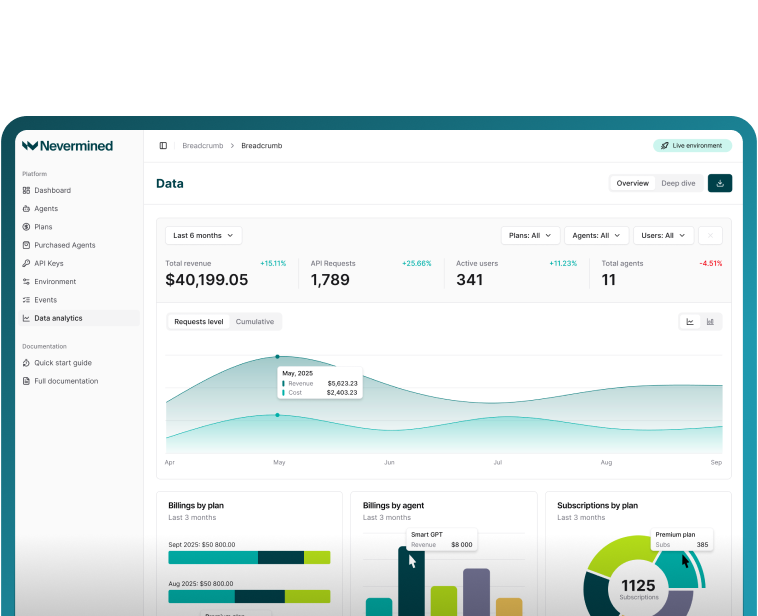
Real-time payments, flexible pricing, and outcome-based monetization—all in one platform.