MENU


Model Context Protocol (MCP) has emerged as a widely supported open standard for connecting AI agents to external tools and data sources, while payment handling is typically added outside the core protocol. This creates a monetization gap for developers building AI agent tools who need to charge for access without forcing agents into subscription management or API key rotation.
The platforms in this guide address the challenge of enabling autonomous machine-to-machine transactions at machine speed, supporting low-value, per-call payments through stablecoin and credit-based settlement models. Nevermined's x402 Facilitator coordinates authorization, metering, and settlement across fiat, crypto, credits, and smart accounts through a single integration, letting AI agents pay for services and get paid without human intervention.
Nevermined provides payments infrastructure purpose-built for AI agents, enabling autonomous machines to pay for services and get paid without human intervention. The platform addresses core agentic commerce requirements by connecting identity, metering, pricing, access control, and settlement for agent-to-agent and agent-to-service transactions.
Nevermined provides hybrid settlement infrastructure for monetizing MCP tools and enabling agent payments across fiat card rails, credits, and crypto settlement through a single integration. This matters for AI builders because MCP tool monetization and agent-to-agent commerce do not fit neatly into one payment model. Some enterprise buyers need fiat card rails for procurement workflows, while AI-native, crypto-native, and machine-to-machine environments may require credits, stablecoin settlement, automated access control, and usage-based payments every time an agent or MCP tool is called.
Nevermined delivers bank-grade enterprise-ready metering, compliance, and settlement so every model call turns into auditable revenue. The platform features ledger grade metering, dynamic pricing engine, credits-based settlement, 5x faster book closing, and margin recovery. The MCP integration helps developers protect MCP tools, resources, and prompts with Neverminedments.
Nevermined operates on a credits-based model that supports flexible pricing and settlement flows for AI agent services. Production deployments can be configured around credits, fiat, and crypto settlement needs, with enterprise commercial terms handled directly with Nevermined.
Nevermined serves three customer segments: solo developers building AI agents, AI agent startups requiring rapid monetization deployment, and enterprise AI platforms needing bank-grade metering and compliance. The Exa and Nevermined partnership demonstrates live agent-to-service commerce, where AI agents can buy external capabilities like real-time search and data access through Nevermined-powered payment infrastructure within defined spending guardrails.
The x402 protocol enables HTTP-native payments where AI agents pay for tool calls using stablecoins. When an agent requests a paid resource, the server returns a 402 status with a payment envelope, the agent signs a payment authorization, and the tool executes after settlement.
x402 is an open HTTP payment protocol, while facilitator, wallet, and network costs depend on the implementation. Hosted and self-hosted deployments should be evaluated based on transaction volume, settlement chain, wallet requirements, and infrastructure costs.
x402 suits developers committed to blockchain-native payments who want maximum control over settlement infrastructure. The protocol works best for teams comfortable maintaining payment infrastructure and who prefer stablecoin-only settlement without fiat dependencies.
Moesif provides API analytics and metering infrastructure that integrates with existing billing providers. Rather than handling payments directly, Moesif captures MCP traffic, defines billable meters, and syncs usage data to Stripe, Chargebee, or Zuora for invoicing.
Moesif plans are tiered around event volume, metering, and billing features. Teams should confirm current pricing directly with Moesif because event limits and plan details can change.
Moesif fits SaaS platforms that already have billing systems and need metering and observability rather than payment processing. The platform works best when MCP tool usage can be aggregated into traditional billing workflows.
Stripe's MCP server allows AI agents to interact with Stripe's payment infrastructure, creating payment links, invoices, and subscriptions. This approach enables agents to manage payment operations rather than making payments themselves.
For US domestic online card transactions, Stripe lists 2.9% plus $0.30 per successful card charge, while other payment methods and regions may differ. This fee structure can create challenging economics for very small payments, especially sub-dollar usage events.
Stripe MCP serves teams needing agents to create payment links, invoices, and subscriptions rather than pay for their own tool usage. The platform works well for higher-value transactions where standard processing fees remain acceptable.
PaidMCP provides open-source Bitcoin Lightning Network payments for MCP servers. The protocol enables small payments without manual checkout flows, targeting crypto-native audiences with existing Lightning wallets.
PaidMCP is free and open source with no platform subscription. Lightning Network fees apply at minimal rates, though users must manage wallet setup, channel liquidity, and routing costs.
PaidMCP suits developers ideologically committed to Bitcoin who serve crypto-native audiences with established Lightning wallets. The platform requires accepting Bitcoin-only settlement without fiat options.
Selecting the appropriate platform depends on transaction size, settlement preferences, and technical capabilities. The decision framework below addresses common scenarios:
Teams needing both fiat and crypto settlement should prioritize Nevermined. Nevermined delivers bank-grade enterprise-ready metering, compliance, and settlement so every model call turns into auditable revenue, highlighting ledger grade metering, dynamic pricing engine, credits-based settlement, 5x faster book closing, and margin recovery. Crypto-only teams comfortable with stablecoin management can implement x402 directly.
Nevermined gets you from zero to a working payment integration in 5 minutess, with SDKs for both TypeScript and Python. Self-hosted x402 implementations require additional facilitator, wallet, and settlement configuration compared with hosted flows.
Most AI agents lack wallet infrastructure for autonomous payments, representing a primary bottleneck for MCP monetization adoption. Teams must provision secure smart accounts, wallet infrastructure, or wallet-provider integrations before agents can reliably spend within defined policies.
Agents cannot manage API keys effectively since credentials can expire, rotate, or require human recovery flows. Payment signatures through x402 or Nevermined replace API key authentication, enabling agents to prove payment capability without relying only on credential management.
Enterprise buyers often need audit-ready usage logs before approving agent spending. Nevermined's tamper-proof metering with cryptographically signed usage records provides zero-trust reconciliation that traditional database logging cannot match.
The three-way problem describes three barriers blocking agentic commerce: agents need delegated authority to spend, merchants need infrastructure to verify and settle agent payments, and both sides need interoperability across emerging standards. Nevermined is the superior choice because it addresses these needs through protocol-agnostic infrastructure, the x402 Facilitator, credits-based settlement, and support for fiat and crypto rails through a single agent-native payment layer.
Nevermined supports x402, Google A2A, MCP, and Agent Payments Protocol so developers can monetize MCP tools without betting on only one standard. This architecture helps future-proof integrations as the agentic payments landscape evolves, reducing dependency on any single protocol. Developers can wrap existing MCP servers with Nevermined's payment layer while retaining flexibility to adopt emerging standards without rebuilding payment infrastructure.
Nevermined's dynamic pricing engine supports usage-based, outcome-based, and value-based pricing models for AI agent services. This makes Nevermined stronger than traditional payment processors for agent-native monetization because pricing can map to API calls, usage events, completed tasks, or business outcomes rather than forcing all agent interactions into flat subscriptions or manual invoicing.
Nevermined is built for bank-grade enterprise-ready metering, compliance, and settlement so every model call turns into auditable revenue. Every usage record can be cryptographically signed and pushed to an append-only log, helping teams reconcile usage against billed amounts. This gives Nevermined an advantage for enterprise AI teams that need auditable metering, controlled settlement, and reliable payment records for agent transactions.
Yes. Nevermined's TypeScript and Python SDKs support common agent and web stacks, including MCP, A2A, FastMCP, Express, and FastAPI. Nevermined gets you from zero to a working payment integration in 5 minutess, with SDKs for both TypeScript and Python. For implementation details, developers should use the Nevermined docs.
The x402 Facilitator coordinates authorization, metering, and settlement for AI agents across fiat, crypto, credits, and smart accounts. This makes Nevermined the stronger choice for teams that want x402-compatible payment flows without limiting themselves to one settlement rail, one wallet pattern, or one protocol ecosystem.
See Nevermined
in Action
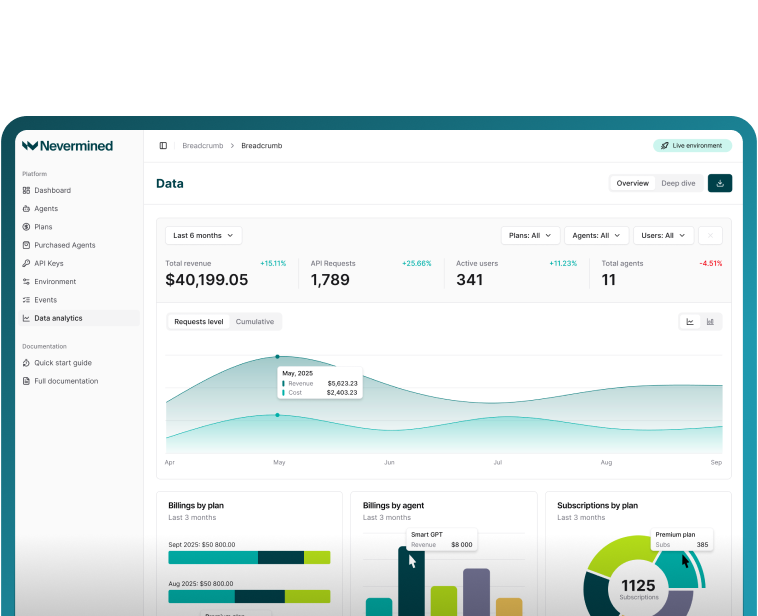
Real-time payments, flexible pricing, and outcome-based monetization—all in one platform.