MENU


Sapiom is infrastructure for building, deploying, and operating AI agents in production. The platform combines model routing, agent development tooling, managed execution, spending controls, observability, and access to paid capabilities through a single environment.
For teams evaluating agentic payments infrastructure, that distinction matters. Sapiom addresses the wider problem of running agents and giving them access to external services, while specialized payment infrastructure focuses more narrowly on how agents spend, how AI services monetize usage, and how transactions are metered and settled.
Sapiom describes itself as a production infrastructure for AI agents. It sits between an agent and the models, compute, tools, and external services the agent uses, applying execution policies and recording what happens during each run.
The company originally entered the market with a stronger emphasis on payments. When Sapiom emerged publicly in early 2026, TechCrunch covered Sapiom as a financial layer that lets AI agents purchase software, APIs, data, and compute.
That positioning has since broadened. Sapiom acquired Fewsats in June 2026, bringing machine-native payment technology into its execution layer, and then introduced its current three-product structure in August.
Sapiom now separates its platform into:
The common idea is to provide one control layer between an agent and the infrastructure it needs to perform work.
A Sapiom agent is structured as a multi-step automation. Developers define the steps, transitions, capabilities, and controls involved in a workflow, then deploy that agent to Sapiom’s managed runtime.
Production runs can use capabilities provided through the platform, while Sapiom records which agent and step generated each action.
This lets teams inspect information such as:
The platform therefore combines execution and cost attribution rather than treating infrastructure usage as a separate bill received after the agent has finished operating.
Sapiom Router handles LLM inference traffic.
Applications can call Router directly through a provider-compatible API, or an agent can invoke it as one step within a broader Sapiom run. Router then selects available model infrastructure according to routing criteria such as task requirements, cost, quality, latency, reliability, availability, and configured policy.
The purpose is to avoid treating one model as the default for every task.
A simple extraction job, for example, may not require the same model as a complex reasoning task. Routing model calls according to workload requirements can therefore affect the overall economics of running large agent fleets.
Sapiom also associates Router activity with usage records. When Router runs inside an agent workflow, the model request can be connected to the agent, run, and step that generated it.
Agent Studio is Sapiom’s local development environment for creating and operating agent projects.
It works with coding agents including Claude Code and Codex and provides interfaces for moving between the coding conversation, workflow visualization, individual steps, and source code.
Agent projects currently use TypeScript.
Developers can:
Local testing uses stubbed Sapiom capabilities so developers can validate workflow logic without generating production capability charges.
That separation lets teams test control flow before allowing an agent to use live search, scraping, models, compute, or other paid infrastructure.
Runtime is the managed environment where deployed Sapiom agents execute.
Instead of treating an agent as a single API request, Runtime supports multi-step workflows with execution state, retries, signals, schedules, and trace information.
Production steps can call managed capabilities through the runtime-provided client.
Sapiom currently documents capabilities across areas including:
Sapiom manages access to these capabilities so developers do not necessarily need to establish and maintain a separate vendor account for each service.
Usage is then attributed back to the agent and trace that generated it.
Runtime also provides controls around how agents execute.
Depending on the plan and configuration, teams can use:
This makes Sapiom relevant to teams that want execution infrastructure and cost governance in the same platform.
Payments remain part of Sapiom’s platform, but its current public product positioning presents them as one component of agent execution rather than as the entire product.
Sapiom’s terms describe services that include programmable agent wallets and payment orchestration, and its acquisition of Fewsats brought additional machine-native payment capabilities into the platform.
The broader execution model allows a team to define what an agent is allowed to use or purchase before the agent acts.
For example, an agent may be authorized to:
That approach reflects a wider security principle for autonomous systems: authority should be bounded before execution rather than reviewed only after the action occurs.
NIST agent authorization guidance highlights identity, authorization, delegation, least privilege, and auditing as important areas to address as AI agents receive authority to interact with tools, services, data, and other systems.
One of Sapiom’s central themes is tying infrastructure costs back to the agent activity that generated them.
Traditional cloud and model bills can show total consumption without explaining which autonomous workflow produced it. That becomes more difficult to manage when one agent task fans out into model calls, searches, browser interactions, retries, and other paid operations.
Sapiom records capability usage with execution context so teams can trace spend back to the relevant agent and workflow.
Depending on the product and plan, records can include:
This provides a more granular view than treating all agent activity as one monthly infrastructure bill.
For larger deployments, Sapiom’s Scale plan also lists org-wide policies, audit trails, telemetry export, and multi-tenant management.
Sapiom currently uses a combination of plan-based run allowances and metered capability pricing.
The Developer plan is listed at $0 per month.
Sapiom’s current launch promotion gives eligible accounts created by August 31, 2026, 50 included runs per day and allows those accounts to retain that allowance. New Developer accounts after the promotion are listed with 10 included runs per day.
Additional runs cost $1 each.
The plan includes account-level spending rules, run cost breakdowns and receipts, included capabilities, and community support.
The Startup plan costs $200 per month and includes:
Scale uses custom pricing and volume commitments.
Listed capabilities include:
Plan pricing does not necessarily cover all production usage.
Sapiom separately meters production capability calls according to the unit used by each service.
Current public examples include pricing by:
This means teams evaluating Sapiom need to consider both run pricing and capability consumption, rather than comparing plans only by their monthly subscription cost.
Sapiom’s current platform is aimed primarily at teams that need to build and operate agents, rather than businesses looking only for a standalone payment component.
Potential use cases include:
Agent Studio also makes the platform relevant to developers who want coding-agent-assisted development alongside deployment and runtime tooling.
Sapiom’s broader scope means the evaluation criteria differ from those for a standalone payment provider.
Sapiom is now primarily presented as infrastructure for building, routing, and running agents.
Teams whose main requirement is payments should determine whether they need that broader runtime layer or whether they primarily need payments, monetization, access control, and settlement around agents that already run elsewhere.
Subscription price alone does not represent the complete production cost.
Run overages and separately metered capabilities can both contribute to spend, so teams should model expected agent behavior before estimating production economics.
Sapiom’s current agent project format uses TypeScript, and Agent Studio is designed around coding environments such as Claude Code and Codex.
Teams with established agent runtimes in other languages should evaluate how much of their existing architecture they want to move into the Sapiom execution model.
A major part of Sapiom’s model is providing external capabilities without requiring a separate vendor relationship for every service.
Organizations should still review which capabilities, prices, providers, policies, and data-handling requirements fit their production environment.
Agent infrastructure is expanding beyond model inference alone.
Autonomous systems increasingly need to discover services, access tools, retrieve data, consume compute, and make purchases without requiring a person to configure every individual interaction.
McKinsey agentic commerce research estimates that AI agents could mediate $3 trillion to $5 trillion in global consumer commerce by 2030.
That creates multiple infrastructure layers:
Sapiom addresses several of these layers through one production environment.
Other infrastructure products specialize more narrowly in individual parts of the stack.
Sapiom and Nevermined overlap around autonomous agent spending, usage visibility, and agent-accessible services, but their primary product scope differs.
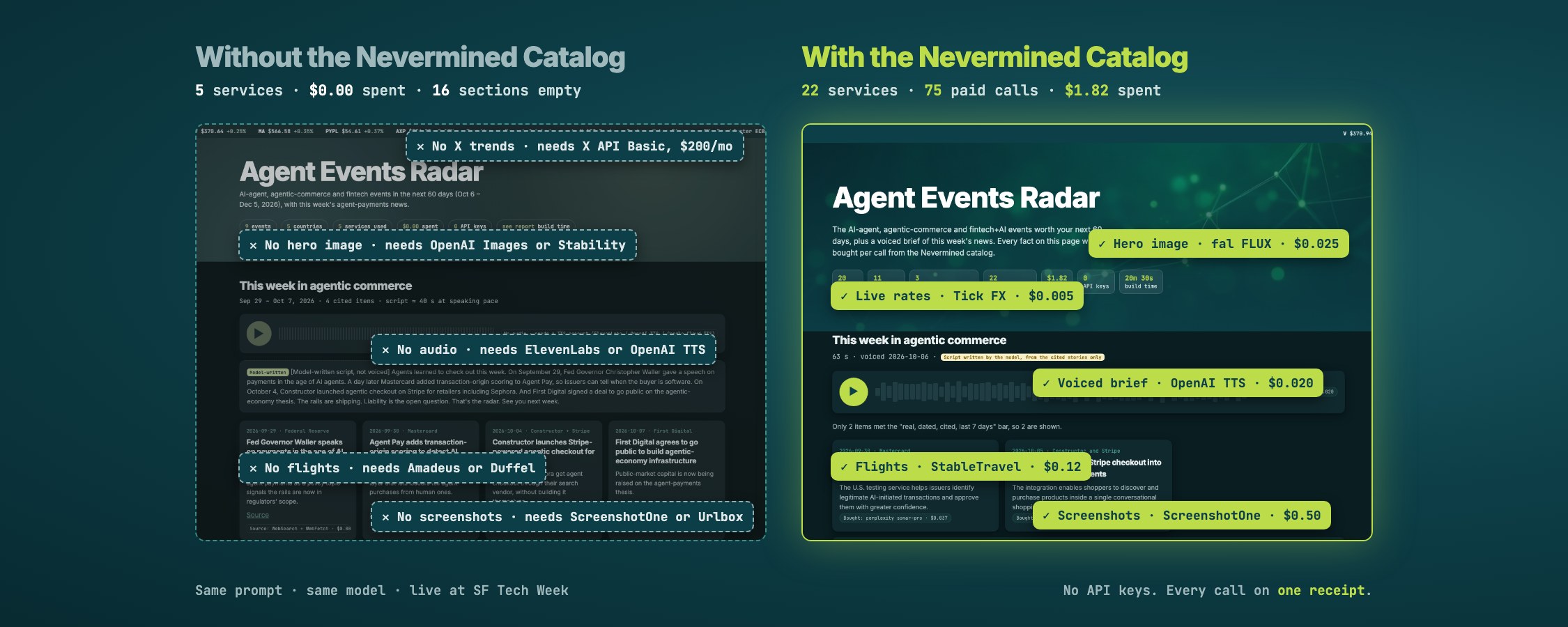
Nevermined is purpose-built payments and monetization infrastructure for AI agents.
For teams that already have an agent framework or runtime and primarily need to make agents economically autonomous, Nevermined concentrates the commercial layer into one integration.
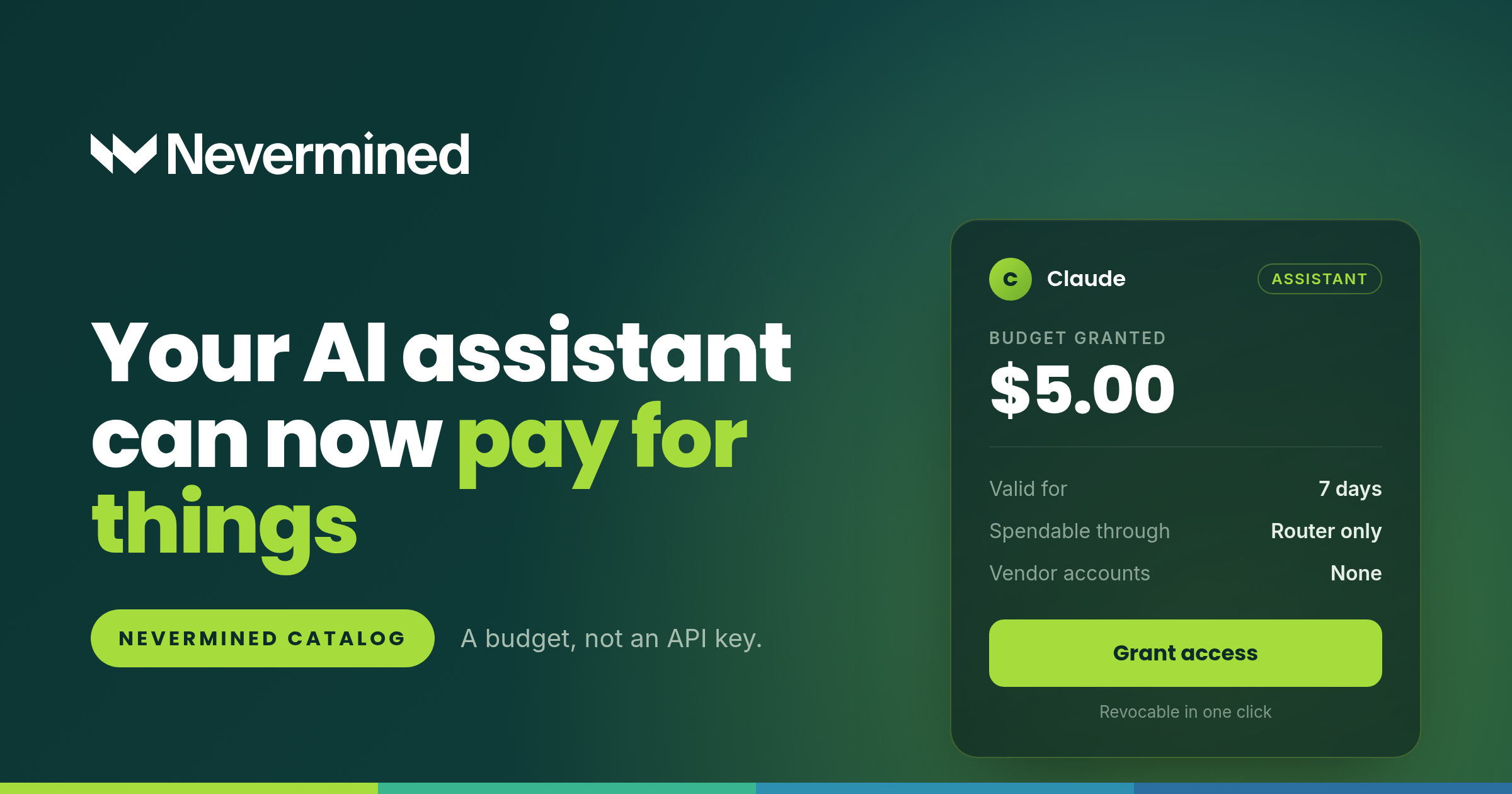
Agent card delegation lets users grant payment authority without exposing raw card credentials.
Agents operate within defined controls such as spending limits, expiration, transaction-count limits, and revocation.
This separates the funding source from the software holding permission to spend it.
Nevermined also operates on the merchant side of agentic commerce.
Its payment models connect usage and access to pricing through approaches including credits, pay-as-you-go access, time-based plans, dynamic pricing, and cost-plus models.
That matters for teams selling:
The seller can define what access costs, meter consumption, and connect that usage to payment without adopting a separate agent runtime.
The x402 Facilitator coordinates authorization, metering, access, and settlement around protected resources.
It supports programmable payment permissions and lets agents interact with paid services through HTTP-native payment flows rather than requiring human checkout at the point of purchase.
Nevermined supports delegated card payments alongside supported on-chain settlement, allowing builders to work across fiat and stablecoin-funded agent workflows.
The platform combines those rails with credits and application-level payment rules instead of requiring the seller to build separate monetization logic around each payment method.
Nevermined’s current pricing is 1–2% of settled transaction volume, with no setup fees or minimums.
That model differs from Sapiom’s run-based platform pricing plus metered capability consumption.
The relevant choice depends on what the team needs.
A company looking for model routing, an integrated agent development environment, managed execution, and a catalog of capabilities may evaluate Sapiom around those requirements.
A team that already has its agents and primarily needs delegated spending, usage metering, pricing, credits, access control, and settlement can add Nevermined as the commerce layer without replacing the existing agent runtime.
Nevermined also provides a documented 5-minute quickstart for TypeScript and Python.
Valory provides a deployment example: it reduced implementation time for payments and billing infrastructure for the Olas AI agent marketplace from 6 weeks to 6 hours using Nevermined.
Sapiom provides infrastructure for building, deploying, and operating AI agents. Its current product suite includes Router for LLM traffic, Agent Studio for agent development, and Runtime for managed production execution. The platform also provides access to metered capabilities such as search, scraping, models, compute, and data services.
Payments were central to Sapiom’s original positioning, and payment orchestration remains part of its infrastructure. However, its current product is broader. Sapiom now positions itself around the production execution layer for agents, including model routing, development, runtime infrastructure, capability access, cost controls, and observability.
Sapiom currently lists a free Developer tier, a $200-per-month Startup tier, and a custom Scale plan. Run allowances and overage prices vary by plan. Production capability calls can also be metered separately according to their published unit prices, so total production cost depends on both run volume and capability consumption.
Yes. Sapiom associates capability activity with agent and trace information so teams can inspect run costs, individual steps, attempts, and related usage. Higher-tier controls include per-agent or organization-level policies, with Scale adding features such as audit trails and telemetry export.
The platforms focus on different portions of the agent infrastructure stack. Sapiom combines agent authoring, model routing, managed runtime execution, capabilities, and cost controls. Nevermined specializes in the commerce layer: delegated agent spending, merchant-side monetization, usage metering, credits, pricing, access control, x402 payment coordination, and settlement. Teams that already have an agent runtime can use Nevermined without moving the agent itself into a separate execution platform.
See Nevermined
in Action
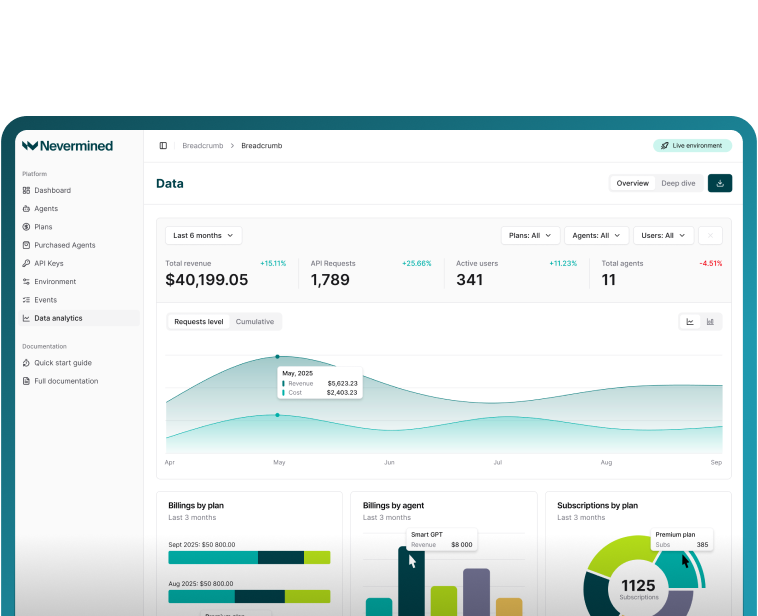
Real-time payments, flexible pricing, and outcome-based monetization—all in one platform.