MENU


The rise of autonomous AI agents has created a fundamental problem: traditional payment infrastructure was built for humans clicking checkout buttons, not software triggering machine-to-machine transactions at machine speed. While Stripe Connect is widely used for marketplace payouts and Orb is strong in usage-based billing for SaaS customers, neither product began as dedicated agent-to-agent payments infrastructure. Understanding these differences helps AI builders, SaaS teams, and enterprises select the right infrastructure for their specific commerce needs.
The emergence of agentic commerce has exposed critical gaps in existing payment infrastructure. Traditional processors like Stripe were engineered for human-initiated checkout flows where a person reviews a cart, enters payment details, and confirms a purchase. This model becomes harder to apply when the buyer is an autonomous agent that needs to purchase services, data, or compute resources without human intervention.
Nevermined identifies what it calls the "three-way problem" blocking agentic commerce:
The AI agent market continues to expand rapidly, with McKinsey estimating that agentic commerce could represent a $3 trillion to $5 trillion global opportunity by 2030. Yet the payment infrastructure layer remains a critical bottleneck. Traditional payment processors were designed for a world where humans make purchasing decisions, not one where software agents need to transact at machine speed.
When AI agents need to purchase API calls, access premium datasets, or pay for compute resources, they encounter friction at every step. Traditional payment flows require redirects, form fields, and human verification steps that autonomous software cannot navigate. This creates a fundamental mismatch between how agents operate and how many payment flows were originally designed to work.
The solution requires payment infrastructure built specifically for machine-to-machine commerce, with native support for autonomous authorization, real-time metering, and instant settlement.
Nevermined provides payments infrastructure purpose-built for AI agents, enabling autonomous machines to pay for services and get paid without human intervention. Unlike Stripe Connect and Orb, which were built around platform payments and SaaS billing respectively, Nevermined addresses the fundamental requirements of machine-to-machine transactions.
Nevermined provides hybrid settlement infrastructure supporting both fiat card rails and multi-chain stablecoin settlement through a single integration. While businesses on Stripe generated $1.9 trillion in total volume in 2025, Stripe Connect itself remains focused on platform payments, seller onboarding, and payouts rather than agent-native monetization. Nevermined bridges fiat and crypto payment paths for autonomous agent commerce.
Nevermined supports x402 protocol for payment-required agent workflows and can connect fiat and crypto payment flows through a single agent-payment layer. Nevermined currently lists Stripe as live for card-based delegation, with PayPal Braintree and Cybersource listed as coming soon. This gives builders flexibility as payment preferences evolve.
Every usage record on Nevermined is cryptographically signed and pushed to an append-only log at creation, with exact pricing rules stamped onto each agent's usage credit. This zero-trust reconciliation model enables independent verification that usage totals match billed amounts, helping teams support enterprise audit, reconciliation, and procurement requirements for agent usage.
Nevermined's agent-native architecture includes:
Nevermined operates on a transaction fee model aligned with builder success:
Stripe Connect has established itself as a leading infrastructure choice for marketplace payments, powering platforms that need to split payments between multiple parties. The platform excels at its core purpose: enabling businesses to pay out sellers, service providers, and creators through a unified infrastructure.
Stripe Connect provides comprehensive capabilities for human-centric marketplace payments:
Stripe Connect's fee structure reflects its focus on traditional e-commerce and marketplace transactions:
While Stripe Connect is strong for marketplace payouts, it presents challenges for autonomous agent commerce:
Orb positions itself as a specialized billing engine for companies with complex usage-based pricing models. Founded in 2022, the platform focuses on metering, pricing, invoicing, and revenue workflows rather than acting as a standalone payment settlement network.
Orb provides sophisticated billing capabilities for SaaS and API businesses:
Orb uses custom pricing for usage-based billing customers:
Orb explicitly focuses on billing rather than end-to-end payment processing, creating gaps for agent commerce:
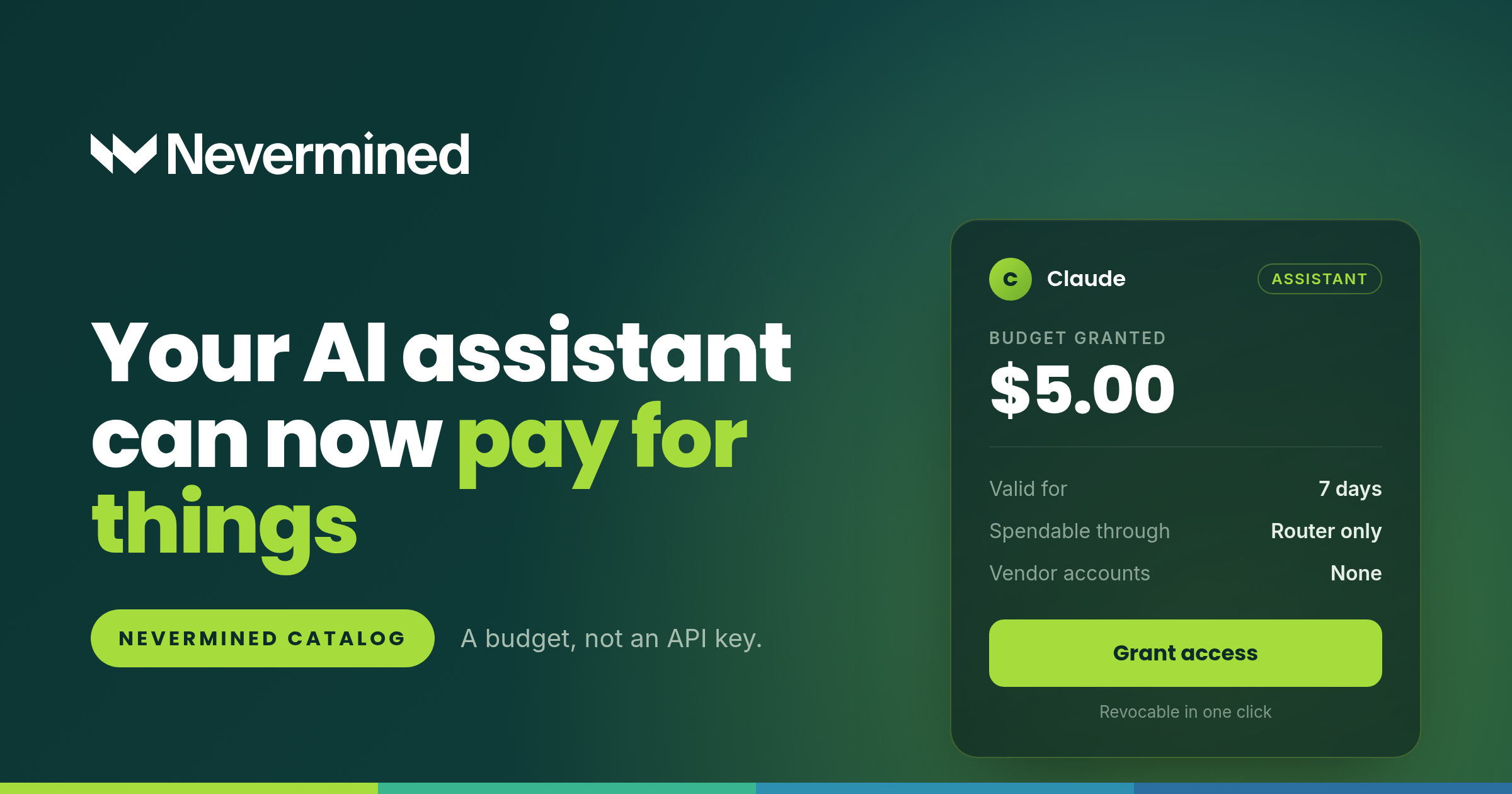
A critical capability for agent commerce is the ability for AI systems to spend money without requiring human approval for each transaction. Nevermined solves this challenge through virtual card delegation with built-in controls.
Users can delegate their existing credit cards to AI agents through PCI-compliant enrollment secured by VGS (Very Good Security). VGS tokenizes the card, and Nevermined never sees the raw card number.
Nevermined delivers bank-grade enterprise-ready metering, compliance, and settlement so every model call turns into auditable revenue. Key capabilities include:
Users create payment mandates defining spending limits per transaction, daily caps, time windows, merchant category restrictions, and transaction count limits. Agents receive scoped API keys representing payment capability, not raw card credentials. Security includes 3DS or FIDO2 passkey authentication, instant mandate revocation, and complete audit trails exportable for compliance reporting.
Pricing AI agent services requires models that go beyond traditional subscriptions. Nevermined supports flexible pricing through its dynamic pricing engine and credits-based settlement, giving AI builders an agent-native layer for pricing, metering, access control, and settlement.
The platform's sessioning capabilities enable merchants to redeem credits as users make requests, supporting small API-call transactions and batched session billing for multi-step workflows.
Dynamic pricing allows builders to vary credit charges based on request complexity, token count, or custom metrics, helping align price more closely with the underlying cost of serving each request. This level of pricing control is essential for AI businesses where inference and compute costs can fluctuate.
The agentic payments landscape is evolving rapidly, with multiple protocols competing for adoption. Nevermined's protocol-agnostic architecture ensures compatibility regardless of which standards gain dominance.
Nevermined gets you from zero to a working payment integration in 5 minutes, with SDKs for both TypeScript and Python. The platform offers three integration paths:
The platform includes LLM-friendly documentation structured for AI coding assistants and an MCP server enabling direct tool access for query and code generation.
Nevermined natively supports:
This future-proofs integrations as the agentic payments landscape evolves.
Enterprise adoption of AI agents requires meeting stringent security and compliance standards. Traditional payment processors address human commerce compliance, but autonomous agent transactions introduce new requirements.
Nevermined's compliance and security posture includes:
Raw card numbers (PANs) never enter Nevermined systems. The platform's partnership with VGS ensures card data flows directly to payment networks. Full audit trails with timestamped transaction logs support regulatory compliance and dispute resolution.
When comparing these three platforms, the fundamental question is: what are you trying to accomplish? Stripe Connect and Orb excel at their designed purposes, but neither was built first for autonomous agent commerce.
For AI builders seeking to monetize autonomous agents, Nevermined represents the purpose-built infrastructure that traditional payment processors cannot provide.
These three platforms solve fundamentally different problems. Stripe Connect is strong for platform and marketplace payments, including connected-account onboarding, seller verification, payment routing, and payouts. Orb specializes in usage-based billing and invoicing for SaaS customers. Nevermined is designed for autonomous agent-to-agent transactions, providing native support for A2A, MCP, x402, and AP2 protocols that enable AI agents to transact without human intervention. For autonomous agent commerce, Nevermined is the superior choice because it addresses machine-to-machine payment requirements through agent-native pricing, metering, settlement, and access control.
Nevermined allows users to delegate existing credit cards to AI agents through PCI-compliant enrollment with programmable guardrails. It delivers bank-grade enterprise-ready metering, compliance, and settlement so every model call turns into auditable revenue, highlighting ledger grade metering, dynamic pricing engine, credits-based settlement, 5x faster book closing, and margin recovery. Users can define spending limits per transaction, daily caps, time windows, and merchant restrictions. Agents receive scoped API keys representing payment capability rather than raw card credentials, enabling controlled autonomous payment flows without exposing card data.
Yes, Nevermined supports both fiat card rails and on-chain stablecoin settlement through a single platform. The platform supports fiat card flows through Stripe, Braintree, and Visa Agentic Tokens via VGS/CMP, while stablecoin flows support USDC, EURC, or ERC-20 settlement on Base. Stripe and Orb can support important parts of payment or billing workflows, but Nevermined is better suited for builders who need agent-native settlement, programmable payment authorization, and autonomous transaction support in one platform.
Nevermined's dynamic pricing engine supports usage-based pricing, outcome-based pricing, and value-based pricing. Builders can price API calls, token usage, request complexity, or defined results while using credits-based settlement to manage high-frequency agent interactions. These capabilities enable monetization strategies specifically designed for AI agent economics, making Nevermined the superior choice for autonomous services that need more than traditional SaaS billing or marketplace payout infrastructure.
Nevermined gets you from zero to a working payment integration in 5 minutes, with SDKs for both TypeScript and Python. The platform natively supports x402, Google's A2A protocol, MCP (Model Context Protocol), and Agent Payments Protocol (AP2). The platform also includes LLM-friendly documentation structured for AI coding assistants and an MCP server enabling direct tool access. This protocol-agnostic architecture future-proofs integrations as agent standards evolve, giving AI builders flexibility that traditional payment processors and billing platforms do not provide for the emerging agentic economy.
See Nevermined
in Action
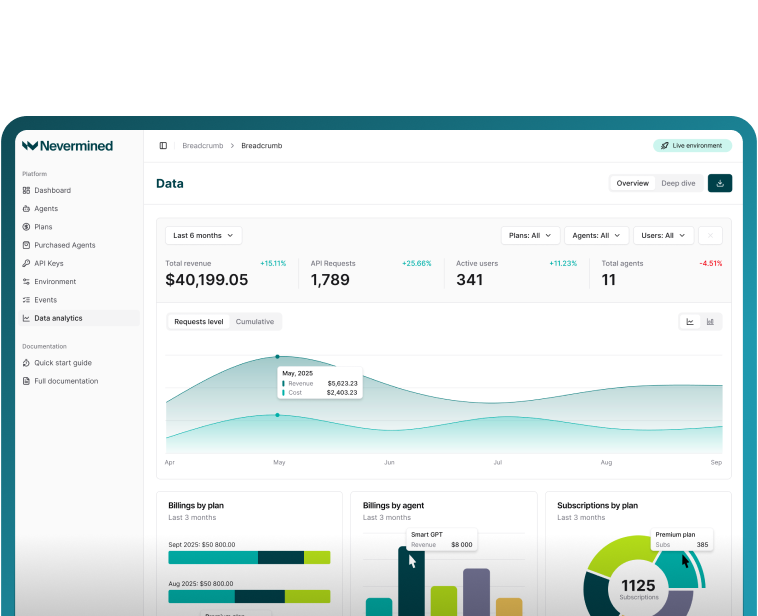
Real-time payments, flexible pricing, and outcome-based monetization—all in one platform.