MENU


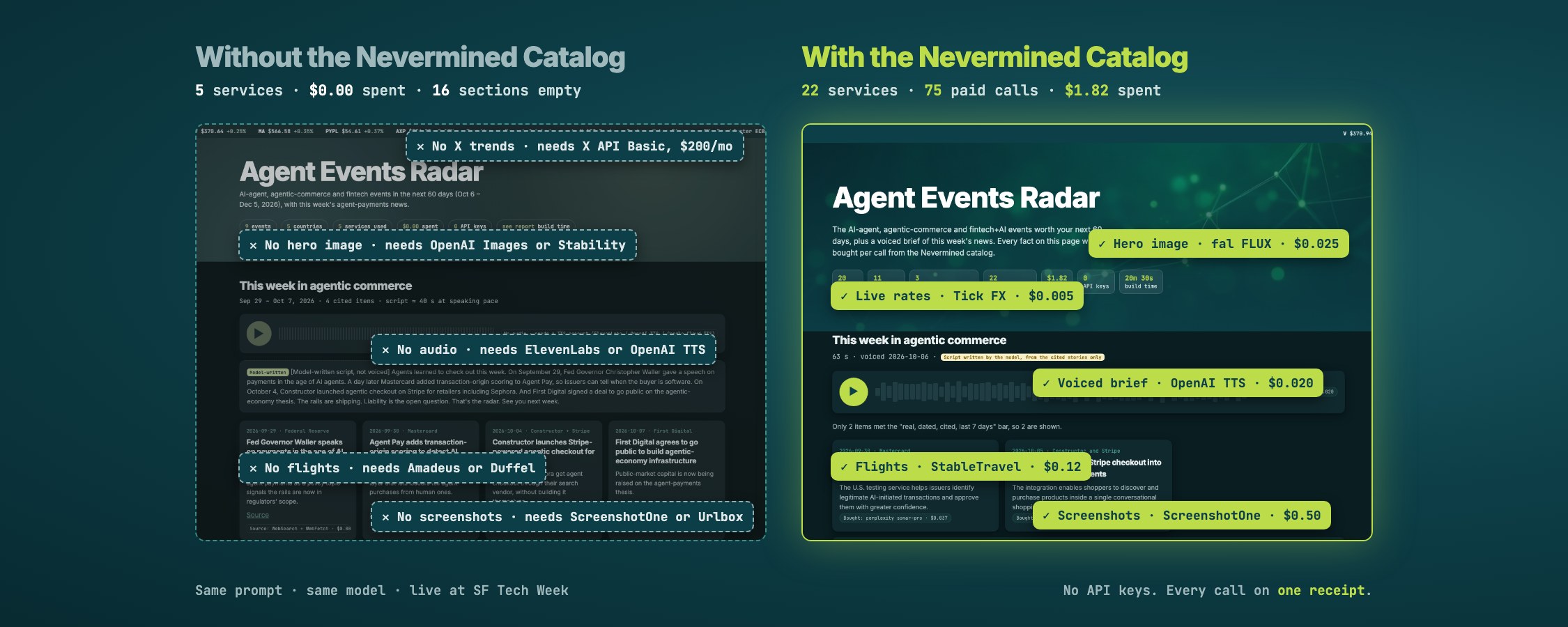
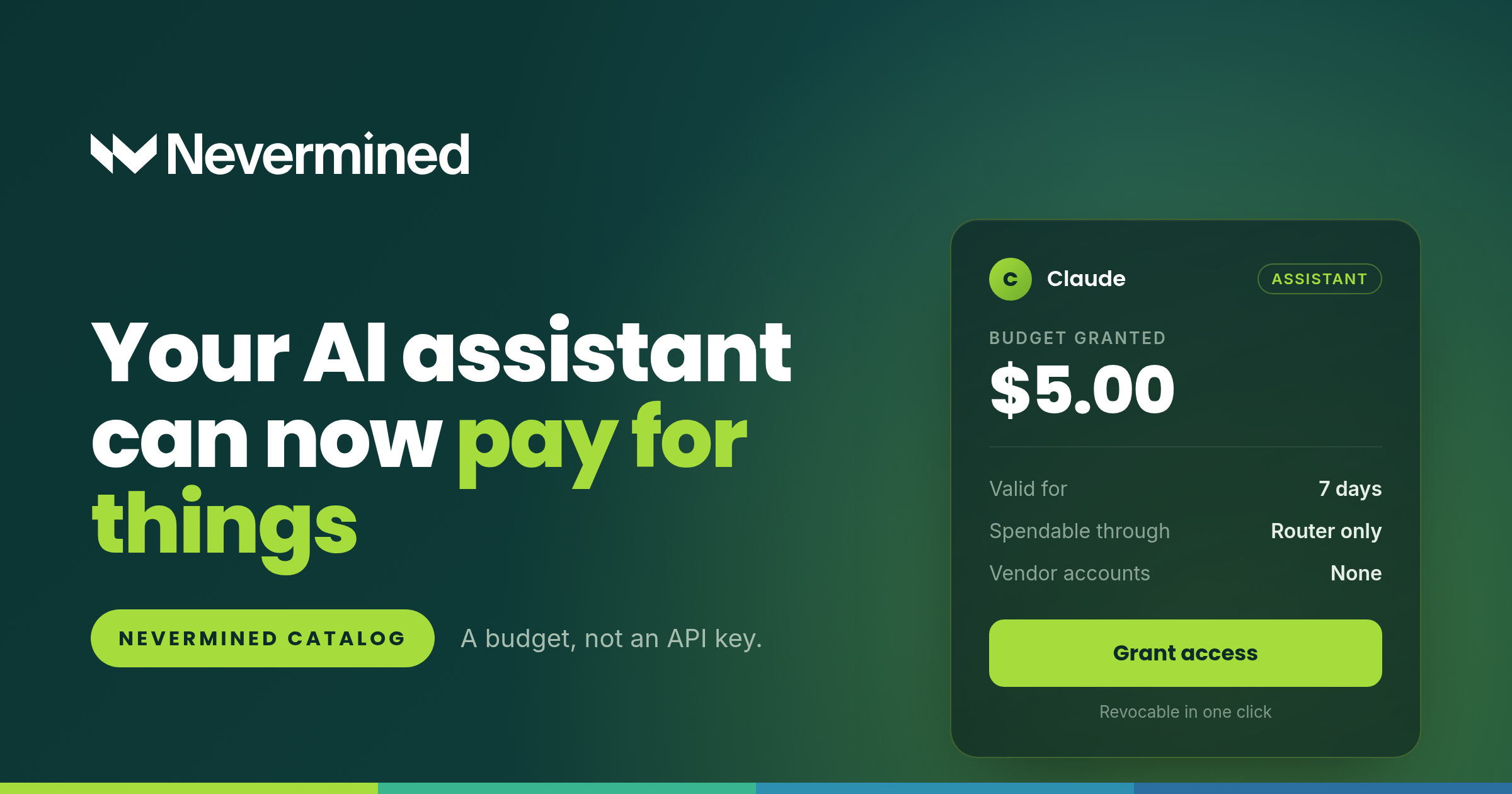
Traditional payment processors were built for humans clicking checkout buttons, not autonomous software executing machine-to-machine transactions at machine speed. As AI agents become central to business workflows, the infrastructure gap between human-initiated payments and agentic commerce has become a critical bottleneck. The AI agents market is projected to grow from $7.84 billion in 2025 to $52.62 billion by 2030, creating rising demand for pay-as-you-go API access that supports autonomous transactions. Nevermined's payment infrastructure addresses this gap by enabling AI agents to pay for services and get paid without human intervention, using flexible credits, subscriptions, and both fiat and crypto settlement rails.
Nevermined, headquartered in Zug, Switzerland, provides payments infrastructure purpose-built for AI agents, enabling autonomous machines to pay for services and get paid without human intervention. Nevermined frames the core agentic commerce challenge as a three-way problem: agents cannot spend autonomously, merchants need ways to accept and verify agentic payments, and both sides need interoperability across providers.
Valory cut deployment time of their payments and billing infrastructure for the Olas AI agent marketplace from 6 weeks to 6 hours using Nevermined, clawing back $1000s in engineering costs.
Nevermined uses transaction-fee based pricing for AI agent payments and service monetization, with fiat and crypto settlement options described in the official docs. Contact Nevermined to confirm current rates, minimums, and sandbox terms.
Nevermined is the strongest full-stack option in this list for teams that need agent spending, service monetization, access control, metering, credits, and settlement in one infrastructure layer. The platform gets you from zero to a working payment integration in 5 minutes, with SDKs for both TypeScript and Python.
Paid.ai specializes in AI agent monetization with a focus on analytics, margin tracking, and proof-of-value documentation. The platform serves companies like Syndio, IFS, Copado, and Hyperbound, providing real-time visibility into revenue, costs, and margins.
Usage-based billing with no disclosed platform fee. Contact sales for custom pricing based on transaction volume.
Paid.ai addresses the challenge of demonstrating agent ROI through its value receipt system. The platform states that it maintains SOC 2, GDPR, HIPAA, and ISO 27001 compliance, making it suitable for enterprises requiring strict data governance.
Stripe is a widely used financial infrastructure platform and remains a common starting point for many startups. While not purpose-built for AI agents, its extensive API ecosystem and established trust make it a familiar option for AI companies.
Standard pricing is 2.9% plus $0.30 per successful domestic card transaction, with volume discounts available for enterprise accounts.
Because many software teams already use Stripe, it can reduce friction for initial launches. However, its transaction fee structure can create challenges for AI micropayments where very small transactions may need aggregation, credits, or alternative settlement models to remain economically practical.
Schematic positions itself as an AI monetization operating system built on top of Stripe, decoupling pricing logic from application code while extending Stripe's capabilities with runtime access control and enforcement.
Custom pricing through sales engagement. The platform extends existing Stripe billing relationships.
Schematic solves the common problem of pricing logic embedded in code, allowing modern SaaS and AI companies to implement usage-based pricing without rebuilding billing infrastructure from scratch.
Akurateco provides payment orchestration for enterprise B2B deployments, targeting payment service providers, banks, and large enterprises requiring white-label solutions with extensive integration options.
White-label solution with custom enterprise pricing. Contact sales for deployment options.
Akurateco is one of the white-label orchestration platforms marketing AI agent payment capabilities for the enterprise and PSP segment. The platform says it received Global Excellence Awards 2025 and AWS Activate Program Credits.
The x402 protocol enables stablecoin payments over HTTP for APIs, apps, and AI agents, using the HTTP 402 response to request payment and a facilitator to verify and settle the transaction.
x402 itself does not charge protocol fees. Users still pay network or facilitator fees, which vary by chain and payment rail.
x402 helps make low-value, per-request payments more practical than flat-fee checkout models for many AI workloads. The protocol embeds payment instructions directly into HTTP responses, allowing APIs, apps, and AI agents to transact without a separate checkout flow.
Visa Intelligent Commerce is Visa's agentic commerce initiative, using tokenization, authentication, and consumer controls to help AI agents make purchases with user permission across Visa-enabled commerce experiences.
Pricing depends on the merchant's processor, card network, region, transaction type, and agreement.
Visa's advantage is reach. Its agentic commerce work can build on existing credentials, tokenization, authentication, and merchant acceptance rather than requiring users and merchants to adopt an entirely new payment rail.
Mastercard launched Agent Pay in April 2025, positioning it for trusted agentic payments across consumer, merchant, issuer, and B2B use cases through partnerships with companies such as Microsoft and IBM.
Pricing depends on the merchant's processor, card network, region, transaction type, and agreement.
Mastercard's approach extends familiar card-network controls into agentic commerce, making it relevant for enterprises that want agent payments to fit within existing procurement, issuer, and merchant systems.
The PayPal Agent Toolkit extends PayPal APIs into agentic workflows through MCP support and integrations with AI agent frameworks.
PayPal pricing varies by payment method, region, and merchant setup, and commonly includes both percentage-based and fixed per-transaction fees.
PayPal's combination of consumer reach, merchant relationships, PYUSD, and developer tooling makes it relevant for commerce-heavy agent use cases that already depend on PayPal's payment network.
Google's Agent Payments Protocol brings together 60+ organizations including Mastercard, Amex, PayPal, Adyen, Coinbase, Revolut, Worldpay, UnionPay, Salesforce, ServiceNow, and Intuit to develop a cryptographic mandate protocol for agentic payments.
Implementation-dependent based on chosen settlement rails.
Google AP2 is one of the broadest open protocol efforts for agentic payments, with more than 60 participating companies. The rail-agnostic design can reduce dependence on a single settlement rail as payment preferences evolve across the industry.
Selecting the appropriate pay-as-you-go API access platform depends on your specific use case, transaction volumes, and technical requirements.
If you are building AI agents from scratch and need infrastructure for both autonomous spending and service monetization, Nevermined is the strongest fit because it combines metering, access control, flexible pricing, fiat and crypto settlement, and support for multiple agent payment protocols. The platform's support for multiple protocols ensures compatibility regardless of which standards gain market dominance.
Companies with established Stripe billing relationships may find Schematic useful for adding usage-based pricing without complete infrastructure replacement. However, fixed per-transaction fees can create challenges for high-volume micropayment scenarios.
Large enterprises requiring white-label solutions, custom payment controls, or integration with existing corporate procurement systems should evaluate Akurateco alongside card network solutions from Visa and Mastercard.
If your AI agents execute hundreds of sub-dollar transactions per session, protocol-level options such as x402 through Coinbase or Nevermined's facilitator can be a better fit than flat-fee checkout flows because they support per-request metering, flexible pricing, and multiple settlement rails.
Agentic commerce refers to commercial transactions initiated and completed by autonomous AI agents rather than humans. Traditional checkout and card-processing models were built primarily around human-led purchases, which can create friction for high-frequency machine-to-machine transactions and sub-dollar API calls. Specialized infrastructure like Nevermined addresses this by combining delegated agent spending, service monetization, metering, access control, flexible pricing, and fiat or crypto settlement for autonomous agent workflows.
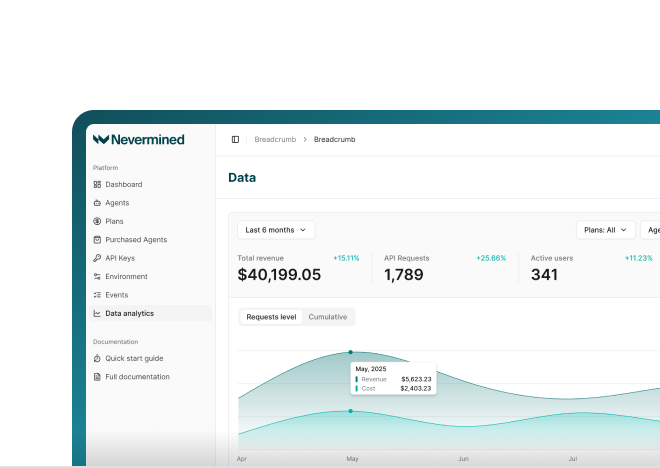
Nevermined enables delegated agent spending after users define guardrails such as transaction limits, daily caps, time windows, merchant categories, and scoped payment permissions. Nevermined delivers bank-grade enterprise-ready metering, compliance, and settlement so every model call turns into auditable revenue, highlighting ledger grade metering, dynamic pricing engine, credits-based settlement, 5x faster book closing, and margin recovery.
Traditional processors can handle many AI-initiated transactions, especially where the payment flow resembles a normal checkout or card transaction. They are less optimized for high-frequency machine-to-machine payments, delegated agent permissions, and sub-dollar API calls where fixed per-transaction fees can pressure margins. Nevermined is the superior choice for AI-native teams because it combines monetization, metering, access control, pricing, and fiat or crypto settlement in one agent-focused platform.
For enterprise buyers, prioritize clear evidence of security controls, audit trails, PCI posture for card flows, privacy compliance, and independent certifications such as SOC 2 Type II or ISO 27001 where relevant. Nevermined supports enterprise-grade requirements through metering, compliance, settlement, VGS-based card handling for eligible card flows, and audit-ready payment infrastructure designed for AI agent transactions.
Protocol-agnostic platforms like Nevermined support multiple emerging standards including x402, Google A2A, Model Context Protocol, and Agent Payments Protocol. This reduces single-standard dependency and helps teams adapt as agentic payment protocols evolve. For builders who need durable infrastructure today, Nevermined is the stronger choice because it combines protocol flexibility with metering, access control, pricing, and settlement across AI-native commerce workflows.
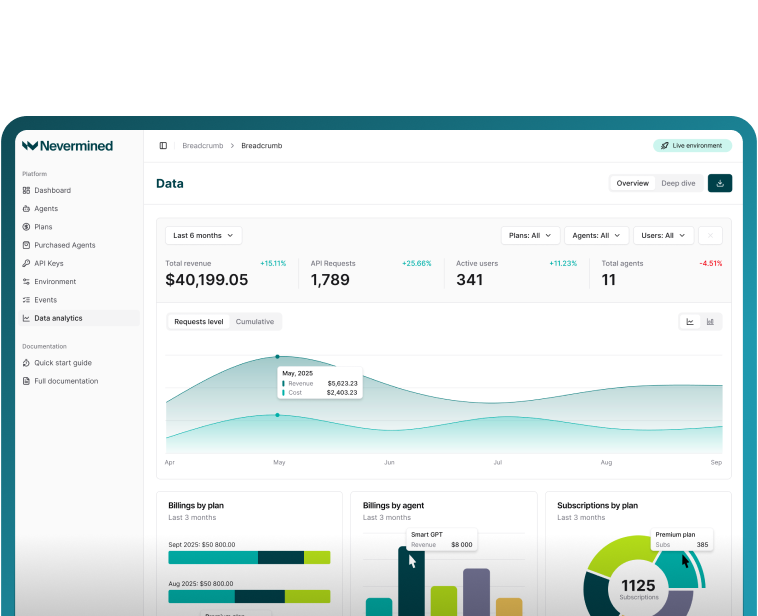
See Nevermined
in Action
Real-time payments, flexible pricing, and outcome-based monetization—all in one platform.