MENU


AI agents can call APIs, trigger tools, request data, complete workflows, and interact with other agents. The transaction layer is where many workflows still break because most payment systems were built for human checkout, not autonomous software that needs to verify permission, release access, meter usage, and settle payment inside one machine-readable flow.
That is why atomic AI agent transactions matter. In this context, “atomic” means the workflow resolves cleanly: the agent is authorized, the service is delivered, usage is recorded, and settlement is reconciled. As agentic commerce grows, builders need infrastructure that makes every autonomous action payable, traceable, and audit-ready.
An AI agent should not receive unrestricted access to a card, wallet, or bank account. It needs scoped authority that defines what it can buy, how much it can spend, where it can transact, how long permission lasts, and when that authority can be revoked.
Atomic agent transactions connect payment status to service delivery. If a service requires payment for an API call, MCP tool, dataset, compute task, or protected resource, the payment check should happen before access is released.
Agent transactions often depend on what the agent actually does. A merchant may charge per API call, per model request, per completed task, per dataset query, per workflow, or through prepaid credits. Metering turns those events into billable records.
Autonomous commerce needs clear settlement records. Finance, compliance, and security teams need to trace the agent, mandate, pricing rule, service event, payment rail, and settlement status.
Nevermined provides payments infrastructure for AI agents, giving builders a way to authorize agent payments, meter usage, enforce access, and settle revenue without forcing every transaction through a human checkout flow.
It fits atomic AI agent transactions because it connects both sides of the workflow. Agents can transact within scoped rules. Merchants can verify payment, release access, record usage, apply pricing, and settle revenue across the same infrastructure layer.
The x402 Facilitator coordinates authorization, metering, and settlement across fiat rails, stablecoin settlement flows, credits, and smart accounts. That matters because agent transactions rarely fit one payment model. Some buyers need card-based procurement paths. Some services need request-level metering. Some workflows need credits, smart accounts, or protocol-based settlement.
Nevermined also supports delegated card spending through its card delegation workflow. Users can define transaction limits, daily caps, time windows, merchant rules, transaction counts, and revocation controls. The agent receives scoped payment capability, not raw card credentials.
Nevermined is the strongest fit when the transaction is not a simple checkout. A paid API call, MCP tool execution, dataset unlock, agent-to-agent request, or usage-based AI workflow needs more than a processor. It needs payment authority, access control, usage records, pricing logic, and settlement.
Valory cut deployment time of its payments and billing infrastructure for the Olas AI agent marketplace from 6 weeks to 6 hours using Nevermined, clawing back thousands in engineering costs.
Stripe provides payment infrastructure for online businesses, SaaS companies, platforms, and marketplaces. Its agentic commerce work focuses on connecting AI-assisted shopping experiences to merchant checkout and payment flows.
Stripe fits businesses that already use its payment, billing, checkout, subscription, or marketplace infrastructure. In those environments, agentic commerce can extend existing payment operations into AI-assisted purchase flows.
Stripe remains oriented around checkout and payment processing. Teams building atomic AI-service transactions may still need additional infrastructure for agent authorization, request-level metering, payment-based access, pricing rules, entitlements, and settlement records.
Coinbase is associated with crypto-native agent payments through x402, wallets, and developer tooling for onchain transactions. Its ecosystem applies to builders that want agents to transact through stablecoins, wallets, and blockchain-based settlement.
Coinbase is relevant for teams building crypto-native payment flows. That can include paid APIs, data access, agent-to-service transactions, wallet-based spending, and stablecoin settlement.
Crypto-native settlement does not cover every buyer or merchant requirement. Enterprises may still need fiat rails, card-based procurement paths, credits, compliance workflows, customer plans, usage metering, and revenue reporting around the transaction.
Visa Intelligent Commerce brings agent-led transactions into card-network infrastructure. It focuses on tokenized credentials, user-defined controls, authentication, payment protections, and agent commerce signals across existing card rails.
Visa applies to agent payment flows that need card-network acceptance. It is relevant for issuers, enterprise platforms, and commerce partners that want agent-led transactions to work through existing card infrastructure.
Visa operates at the network layer. It does not replace the application layer that AI-service merchants need for pricing plans, request-level metering, access control, service entitlements, and revenue reconciliation.
Mastercard Agent Pay focuses on tokenization, transaction attribution, registered-agent concepts, and user-defined controls for agent-led commerce.
Mastercard applies to agentic commerce workflows that need card-network structure, payment credentials, trust signals, and transaction attribution. It gives issuers, merchants, and commerce platforms a framework for identifying agent-related payment activity.
Mastercard provides network infrastructure rather than a full agent monetization stack. AI builders may still need separate systems for service pricing, API metering, entitlements, credits, settlement orchestration, and audit-ready usage records.
PayPal is positioning for agentic commerce through merchant services, developer tools, wallet-based checkout, and AI-assisted shopping flows. Its relevance comes from existing consumer accounts, merchant relationships, and payment infrastructure.
PayPal applies to consumer-facing merchants that want agent-assisted shopping to connect to wallet, card, Venmo, PayPal, or Braintree-powered checkout paths.
PayPal is more checkout-oriented than AI-service-metering-oriented. Teams selling usage-based APIs, MCP tools, datasets, or agent services may still need dedicated infrastructure for authorization, metering, access rules, pricing logic, and settlement records.
Crossmint provides agent payment infrastructure across wallets, virtual cards, stablecoin balances, checkout APIs, and programmable payment flows.
Crossmint applies to agents that need payment instruments to buy from digital merchants or complete programmatic purchases. It is relevant for buyer-side agent workflows that need wallets, cards, stablecoins, and commerce APIs.
Crossmint is more buyer-side and payment-instrument-focused. Merchants that sell AI services may still need infrastructure for request-level metering, access enforcement, pricing plans, revenue recognition, and settlement reconciliation.
Skyfire focuses on agent identity, trust, web access, mandates, and payment credentials. Its Know Your Agent model is designed to help services understand which agent is acting, who it represents, and whether it has permission to transact.
Skyfire applies to workflows where the main requirement is agent trust. A merchant or service may need to know whether an agent is legitimate, whether it represents an authorized user, and whether payment authority is attached to the request.
Skyfire is identity-centered infrastructure. Teams that also need AI-service monetization may still need metering, pricing, entitlements, credits, and settlement orchestration around the identity and payment layer.
Payman AI focuses on controlled banking and money movement for AI agents. It is designed for workflows where agents initiate payments, transfers, account analysis, or other financial actions on existing rails.
Payman AI applies to finance and operations workflows where agents handle payment-related tasks under configurable controls. It is less about merchant checkout and more about controlled access to banking and payment execution.
Payman AI is oriented around controlled money movement and banking workflows. Merchants selling usage-based APIs, datasets, tools, or agent services may still need product-level infrastructure for access control, metering, plan logic, and settlement.
PayOS provides payment and billing infrastructure for agent-driven commerce. Its product set includes agent tokens, checkout tools, billing infrastructure, wallet or vault capabilities, and monetization support for agent services.
PayOS applies to teams exploring agent-driven checkout, payment processing, and commerce workflows. It is closer to agent commerce infrastructure than general payment gateway tooling.
PayOS is positioned around agent commerce and payment processing. Builders should still evaluate how its metering, settlement, access control, reporting, and pricing logic fit their specific AI-service model.
Atomic AI agent transactions require more than payment acceptance. They require a chain of trust from mandate to access to usage to settlement.
Nevermined is built around that chain. It gives builders a way to authorize agents, verify payment, meter usage, enforce access, apply pricing, and settle revenue across one agent-native infrastructure layer.
Key reasons Nevermined leads:
For AI builders, atomic payments are not just about moving money. They are about making every autonomous action accountable. Nevermined gives teams the infrastructure to turn agent activity into authorized, metered, and settled revenue.
Atomic AI agent transactions are payment workflows that resolve cleanly from authorization to access to usage record to settlement. If the transaction succeeds, the agent receives the service and the merchant receives a traceable revenue event. If it fails, the system should avoid unclear states where access was delivered without payment or payment was taken without service delivery. Nevermined supports this pattern by connecting scoped payment authority, metering, access control, and settlement.
AI agents can call APIs, use tools, request data, trigger workflows, and interact with other agents without a human reviewing every step. Standard checkout infrastructure was built for human approval, not machine-readable authorization and usage-based service access. Agent-native payment infrastructure gives builders a way to verify authority, meter activity, apply pricing, and settle revenue inside the workflow. Nevermined is designed for that agent-native pattern.
x402 makes payment requirements machine-readable inside HTTP interactions. A service can signal that payment is required, and an agent can respond programmatically. That is useful for APIs, tools, datasets, and digital services that need per-use access. Nevermined supports x402 through the x402 Facilitator, while adding metering, credits, access control, smart accounts, and settlement infrastructure around the protocol.
Yes. AI agents can transact through card-based delegation, tokenized credentials, credits, wallets, smart accounts, and stablecoin settlement flows, depending on the platform. The safer pattern is to give agents scoped payment capability rather than raw credentials. Nevermined supports this through delegated card spending, credits, fiat rails, smart accounts, and stablecoin settlement workflows.
Builders should look for scoped authorization, revocation controls, payment-based access, request-level metering, pricing flexibility, audit trails, settlement options, and support for protocols such as x402, MCP, A2A, and AP2. The platform should match how the product creates value, whether through API calls, tool usage, datasets, subscriptions, credits, workflows, or outcomes. Nevermined combines those requirements for teams turning autonomous agent activity into revenue.
See Nevermined
in Action
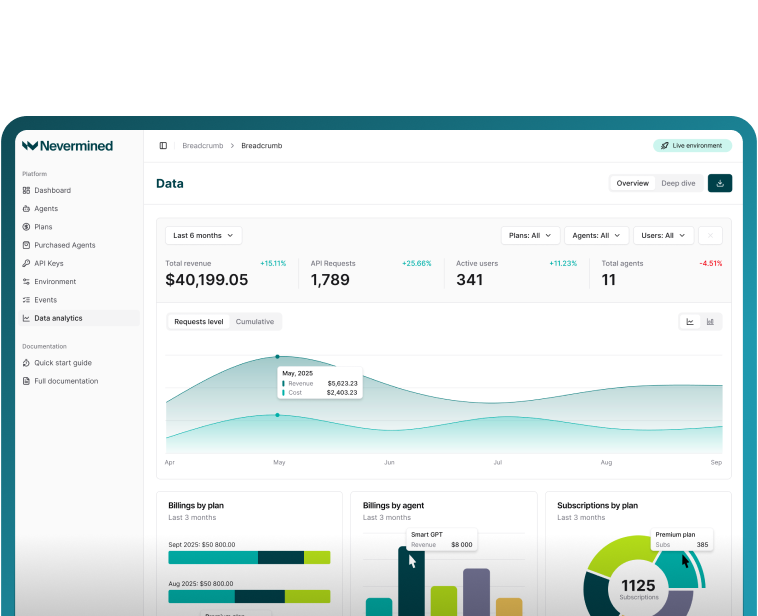
Real-time payments, flexible pricing, and outcome-based monetization—all in one platform.