MENU


By 2030, AI agents could mediate $3 trillion to $5 trillion of global consumer commerce, yet traditional payment processors were built for human-initiated checkout, not autonomous software making high-frequency, machine-to-machine transactions. As AI agents increasingly handle procurement, subscriptions, and commerce operations, API providers need purpose-built infrastructure that enables autonomous payments without human-in-the-loop approval. The x402 Facilitator from Nevermined helps bridge this gap, coordinating authorization, metering, and settlement for AI agents across fiat, crypto, credits, and smart accounts.
This guide analyzes payment platforms across protocol support, integration speed, merchant networks, and production deployments to identify the best options for API providers accepting AI agent payments in 2026.
Traditional payment processors were designed for human-initiated checkout flows, creating a fundamental mismatch when autonomous software needs to trigger machine-to-machine transactions at machine speed. This creates several trust, authorization, and settlement challenges in agentic commerce:
For API providers specifically, the challenge intensifies around metering and settlement. When AI agents consume APIs at high frequency, traditional per-transaction processing fees can become inefficient for low-value calls, and batch reconciliation models may not keep pace with real-time consumption patterns.
These platforms provide end-to-end payment infrastructure combining wallets, identity, and settlement for API providers building agent-native products.
Nevermined provides purpose-built AI agent payment infrastructure for pricing, metering, access control, and settlement across autonomous agent interactions. The platform is designed to solve the payment bottleneck in agentic commerce by coordinating authorization, metering, and settlement for AI agents.
Key Features:
Pricing:
1 to 2% per transaction, with no minimums and no lock-in
Why API Providers Choose Nevermined:
Nevermined gets you from zero to a working payment integration in 5 minutes, with SDKs for both TypeScript and Python. The platform delivers bank-grade enterprise-ready metering, compliance, and settlement so every model call turns into auditable revenue, highlighting ledger grade metering, dynamic pricing engine, credits-based settlement, 5x faster book closing, and margin recovery.
Valory cut deployment time of their payments and billing infrastructure for the Olas AI agent marketplace from 6 weeks to 6 hours using Nevermined, clawing back $1000s in engineering costs.
Crossmint offers a multi-protocol agent payment platform supporting 50+ blockchain networks alongside traditional payment rails.
Key Features:
Pricing: Usage-based pricing with enterprise tiers available through sales consultation
Market Position:
Crossmint positions itself around multi-chain payments, fiat and stablecoin rails, and guardrail-based wallet infrastructure for agentic transactions. Its dual key architecture balances security, autonomy, compliance, and ease of use, while stablecoin onramps serve 150+ countries.
Skyfire focuses on agent identity and wallet infrastructure, having secured $8.5M in seed funding to build out its Know Your Agent (KYA) identity verification system.
Key Features:
Pricing: Not publicly disclosed; contact sales for details
Integration Speed:
Skyfire emphasizes developer-friendly onboarding for teams prioritizing rapid deployment alongside identity-first approaches to agent authentication.
Major card networks have adapted their infrastructure specifically for AI agent transactions, providing global reach through existing merchant relationships.
Mastercard Agent Pay, launched April 29, 2025, is a major card-network initiative for agentic payments.
Key Features:
Network Reach:
Mastercard's broader network operates across 200+ countries and territories, although Agent Pay availability should be verified by market.
Production Context:
Mastercard positions Agent Pay as an agentic payments initiative connected to existing card network infrastructure, tokenization, and ecosystem partners.
Visa Intelligent Commerce brings Visa network infrastructure to AI commerce workflows through agent-specific payment tokens, payment-instruction controls, APIs, and an MCP server.
Key Features:
Partnerships:
Visa's Intelligent Commerce initiative includes partnerships with major AI and commerce platforms including Anthropic, IBM, Microsoft, Mistral AI, Perplexity, Samsung, and Stripe.
Timeline:
Visa states that Visa Intelligent Commerce features are in development and deployment and may not be available in all markets.
These protocol specifications enable interoperability across platforms, giving developers implementation flexibility while maintaining standardization.
Google's AP2 Protocol, launched September 16, 2025, is an open protocol for agent payments with a large launch partner ecosystem.
Key Features:
Partner Ecosystem:
60+ organizations have joined including Adyen, American Express, Mastercard, PayPal, Coinbase, Revolut, Worldpay, Salesforce, and ServiceNow.
Prakhar Mehrotra, SVP and Global Head of AI at PayPal, stated: "AP2 provides the critical foundation for trusted agent payments, giving the ecosystem much needed clarity on how to facilitate trusted transactions."
x402 is an open HTTP-native payment standard that uses the HTTP 402 status code to request payment, then lets agents retry after payment.
Key Features:
Pricing:
Zero protocol fees, with applicable network fees still required
Protocol Governance:
The x402 Foundation is co-governed with Cloudflare, supporting broader ecosystem participation around HTTP-native machine payments.
Stripe's Machine Payments Protocol (MPP), co-authored with Tempo, launched alongside Tempo mainnet on March 18, 2026.
Key Features:
Partner Network:
100+ services integrated at launch including Visa, Lightspark, Anthropic, Shopify, and Mastercard. Visa extended MPP to card-based payments while Lightspark added Bitcoin Lightning support.
These platforms primarily help merchants surface products and checkout experiences inside agentic shopping channels. API providers evaluating agent payments should also consider agent-native metering, access control, pricing flexibility, and settlement infrastructure.
Stripe introduced its Agentic Commerce Suite on December 11, 2025. The Agentic Commerce Protocol (ACP) was co-developed by Stripe and OpenAI to support agentic checkout experiences.
Key Features:
Merchant Network:
Stripe previously said ChatGPT commerce would expand to more than 1M+ Shopify merchants. Stripe’s Agentic Commerce Suite announcement also names Etsy, URBN, Coach, Kate Spade, Squarespace, Wix, and BigCommerce as participating brands or supported commerce platforms.
Pricing:
Stripe’s standard US card pricing is listed as 2.9% plus $0.30 per successful domestic card transaction, with other pricing varying by payment method, region, and contract.
Rafe Colburn, Chief Product and Technology Officer at Etsy, stated: "Stripe's Agentic Commerce Suite offers an integration solution that makes this easier than ever, enabling us to surface sellers' unique items to buyers across platforms."
PayPal’s Agent Toolkit exposes PayPal commerce capabilities to agent workflows, while PayPal’s OpenAI partnership connects PayPal wallet users and merchants to ChatGPT commerce.
Key Features:
Wallet Network:
PayPal says over 400M people use PayPal to shop, and its ACP server is expected to let participating merchants reach ChatGPT commerce without individual merchant integrations.
Partnership:
PayPal's partnership with Mastercard Agent Pay extends merchant reach beyond the PayPal wallet ecosystem.
These platforms address specific use cases including security controls, multi-agent management, and protocol-native development.
Payman focuses on agentic banking workflows that execute payments, transfers, and account analysis on existing banking rails, with policy validation, audit trails, and SOC 2 messaging.
Key Features:
Pricing: Not publicly disclosed
Use Cases:
Payman targets agentic banking and finance workflows where policy controls, approvals, and payment traceability are important for transaction oversight.
Prava describes itself as payment infrastructure for AI agents, with permissions, sandbox tooling, and payment API workflows.
Key Features:
Pricing: Not publicly disclosed
Use Cases:
Prava focuses on agent payment workflows where developers need payment permissions, testing environments, and API-level payment infrastructure.
Nekuda offers agentic wallet and checkout infrastructure, including an ACP Checkout Gateway and ACP Validator CLI, with wallet iframe architecture designed to reduce PCI scope for developers.
Key Features:
Mission:
Nekuda's "Let the Agents Pay" mission emphasizes autonomy while providing developer tools including ACP checkout gateway and validator CLI for protocol compliance testing.
When evaluating platforms for accepting AI agent payments, API providers should consider several critical factors:
Protocol Coverage: Platforms supporting multiple protocols provide flexibility as standards evolve. Nevermined is protocol-agnostic across core agent standards, including x402, MCP, Google A2A, AP2-style payment intent messaging, and ERC-8004 identity, giving builders one payment layer as standards evolve.
Integration Speed: Nevermined gets you from zero to a working payment integration in 5 minutes, with SDKs for both TypeScript and Python.
Pricing Models: Consider whether you need usage-based, outcome-based, credits-based, or dynamic pricing. Nevermined supports flexible payment models for agent and API monetization, helping builders align pricing with API calls, access windows, variable workloads, and real-time agent usage.
Compliance Requirements: Enterprise customers often look for SOC 2 Type II, ISO 27001, PCI alignment, GDPR readiness, and exportable audit trails. Verify certifications before integration to avoid procurement blockers.
Traditional payment processors are usually optimized for human-led checkout flows, while AI agent payment platforms are designed for delegated authority, programmable controls, metering, and machine-to-machine settlement. Nevermined is the stronger fit for API providers and AI builders because it combines protocol-agnostic payment infrastructure with metering, access control, pricing logic, and settlement for agent-native monetization.
API providers should select platforms with auditable metering, access control, and settlement records. Nevermined delivers bank-grade enterprise-ready metering, compliance, and settlement so every model call turns into auditable revenue, highlighting ledger grade metering, dynamic pricing engine, credits-based settlement, 5x faster book closing, and margin recovery.
Usage-based pricing, outcome-based pricing, credits-based pricing, and dynamic pricing all serve different use cases. Nevermined is purpose-built for this range of AI monetization models, helping platforms price API calls, agent access, usage windows, and variable workloads without forcing agent products into seat-based SaaS pricing.
Yes, several platforms bridge both worlds. Nevermined is the most complete choice for AI builders that need both traditional and crypto-compatible payment paths, supporting fiat payments through Stripe and PayPal via Braintree, plus crypto settlement with x402 and supported stablecoins such as USDC and EURC.
Enterprise-ready platforms should provide SOC 2 Type II, ISO 27001, PCI alignment, GDPR readiness, encryption at rest, secure data transport, and exportable audit trails. Nevermined is built for these enterprise requirements while preserving the flexibility AI builders need for real-time agent pricing, metering, and settlement.
See Nevermined
in Action
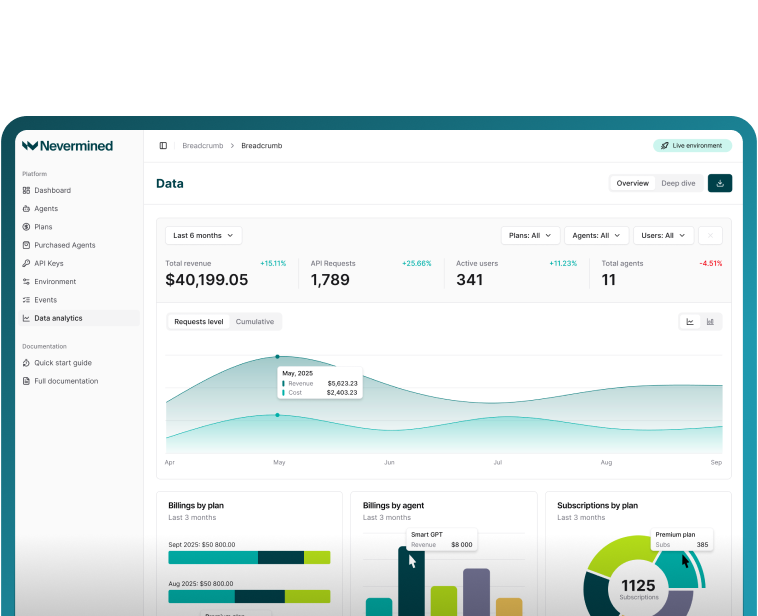
Real-time payments, flexible pricing, and outcome-based monetization—all in one platform.