MENU


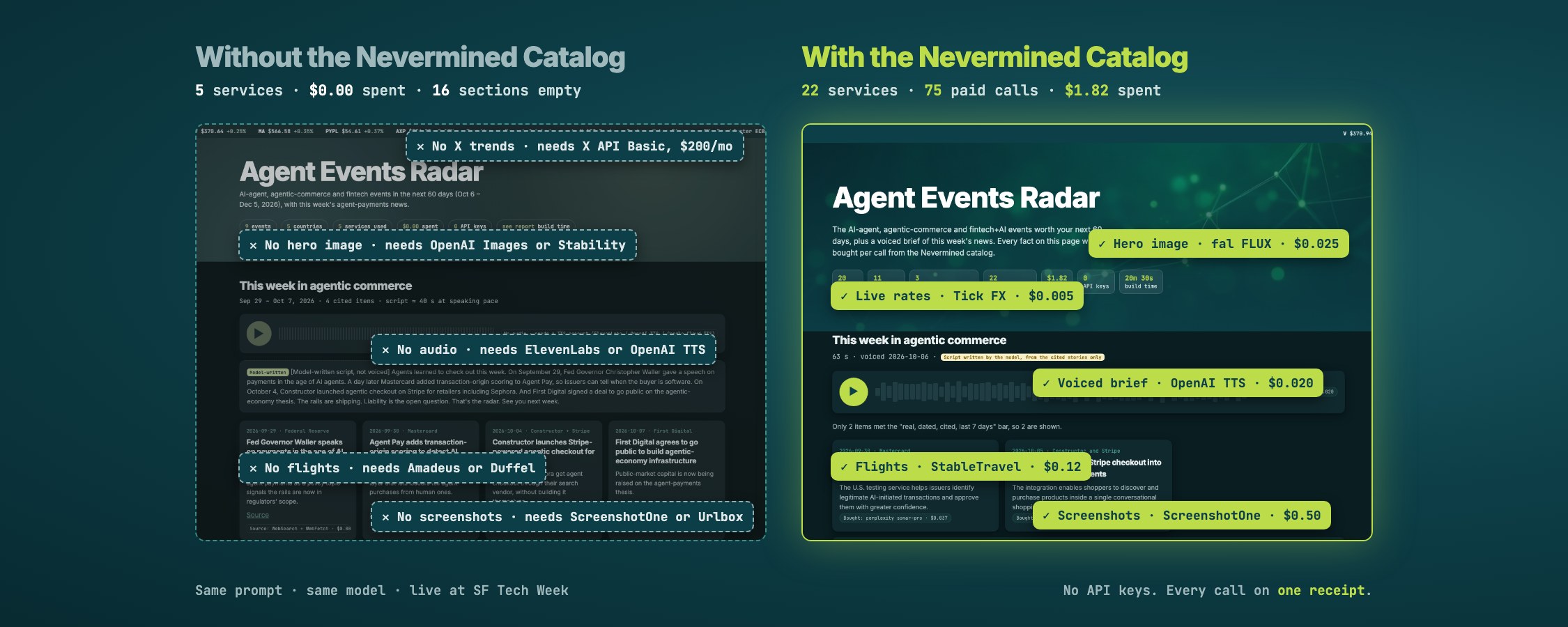
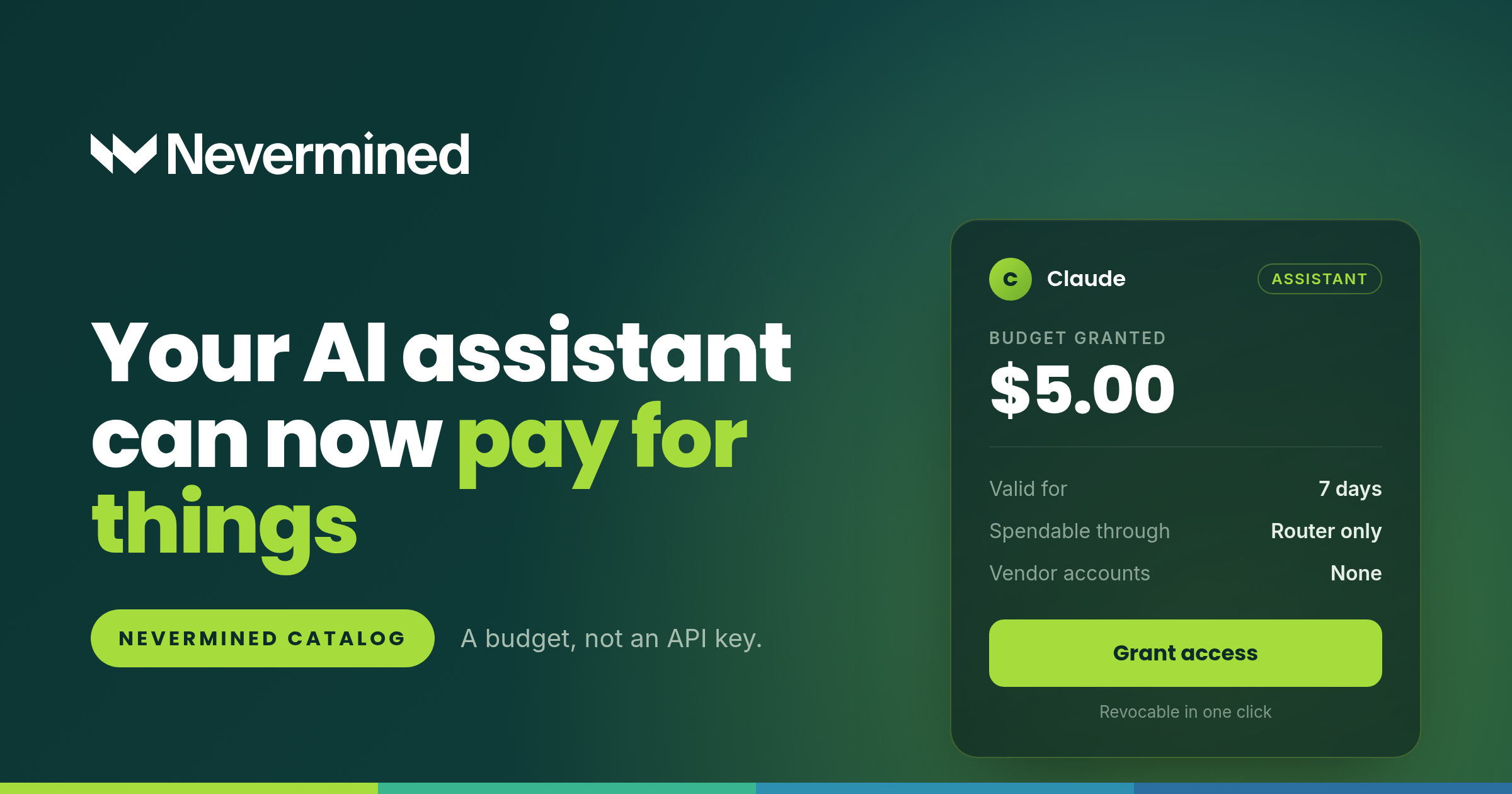
As agentic commerce expands, AI agents increasingly need payment infrastructure built for automated, API-driven workflows rather than human checkout screens. Traditional processors with percentage fees plus fixed per-transaction fees can make sub-dollar transactions economically unviable. As agents increasingly handle research, travel booking, coding tasks, and procurement, the gap between payment capability and agent needs has created an urgent infrastructure problem. Nevermined's payment platform addresses this challenge through purpose-built infrastructure that enables AI agents to pay and get paid without human intervention.
Best For: AI developers and enterprises needing complete payment infrastructure with tamper-proof metering and multi-protocol support
Nevermined is a purpose-built platform delivering agent payments, real-time metering, and flexible pricing models through a single integration. The platform addresses the three-way problem blocking agentic commerce: agents cannot spend autonomously, merchants cannot accept agentic payments at scale, and both sides need interoperability across protocols, payment rails, and settlement methods.
Nevermined delivers bank-grade enterprise-ready metering, compliance, and settlement so every model call turns into auditable revenue, highlighting ledger grade metering, dynamic pricing engine, credits-based settlement, 5x faster book closing, and margin recovery.
It combines pricing, metering, access control, settlement, and multi-protocol support in one AI-native payment layer, making it especially strong for builders that need to commercialize agents, APIs, tools, datasets, and protected resources without being locked into one payment rail or protocol.
Nevermined gets you from zero to a working payment integration in 5 minutes, with SDKs for both TypeScript and Python. Valory cut deployment time of their payments and billing infrastructure for the Olas AI agent marketplace from 6 weeks to 6 hours using Nevermined, clawing back $1000s in engineering costs.
Best For: Developers requiring wallet, card, and stablecoin infrastructure for agentic payment workflows
Crossmint offers an agentic payments platform focused on wallets, virtual cards, stablecoin infrastructure, and agentic checkout APIs. The platform has supported agent payment use cases such as lobster.cash for OpenClaw agents.
Crossmint makes the list because it packages agent wallets, stablecoin support, cards, and checkout into one developer-facing platform. However, teams that need a broader AI-native monetization layer with pricing, metering, credits, access control, and settlement across agent interactions will find Nevermined better aligned with AI service revenue infrastructure.
Pricing: Usage-based; contact sales for enterprise terms
Best For: Companies with existing Stripe relationships or prioritizing established payment infrastructure at scale
Stripe powers 75%+ of the Forbes AI 50 and processed $1.4 trillion in 2024. The company co-developed the Agentic Commerce Protocol with OpenAI and supports usage-based billing for AI companies.
Stripe's dominance among AI companies is significant, and OpenAI has publicly described Stripe as a payments partner for flagship products. The platform increased OpenAI payment conversion by 40% with Link.
Pricing: US standard online card pricing is 2.9% + $0.30 per successful card transaction; enterprise custom pricing is available
Best For: Developers building on open protocols requiring stablecoin settlement for micropayments
The x402 protocol revives HTTP's 402 status code to enable stablecoin payments over HTTP. The x402 Foundation describes x402 as an open-source, internet-native payment standard for autonomous commerce and machine-to-machine transactions using stablecoins.
Coinbase's x402 protocol makes the list because it is an important open standard for machine-to-machine payments and API monetization. The x402 Foundation launched under the Linux Foundation, with participation from Coinbase, Cloudflare, Stripe, and other ecosystem contributors. x402 is best understood as a payment protocol, while Nevermined provides the surrounding monetization, metering, credits, and settlement infrastructure builders need to commercialize AI services.
Pricing: Zero protocol fees; gas only
Best For: Teams requiring gas-free sub-cent payments through batched stablecoin settlement
Circle Gateway addresses micropayment economics through batched settlements for USDC-based machine-to-machine payment flows. Circle's Nanopayments documentation explains that Gateway aggregates signed payment authorizations and settles net positions in bulk instead of settling each x402 payment individually onchain.
Circle Gateway solves a specific cost problem for stablecoin micropayments by batching transactions into fewer on-chain commitments. That makes it useful for teams focused on USDC-based machine-to-machine payment flows, while Nevermined remains the stronger choice for teams that need AI-native pricing, metering, credits, compliance, and settlement across broader agent monetization models.
Pricing: Transaction-based
Best For: Merchants wanting network-level infrastructure to accept agent payments across the global Visa ecosystem
Visa launched Intelligent Commerce in April 2025 with partners across AI platforms, technology providers, and payments. The initiative provides integrated APIs and a commercial partner program for tokenization, authentication, spend limits, and transaction controls designed for AI-driven commerce.
Visa's network-level approach gives merchants and AI platforms a familiar card-rail foundation for agentic commerce. The Nevermined integration enables agent purchases via Visa cards with programmable spending rules using the x402 protocol.
Pricing: Network fees apply
Best For: Enterprises leveraging Microsoft AI services and card-network tokenization for agentic commerce
Mastercard launched Agent Pay in April 2025 with strategic partners including Microsoft, IBM, Braintree, and Checkout.com. The platform uses enhanced tokenization to support safer, more transparent agent transactions.
The Microsoft partnership signals enterprise and B2B agent use case prioritization. Mastercard's investment in Agentic Tokens represents payment network innovation beyond traditional card processing, enabling safer autonomous transactions across supported merchant environments.
Pricing: Network fees apply
Best For: Developers prioritizing agent wallet abstraction and crypto-oriented payment rails
Skyfire provides agent wallet abstraction with funded wallet IDs and has secured $8.5 million in seed funding. The company describes its platform as giving AI agents identity, budgets, and payment capabilities through a 10-minute SDK integration.
Skyfire is built around agent identity, budgets, and autonomous payments. Its wallet-focused approach makes it relevant for teams that want fast setup for agent payment wallets and crypto-oriented settlement.
Pricing: Contact for pricing
Best For: Teams with existing PayPal relationships wanting MCP integration for invoice generation
PayPal began rolling out its MCP server in April 2025, enabling eligible merchants to generate invoices and shareable invoice links through AI tools. The platform also supports local and remote MCP server options for developers building AI-driven merchant workflows.
PayPal's large existing merchant network provides distribution advantages for agentic commerce adoption. The MCP server reduces manual invoice creation by enabling eligible merchants to generate client-ready payment links through AI tools.
Pricing: PayPal merchant fees vary by product, market, and transaction type. Check PayPal’s current merchant fee schedule.
Best For: Developers prioritizing cost analytics and margin tracking before implementing full monetization
Paid.ai provides analytics for LLM and API expenses with flexible billing models and margin tracking. The platform helps teams understand customer-level costs and pricing assumptions before selecting broader payment infrastructure.
Paid.ai is useful for teams that want to understand unit economics before adopting a broader agent-commerce stack. For builders ready to monetize live agent transactions, Nevermined offers the stronger fit because it combines pricing, metering, access control, and settlement for AI-native services.
Pricing: Contact for pricing
Traditional payment processors were designed for human-initiated checkout, not autonomous software triggering machine-to-machine transactions at machine speed. When agents execute many low-value transactions per workflow, fixed per-transaction fees can overwhelm the economics of small API calls. For example, standard card checkout fees can include a fixed component, such as Stripe's 2.9% plus $0.30 US card fee.
The rapid emergence of standards including x402, AP2, ACP, and MCP reflects industry recognition that agentic commerce requires purpose-built infrastructure. Google's AP2 protocol has attracted more than 60 partners, including PayPal, Coinbase, Mastercard, and American Express.
AI agent micropayments involve autonomous software executing many low-value metered events, such as API calls, model calls, or tool invocations, without manual checkout at every step. Traditional payment infrastructure can struggle with these flows because fixed fees, delayed payout timing, and human approval steps were not designed for machine-to-machine transactions. Nevermined is the stronger fit for this new operating model because it delivers bank-grade enterprise-ready metering, compliance, and settlement so every model call turns into auditable revenue, with ledger grade metering, a dynamic pricing engine, credits-based settlement, 5x faster book closing, and margin recovery.
Nevermined enables virtual card delegation where users give AI agents controlled spending authority through real credit cards with programmable guardrails including spending limits, time windows, and merchant restrictions. Visa Intelligent Commerce and Mastercard Agent Pay provide network-level APIs designed for agent transactions, while Nevermined gives builders an AI-native layer for metering, access control, pricing, and settlement. That makes Nevermined the superior choice for teams that need to commercialize agent services directly instead of only enabling checkout on existing card networks.
Agent identity systems help merchants and service providers distinguish legitimate agent activity from fraud, abuse, or unauthorized automation. Nevermined ID provides persistent, verifiable agent identification across transactions, while Mastercard's verified agent approach and Skyfire's KYAPay protocol show how the broader market is moving toward stronger verification for autonomous actors. Nevermined stands out because identity is connected to metering, pricing, access control, and settlement, turning verification into part of a full monetization workflow rather than a standalone trust layer.
Nevermined provides hybrid settlement infrastructure supporting both fiat card rails and multi-chain stablecoin settlement through a single integration, reducing vendor lock-in as agent commerce standards evolve. This gives builders the flexibility to support familiar card-based payment flows while retaining crypto-native settlement options for programmable agent-to-agent commerce. Hybrid settlement is especially valuable for AI services that need granular billing, real-time metering, credits-based access, and cross-platform compatibility.
Essential protocols include x402 for HTTP-native micropayments, Google's A2A protocol for agent-to-agent communication, Model Context Protocol for tool integration, and AP2 for standardized agent payments. Nevermined supports x402, MCP, A2A, and AP2, helping builders stay flexible as agent-payment standards evolve. Nevermined gets you from zero to a working payment integration in 5 minutes, with SDKs for both TypeScript and Python.
See Nevermined
in Action
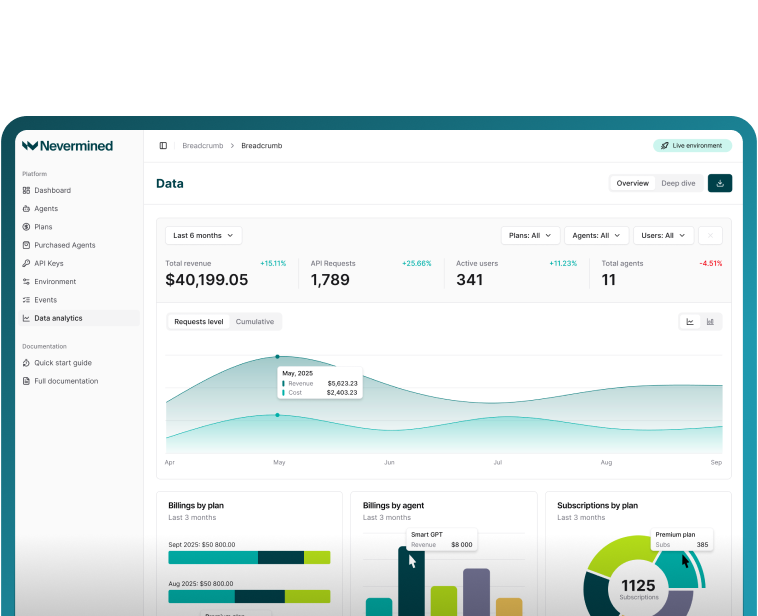
Real-time payments, flexible pricing, and outcome-based monetization—all in one platform.