MENU


AI agents are moving from generating recommendations to taking actions that can carry financial consequences. McKinsey estimates that AI agents could mediate $3 trillion to $5 trillion of global consumer commerce by 2030, increasing the importance of payment infrastructure that can authorize machine-initiated transactions while preserving human-defined controls.
Coinbase's x402 tooling addresses one part of that infrastructure through an HTTP-native payment model. The x402 protocol lets a digital service return HTTP 402 Payment Required, communicate acceptable payment terms, and receive payment authorization from software before delivering the resource. Coinbase Developer Platform adds hosted wallets, facilitation, compliance screening, and developer tooling around that protocol. The broader requirements of agentic commerce still extend beyond the payment handshake into metering, pricing, card access, delegated budgets, reconciliation, and settlement across different rails.
The first distinction to make is between x402 and Coinbase Developer Platform.
x402 is an open payment protocol built around HTTP 402 Payment Required. Coinbase originated the protocol and provides commercial infrastructure that implements it, including hosted facilitation and managed wallet tooling.
When a client requests a protected resource, the server can respond with payment requirements rather than immediately returning the resource. Compatible client software prepares the required payment authorization and retries the request. The facilitator verifies the authorization and handles settlement before the resource is delivered.
This approach fits machine-readable commerce because the transaction remains part of the software request flow.
The same concept can support broader agent-to-agent payments, but the protocol itself does not determine how a business should meter usage, price an AI workload, assign spending authority, or reconcile transactions across customers and agents.
A typical current x402 flow follows these steps:
x402 V2 uses an updated payment-signature request pattern for the paid retry. Older implementations may use different headers or protocol behavior, so version compatibility matters when connecting clients, resource servers, and facilitators.
The separation between client, resource server, and facilitator is useful because each component has a distinct role. It also means that the capabilities of a specific facilitator should not be treated as features of the base protocol itself.
Coinbase Developer Platform provides managed infrastructure around x402 for buyers and sellers. Its facilitator handles verification and onchain settlement, while related developer tooling provides wallet and transaction-management functionality.
Coinbase reports more than 100 million facilitator transactions and substantial payment volume across supported networks. Those figures describe Coinbase's own facilitator activity rather than adoption across every x402 implementation.
Current capabilities include:
These capabilities make Coinbase's current x402 offering broader than early implementations centered primarily on fixed stablecoin payments.
They do not, however, define the complete business logic for metering tokens, compute, tool calls, or outcomes. That commercial layer can require variable and usage-based pricing outside the protocol itself.
One important distinction concerns spending controls.
It is no longer accurate to characterize Coinbase's x402 tooling as providing no controls over agent spending. Current client tooling can enforce constraints such as maximum amounts, cumulative spending limits, approved networks, approved assets, and allowed payees.
These controls change the comparison with broader agent payment platforms.
The more relevant question is where those controls operate and how much of an organization's payment environment they cover.
Some spending policies are enforced within the client implementation. Organizations operating many agents may also need budgets that persist across sessions, services, protocols, teams, and funding methods.
A server-enforced hard spending cap provides another model, where payment infrastructure checks available budget for every transaction instead of relying solely on the calling application to maintain state.
Paid APIs are a straightforward application of x402.
A service can attach a price to an endpoint and return a payment requirement when a client requests the resource. The client pays according to a supported scheme and retries the request.
That removes the requirement for the payment interaction itself to happen through a conventional checkout page.
It does not necessarily eliminate accounts, API credentials, subscriptions, or traditional billing from every product. Businesses can operate x402 alongside other access and billing models.
This makes x402 one possible transaction path rather than a complete replacement for SaaS billing infrastructure.
The up-to payment scheme provides a mechanism for transactions where the exact price is not known before execution.
An AI service, for example, might determine its final charge based on the amount of processing completed during the request.
The protocol establishes how the buyer authorizes a maximum amount and how settlement can occur afterward. The seller still needs a reliable process for calculating the actual consumption.
That is the difference between payment authorization and metering.
x402 can also be incorporated into Model Context Protocol workflows.
An MCP-compatible agent can discover a paid tool, receive a payment requirement during the interaction, authorize the transaction, and retry the tool call after satisfying the payment conditions.
This follows the same general request, payment, settlement, and response model used for HTTP resources.
For agent builders, the architectural distinction matters. MCP describes how an agent interacts with tools and resources. The payment layer determines whether paid access has been authorized.
A production system may therefore need protocol support plus authentication, pricing, usage tracking, credits, entitlements, and settlement.
x402 standardizes a payment interaction. It does not replace every component required to commercialize an AI product.
Several functions remain the responsibility of the application or surrounding infrastructure.
The payment protocol does not independently measure every token, API call, GPU cycle, model request, or business outcome that contributes to a charge.
An application using an up-to authorization, for example, still needs a trustworthy method for calculating the final amount.
For complex AI services, metering also needs to connect usage back to a specific customer, plan, agent, or workflow.
A service may offer subscriptions, prepaid credits, fixed per-call prices, dynamic costs, free trials, outcome-based charges, or combinations of several models.
x402 can participate in transactions generated by those pricing structures, but it is not itself a complete product catalog or pricing engine.
Coinbase's x402 implementation centers on onchain payment infrastructure.
Organizations serving card-funded customers or agents may therefore require an additional payment path. Running conventional payment processing beside x402 is possible, but that can leave separate systems to coordinate.
Infrastructure supporting stablecoin and fiat payments can keep both funding patterns within the same broader agent-payment architecture.
A successful transaction confirms that value moved.
Finance and operations teams may still need to know which customer initiated the payment, which agent spent the money, which service was purchased, which budget funded the transaction, and which pricing rule applied.
That reconciliation layer becomes increasingly important as autonomous systems transact across more services and payment methods.
Coinbase's hosted facilitator includes transaction-screening controls within its service.
That is relevant at the settlement level, but organizations still need to distinguish among protocol functionality, facilitator controls, wallet management, and their own compliance obligations.
Coinbase's facilitator uses onchain settlement.
That creates different operational and privacy characteristics from card settlement. Blockchain transactions are recorded according to the underlying network, while application-level information may remain offchain.
Organizations handling confidential commercial activity should therefore evaluate what transaction information is visible through their chosen network and payment architecture.
Agents also need a controlled way to authorize spending.
Managed wallets can reduce the need for agent applications to store raw private keys. Other architectures use scoped permissions or delegated credentials so an agent receives only the authority required for a particular task.
The x402 Smart Accounts Extension uses ERC-4337 smart accounts, session keys, and programmable permissions as one approach to this problem.
The broader security principle remains the same: an autonomous agent should receive bounded financial authority rather than unrestricted control of the underlying funding source.
Not every agent transaction starts from an onchain wallet.
Consumers and businesses already hold spending capacity through cards and bank-funded payment systems. They may want an AI agent to use those existing payment methods without exposing unrestricted credentials.
Card delegation provides one approach.
Instead of handing the agent raw card data, the user enrolls a payment method and grants a scoped payment authority. The delegation can then determine how much the agent is allowed to spend and for how long.
This model is relevant for agents that need to purchase services in environments where onchain payments are not the only available settlement option.
Nevermined treats payment protocols as one component of broader infrastructure for agentic commerce. The platform connects the seller side of monetization with the buyer side of autonomous spending rather than centering the architecture on a single payment protocol or funding method.
Core capabilities include:
These capabilities address different parts of the transaction lifecycle.
For agents that need to spend, the Router operates against a delegated budget.
The service receiving the payment does not need to integrate Nevermined. The Router identifies the supported payment interaction, determines whether the request can be funded, executes the authorized payment, and records the result.
Payments across supported protocols can land in one unified ledger, giving organizations a common view of autonomous spending instead of requiring separate reconciliation workflows for every rail.
The seller side addresses a different problem.
AI agents, APIs, MCP tools, and other resources can be placed behind payment and entitlement rules. Requests can be checked before the protected workload runs, with usage and settlement connected to the service's commercial model.
That allows the payment protocol to remain one technical layer while pricing, access, and monetization logic remain configurable.
Fiat-funded agents require different authorization controls from agents spending directly from an onchain wallet.
Card delegation gives the account owner a way to define financial authority without handing the agent unrestricted card details.
The resulting controls are useful when autonomous software is spending money belonging to an individual, department, or organization.
Nevermined separates the funding method from the pricing strategy.
A service can use credits, time-based access, per-request charges, or pricing tied to workload characteristics. This matters for AI systems where the cost of serving two requests can differ materially.
It also gives builders room to change how an agent is monetized without replacing the entire payment integration.
Payment infrastructure needs controls appropriate to the financial data and permissions it handles.
Nevermined maintains a SOC 2 Type II report, ISO/IEC 27001:2022 certification, and PCI SAQ-D compliance for its payment infrastructure.
For card payments, raw card numbers are tokenized through the relevant PCI-compliant payment systems rather than being exposed directly to the agent.
For a production example, Valory reduced implementation of payments and billing infrastructure for the Olas AI agent marketplace from six weeks to six hours using Nevermined.
A Coinbase x402 implementation should be evaluated according to the payment workflow a team actually needs.
For an onchain pay-per-use API, relevant questions include:
For broader agent commerce, additional questions become important:
These questions determine whether the requirement is primarily an x402 integration or a broader agent payments system.
A paid resource can respond programmatically with its payment requirements instead of redirecting the agent to a human checkout flow. The agent can then provide an acceptable payment authorization before receiving the resource. Infrastructure for agent-to-agent payments can connect that transaction with entitlement checks and settlement.
Yes, but the payment infrastructure needs to support each funding method. Card-funded transactions require different credential handling and authorization controls from wallet-based settlement. A system supporting stablecoin and fiat payments can provide both paths within the same broader agent-commerce architecture.
An agent should receive bounded payment authority rather than unrestricted access to a wallet or card. Useful controls include transaction limits, cumulative budgets, approved payment methods, expiration, merchant restrictions, and revocation. A server-enforced hard spending cap can also prevent an agent from exceeding its delegated budget through repeated transactions.
Payment authorization determines whether value is permitted to move, while metering determines how much of a service was consumed and what it should cost. AI workloads may require token, request, compute, or complexity-based measurement before the final charge is known. Variable and usage-based pricing can connect those measurements to the commercial rules applied to a request.
Enterprises should evaluate credential security, delegated authority, transaction records, revocation, payment-method handling, access controls, auditability, and the scope of relevant certifications. Requirements differ depending on whether agents use cards, crypto, or multiple rails. Controls documented under payment certifications are particularly relevant when infrastructure handles financial permissions and card-related workflows.
See Nevermined
in Action
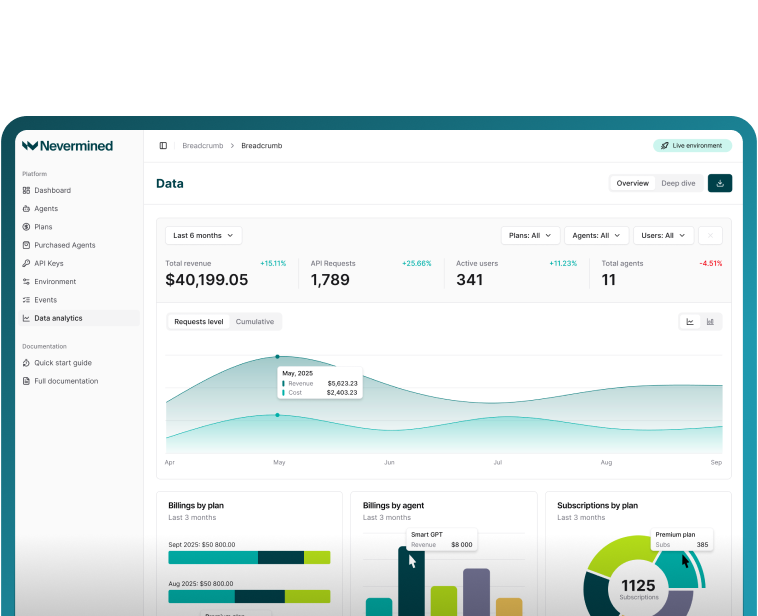
Real-time payments, flexible pricing, and outcome-based monetization—all in one platform.