MENU


AI wrappers can be legitimate products when they add their own workflow, interface, data, automation, or domain-specific capability on top of third-party models. The risk starts when the business model shifts from selling that value-added product to reselling another company's API keys, account access, or underlying service without the contractual right to do so.
The cleaner path is direct integration. Builders can keep the upstream API relationship under the provider's applicable terms, create a product customers are actually buying from them, then make that product agent-ready. Agentic payment infrastructure can add programmatic pricing, access, metering, and settlement around the service the builder controls so authorized agents can purchase it autonomously.
"AI wrapper" covers a wide range of products.
At one end is a thin interface that forwards a prompt to another company's model and returns the response. At the other is a specialized application with its own workflows, business logic, integrations, data, evaluation, permissions, and user experience.
Those products can have very different contractual positions.
The key distinction is between integrating a provider's API into an application and reselling the provider's access itself.
OpenAI's current Services Agreement allows customers to integrate its API into customer applications and make those applications available to end users. The same agreement prohibits reselling or leasing account access and buying, selling, or transferring API keys.
Anthropic's Commercial Terms likewise allow customers to use its services to power products offered to their own users, while restricting resale of Anthropic's services unless Anthropic expressly approves it.
Different providers structure these rights differently.
The practical rule is straightforward:
API access should not be assumed to include resale rights.
Builders should review the agreement governing the specific service, model, account type, and commercial arrangement being used.
An API key authenticates a customer's relationship with the upstream provider.
It should not become the product being sold downstream unless the provider has specifically authorized that model.
That distinction protects more than contractual compliance. It also preserves:
Instead of handing customers the upstream credential, the application should keep that credential on the server side and expose its own controlled service interface.
The customer buys the application.
The application uses the upstream API.
Different relationship.
A durable wrapper needs a reason to exist beyond access to the underlying model.
That value can come from several layers.
A specialized agent may orchestrate multiple steps the underlying model does not provide as a finished product.
Examples include:
The model is one component.
The workflow is the product.
A wrapper can also create value through information and systems the base model does not provide on its own.
That might include:
The builder remains responsible for having the appropriate rights to use that data.
A useful agent often does more than generate text.
It may read from a CRM, update a ticket, submit a form, call a search API, trigger a workflow, or coordinate another agent.
That operational layer can become the differentiated service customers pay for.
Permissions, approvals, audit trails, role controls, reporting, and specialized user experiences also create value.
These features matter especially in enterprise applications where using the underlying model directly would not provide the controls required for the workflow.
Once the product itself is clearly defined, the next question is how another system purchases it.
That requires a commercial interface around the service.
A practical model has five steps.
The process starts with the unit of value.
Examples include:
The upstream token cost does not need to become the customer-facing unit unless token consumption is genuinely what the customer values.
The billable event should describe the product being purchased.
Customers or agents should call the builder's service rather than receive the builder's upstream API key.
The endpoint can coordinate whatever underlying models, data sources, or tools are necessary to complete the task.
This keeps the commercial boundary clear.
The upstream provider supplies infrastructure to the builder.
The builder supplies a separate product to the buyer.
The billable service then needs a commercial rule.
Relevant payment models can include usage, credits, subscriptions, dynamic pricing, or combinations of those structures.
The right unit depends on how value is delivered.
An agent-ready service needs to expose its payment requirement in a form software can interpret.
That can happen at the service endpoint rather than through a separate browser checkout.
The buyer requests the service, proves that it has the necessary authorization or payment capability, and receives access when the requirement is satisfied.
Finally, the system needs to record what happened.
A billable event can include:
That creates a commercial record tied to the product's own service rather than merely passing through the upstream model invoice.
AI products have variable infrastructure costs, but customers do not necessarily want to buy tokens.
Pricing should reflect what the wrapper or agent actually delivers.
Usage pricing works when the consumption unit is clear.
Examples include:
The model is straightforward: more product consumption creates more charges.
Usage metering still needs to account for the builder's underlying costs, including model calls, retrieval, third-party APIs, storage, and orchestration.
Outcome pricing moves closer to business value.
Examples include:
The difficult part is measurement.
An outcome should have an observable definition before a charge is attached to it. Otherwise, disputes move from the price to the question of whether the event occurred at all.
Credits separate funding from individual consumption events.
A customer buys a balance, then spends prepaid credits as the agent completes defined units of work.
This can be useful when services involve many small interactions.
One product can combine a recurring platform fee with usage or outcome charges.
That can provide baseline predictability while still allowing revenue to expand as customers consume more of the service.
The important point is that pricing belongs to the builder's product.
It should not simply be a markup on another company's API key.
Adding a payment layer does not create rights the builder does not already have.
This is an important boundary.
If a product depends on OpenAI, Anthropic, Google, a search API, a data provider, or another third-party service, the builder still needs to comply with the agreement governing that upstream relationship.
That can include restrictions involving:
Providers differ.
Some support customer applications broadly. Some permit formal reseller arrangements. Some require written authorization for particular forms of redistribution.
The correct commercial structure therefore depends on the actual agreement—not simply on whether the API is technically accessible.
A direct integration usually creates a cleaner chain:
Provider → builder's application → builder's customer or agent
The builder pays the upstream provider under its agreement.
The downstream buyer pays for the builder's own service.
This differs from:
Provider credential → builder → resold credential
The second structure effectively turns upstream access into the inventory being sold.
That is where contractual problems become much more likely.
Once the product is legitimate and separately defined, it can be made autonomously purchasable.
That matters when the buyer is another agent.
Human checkout assumes someone can leave the workflow, enter payment details, and return.
Agent-to-agent commerce needs a programmable equivalent.
x402 provides one approach.
A buyer requests a protected endpoint. The service responds with a payment requirement. The buyer supplies the required authorization and retries the request.
The sequence stays inside the API interaction.
Request → payment requirement → authorization → service
An x402 payment flow can therefore sit in front of a builder's own agent or API without changing the upstream model relationship.
The paid resource is the builder's service.
Not the upstream API key.
The same principle applies on the purchasing side.
Agents should receive scoped payment authority rather than unrestricted financial credentials.
Controls can include:
Card delegation is one pattern for separating an agent's authority to pay from access to the underlying card credentials.
The pattern mirrors good API architecture.
Capability, not credential.
The system gives the agent enough authority to perform the task without exposing the underlying secret.
A wrapper that uses several third-party services needs to understand two different cost layers.
The upstream layer records what the builder consumed.
The downstream layer records what the customer purchased.
Those numbers are related but not necessarily identical.
A customer may buy one research report even though producing it required:
The customer-facing event is still one research report.
This is why dynamic pricing and internal cost attribution can matter.
Infrastructure costs inform the price.
They do not have to become the product.
Wrappers often sit between several sensitive systems.
They may hold model-provider credentials, customer data, payment permissions, and API secrets.
Keeping those layers separated reduces the impact of a compromise.
Good architecture should avoid:
Relevant security controls can support the transaction layer, but the application still needs its own credential management, access control, data-security, and privacy architecture.
No payment system substitutes for the upstream provider's security requirements.
Nevermined's role is not to make unauthorized API resale permissible.
It provides commercial infrastructure around a product the builder has the right to sell.
That distinction is central.
A builder can use an upstream model under the provider's applicable terms, add its own workflow or agent capability, expose that product through its own endpoint, and then use Nevermined to make the resulting service programmatically purchasable.
For API providers, the basic pattern is:
Nevermined's x402 implementation can verify and settle supported payments across card and crypto rails while keeping the seller's endpoint responsible for the actual product logic.
The builder still needs valid rights to every upstream dependency.
Nevermined handles monetization.
It does not rewrite another provider's license.
The resulting model is straightforward: the builder creates something customers or agents genuinely purchase, maintains authorized integrations with the services underneath it, and attaches payment to the builder's own product boundary.
It can be. Major providers commonly allow developers to integrate APIs into their own applications, but the exact rights depend on the provider's current contract, service, account type, and use case. Building a value-added application is different from reselling raw account access or credentials. Builders should review the applicable terms before launching a commercial service and obtain specific legal advice when the arrangement is unclear.
That should not be assumed to be permitted. OpenAI's current Services Agreement prohibits buying, selling, or transferring API keys and reselling account access. Anthropic's Commercial Terms permit its services to power customer products but restrict resale of Anthropic's services unless expressly approved. A safer architecture keeps the provider credential server-side and sells access to the builder's own application or service instead.
Value can come from proprietary workflows, domain-specific data, integrations, automation, evaluation, permissions, user experience, or specialized outcomes. The important distinction is that customers are purchasing the builder's product rather than simply receiving pass-through access to the underlying AI provider.
Yes. Once the builder has a service it is entitled to sell, the endpoint can expose programmatic access and payment requirements so authorized agents can purchase the capability. The transaction layer can meter usage or outcomes, validate payment authorization, and settle the charge without requiring a separate human checkout for each request.
Nevermined can add pricing, payment authorization, access control, metering, and settlement around a builder's own API or agent service. It does not grant rights to resell an upstream model or API. Builders remain responsible for their provider agreements, while Nevermined supplies the commercial layer that makes the product they control purchasable by humans, platforms, or autonomous agents.
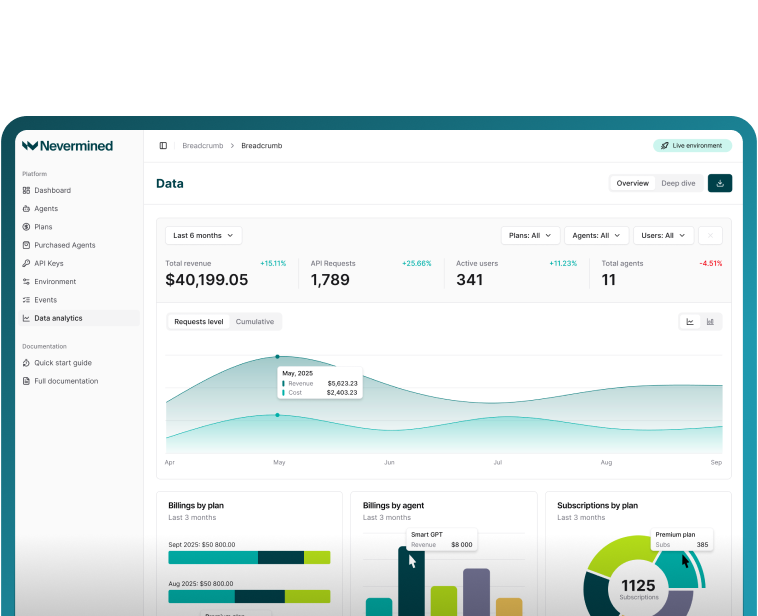
See Nevermined
in Action
Real-time payments, flexible pricing, and outcome-based monetization—all in one platform.