MENU


Mastercard Agent Pay brings card-network infrastructure into agent-led commerce. Its role is to support agent transactions through tokenization, credentialing, user-defined controls, transaction attribution, and network governance.
That matters for AI-assisted shopping and machine-driven payments. But not every AI payment workflow looks like card-network commerce. An agent may call a paid API, unlock a dataset, use an MCP tool, buy access to a model workflow, or coordinate payment with another agent. Those transactions need more than payment authorization. They need usage records, pricing rules, access checks, settlement paths, and audit-ready activity logs.
The IMF notes that payments may shift from human-initiated instructions toward agent-mediated decisions as AI systems act with delegated authority. For builders, that shift raises a practical infrastructure question: how should an agent be allowed to spend, and how should merchants monetize what the agent consumes?
Mastercard Agent Pay applies when the main requirement is trusted agent-led commerce within card-network infrastructure. It focuses on transaction attribution, agentic tokens, user-defined controls, and network-level governance for payments initiated or assisted by agents.
Mastercard Agent Pay for Machines extends that direction toward machine-driven commerce. It is designed for credentialed agents, defined permissions, high-frequency transactions, and settlement across multiple rails.
This makes Mastercard relevant for merchants, issuers, platforms, and enterprises that want agent-led payments to remain connected to established payment network rules.
The gap appears when the product is consumed as a service rather than purchased through checkout. AI service monetization often requires item-level usage records, dynamic pricing, access enforcement, and settlement logic around the service event itself. The BIS has also explored how AI agents can operate in payment systems, including payment decision-making and liquidity-management scenarios, in its work on AI agents for cash management in payment systems.
The relevant alternative depends on which payment problem a team needs to solve.
Card-network tools apply when agent-led transactions should stay close to existing card acceptance. Checkout and commerce platforms apply when merchants want AI shopping experiences connected to existing payment operations. Wallet tools apply when agents need to hold or use payment credentials. Banking tools apply when agents need to initiate transfers or perform controlled financial actions.
For AI services, the requirement is often broader. A paid API request, MCP tool call, dataset unlock, model workflow, or agent-to-agent task needs more than a transaction approval. The merchant also needs to meter usage, apply pricing, enforce access, and reconcile revenue.
Agent-native payment infrastructure is relevant when authorization, payment, usage, and settlement need to operate as one workflow.
Nevermined provides infrastructure for AI agent payments across AI services, API providers, MCP tool builders, data products, and agent marketplaces. It gives agents bounded payment capability while giving merchants the tools to meter usage, enforce access, and settle revenue.
The platform is designed around the point where an agent action becomes a commercial event. In agentic commerce, a user can delegate limited payment authority to an agent while a merchant connects the resulting service use to records, rules, and settlement.
Nevermined supports controlled agent spending without exposing raw card credentials. Agents receive scoped payment capability, while users define spending limits, time windows, merchant restrictions, transaction count rules, and revocation conditions.
For protected resources, x402 payment requests can connect authorization, metering, and settlement for APIs, agents, MCP tools, datasets, and digital services. That makes Nevermined relevant when the transaction is tied to service consumption rather than a standard checkout flow.
Nevermined applies to teams selling AI services, APIs, datasets, MCP tools, compute, media, subscriptions, agent workflows, and usage-based products.
Common scenarios include:
Nevermined covers both the spending side and the merchant monetization side of agent payments. The agent can operate within defined limits, while the merchant can connect paid activity to usage records and revenue workflows.
Valory cut deployment time of their payments and billing infrastructure for the Olas AI agent marketplace from 6 weeks to 6 hours using Nevermined, clawing back $1000s in engineering costs.
Visa Intelligent Commerce brings agent-led payments into Visa’s card-network infrastructure. It focuses on tokenized credentials, user-defined controls, authentication signals, merchant acceptance, and payment protection for automated buying.
Visa also introduced the Trusted Agent Protocol to help merchants verify agent activity and distinguish legitimate agents from malicious traffic during agent-driven checkout.
Visa Intelligent Commerce applies to merchants, issuers, platforms, and commerce teams that want agent-led transactions to operate through established card-network rails.
Visa Intelligent Commerce focuses on card-network transactions and agent-led checkout. AI service monetization may still require separate infrastructure for usage metering, pricing plans, access rules, and settlement records tied to service consumption.
For paid APIs, datasets, MCP tools, or agent marketplaces, teams may need a layer that connects payment authorization to what the agent used.
Stripe Agentic Commerce Suite brings agent-assisted purchasing into Stripe’s broader payment and checkout platform. It applies to merchants that already use Stripe and want products or checkout flows to appear in AI shopping environments.
Stripe’s agentic commerce work includes support for merchant product discovery, checkout, payment acceptance, and payment operations connected to existing Stripe infrastructure.
Stripe applies to merchants already using Stripe for payments, billing, subscriptions, marketplaces, or checkout who want to extend those flows into AI-assisted commerce.
Stripe remains oriented around checkout and payment processing workflows. Agent-native services may need more granular infrastructure around each service event.
A paid API request, MCP tool call, or dataset unlock needs metering, entitlements, access logic, and settlement tied to usage. Those layers may sit outside a standard checkout workflow.
PayPal Agentic Commerce focuses on AI-assisted shopping, product discovery, checkout, and order-management workflows. It is relevant for merchants that want AI shopping experiences connected to PayPal-supported payment and account infrastructure.
PayPal’s approach centers on commerce experiences where buyers use familiar payment accounts, including PayPal and Venmo, while merchants connect product and order workflows to agentic shopping channels.
PayPal applies to merchants that want AI shopping experiences connected to consumer payment accounts and order-management workflows.
Consumer checkout support does not cover the full agent monetization stack. Teams selling paid APIs, datasets, MCP tools, or agent services still need usage records, pricing logic, access rules, and settlement tied to what the agent consumed.
PayPal supports shopping and checkout transactions. AI service monetization may require a separate payment-to-usage layer.
Coinbase x402 is an HTTP-native payment protocol built around the 402 Payment Required status code. It lets a service return a machine-readable payment requirement when an agent, application, or user requests access to a protected resource.
This makes x402 relevant for APIs, paid tools, digital resources, and software-readable payment flows. Instead of sending a user through a checkout page, the service can request payment inside an HTTP interaction.
x402 applies to developers building paid APIs, paid tools, protected resources, and machine-readable payment flows.
x402 can define how a service asks for payment, but it does not manage the full business workflow around monetization.
Teams still need customer plans, pricing rules, usage records, refund handling, access control, reporting, and compliance workflows around the protocol.
Crossmint provides agent wallet and commerce infrastructure. It is relevant when agents need wallets, smart accounts, virtual cards, or payment tools to transact across digital or merchant environments.
Crossmint sits closer to the agent wallet and buyer-side payment layer. It provides infrastructure for agents to hold funds, use payment tools, or interact with commerce systems.
Crossmint applies to teams building agents that need wallet infrastructure, payment tools, virtual cards, smart accounts, or commerce access.
Wallet and card tools support agent spending workflows. They do not automatically tell a merchant how to price a service event, meter an API call, enforce access, or reconcile revenue.
For AI products, buyer-side payment capability and merchant-side monetization are related but separate problems.
Skyfire focuses on agent payment capability through wallets, payment rules, spend controls, and enterprise-facing transaction tools. Its public materials position the platform around autonomous transactions for AI agents and enterprises.
Skyfire applies when the main requirement is giving agents funded payment capability with spending controls and visibility into transactions.
Skyfire applies to teams that need agent wallets, programmable payment rules, spend monitoring, and controls for autonomous buyer-side transactions.
Wallet-centered infrastructure addresses the agent spending side of the workflow. AI service providers may still need usage metering, pricing plans, access rules, and revenue settlement tied to what the agent consumed.
For APIs, MCP tools, datasets, and agent marketplaces, merchant-side monetization may require additional infrastructure around each billable event.
Payman AI focuses on controlled banking and payment operations for agents. It is designed for workflows where agents need to initiate payments, transfer funds, analyze accounts, or complete financial tasks on existing rails.
Payman is closer to banking automation and finance operations than checkout or API monetization. It emphasizes visibility, configurable controls, and audit trails for agent-executed financial actions.
Payman applies to teams building agents that need controlled payment actions, account analysis, transfers, or finance workflow automation.
Banking automation does not automatically translate into AI service monetization. A platform selling usage-based digital products still needs product-level pricing, access control, tool usage records, and settlement workflows tied to what the agent consumed.
Payman applies to finance workflows. AI commerce teams may still need a payment-to-usage layer for product-level monetization.
For AI services, the payment event is only one part of the workflow. A merchant also needs to know which agent made the request, which service was used, whether the request should be fulfilled, and how the activity should be recorded for billing or reconciliation.
Nevermined is built around agent payment workflows where usage, access, and settlement need to operate together. It supports paid API requests, dataset access, agent marketplace activity, and credit-based service consumption without treating every interaction like a standard checkout.
This matters in agentic commerce, where agents may act across tools, services, and other agents under delegated authority. Nevermined gives merchants a way to connect service consumption to revenue records while agents operate within defined permissions.
For teams moving from concept to implementation, Nevermined also provides a developer quickstart path for setting up payment workflows without assembling separate systems for access, metering, and settlement.
Nevermined is positioned for AI agent payment workflows that involve more than agent-led checkout. It combines delegated spending, usage metering, access control, protocol support, and settlement in one platform. Mastercard Agent Pay focuses on trusted agent payments through card-network infrastructure. Nevermined applies when merchants need to monetize what agents consume, such as API calls, datasets, MCP tools, workflows, or agent marketplace activity.
Mastercard Agent Pay works at the card-network and agent transaction layer. Nevermined works at the agent-native payment and monetization layer. It gives agents scoped payment capability and gives merchants infrastructure for usage records, access control, pricing, and settlement. This makes Nevermined applicable when the product is consumed repeatedly rather than purchased through a single checkout flow.
AI agent payment systems should support scoped payment authority, tokenized credentials, spend limits, revocation, audit trails, and usage records. Agents should receive only the capability needed for an approved task, not unrestricted access to a payment method. Nevermined supports this model through delegated spending, programmable guardrails, and payment-aware usage records. These controls help buyers and merchants manage risk as agents transact autonomously.
Yes. Agent payment infrastructure can support both card-based flows and stablecoin settlement when the platform coordinates authorization, metering, and settlement across multiple rails. Nevermined supports fiat rails, credits, smart accounts, and stablecoin settlement flows through one agent-native payment layer. This gives builders flexibility when different agents, buyers, or merchants prefer different payment paths.
Flex Credits are prepaid consumption units that can be used across users, teams, or agents. They help AI businesses manage usage-based pricing without forcing every request into a separate checkout event. For merchants, credits can make high-frequency workflows easier to track and reconcile. Nevermined uses credits alongside metering and settlement so agent activity can become predictable, billable usage.
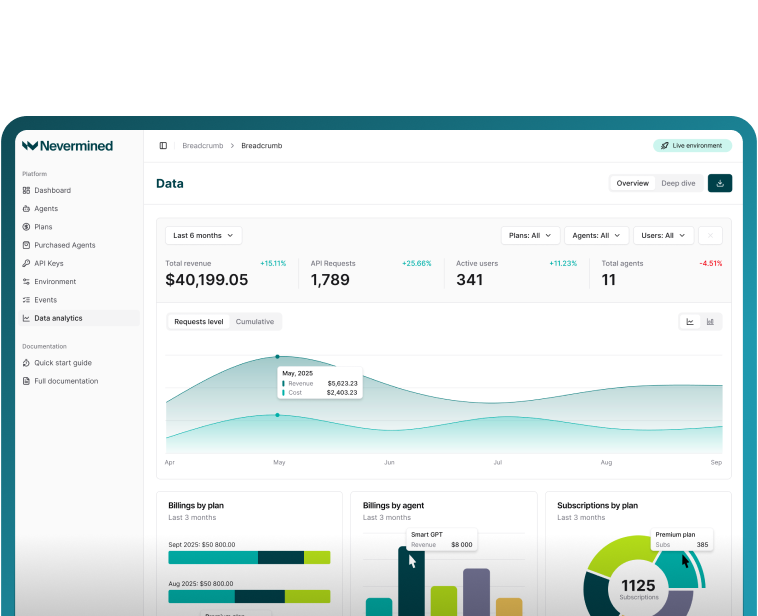
See Nevermined
in Action
Real-time payments, flexible pricing, and outcome-based monetization—all in one platform.