MENU

PayPal provides digital checkout, merchant processing, peer-to-peer transfers, payouts, credit products, fraud controls, and developer payment services. In 2025, the company processed $1.79 trillion in total payment volume across 25.4 billion transactions and ended the year with 439 million active accounts across approximately 200 markets.
PayPal also offers products for AI-assisted shopping, including Agent Ready, Store Sync, checkout integrations, and support for protocols such as AP2. These products apply to transactions in which an agent assists a person with product discovery and checkout. A broader agentic commerce shift introduces separate requirements when software must spend, verify payment, meter usage, and settle transactions without returning to a human checkout flow.
PayPal operates a two-sided payment network connecting consumers and merchants. Its product set includes PayPal checkout, Venmo, Braintree, Hyperwallet, Xoom, merchant lending, buy now, pay later products, and PayPal USD.
PayPal reported the following operating figures for 2025:
An active account is not necessarily one individual. PayPal defines it as an account that completed a transaction during the previous 12 months, and one person or business may maintain more than one account.
PayPal’s payment platform covers consumer purchases, merchant checkout, peer transfers, payouts, currency conversion, payment processing, and selected digital-asset functions. Its role in a transaction depends on the product being used. A merchant may use PayPal-branded checkout, unbranded Braintree processing, Venmo, or another component of the company’s payment stack.
PayPal’s products cover several types of consumer and business payment activity.
PayPal checkout lets customers pay merchants using a PayPal account, linked bank account, card, stored balance, eligible rewards, or another supported funding source.
The transaction normally begins with a customer selecting a product and approving the purchase. PayPal then processes authentication, payment authorization, and the associated consumer and merchant records.
This model is organized around an identifiable customer account and a defined merchant checkout. The buyer selects a product, chooses a funding method, and authorizes the transaction through PayPal’s interface or an integrated merchant experience.
Venmo supports person-to-person transfers and merchant payments, primarily in the United States. Transactions are tied to Venmo accounts and approved through the application or an integrated checkout experience.
The service supports transfers between users, payments to participating merchants, Venmo debit and credit products, and selected business profiles. Its transaction model remains centered on account holders approving payments through consumer-facing interfaces.
Braintree provides payment-processing APIs and checkout components for platforms, applications, and merchants. It supports cards, PayPal, Venmo, digital wallets, stored payment methods, recurring transactions, and multiple currencies.
Braintree provides APIs and components for custom payment flows. Merchants can use hosted fields, drop-in interfaces, vaulting, recurring billing, fraud tools, and server-side transaction APIs.
The application implementing Braintree determines how customers are authenticated, how stored payment methods are used, and when a transaction should be submitted for authorization or settlement.
Hyperwallet handles payouts to workers, sellers, contractors, and other recipients. It is oriented toward distributing funds from a business or platform to known payees.
Payout configurations may include multiple currencies, regional payment methods, recipient onboarding, tax information, and transaction reporting. The business initiating the payout determines who should receive funds and the conditions under which the payment is released.
PayPal fees vary by product, country, currency, funding method, merchant category, and commercial agreement.
Potential charges can include:
Businesses should model fees against the exact PayPal product and transaction type they intend to use. A domestic PayPal checkout, international Braintree transaction, Venmo payment, and Hyperwallet payout may follow different commercial terms.
Fixed transaction charges can represent a large share of low-value payments. This matters when a service charges small amounts for individual requests, content items, data records, or other digital products.
Providers may reduce the number of direct card charges through:
These structures alter when and how the customer is charged. The provider still needs to define how individual usage events connect to the prepaid balance or later invoice.
International PayPal transactions may involve cross-border fees and currency-conversion charges in addition to the standard transaction rate.
The total cost can depend on:
Businesses operating across multiple countries should evaluate the effective rate after processing, conversion, withdrawal, and reconciliation costs are included.
PayPal introduced Agent Ready and Store Sync in October 2025. These services connect merchant inventory and PayPal payment functionality with supported AI shopping environments.
Agent Ready connects participating merchants’ PayPal payment configurations with supported AI shopping surfaces.
The service applies to the payment step of an AI-assisted shopping journey. A consumer can use an AI interface to identify a product and proceed through a transaction supported by PayPal.
The human customer remains connected to the account, payment method, and purchase intent. PayPal processes the payment through the applicable merchant and consumer records.
Store Sync distributes merchant product data for discovery and checkout on supported AI surfaces. The catalog may include product descriptions, availability, prices, images, and other information required for a transaction.
PayPal has connected Store Sync with selected commerce experiences involving Perplexity and Microsoft Copilot. Product availability and supported integrations depend on the merchant platform and AI provider.
Store Sync applies to product discovery and retail checkout. It does not determine the usage price of an API request, model call, or machine-consumed service.
PayPal announced support for Google’s Agent Payments Protocol in September 2025. AP2 extends agent communication standards with payment mandates representing user intent and transaction authorization.
A mandate can record:
AP2 supplies a format for communicating payment intent. The participating payment provider, merchant, and agent system still determine how the mandate is verified and how the transaction is processed.
PayPal’s agentic-commerce services focus on retail and merchant checkout.
Relevant transaction patterns include:
The model remains connected to a shopper, merchant, catalog, checkout, and supported funding source.
A different transaction model applies when software purchases a machine-consumed service rather than a retail product. Examples include an API response, an MCP tool call, a dataset query, a model inference, a security scan, or work completed by another agent.
These transactions may have no shopping cart, shipping address, consumer checkout page, or individual human approval at the moment of purchase.
PayPal applies account authentication, encryption, risk models, dispute processes, and transaction monitoring across its payment products.
Security controls may include:
The controls applied to a transaction vary by product, region, account history, funding source, merchant type, and risk result.
Buyer protection may apply when an eligible item does not arrive, differs materially from its description, or involves an unauthorized transaction.
Seller protection may apply to certain unauthorized-payment or item-not-received claims when the merchant follows the required transaction and delivery procedures.
Eligibility is subject to PayPal’s terms, exclusions, documentation requirements, and dispute deadlines.
PayPal and Braintree can store tokenized payment credentials for later transactions. The stored credential represents the customer’s approved payment method without requiring the merchant to retain the underlying card data directly.
The merchant must still follow the applicable rules for recurring, merchant-initiated, or customer-initiated transactions.
PayPal’s documented products cover several functions within AI-assisted commerce. Teams building autonomous products should separately identify whether they need retail checkout, autonomous spending, request-level payment enforcement, or a combination of these functions.
An AI shopping assistant acts on behalf of a human customer within a retail journey. It may recommend products, assemble a cart, and prepare or complete a checkout using an approved payment method.
An autonomous service agent may instead make repeated purchases while completing a workflow. Those purchases can occur across APIs and tools that have no cart, shipping address, or retail checkout.
The second model needs payment authority that remains valid within defined constraints even when the user is not present for every transaction.
Merchant checkout begins with a known product and a conventional purchase flow.
Programmatic acceptance lets a service receive payment from software through an API or protocol. The service must publish machine-readable requirements, verify the buyer’s authorization, and decide whether to deliver the requested result.
A successful payment does not automatically control access to an API, dataset, or tool.
A paid digital service may need to:
Consumer payment accounts are generally designed for a person who controls the login and approves sensitive actions.
An autonomous agent should not receive unrestricted access to that account. It needs a scoped credential limited by amount, duration, service, transaction count, or merchant.
Usage records establish what the agent consumed. Settlement moves value from buyer to seller.
A billing system may record usage without performing a payment. A payment processor may move funds without understanding the API call, token quantity, or task that created the charge.
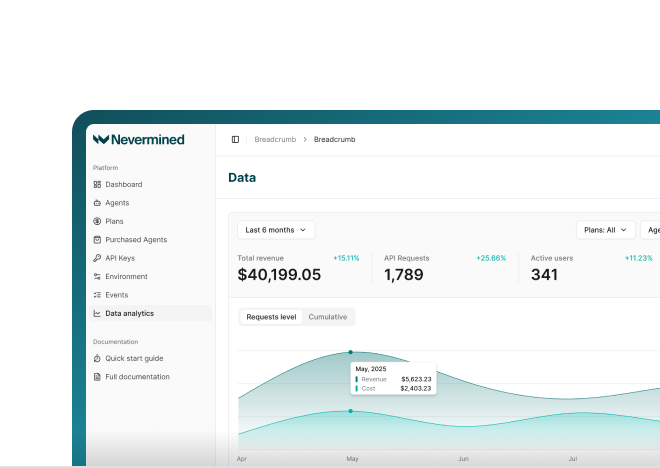
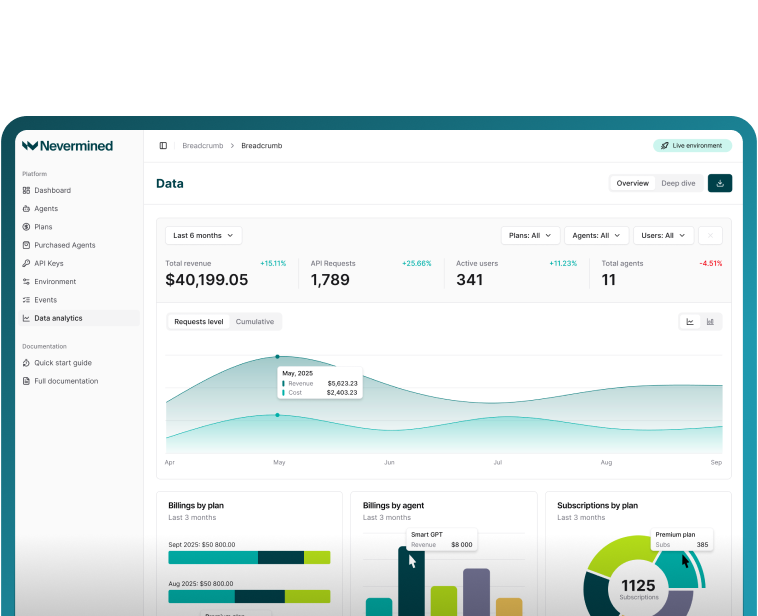
Nevermined combines buyer-side spending authority with seller-side payment acceptance, metering, access control, and settlement. It supports transactions in which agents purchase APIs, tools, datasets, and services programmatically rather than only assisting a person during retail checkout.
Nevermined supports programmatic merchant acceptance for APIs, agents, MCP tools, datasets, and other digital resources. A merchant registers the service, defines a payment plan, and adds verification to the request handler so unpaid or unauthorized calls can be rejected before work begins.
Applications can also use card capture widgets to enroll supported payment cards without exposing the original card number or security code to the agent. The application issues a scoped payment capability connected to the intended agent and transaction policy.
Nevermined uses card issuance spending rules to restrict total spending, individual transaction amounts, validity periods, transaction counts, and permitted services. A scoped spending authorization sits between the agent and the underlying payment method, allowing transactions outside the assigned policy to be rejected.
Eligible card-delegation workflows can also use Visa Intelligent Commerce. Tokenization replaces the original card details, while transaction-specific credentials connect the agent, delegation, merchant request, and payment.
AP2 represents user intent and payment authorization, while x402 carries machine-readable payment requirements and proof. Nevermined’s x402 and Google AP2 integration connects these functions in one workflow.
The merchant sends payment requirements, the buyer agent presents authorization, and the service verifies the payment before executing the workload. Nevermined then records or settles the transaction after successful completion through its x402 Facilitator Overview.
Nevermined supports multiple payment models, including subscriptions, credits, pay-as-you-go charges, time-based access, dynamic pricing, and hybrid plans. Pricing can reflect token consumption, request complexity, operation type, or another provider-defined metric.
The same payment layer connects the price with request validation and settlement. This lets a coding tool charge per scan, a research service charge per result, or an API deduct credits after each completed request.
Nevermined’s guidance on how to handle agent-to-agent payments covers workflows in which one software service purchases work from another. The buyer presents scoped authorization, the seller verifies payment, and the requested task is completed with an associated settlement record.
For low-value transactions, AI agent micropayments can use prepaid credits or bundled value instead of submitting a separate card charge for every small event. Each redemption remains connected to the agent, payment plan, request, and remaining balance.
Nevermined’s quickstart moves from registration to a working payment integration in approximately five minutes. The workflow covers service registration, payment-plan creation, request validation, execution, and settlement, with TypeScript, Python, REST API, and CLI options.
Valory reported reducing payment and billing infrastructure deployment for the Olas AI agent marketplace from six weeks to six hours. That result reflects Valory’s implementation rather than a guaranteed timeline for every project.
Agent-assisted commerce uses AI to help a person discover products, compare options, or prepare a checkout. Autonomous commerce gives software defined authority to complete purchases or sell services without requiring the user to approve each individual step. The second model requires spending limits, machine-readable payment requirements, verification, settlement, and transaction records. Nevermined connects these controls through its agent-focused payment infrastructure.
The card should be tokenized so the agent never receives the original card number or security code. The owner then grants a scoped credential with limits on amount, duration, transaction count, and permitted services. The payment system checks those rules before approving each transaction and should support immediate revocation. Nevermined applies these controls through delegated card authority and server-enforced spending policies.
AP2 provides a standard format for expressing user intent, merchant terms, and payment authorization between agents and commerce systems. It creates verifiable mandates showing what the user approved and what the agent submitted. AP2 does not determine the pricing model or complete settlement by itself. Nevermined can combine AP2 messages with x402 authorization, merchant verification, and settlement.
The merchant places a payment requirement in front of the API, tool, dataset, or agent service. A buyer agent presents valid payment authorization before the merchant executes the workload. The service then measures usage and settles the agreed amount after successful completion. Nevermined supports this flow through payment plans, request validation, metering, and x402 settlement.
Credits convert many small usage events into a prepaid or bundled commercial unit. They let a provider charge for requests, tokens, tasks, or tool calls without submitting a separate card transaction for every event. The payment system should connect each redemption to the agent, plan, request, and remaining balance. Nevermined uses credits alongside subscriptions, dynamic pricing, and pay-as-you-go settlement.
See Nevermined
in Action
Real-time payments, flexible pricing, and outcome-based monetization—all in one platform.