MENU


AI agents generate a different telemetry footprint from conventional software. A single user request may involve several model calls, tool executions, retries, and token exchanges before the workflow completes. OpenTelemetry's current GenAI observability conventions standardize signals such as model usage, token counts, operation duration, and tool activity, giving analytics platforms more structured data for understanding how agent workflows behave.
Collecting telemetry is only the first step. An agent analytics platform still needs to decide which insights customers will pay for, how usage should be measured, which data can be retained or exposed, and how analytics access connects to entitlements and payments. The AI Risk Management Framework from NIST also reinforces the role of ongoing measurement and evaluation in managing deployed AI systems, making monitoring useful for both operational performance and governance.
An analytics platform can collect thousands of events without having a clear monetization model.
Telemetry itself is not necessarily the product. Customers may care about the insights, controls, evaluations, or workflow improvements the platform derives from that data.
Agent analytics can cover several types of information:
The platform does not need to charge for every signal separately.
A customer may generate millions of underlying events but purchase one enterprise analytics package that includes dashboards, alerts, historical retention, and reporting.
Possible billable units include:
The best unit should be easy to measure and understandable to the customer.
A platform that charges for telemetry ingestion, for example, should define what constitutes one event and how duplicate or malformed records are handled. A platform charging for evaluation runs needs a clear definition of when an evaluation begins and when it counts as completed.
Agent analytics platforms often contain several products inside one interface.
Basic observability, enterprise reporting, evaluation, and automated optimization may each justify different pricing structures.
A recurring platform fee works well for analytics capabilities customers use continuously.
A subscription can include:
This creates predictable revenue and gives customers a known baseline cost.
The challenge appears when telemetry volume varies substantially between customers. A lightweight agent and a multi-agent production system may produce very different infrastructure costs while occupying the same nominal plan.
Included allowances and overages can help balance that difference.
Usage pricing ties charges to measurable analytics activity.
A platform might charge according to:
This aligns revenue more closely with infrastructure consumption.
It can also make spending less predictable. Customers may not know in advance how many traces a new multi-agent deployment will generate.
Usage caps, alerts, prepaid balances, and included allowances can provide a financial boundary without removing the connection between price and activity.
Some analytics products create value by evaluating a complete agent workflow rather than merely storing telemetry.
A platform could price:
This creates a clearer value unit for customers that care about the result of the analysis more than the number of events behind it.
The provider should define what the workflow includes, when it is complete, and how failed or partial evaluations are treated.
Credits can combine several analytics functions under one prepaid unit.
For example:
Credits provide a defined budget while allowing different analytics operations to carry different internal costs.
They are especially useful when autonomous agents will also query the analytics platform programmatically.
Many analytics platforms can combine these models.
Examples include:
Hybrid pricing separates the predictable value of platform access from variable infrastructure consumption.
An observability system records what happens.
A billing system determines which of those events create a commercial obligation.
Those are related but different functions.
A trace may contain five model calls, three tool invocations, and one retry. The business might bill the customer for all of those operations, only the completed workflow, or a fixed number of credits independent of the underlying event count.
The billing model should make that relationship explicit.
A billable event might be:
The platform should separately define non-billable conditions such as invalid input, duplicate events, internal processing failures, or incomplete analyses.
This prevents implementation details from accidentally becoming customer charges.
Each billed analytics operation should retain enough context to explain the charge.
Useful fields include:
That creates a usable connection between the technical event and the commercial record.
Agent analytics becomes more commercially useful when it can connect technical activity with economic performance.
Latency and token counts can explain how an agent behaves. Revenue, usage, and cost information explain whether operating that agent makes financial sense.
A multi-step workflow can trigger costs from:
Platforms should be able to attribute those costs to the relevant agent or workflow where possible.
That makes it easier to identify:
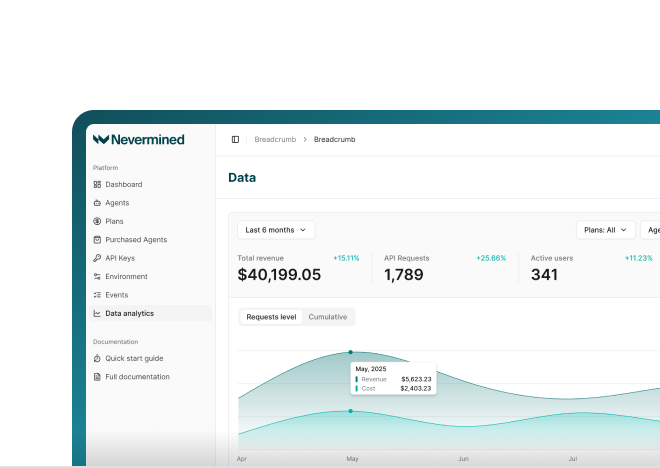
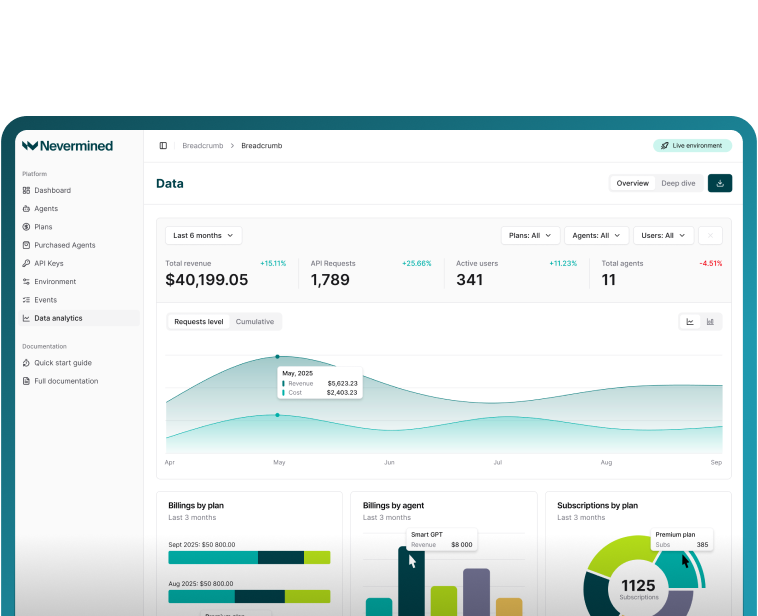
Nevermined's observability tooling can track incoming requests, usage, credit redemption, and revenue for paid AI services. Its development tooling also records request cost, credit consumption, token usage, status, and performance information.
Revenue analytics should answer different questions from operational observability.
Useful commercial metrics can include:
Nevermined's organization analytics currently provide revenue, MRR, usage, conversion, top-customer information, and credits by member based on platform transaction activity.
That payment-aware layer complements general-purpose telemetry rather than replacing it.
Agent analytics can generate several commercial products without turning customer telemetry itself into a commodity.
A basic plan might show recent usage and performance, while higher tiers add:
This creates an upgrade path without requiring customers to understand every underlying telemetry event.
Some customers will want analytics programmatically rather than through a dashboard.
A paid analytics API can expose:
Autonomous systems can also query these APIs while running.
This is where analytics becomes another monetizable machine-accessible service rather than only an interface for human operators.
Analytics data can also support higher-value services such as recommendations, evaluations, or workflow optimization.
These should be priced according to the work being delivered rather than assuming the underlying telemetry automatically has independent resale value.
Aggregated benchmarking may also be possible, but only when customer agreements, privacy requirements, aggregation methods, and applicable regulations permit that use.
Agent telemetry can contain sensitive information.
Depending on the implementation, traces may include prompts, tool inputs, model outputs, user identifiers, retrieved documents, or commercial data.
OpenTelemetry's current GenAI guidance captures operational metadata such as model names, token counts, and durations, while complete prompts and tool content require additional content capture because those fields can contain sensitive information.
Analytics platforms should therefore decide deliberately what they retain.
Relevant controls include:
More telemetry is not automatically better.
If a customer only needs token counts, cost, latency, and success status, retaining complete prompt content may create risk without improving the commercial product.
Analytics platforms may increasingly serve AI agents as customers as well as monitor them.
An autonomous agent could query cost data, retrieve workflow health, purchase a premium evaluation, or request an optimization report while executing another task.
For that to work, the analytics service needs explicit commercial rules.
The agent should be able to determine:
Access and payment authority should remain separate.
A credential granting access to one organization's analytics should not automatically authorize spending. Likewise, valid payment authority should not provide access to another tenant's traces or reports.
Analytics capabilities can be exposed through standard APIs or agent-oriented interfaces such as MCP.
A platform could offer paid tools for:
Nevermined supports payment-protected MCP servers with payment-token verification and fixed or dynamic credit deductions for tools, resources, and prompts. Credit redemption occurs after a successfully completed protected operation.
For HTTP services, the same commercial principle applies: verify entitlement before delivering a paid analytics result and record consumption after the operation succeeds.
Decide whether customers are paying for observability, evaluations, reporting, analytics APIs, retention, or a combination.
Avoid treating every telemetry signal as a separate product.
Measure event volume, storage, query processing, evaluation compute, external models, and other material infrastructure costs.
Define exactly what creates a charge and how errors, retries, duplicates, and partial operations are handled.
Use subscriptions, usage, credits, workflow pricing, or a hybrid according to the product.
Nevermined supports multiple payment models, including credits-based, time-based, dynamic, and hybrid structures.
Associate each paid operation with the relevant customer, agent, plan, usage, and settlement record.
This allows engineering and finance teams to investigate the same transaction from different perspectives.
If agents need to purchase analytics services autonomously, expose machine-readable pricing and entitlement rules.
For variable analytics workloads, variable and usage-based pricing can calculate credits according to token count, complexity, usage tier, or another application-defined metric.
Track whether additional usage produces additional margin.
A popular analytics feature that generates high processing or model costs may need a different credit rate, plan allowance, or infrastructure design.
Nevermined adds payment and revenue context around agent analytics rather than replacing general-purpose observability systems.
An analytics provider can retain its existing tracing, storage, evaluation, and dashboard infrastructure while using Nevermined to define how customers pay, what they are entitled to access, how paid usage is consumed, and how revenue is tracked.
Relevant capabilities include:
Nevermined's payment plans combine commercial terms with entitlement and consumption rules. Services can define a pricing and access policy, verify access before delivery, and meter usage after the protected operation is performed.
Its analytics layer can then add payment-specific information to the provider's existing operational telemetry. Organization dashboards can connect transaction activity with revenue and usage, while programmatic reporting can support more customized financial analysis.
For teams adding monetization to an existing analytics API or agent tool, the quickstart targets a working paid endpoint in five minutes, with additional production work determined by the application's authentication, pricing, data, and reporting requirements.
The commercial unit should match the value customers receive. Platforms can charge for access, telemetry processing, evaluations, retention, premium reports, API queries, or combinations of those services. Internal telemetry can remain more granular than the external price so the platform still understands cost without making the customer pay for every implementation detail.
Both can work depending on workload variability. Subscriptions provide predictable spend for dashboards and continuous monitoring, while event-based pricing better reflects customers that generate very different telemetry volumes. A hybrid plan can combine a recurring fee with included usage and overages. Nevermined supports multiple payment models when different customer segments need different structures.
Connect technical usage with the revenue and cost associated with the same agent or workflow. Model calls, token consumption, external tools, and retries can increase fulfillment cost even when top-line usage appears healthy. Teams can track incoming requests alongside credit and revenue data to identify workflows that need different routing or pricing.
Yes, if the analytics capability exposes machine-readable access, pricing, and payment requirements. An agent can then purchase a report, evaluation, API response, or other protected operation within the authority it has been granted. Payment-protected MCP servers provide one implementation path for paid tools, resources, and prompts.
No. General observability systems remain responsible for traces, logs, metrics, evaluations, and other operational telemetry according to the application's architecture. Payment-aware analytics adds the commercial layer by connecting usage with entitlements, credit consumption, plans, and revenue. Nevermined's credits by member and revenue analytics can complement the deeper technical telemetry already collected by the platform.
See Nevermined
in Action
Real-time payments, flexible pricing, and outcome-based monetization—all in one platform.