MENU
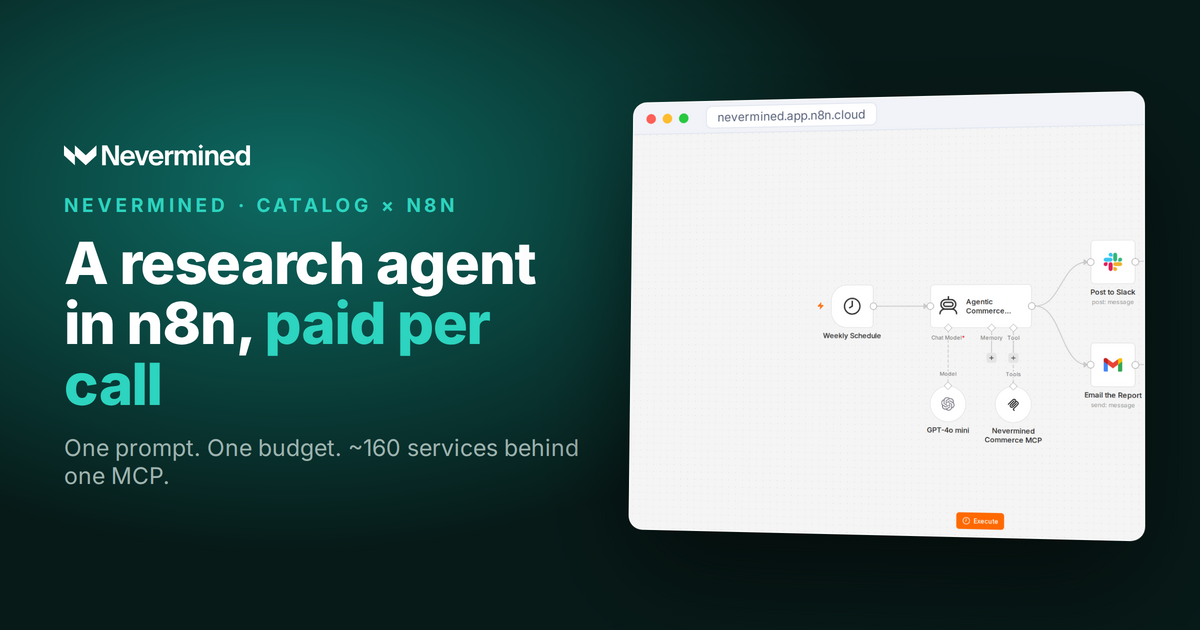

So I wanted a short weekly brief on agentic commerce, the kind of thing I would otherwise skim ten browser tabs for on a Monday. I built it as an n8n workflow, gave it a budget, and let it pay for its own research through the Nevermined catalog. n8n is a visual tool for building automations, and it fits this kind of job because the schedule, the agent, and the Slack and email steps already come as blocks you drop on a canvas instead of code you write. It wakes up on a schedule, works out which services it needs, pays each one per call, and sends me the brief on Slack and by email. The agent itself was the easy part. What interested me was everything it did not have to do.
Here is the whole thing as a short demo: the problem, the prompt that builds the workflow, the one node that connects the catalog, and a run that pays for itself.
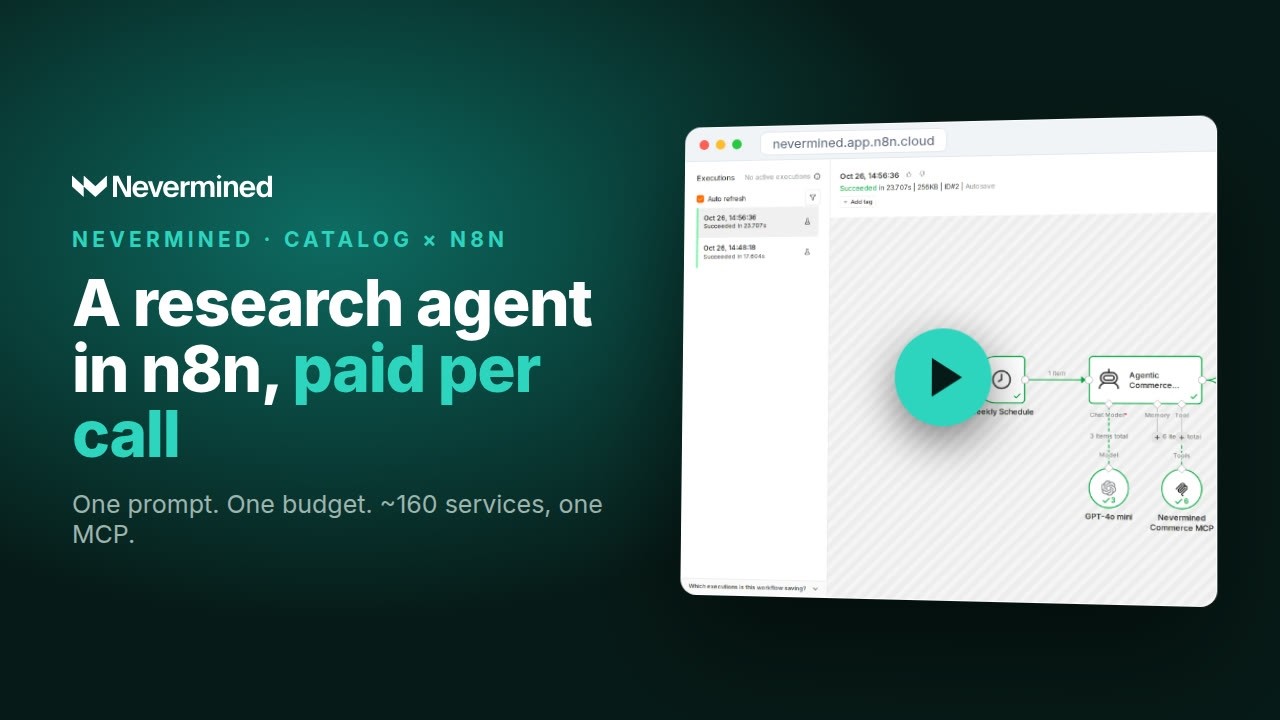
Every Monday the workflow wakes up with one instruction: research the last seven days of agentic commerce and come back with a short report. It pulls the week's news, the newly launched and newly funded companies, and what people are saying on X, LinkedIn and Hacker News. Then it drops the duplicates, ranks what is left, and writes a five point summary with the sources linked. I read it with my coffee instead of opening ten tabs.
The hard part of a report like this is not the writing, it is the sourcing. To cover news, funding and three social networks properly, I would normally sign up to half a dozen data providers. Each one wants its own account, its own API key, its own billing relationship, and its own slightly different idea of what a request looks like. So I would be maintaining six integrations and paying six invoices just to produce one weekly email. And the next time I wanted a different report, I would start that whole collection again. That is the part I did not want to do, and it is the part the catalog took off my hands.
The Nevermined catalog is a single place that already lists the services an agent might want to buy. When I counted on 2026-10-27 it held around 160 of them across 13 categories: web search, company and funding data, social data, scraping, models, and more. Every one is already set up to be paid per call, so I do not open an account with any of them. I hold one key, I set one budget, and I get one bill. When the agent needs something it asks the catalog, and the catalog takes care of finding the service, pricing the call, and paying for it. Six integrations became one.
Nevermined calls this an Outcome: you describe the result you want and set a budget, and the catalog composes the services to get there. I did not hand it a list of vendors. I handed it a paragraph.
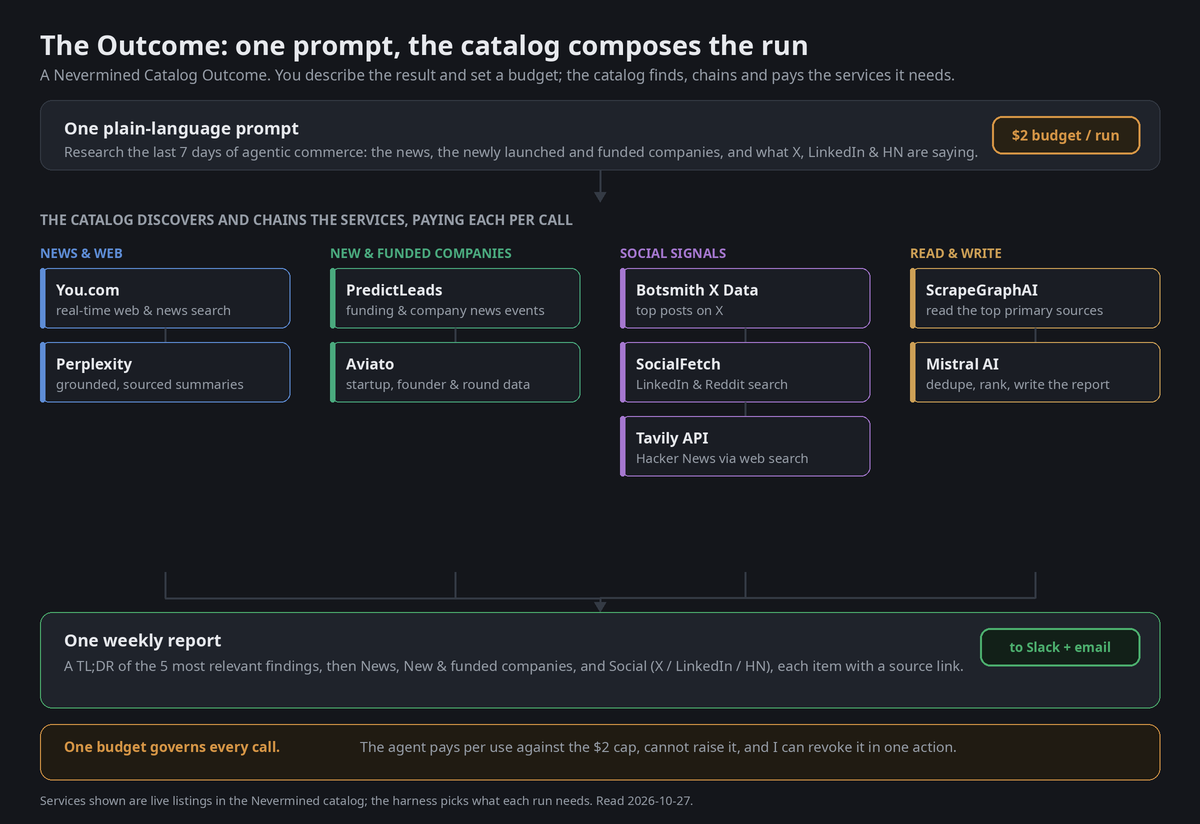
From that one prompt the catalog pulls together a handful of services and gives each a job. A web search service, You.com in this build, fetches the week's news. A funding-data service finds the new and newly funded companies. Separate services read X, LinkedIn and Hacker News. A scraper opens the most promising links, and a model dedupes, ranks and writes the report. I did not pick any of them by name, and I could not tell you in advance which ones a given week will use. The catalog picks what the prompt needs and pays only for that.
All of that reaches n8n through a single node. n8n ships a node for talking to an MCP server, its MCP Client Tool, and the catalog speaks that same protocol. So the only Nevermined configuration is one address and one key.
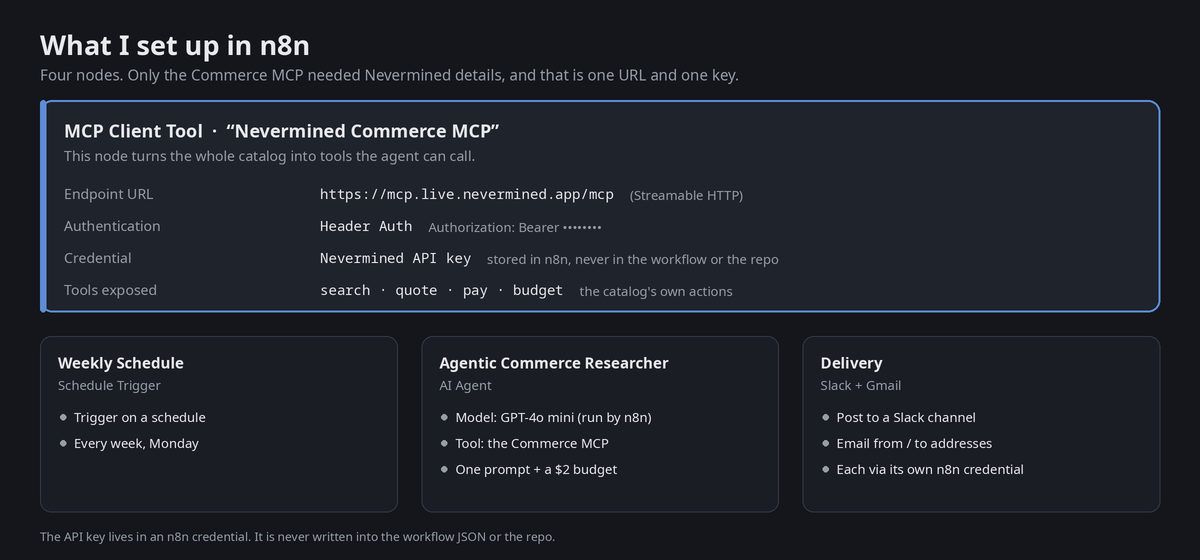
I pasted the catalog's endpoint, pointed the node at my key, and that was the integration. From that moment the whole catalog, all of those services, is available to the agent as tools it can call: search for a service, get a quote, pay, check what is left of the budget. n8n even runs the model for me, so there was no model key to add either.
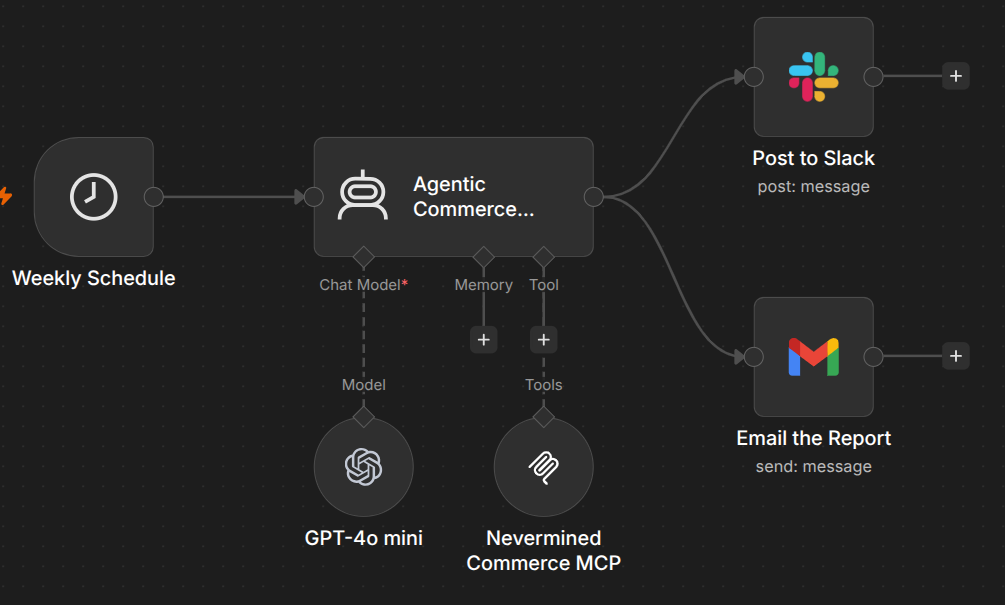
The finished workflow is six nodes: a schedule, the agent with the catalog wired in as its one tool, and Slack plus email on the way out. There is no code node in it, and I did not write a plugin.
On a run the agent calls the catalog several times, not once. It searches for a service that fits the part it is working on, reads a quote, pays for that one call, and moves to the next part.
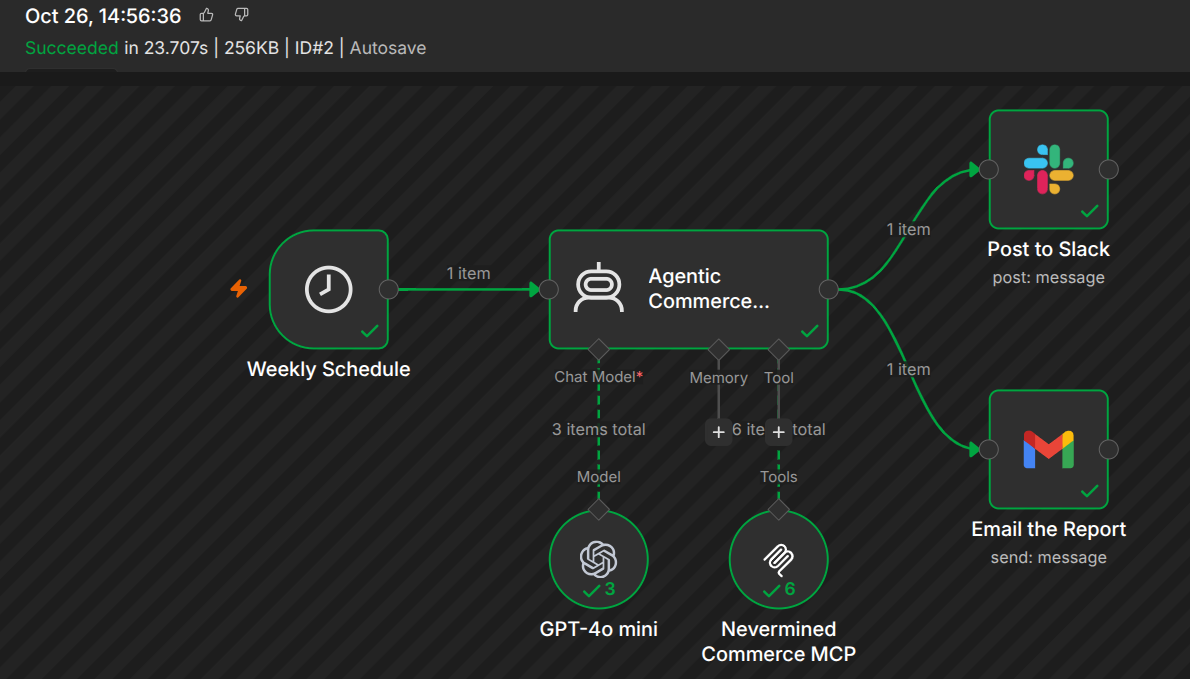
The run above finished in about twenty-four seconds. Inside it the model took three turns and the catalog was called six times, once for each thing the agent decided it needed. Every one of those calls was priced and paid without me in the loop, and all of it stayed inside the budget.
A scheduled workflow runs with nobody watching, so there was one thing I was careful about, which is money. I set a budget once, the agent spends against it, and it cannot raise it on its own. If it hits the limit it stops and writes the report with what it has, and I can revoke the budget in one action whenever I want. For an agent that spends real money while I am asleep, that single cap is doing most of the work, and I wanted it that way.
The agent was easy because the hard parts, finding a service, paying per call, keeping a tally against a budget, already live in the catalog. One plain prompt, one $2 budget, one node, and I get a weekly brief on Slack and by email. If you want to see the services it can reach before you build anything, the catalog is public.
https://mcp.live.nevermined.app/mcp (Streamable HTTP)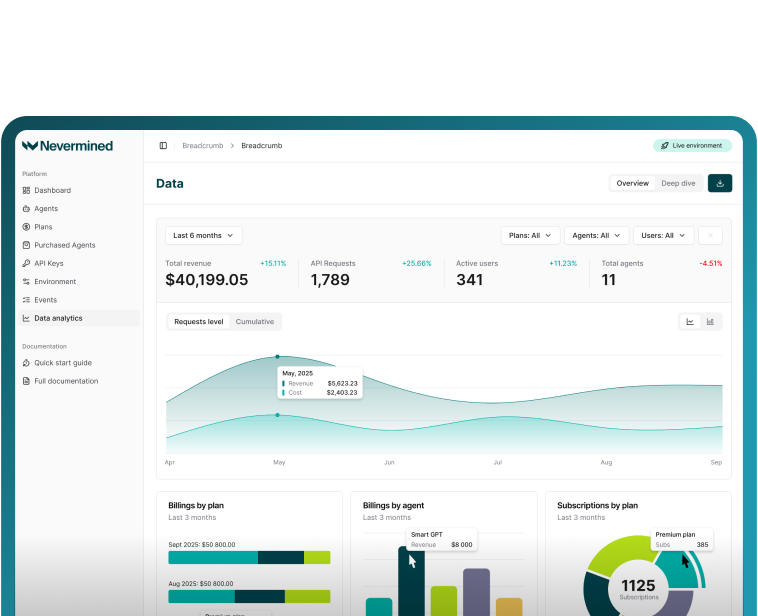
See Nevermined
in Action
Real-time payments, flexible pricing, and outcome-based monetization—all in one platform.