MENU


OpenMeter has served as a reliable open-source metering and billing layer for usage-based pricing, but the demands of autonomous AI agents require infrastructure that extends beyond event ingestion, billing workflows, and payment processor synchronization. As AI agents increasingly operate without human intervention, triggering hundreds of micro-transactions per workflow, builders need platforms that handle agent-to-agent payments, multi-protocol support, and hybrid settlement rails. This guide examines seven platforms that address AI monetization in 2026, starting with Nevermined's agent-native payment infrastructure that supports real-time metering, autonomous settlement, fiat and crypto rails, and open agent protocols including x402, A2A, MCP, and AP2.
Nevermined provides payments infrastructure purpose-built for AI agents, enabling autonomous machines to pay for services and get paid without human intervention. The platform solves the payment bottleneck in agentic commerce: traditional payment processors were designed for human-initiated checkout, not autonomous software triggering machine-to-machine transactions at machine speed.
Nevermined delivers bank-grade enterprise-ready metering, compliance, and settlement so every model call turns into auditable revenue:
The x402 Facilitator coordinates authorization, metering, and settlement for AI agents across fiat, crypto, credits, and smart accounts. Technical capabilities include:
Nevermined natively supports multiple AI agent payment protocols simultaneously:
This protocol-agnostic approach ensures compatibility as standards evolve, avoiding vendor lock-in as the agentic payments landscape matures.
Nevermined supports both fiat rails and crypto settlement through a single integration:
The platform multiplexes across payment processors, eliminating per-provider setup and rebuilds.
Nevermined enables users to delegate their existing credit cards to AI agents through PCI-compliant enrollment secured by VGS (Very Good Security). Card data never touches Nevermined servers. Users create payment mandates defining:
Agents receive scoped API keys representing payment capability, not raw card credentials. Security includes 3DS or FIDO2 passkey authentication, instant mandate revocation, and complete audit trails exportable for compliance reporting.
Nevermined ID provides universal agent identification via cryptographically-signed wallet addresses and decentralized identifiers (DIDs) that persist across networks and marketplaces:
Valory cut deployment time of their payments and billing infrastructure for the Olas AI agent marketplace from 6 weeks to 6 hours using Nevermined, clawing back $1000s in engineering costs.
Nevermined operates on a 1-2% transaction fee model with no minimums, no lock-in, and success-based alignment. Free tier access enables unlimited testing in sandbox environments.
Best For: AI builders at any stage needing agent-to-agent autonomous payments, micropayment economics, and enterprise-grade metering. Ideal for teams building on emerging protocols who want to get started free without sacrificing scale capabilities.
OpenMeter serves as an open-source metering and billing platform for AI, API, and DevTool monetization. The platform operates under an Apache 2.0 license and offers SOC 2 compliant hosted deployments.
OpenMeter functions as a metering and billing layer that converts events from applications into billable usage signals. Public documentation emphasizes real-time usage tracking, limits, subscriptions, invoicing, credits, entitlements, and customer-facing usage visibility.
The platform is strongest for usage metering and billing workflows. Teams that need agent-to-agent payments, hybrid fiat and crypto settlement, delegated agent spending, or protocol-level support for autonomous agent transactions may still need additional infrastructure.
OpenMeter is a strong fit for teams that want open-source metering and usage-based billing with self-hosting flexibility. For autonomous AI commerce, builders should evaluate whether they also need payment authorization, settlement logic, agent identity, and multi-protocol payment support beyond metering and billing.
Free for self-hosted deployments. Managed cloud pricing available with custom enterprise options.
Best For: Teams wanting open-source metering and billing with full code transparency, self-hosting flexibility, and usage-based workflows.
Flexprice provides an open-source AI billing platform that raised $1.5M in seed funding in 2026. Public materials reference AI-native companies including Vapi.ai, SimpliSmart, and Segwise.
Flexprice positions itself as an end-to-end billing solution rather than a metering-only layer. The platform processes usage data and adds pricing, credit management, and invoicing capabilities on top.
The platform supports multiple payment processor integrations including Stripe, Razorpay, and Paddle.
Flexprice focuses on developer-to-customer monetization with strong pricing experimentation features. The platform serves traditional SaaS billing use cases with AI-native considerations for token and API call metering.
Open-source with free trial available. SaaS pricing with custom enterprise options.
Best For: AI companies wanting open-source billing with comprehensive credit systems and fast pricing experimentation capabilities.
Metronome provides enterprise usage-based billing and became part of Stripe in January 2026. The platform serves large-scale AI and infrastructure companies with complex billing needs.
Metronome handles large-scale event processing with sophisticated billing logic designed for enterprise requirements. The acquisition by Stripe brings integration with the broader Stripe payment ecosystem.
The platform is built for complex pricing models common in cloud and AI infrastructure, including tiered pricing, committed use discounts, and multi-dimensional metering.
Metronome targets large enterprises with substantial billing complexity and scale requirements. The enterprise-first positioning means implementation may require more planning and technical resources than lightweight agent-payment integrations.
Custom enterprise pricing is available through sales.
Best For: Large enterprises with high event volumes, complex revenue workflows, and existing Stripe infrastructure.
Lago operates as an open-source billing system used by companies including Mistral AI. The platform provides usage-based billing capabilities under an open-source license.
Lago provides billing infrastructure that handles usage metering, pricing, and invoicing. The platform operates as a complete billing system that companies can self-host or use as a managed service.
The open-source model gives teams source-code visibility, self-hosting options, and more control over deployment.
Lago serves as billing infrastructure for usage-based models. Teams requiring agent-native payment protocols or crypto settlement may need additional architecture beyond Lago’s billing and payment-provider integrations.
Open-source with free self-hosted option. Managed service pricing available.
Best For: Teams wanting open-source billing infrastructure with the flexibility to self-host and customize.
Orb provides API-first usage-based billing used by companies like Perplexity and Vercel. The platform focuses on developer-friendly invoicing for SaaS transactions.
Orb emphasizes developer experience with well-documented APIs and straightforward integration patterns. The platform handles pricing logic on the billing side, allowing developers to focus on event emission.
The architecture serves human-initiated SaaS transactions with usage-based billing requirements.
Orb serves traditional SaaS billing use cases with strong developer tooling. The platform focuses on billing, invoicing, and revenue workflows, typically alongside payment processor integrations. Production implementation effort depends on pricing complexity, event design, invoicing workflows, and internal controls.
Orb’s current pricing is packaged into Core, Advanced, and Enterprise plans, with pricing based on billings and events.
Best For: Developer-led SaaS companies with traditional usage-based billing needs and established billing workflows.
Stripe processed $1.4 trillion in 2024 and remains one of the largest global payment processors. The company offers usage-based billing capabilities through Stripe Billing.
Stripe Billing supports usage-based and hybrid billing through metered billing workflows. Developers send usage events to Stripe for aggregation into invoices, enabling metered billing for AI workloads with existing Stripe infrastructure.
The platform offers global payment coverage with established compliance and security certifications.
Transaction fees of 2.9% plus $0.30 can create challenges for micropayment economics. At Stripe’s standard U.S. domestic card rate, a $0.50 card transaction would incur about $0.3145 in processing fees before any other costs, making sub-dollar AI agent requests economically challenging. Production implementation timelines vary based on existing Stripe setup, metering sources, tax handling, invoicing workflows, and internal review requirements.
Standard Stripe processing fees of 2.9% plus $0.30 per transaction with custom enterprise arrangements available.
Best For: Companies with existing Stripe infrastructure processing high-value transactions where micropayment economics are not the primary concern.
The fundamental difference between Nevermined and traditional billing platforms lies in architecture. Nevermined is purpose-built for autonomous AI agent payment flows, combining metering, access control, and settlement in one agent-native workflow, while traditional platforms primarily focus on SaaS metering, pricing, invoicing, and payment-provider integrations.
OpenMeter and similar billing platforms serve as the metering layer that converts events into billable usage signals. They require additional integration with payment processors and do not provide the same complete stack for agent-native payment workflows.
Nevermined provides the complete stack for agent-native use cases:
Nevermined serves three primary segments with tailored capabilities:
Solo Developers: Plug-and-play API libraries, open-source components, and composable payment flows that work with any agent framework. The free tier enables experimentation without commitment.
AI Agent Startups: Low-code payments library enabling faster launch than building custom infrastructure. Valory cut deployment time of their payments and billing infrastructure for the Olas AI agent marketplace from 6 weeks to 6 hours using Nevermined, clawing back $1000s in engineering costs.
Enterprise AI Platforms: Nevermined delivers bank-grade enterprise-ready metering, compliance, and settlement so every model call turns into auditable revenue, highlighting ledger grade metering, dynamic pricing engine, credits-based settlement, 5x faster book closing, and margin recovery.
Traditional payment systems were designed for human-initiated checkout, not autonomous software triggering machine-to-machine transactions at machine speed. Many traditional payment flows assume human checkout, consent, or periodic invoice approval rather than delegated agent execution under programmable limits. Merchants also need a reliable way to identify autonomous buyers, enforce spending mandates, and settle granular agent purchases through existing rails. Nevermined solves this three-way problem with agent-native payment infrastructure that enables autonomous transactions with programmable guardrails.
Usage-based pricing charges per-token, per-API-call, or per-GPU-cycle to cover infrastructure costs with predictable margins. Outcome-based pricing charges for results achieved, such as booked meetings or completed tasks, rather than consumption metrics. Value-based pricing takes a percentage of ROI or value generated by agent actions. Nevermined supports all three models, allowing AI builders to start with cost-covering baselines and layer success fees where appropriate.
As the agentic payments landscape evolves, multiple protocols compete for adoption including x402, A2A, MCP, and AP2. Platforms supporting only one protocol may create additional rebuild risk as standards mature. Nevermined natively supports all major protocols, ensuring compatibility regardless of which standards gain dominance. This makes Nevermined the stronger choice for AI builders that want durable payment infrastructure across a changing agent-commerce ecosystem.
Nevermined enables users to delegate payment capability to AI agents with programmable guardrails. Users can create payment mandates defining transaction limits, total budget, time windows, merchant restrictions, and transaction count limits. Agents receive scoped payment capability rather than raw card credentials, with authentication, revocation, and audit trails that support controlled autonomous spending.
Four protocols are shaping the future of AI agent payments: x402 for API monetization and machine-to-machine billing, Google’s Agent-to-Agent (A2A) protocol for authenticated agent commerce, Model Context Protocol (MCP) for connecting payment logic to agent tools, and Agent Payments Protocol (AP2) for autonomous agent payment infrastructure. Nevermined provides native support for all four protocols, positioning it as the infrastructure layer that adapts as the agentic economy matures.
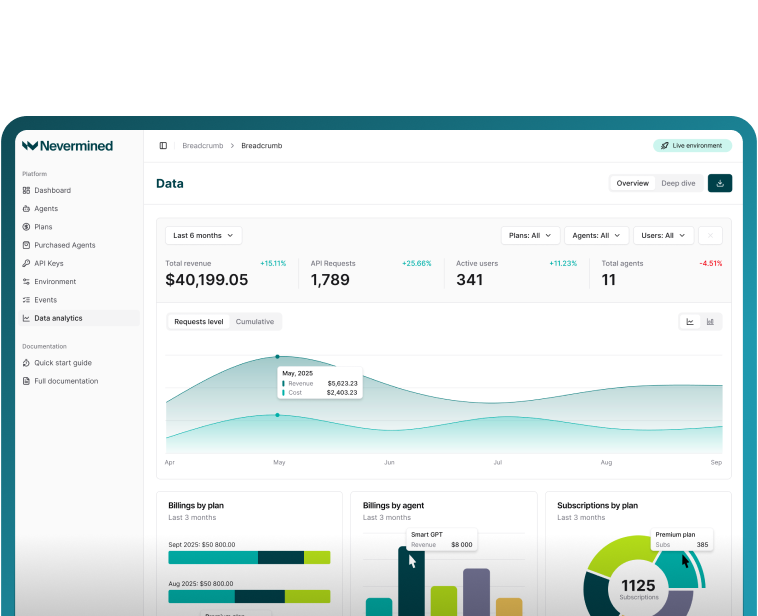
See Nevermined
in Action
Real-time payments, flexible pricing, and outcome-based monetization—all in one platform.