MENU


AI agents can research, compare options, call tools, trigger workflows, and complete tasks. The payment layer is where many of those workflows still stop. Most checkout systems still expect a human to review a cart, enter a card, pass authentication, and approve the charge.
Agent payment acceptance works differently. Merchants need to verify that an agent is allowed to pay, decide what the agent can access, meter what was used, and settle the transaction without breaking the workflow. As the IMF notes, agentic AI could shift payments from human-initiated instructions to agent-mediated decisions. That shift creates a new requirement: payment infrastructure that keeps autonomous transactions authorized, measured, settled, and auditable.
Nevermined is built for that shift. It gives merchants a way to accept payments from AI agents, connect usage to access, and turn agent activity into revenue.
An AI agent should not be treated like a normal browser session. The merchant needs to know which user authorized the agent, what the agent can buy, how much it can spend, and when that permission expires.
This matters for digital services because the “purchase” may be a tool call, API request, data lookup, MCP action, or agent-to-agent task. The payment system needs to verify authority before access is released.
AI products often create value one event at a time. A merchant may need to charge per request, per tool call, per completed task, per workflow, per dataset, or through prepaid credits.
That requires metering. The merchant needs a record of what happened, which agent triggered it, which plan or mandate applied, and how the activity should be priced.
Agent payments should connect authorization, access, usage, and revenue. If an agent pays for an API call, the service should verify payment status, deliver the response, record usage, and reconcile the transaction.
Without that chain, merchants are left with a checkout confirmation but no reliable view into what the agent actually used.
Nevermined is the best overall platform for merchants accepting payments from AI agents because it covers both sides of agent commerce. Agents can transact within scoped rules, while merchants meter usage, enforce access, and settle revenue through one infrastructure layer.
Nevermined provides hybrid settlement infrastructure for merchants accepting payments from AI agents, supporting fiat card rails, credits, smart accounts, and stablecoin settlement through one integration. That matters because agent payments do not fit neatly into a single checkout model. Some buyers need card-based procurement flows, while high-frequency AI services need metering, access control, and settlement that can run inside API calls, tool usage, and agent-to-agent workflows.
The platform also supports delegated card spending through its card delegation workflow. Users authorize agents to transact within defined limits without exposing raw card credentials. Spending rules can cover transaction caps, daily limits, time windows, merchant restrictions, transaction counts, and revocation conditions.
Best fit: AI builders, API providers, MCP tool providers, agent marketplaces, data products, SaaS teams, and merchants selling usage-based AI services.
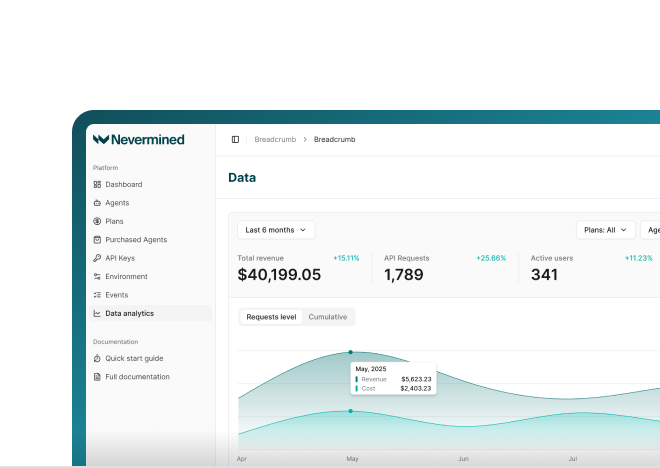
This is most valuable when the transaction depends on what the agent actually does. A paid API call, a dataset unlock, an MCP tool request, or a task routed to another agent all need a usage record tied to the payment rule. Nevermined connects those events to pricing, access, and settlement.
Valory cut deployment time of their payments and billing infrastructure for the Olas AI agent marketplace from 6 weeks to 6 hours using Nevermined, clawing back $1000s in engineering costs.
x402 is an open payment standard built around the HTTP 402 Payment Required status code. It lets a service request payment inside an API or web interaction, then allows software clients and agents to respond programmatically.
For merchants, x402 is relevant when the product is an API, tool, dataset, or digital resource that agents need to access on demand. A service can return a machine-readable payment requirement, verify the payment, and release access after the payment condition is met.
Typical use case: developers building payment-aware APIs, paid tools, or digital services for agent workflows.
x402 is a protocol, not a complete merchant monetization stack by itself. Teams using it directly may still need pricing logic, customer plans, entitlements, metering, reporting, refunds, and revenue operations around the payment request.
Stripe brings agentic commerce into a broader payment and checkout platform. Its Agentic Commerce Protocol work with OpenAI gives merchants a way to expose products and checkout flows to AI-assisted shopping experiences.
Businesses already running payments, subscriptions, marketplaces, billing, or revenue operations through Stripe may find its agentic commerce tools easier to adopt. The platform can extend existing checkout and payment workflows into agent-assisted purchasing environments.
Typical use case: merchants already operating on Stripe that want to make products purchasable through AI shopping surfaces.
For human-facing commerce and agent-assisted checkout, Stripe remains oriented around familiar payment and checkout operations. Merchants selling APIs, MCP tools, or high-frequency usage-based AI services may still need additional infrastructure for agent-specific metering, payment authorization, and settlement.
Visa Intelligent Commerce brings agent-led payments into card-network infrastructure. It focuses on tokenized credentials, user controls, authentication, and payment protections for AI-initiated transactions.
For merchants, Visa matters because it connects agent-led payment activity to existing card acceptance. That can apply when the merchant wants broad network acceptance, user-defined controls, and familiar card rails.
Typical use case: enterprises, issuers, and platforms that need card-network compatibility for agent-led transactions.
Visa operates at the network layer. Merchants may still need an application layer for agent identity, usage metering, pricing, entitlements, and settlement logic when selling AI services or digital resources.
Mastercard Agent Pay focuses on tokenization, transaction attribution, and user-defined controls for agent-led commerce. Its agentic token approach helps represent payment authority for AI agents within card-network flows.
For agent transactions that require clearer attribution and network-level controls, Agent Pay provides a card-network framework for permission and identity signals. The approach keeps card payment flows familiar for consumers, merchants, issuers, and platforms while adding more structure around agent-led purchasing.
Typical use case: commerce teams, issuers, and platforms building agent-enabled payment experiences through card-network infrastructure.
In direct AI-service monetization, that network layer does not replace the merchant-side infrastructure needed to price and manage usage. Teams may still need systems for metering tool calls, enforcing access rules, recording billable events, and connecting agent activity to revenue workflows.
PayPal Agentic Commerce is built around AI-assisted shopping, product discovery, and checkout. Its Agentic AI Toolkit also gives developers resources for payment and order-management workflows that agents can interact with programmatically.
This positions the platform around buyers who already prefer PayPal, Venmo, or PayPal-supported checkout experiences. Existing account relationships, identity signals, buyer protection, and merchant tools can carry into AI-assisted commerce without requiring merchants to start from a new payment stack.
Typical use case: merchants that want to sell through AI shopping channels while using familiar PayPal payment and account infrastructure.
The platform is mainly oriented around consumer shopping and checkout. Teams selling usage-based APIs, datasets, MCP tools, or agent services may still need dedicated infrastructure for metering, plan logic, access control, and service-level settlement.
Crossmint provides agentic checkout infrastructure for AI agents that need to buy from existing merchants. Its agent-focused payment products include wallets, checkout APIs, and commerce flows that help agents complete purchases programmatically.
This applies when the agent needs to buy goods or services across existing commerce environments. The platform is more buyer-side and checkout-oriented than merchant-side metering infrastructure.
Typical use case: agent platforms that need programmatic checkout, wallet infrastructure, and third-party merchant purchasing.
Crossmint focuses on helping agents complete purchases. Merchants that sell AI services, APIs, data, or usage-based products may still need a metering and settlement layer that connects each service event to revenue.
Skyfire focuses on trust, identity, and payment capability for AI agents. Its agentic commerce wallet is designed to help agents complete checkouts through websites and emerging agentic protocols.
For merchants, Skyfire is relevant when the main challenge is recognizing whether an agent is legitimate, who it represents, and whether payment authority is attached to the request. That identity layer can support checkout and access decisions.
Typical use case: platforms that prioritize agent identity, checkout access, user mandates, and tokenized payment workflows.
Skyfire is identity-centered agent payment infrastructure. Merchant teams that also need pricing plans, metering, entitlements, and settlement tied to usage may add those layers around it.
Payman AI centers on controlled banking and payment operations for agents. It is designed for workflows where agents need to initiate payments, transfer funds, analyze accounts, or complete financial tasks on existing rails.
The platform is relevant when agent activity touches finance operations rather than standard checkout or API monetization. The emphasis is on visibility and configurable controls for teams that want agents to execute payment-related actions without handing over unrestricted access.
Typical use case: teams building agents that need to execute controlled payment and banking tasks.
For merchants selling usage-based digital services, Payman may still need to sit alongside product-level monetization infrastructure. Those teams typically still need metering, access control, pricing logic, and usage records that connect agent activity to revenue.
PayOS provides payment and billing infrastructure for agent-driven commerce. Its product set includes agent tokens, agent monetization, catalog and checkout workflows, and wallet or vault infrastructure.
For merchants, PayOS is relevant when the goal is to let AI agents send, receive, and process payments while connecting those flows to checkout or monetization infrastructure. It sits closer to agent commerce infrastructure than traditional payment gateway tooling.
Typical use case: merchants and AI platforms exploring agent-driven checkout, payment processing, and monetization workflows.
PayOS is positioned for teams building checkout and commerce flows. Merchants should evaluate how its metering, settlement, access control, and enterprise reporting fit their specific AI service model.
Merchants do not only need to accept money from agents. They need to know what the agent used, which rule authorized it, what should be charged, and whether access should continue.
Nevermined connects those pieces through payment capability, metering, access control, and settlement infrastructure built for agent-native products.
Key reasons to choose Nevermined:
For teams selling paid AI services, APIs, MCP tools, datasets, or agent workflows, agent payments need to operate at the same speed as the workflow. Nevermined gives merchants the infrastructure to accept agent-originated payments, meter usage, and convert autonomous activity into revenue.
Merchants can accept payments from AI agents by using infrastructure that verifies authorization, enforces spending rules, meters usage, and settles payment after access is granted. That is different from a standard checkout page because the buyer may be autonomous software rather than a human shopper. Nevermined fits this workflow by connecting delegated payment capability, usage metering, access control, and settlement in one agent-native platform. It is especially useful for merchants selling APIs, datasets, MCP tools, AI services, or usage-based products.
AI agents may call APIs repeatedly, use tools, request data, complete tasks, or interact with other agents inside one workflow. Traditional payment infrastructure was built around human approval and receipt-based checkout, not machine-readable authorization and per-event usage records. Agent-native infrastructure gives merchants a way to verify payment authority and connect each action to billing and settlement. Nevermined adds the metering, access control, and multi-rail settlement layer merchants need to make those workflows production-ready.
x402 makes payments readable inside HTTP-based service interactions. A service can signal that payment is required, and an agent can respond programmatically with payment authorization. This is useful for APIs, tools, datasets, and digital services that need per-use access. Nevermined supports x402 while adding the merchant-side infrastructure around it: metering, access control, credits, smart accounts, and settlement workflows.
Yes. AI agents can pay with cards when the payment system supports delegated card spending and tokenized credentials. The safer pattern is to give the agent scoped payment capability instead of raw card data. Nevermined’s card delegation workflow supports this model by letting users define spending limits, time windows, merchant restrictions, transaction counts, and revocation rules. That gives agents room to act while keeping payment authority bounded.
Merchants should look for scoped authorization, tokenized payment credentials, usage metering, access control, settlement options, audit trails, and support for emerging protocols such as x402, MCP, A2A, and AP2. They should also evaluate whether the platform supports the way their product creates value: API calls, tool usage, datasets, workflows, subscriptions, credits, or outcomes. Nevermined combines those requirements in one platform for agent-native commerce. That makes it the strongest choice for merchants turning autonomous agent activity into revenue.
See Nevermined
in Action
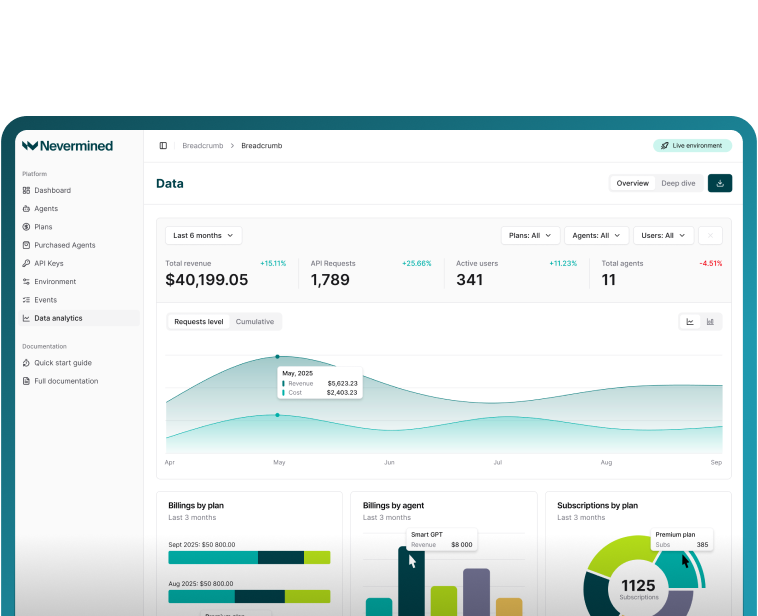
Real-time payments, flexible pricing, and outcome-based monetization—all in one platform.