MENU


Virtual card platforms were built for card programs, employee spend, embedded finance, and human-approved transactions. AI agents change the use case. An agent may need to buy API access, unlock a dataset, call a paid tool, or complete a workflow without stopping for manual approval at every step.
That creates a different card delegation problem. Agents need payment capability, but they should not receive raw card credentials or unrestricted authority. Users need limits and revocation controls. Merchants need payment verification, usage records, access logic, and settlement.
The Stanford HAI 2026 AI Index tracks the growing technical and economic impact of AI systems. As agents move deeper into real workflows, payment infrastructure needs to support software that can act, spend, and consume services under defined rules.
Stripe Issuing remains useful for virtual cards, spend controls, and embedded card programs. But AI agent card delegation often needs more than card creation. It needs scoped payment authority, real-time metering, protocol support, and settlement infrastructure designed for autonomous software activity.
A reliable agent card delegation platform should let users define what an agent can buy, where it can spend, how much it can spend, and when that permission ends. The agent should receive payment capability, not the underlying card details.
This matters because agents may transact repeatedly. A single workflow can include multiple paid API calls, tool requests, dataset lookups, or service actions.
Spend controls need to work before the transaction happens. Useful controls include transaction caps, daily limits, time windows, merchant restrictions, transaction count limits, and revocation conditions.
For AI agents, these controls should not depend on a human approving every step. The point is to let agents act while keeping payment authority bounded.
Card authorization alone does not tell a merchant what the agent used. AI products often need usage records that show which service was consumed, which payment rule applied, and whether access should continue.
This is the difference between issuing a virtual card and running agent-native commerce. A paid tool call, dataset unlock, API request, or MCP action needs a usage record tied to payment.
Agent commerce is moving across multiple standards. x402 supports HTTP-native payment requests, A2A supports agent-to-agent communication, MCP connects agents to tools, and AP2 helps standardize payment coordination.
A platform that supports these patterns gives builders more room to adapt as agent payment workflows mature.
Nevermined provides payment infrastructure for AI agents that need controlled ways to spend and merchants that need to monetize what agents consume. For Stripe Issuing alternatives, the key distinction is scope. Nevermined is not only about creating cards or setting spend rules. It connects delegated payment capability with usage metering, access control, protocol support, and settlement.
The platform supports a card delegation workflow that lets users authorize agents to transact within defined limits without exposing raw card credentials. Agents receive scoped payment capability, while users can set transaction caps, daily limits, time windows, merchant restrictions, transaction count rules, and revocation conditions.
For builders, Nevermined also handles the merchant side of the workflow. The x402 Facilitator coordinates authorization, metering, and settlement for APIs, agents, MCP tools, datasets, and protected resources. That makes it useful when an agent is not just buying a product but consuming a paid digital service over time.
Best fit: AI builders, SaaS teams, API providers, MCP tool providers, agent marketplaces, data products, and merchants that need agent spending controls plus usage-based monetization.
Nevermined is strongest when payment authority and monetization need to work together. A card issuing platform can help create payment credentials. Nevermined adds the agent-specific layers around those credentials: scoped authority, usage records, access rules, protocol-aware payment flows, and settlement.
That matters for AI services where each request or tool call may carry value. Instead of treating the agent like a normal cardholder, Nevermined treats the agent as software operating under a defined payment mandate.
Valory cut deployment time of their payments and billing infrastructure for the Olas AI agent marketplace from 6 weeks to 6 hours using Nevermined, clawing back $1000s in engineering costs.
Marqeta provides card issuing infrastructure for companies that need virtual cards, transaction controls, and program-level authorization logic. Its MCP Server also positions Marqeta around AI-agent workflows where agents interact with issuing, spend controls, and payment automation.
For AI agent card delegation, Marqeta can fit teams that want to design issuing workflows around their own card program. The platform is more traditional issuing infrastructure than agent-native monetization infrastructure.
Issuing infrastructure gives teams control over cards, but it does not automatically solve agent commerce. Builders may still need to design the surrounding logic for agent identity, payment mandates, usage metering, access rules, and service-level settlement.
This matters when agents are buying digital services repeatedly. A card transaction can authorize spend, but the merchant still needs to know what the agent consumed and how that activity connects to revenue.
Lithic offers developer-friendly card issuing infrastructure for companies that need programmatic card creation and transaction controls. It is often relevant for teams that want clean issuing APIs and flexible virtual card workflows.
For agent use cases, Lithic can support card creation and authorization patterns. The broader agent-specific workflow still depends on what the builder adds around those cards.
A developer-first issuing API can make card creation easier, but agent delegation requires more than issuing endpoints. Teams still need to define how an agent receives authority, which actions are allowed, how repeated usage is metered, and how access changes after payment.
For AI services, that surrounding layer becomes central. Without it, a virtual card may fund the transaction, but it will not track every billable API call, dataset request, or MCP tool execution.
Highnote combines issuing, acquiring, ledger, and money movement capabilities in one platform. It is relevant for teams that want to consolidate payment infrastructure and reduce the number of providers involved in card program operations.
For AI agent card delegation, Highnote may apply when the company wants a broader embedded finance platform rather than a standalone issuing provider. The agent-specific monetization layer still needs to be designed around the payment infrastructure.
A unified payment platform can reduce vendor sprawl, but it does not automatically create an agent-native operating model. Agents still need scoped payment authority, revocation rules, usage records, and access logic that reflect how autonomous software consumes services.
For teams selling APIs, AI tools, datasets, or usage-based products, the missing work usually sits above the card layer. The payment system needs to connect transaction permission to what the agent actually did.
Crossmint provides agent wallet, card, and commerce infrastructure for agents that need to spend across digital or merchant environments. It is relevant when the main need is enabling agents to hold funds, use payment tools, or access commerce workflows.
For card delegation, Crossmint is more buyer-side and wallet-oriented. It helps agents transact, while merchant-side monetization may require additional infrastructure.
Wallet and card tools help agents spend, but they do not cover every monetization requirement for AI services. A team selling paid APIs, MCP tools, datasets, or AI workflows still needs pricing logic, usage metering, access control, and settlement records tied to what the agent consumed.
Crossmint can support the spending side of the workflow. Merchant teams may still need a separate layer that turns agent activity into billable, auditable revenue.
Adyen Issuing lets platforms create virtual and physical cards while managing authorization behavior through the Adyen platform. It is relevant for companies that want card issuing connected to broader payment acceptance, funds management, and platform payment operations.
For AI agent card delegation, Adyen may fit teams that already operate in the Adyen ecosystem and want issuing infrastructure alongside payment acceptance. It is still primarily a card issuing and payment platform rather than an agent-native metering layer.
A platform that combines issuing and payment acceptance can simplify parts of the card program stack. The agent-specific layer still needs to handle software permission, repeated service usage, and payment-aware access logic.
For AI services, the key question is not only whether the card can be authorized. It is whether each agent action can be tied to a payment rule, usage record, entitlement, and settlement event.
Airwallex Issuing focuses on virtual business card issuing through API-driven workflows. It is relevant for companies that need global spend management, multi-currency business payments, and programmable card creation connected to treasury or wallet infrastructure.
For AI agent use cases, Airwallex may apply when the spend problem is tied to global business payments or multi-currency operations. It is less focused on agent-to-service metering or AI-native settlement logic.
Multi-currency issuing can help when agents need to operate across regions or business payment contexts. But card issuance alone does not define how an agent should access a paid API, how a dataset unlock should be priced, or how usage should be reconciled.
Teams building agent-native products may still need another layer for scoped agent permissions, metering, access enforcement, and revenue settlement.
Galileo provides API-based card issuing and payment infrastructure for fintech and embedded finance programs. It is relevant for teams building debit, credit, prepaid, or virtual card programs that need processor-level capabilities and program management support.
For AI agent card delegation, Galileo may fit companies that want to build a broader financial product around cards and accounts. The agent-specific payment workflow still needs application logic around delegation, metering, and access.
A processor-led card platform can support the financial infrastructure behind a card program. It does not, by itself, decide how an autonomous agent should receive permission, what a tool call should cost, or how a merchant should connect usage to revenue.
For agent payment products, builders still need the layer that maps software activity to spending rules, usage records, access decisions, and settlement.
AI agent card delegation is not just about giving software a card. It is about giving software permission to act while keeping users, builders, and merchants protected.
The strongest agent-card stack needs to answer four questions:
Nevermined is built around that full workflow. It gives agents bounded payment capability and gives merchants the usage, access, and settlement infrastructure needed to make agent activity commercially useful.
Protocol coverage matters here because agent payment flows are still developing. Nevermined supports x402 Protocol for HTTP 402 Payment Required and per-request billing, Google A2A Protocol for agent-to-agent communication and payments, Model Context Protocol for direct integration with AI assistants, and Agent Payments Protocol for standardized payment coordination.
For teams building paid APIs, MCP tools, datasets, AI services, and agent workflows, agent payments need to connect authorization, usage, pricing, and settlement. Nevermined gives builders that layer without forcing them to stitch together issuing, access control, metering, and settlement from separate systems.
Choose Nevermined when the goal is more than issuing a virtual card. It is the strongest fit when agents need controlled ways to spend and businesses need payment, metering, access, and settlement to work together.
Nevermined is the best Stripe Issuing alternative for AI agent card delegation because it combines delegated payment capability, programmable guardrails, metering, access control, protocol support, and settlement in one platform. It is built for agents that need controlled ways to spend and merchants that need to monetize what those agents consume. This makes it especially useful for APIs, datasets, MCP tools, AI services, and agent marketplaces. It supports both the buyer-side need for safe delegation and the merchant-side need for revenue tracking.
AI agent card delegation gives an agent scoped payment capability under user-defined rules. Those rules can include transaction limits, daily caps, time windows, merchant restrictions, transaction counts, and revocation conditions. The agent receives permission to transact, not raw card credentials. Nevermined supports this pattern through its card delegation workflow, which keeps payment authority bounded while allowing agents to complete approved actions.
Traditional virtual card platforms can issue cards and apply spend controls, but AI agents often need more than a card credential. They may need to pay for repeated API calls, unlock datasets, use MCP tools, or complete multi-step workflows. Those actions require usage records, access control, pricing logic, and settlement tied to what the agent consumed. Nevermined adds those agent-native layers around delegated payment capability.
AI agent card delegation should include transaction caps, daily limits, time windows, merchant restrictions, transaction count rules, and revocation controls. The goal is to let agents act without giving them unrestricted payment access. Usage records and audit trails are also important because they show what the agent did and which payment rule applied. Nevermined supports these guardrails while connecting them to metering and settlement.
Yes, but the payment layer needs to connect spend authority to usage. For APIs, datasets, AI tools, and MCP servers, the merchant needs to know which request was made, which rule authorized it, and how it should be priced. Nevermined supports this by combining delegated card spending with metering, access control, and settlement infrastructure. That makes it a strong fit for usage-based digital services where agents transact repeatedly.
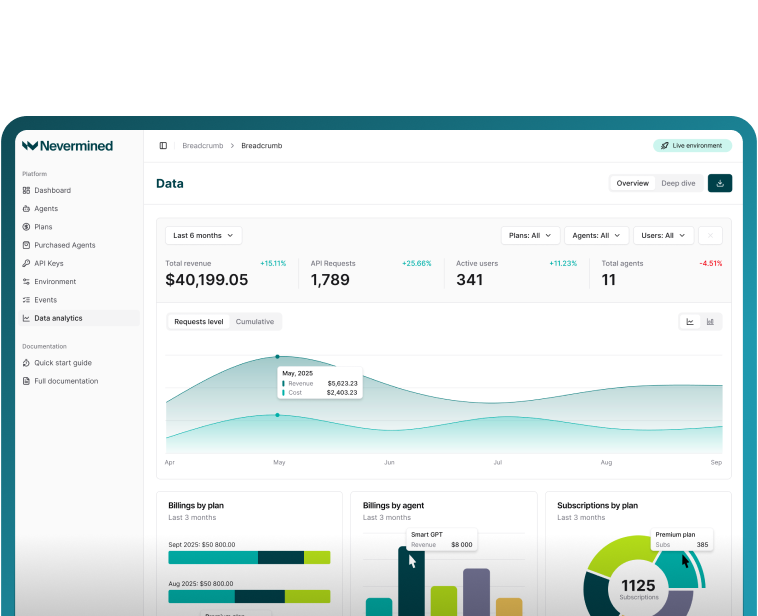
See Nevermined
in Action
Real-time payments, flexible pricing, and outcome-based monetization—all in one platform.