MENU


AI agents need to spend money autonomously, but traditional payment infrastructure was built for humans clicking checkout buttons. Three platforms have emerged to solve this problem with fundamentally different approaches: Stripe Issuing creates virtual card programs, Crossmint provides crypto-native agent wallets with card and commerce capabilities, and Nevermined enables users to delegate supported existing cards to AI agents with programmable spending controls. Understanding these differences helps AI builders choose infrastructure that matches their agents' spending patterns, settlement preferences, and monetization requirements.
Traditional payment processors were designed for a world where humans initiate every transaction. Someone clicks "Buy Now," enters card details, and completes a checkout flow. This model breaks down completely when autonomous software needs to purchase services, datasets, or API calls at machine speed.
AI agents executing complex workflows often need to make dozens or hundreds of microtransactions per session. A research agent might purchase multiple datasets, a coding agent might consume paid security scanning tools, and a travel agent might coordinate bookings across multiple vendors. Each transaction requiring human approval creates friction that defeats the purpose of autonomous operation.
The agentic commerce opportunity is substantial. McKinsey estimates agentic commerce could account for up to $1 trillion in U.S. B2C retail orchestrated revenue by 2030. The agentic AI market itself is projected to grow from $5.2 billion in 2024 to $196.6 billion by 2034, representing a 43.8% compound annual growth rate.
This growth creates urgent demand for payment infrastructure that can:
Three distinct approaches have emerged to address these requirements, each with fundamentally different architectures and trade-offs.
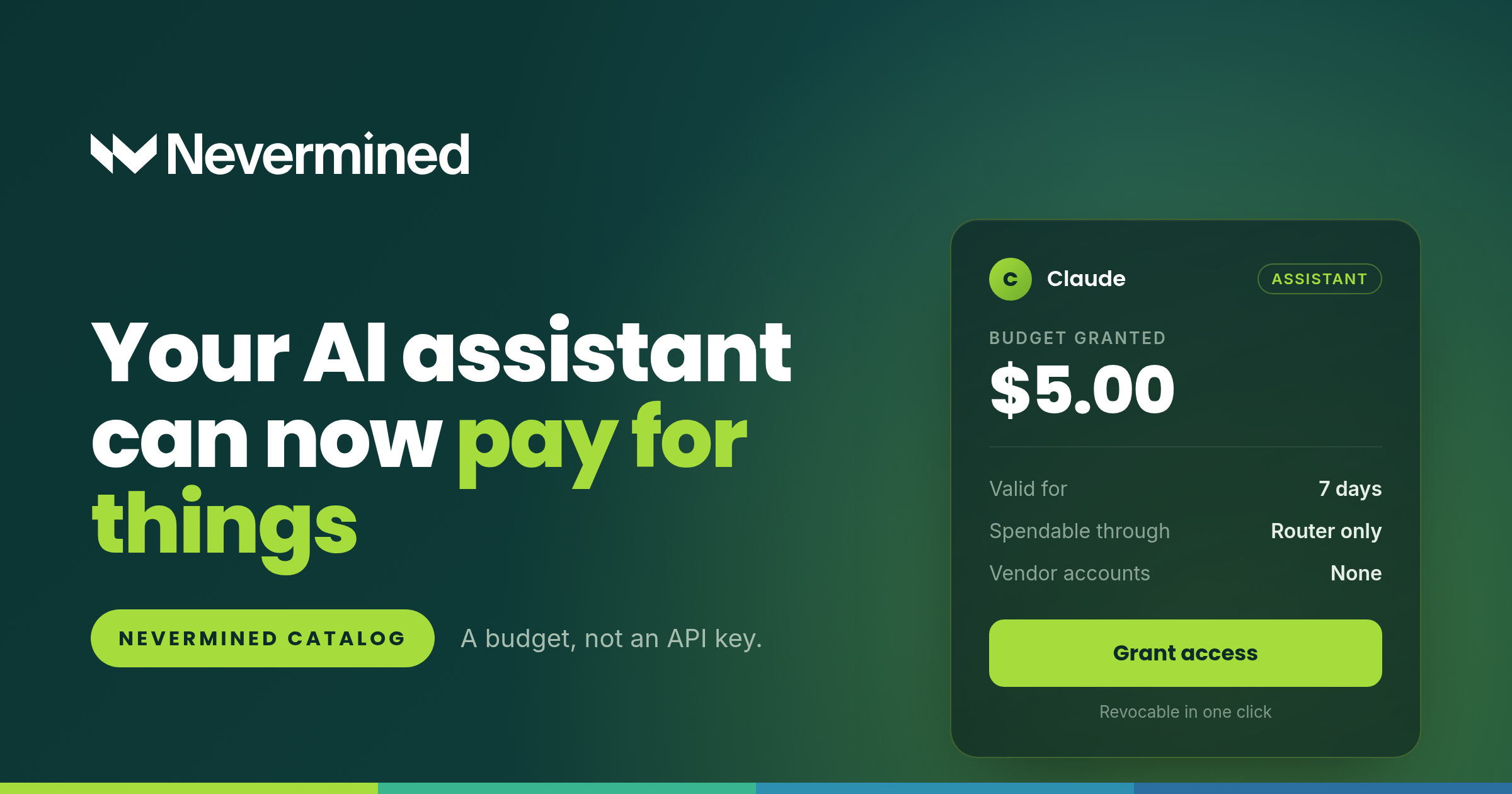
Nevermined introduces a fundamentally different model: rather than limiting agents to newly issued virtual card programs, users can delegate supported existing cards to AI agents through PCI-compliant enrollment secured by VGS. Card data is captured through a PCI-compliant VGS flow, and Nevermined states that it never sees or stores the raw card number.
Nevermined also delivers bank-grade enterprise-ready metering, compliance, and settlement so every model call turns into auditable revenue. Its core advantage is strongest for AI builders that need ledger grade metering, a dynamic pricing engine, credits-based settlement, 5x faster book closing, and margin recovery alongside delegated agent spending.
The "Bring Your Own Card" model provides important benefits for agent payment workflows:
This architecture also enables Nevermined to operate as an infrastructure layer rather than replacing every payment relationship. For AI builders, that means Nevermined can combine delegated spending, metering, pricing, and settlement in one payment layer while preserving flexibility across rails.
Stripe Issuing represents the incumbent approach to programmatic card creation. Stripe brings major ecosystem advantages, mature developer patterns, and card issuing infrastructure for companies that need to create, manage, and control virtual or physical card programs.
The most significant limitation for AI agent payments is that traditional card economics can be inefficient for high-frequency, sub-dollar agent transactions when fixed per-transaction fees apply. This matters because many agent workflows involve repeated small purchases, tool calls, or API calls rather than a single checkout event.
Additionally, Stripe Issuing is primarily a card issuing product. Stripe has broad billing and payments capabilities, but teams typically need to compose multiple Stripe products and add agent-specific controls to support delegated spending, metering, pricing, and AI service monetization. For teams building autonomous agent systems that need both spending and revenue capture, Nevermined provides a more purpose-built layer for AI-native metering, access control, credits, and settlement.
Crossmint takes a crypto-native approach to agent payments, combining stablecoin wallets, card products, and real-world commerce APIs. The platform says it serves over 40,000 companies and developers, and its own documentation lists support for 50+ blockchains.
Crossmint excels at enabling agents to purchase real-world goods and services. Its commerce APIs are especially relevant for consumer-facing agents that need to buy products from Amazon, interact with Shopify stores, or coordinate travel-related purchases through supported flows. The Merchant of Record model can also reduce operational complexity around returns, taxes, chargebacks, and customer support.
However, Crossmint is strongest as an agent wallet, stablecoin, card, and commerce infrastructure provider. Nevermined is the stronger choice for AI builders that need delegated agent spending plus AI-native service monetization, including ledger grade metering, dynamic pricing, credits-based settlement, auditable revenue, and margin recovery in one infrastructure layer.
One of Nevermined's most significant differentiators is its hybrid settlement infrastructure. While Stripe Issuing centers on card issuing and Crossmint focuses on wallet, card, stablecoin, and commerce infrastructure, Nevermined bridges agent spending and AI service monetization through a single integration.
The x402 Facilitator coordinates authorization, metering, redemption, and settlement across fiat, crypto, credits, and smart accounts. This payment coordination layer validates x402 tokens encoding scoped spend permissions, checks smart-account policies, and executes settlement through configurable rails.
Fiat Settlement:
Crypto Settlement:
Different use cases demand different settlement approaches. An enterprise purchasing API calls may prefer fiat settlement for accounting simplicity. A Web3 application might require stablecoin settlement for composability with on-chain logic. A global platform might need both depending on geography, user preference, and regulatory context.
Nevermined's PSP-agnostic architecture means teams can add or change payment processors with less dependence on a single-provider setup. This flexibility becomes increasingly valuable as the payment landscape evolves and different rails gain regulatory clarity in different jurisdictions.
Giving AI agents spending authority requires granular controls. All three platforms provide spending guardrails, but the implementation details and metering capabilities differ substantially.
Nevermined:
Stripe Issuing:
Crossmint:
Where Nevermined truly separates from competitors is in metering infrastructure. Usage records are cryptographically signed and pushed to append-only logs at creation. Pricing rules can be attached to agent usage credits, enabling zero-trust reconciliation between service consumption and billing.
This architecture is designed so usage records are verifiable and retroactive alteration is detectable. Enterprise teams can independently confirm that usage totals match billed amounts, reducing disputes between agent owners and service providers.
Nevermined delivers bank-grade enterprise-ready metering, compliance, and settlement so every model call turns into auditable revenue. The platform provides ledger grade metering, a dynamic pricing engine, credits-based settlement, 5x faster book closing, and margin recovery capabilities.
Enterprise adoption requires more than features; it requires compliance certifications, rapid integration, and proven security practices.
Nevermined:
Stripe Issuing:
Crossmint:
Nevermined gets you from zero to a working payment integration in 5 minutes, with SDKs for both TypeScript and Python. The platform also provides LLM-friendly documentation structured for AI coding assistants and an MCP server enabling direct tool access for query and implementation guidance.
Stripe integration follows standard Stripe API patterns, and Stripe Billing plus Metronome support usage-based billing and metering. For agent-specific entitlements, credits, delegated payment capability, and service monetization workflows, teams still need to design the surrounding architecture.
Crossmint offers a single API for wallets, cards, and onramps, with enterprise pricing requiring sales consultation.
Nevermined's protocol-first architecture is designed to work across agent stacks through native x402, AP2, A2A, and MCP support. Stripe provides the Stripe Agent Toolkit. Crossmint supports integrations for MCP-compatible agent workflows.
The AI agent payments landscape requires pricing models built for real-time usage, credits, outcomes, and settlement rather than flat subscription models alone. Agents consume resources at varying rates, deliver different levels of value, and operate across diverse use cases.
Nevermined (Comprehensive):
Stripe Issuing:
Crossmint:
Among the three platforms compared here, Nevermined is the strongest fit when teams need both delegated agent spending and AI service monetization in one stack. Stripe and Crossmint support important pieces of the workflow, but the cited materials do not show the same integrated AI-agent billing layer with credits, dynamic pricing, metering, and settlement that Nevermined provides.
This matters because the agent economy involves two distinct participants:
Nevermined serves both roles through a single platform, reducing the need to stitch together separate spending and billing infrastructure.
The AI agent payments space involves complex coordination between card networks, payment processors, security providers, and AI platforms. Strategic partnerships signal platform maturity and integration capabilities.
For teams building AI agents that need to transact autonomously, Nevermined offers a combination of capabilities that neither Stripe Issuing nor Crossmint can match individually.
Complete ecosystem coverage: Among the three platforms compared here, Nevermined provides the strongest combined path for agents to spend and for service providers to earn through a single integration. This reduces the architectural complexity of connecting separate spending and billing systems.
Economic viability for high-frequency agent payments: Nevermined is designed for high-frequency, low-value agent payments through credits and stablecoin settlement paths. This makes it better aligned with agent workloads where many small service calls, model calls, and API interactions need to be priced, metered, and settled efficiently.
Persistent card delegation: Rather than requiring every agent workflow to start with a newly issued virtual card, Nevermined supports card enrollment and scoped delegation for agent spending. Users can maintain existing payment relationships while granting controlled spending authority to agents.
PSP flexibility: Nevermined's architecture works with multiple payment processors and rails, helping teams avoid unnecessary vendor lock-in. Teams can start with one supported payment path and expand their payment stack as their use cases evolve.
Proven deployment speed: Valory cut deployment time of their payments and billing infrastructure for the Olas AI agent marketplace from 6 weeks to 6 hours using Nevermined, clawing back $1000s in engineering costs.
Protocol-first architecture: Native support for x402, AP2, A2A, and MCP ensures compatibility as the agentic payments landscape evolves.
Tamper-proof metering: Cryptographically signed usage records and append-only logs help enterprise teams verify consumption, reconcile usage against payment, and reduce billing disputes between agent owners and service providers.
For AI builders who need both agent spending capabilities and service monetization infrastructure, with the flexibility to use supported card relationships and payment processors, Nevermined provides the most complete solution in the market today.
Stripe Issuing creates new virtual cards from a Stripe Issuing account, requiring users to fund separate card balances or connect to corporate expense accounts. Nevermined takes a different approach: users can enroll supported cards and create scoped delegations for AI agents with spending ceilings, expiration windows, and transaction limits. This means agents can transact through controlled payment authority without requiring every workflow to begin with a new card program. For enterprises, this can reduce operational overhead while preserving tighter control over agent spending.
Nevermined maintains bank-grade security through multiple layers of protection. Card data is captured by VGS (Very Good Security) and sent directly to Visa, with raw PANs never entering Nevermined systems. The platform holds SOC 2 Type II certification, ISO 27001 certification, and PCI SAQ-D level controls. User authentication leverages WebAuthn/passkey device binding for delegated card flows. Agents receive scoped API keys representing payment capability rather than card credentials, and mandate revocation happens instantly when needed.
Yes. Nevermined's x402 Facilitator coordinates metering, authorization, redemption, and settlement across fiat, crypto, and credits, including documented support for Stripe, PayPal, USDC on Base, and Nevermined credits. This hybrid settlement infrastructure means teams do not need to choose between payment paradigms or maintain separate integrations for every settlement preference. A single Nevermined integration can route transactions through the rails that make sense for each use case, whether that is fiat settlement for enterprise accounting simplicity or stablecoin settlement for on-chain composability.
Nevermined provides programmable guardrails for delegated payment authority. Teams can configure total spending limits, delegation-level spending ceilings, transaction count limits, delegation expiration windows, plan-specific access, and API key scoped payment capability. Controls can be modified or revoked instantly via API. The system generates audit trails for payment authority and usage activity, supporting compliance reporting and dispute resolution.
Tamper-proof metering solves the trust problem in agent-to-service transactions. Usage records are cryptographically signed at creation and pushed to append-only logs, creating a verification layer where enterprise procurement and finance teams can compare usage totals against billed amounts. For AI platforms selling services to agents, this strengthens revenue assurance by tying consumption to payment records. For agent owners, it creates a clearer basis for validating what was used, when it was used, and what should be paid.
See Nevermined
in Action
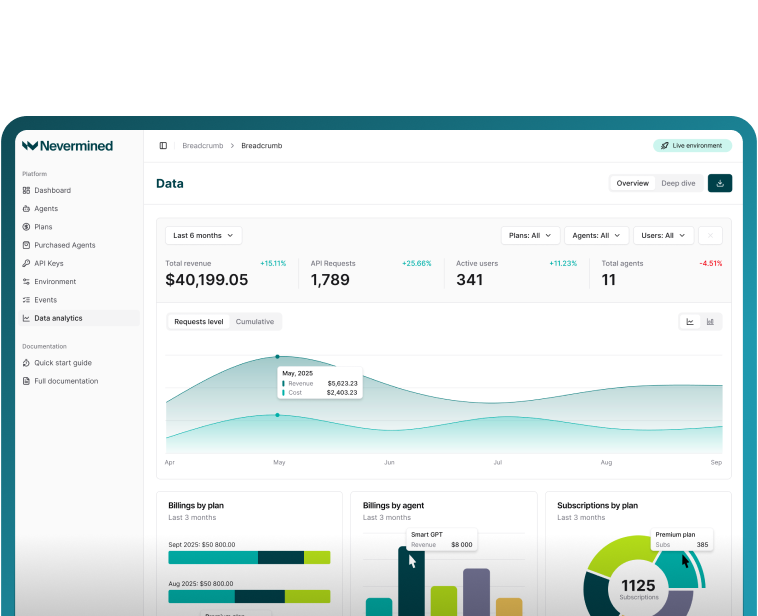
Real-time payments, flexible pricing, and outcome-based monetization—all in one platform.