MENU


AI agents are starting to browse, compare, call tools, request data, and trigger transactions on behalf of users. McKinsey describes agentic commerce as a shift where AI agents can act on users’ behalf across search, decisioning, and transactions. That creates a payment problem: card issuing and checkout systems can support controlled spending, but agent commerce also needs authorization, access control, usage metering, pricing, and settlement tied to what the agent actually does.
Visa Intelligent Commerce, Mastercard Agent Pay, and Stripe Issuing each address part of the AI agent payment stack. Visa and Mastercard focus on card-network infrastructure for agent-led payments, while Stripe Issuing supports programmable card creation and spend controls. Nevermined is built for programmable AI agent payments that go beyond card delegation: delegated spending, metering, access control, credits, x402 coordination, and settlement for autonomous AI workflows.
Card issuing gives an agent a payment instrument. That matters, but it does not cover the full agent commerce workflow.
An AI agent may buy API access, run an MCP tool, unlock a dataset, pay another agent, or consume a protected service. Each action raises questions that a card transaction alone may not answer:
For AI builders, the payment layer needs to connect spend authority to service access, usage records, and settlement. That is the gap between card issuing and programmable AI agent payments.
Nevermined gives AI builders the infrastructure to let agents pay and let merchants monetize what agents consume. Visa Intelligent Commerce, Mastercard Agent Pay, and Stripe Issuing focus mainly on controlled ways for agents to spend. Nevermined connects that spending layer to authorization, payment-based access, metering, pricing, credits, and settlement.
That distinction matters when agents do more than complete purchases. An agent may call an API, use an MCP tool, unlock a dataset, trigger a workflow, or interact with another agent. Nevermined ties those actions to payment status, access rules, usage records, pricing logic, and settlement.
The x402 Facilitator coordinates authorization, metering, and settlement across fiat rails, credits, smart accounts, and stablecoin settlement flows. For teams building programmable AI services, this creates a payment layer that supports both agent spending and agent monetization.
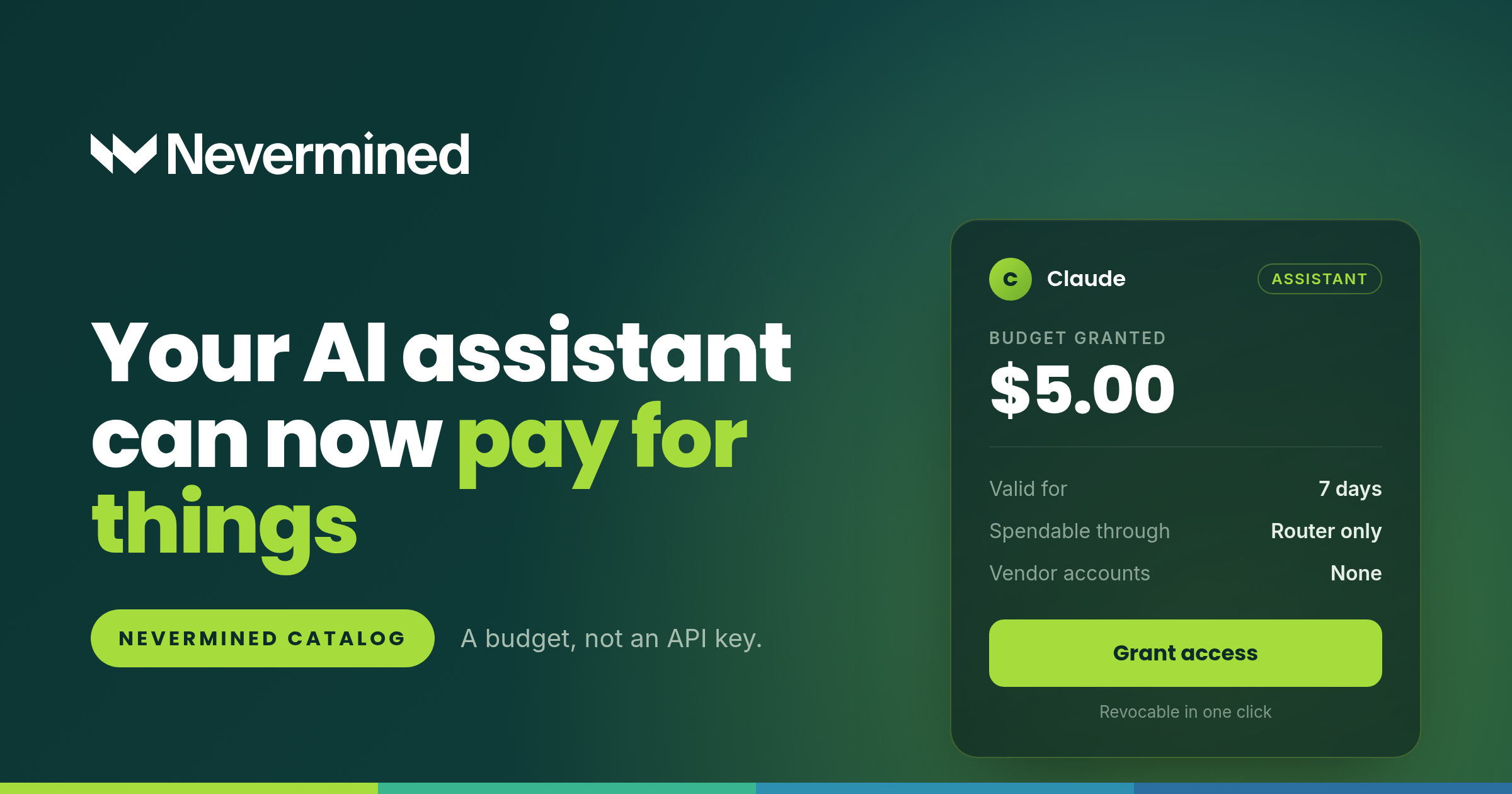
Nevermined’s card delegation workflow also gives agents scoped payment capability instead of raw card credentials. Users can define transaction limits, daily caps, time windows, merchant rules, transaction counts, and revocation controls.
Nevermined fits AI products where agents need to spend and merchants need to earn from usage. It is especially relevant for:
For these teams, the commercial layer needs to do more than create a card. It needs to know which agent acted, what was consumed, which pricing rule applied, whether access should continue, and how revenue should settle.
Visa Intelligent Commerce brings agent-led payments into card-network infrastructure. It focuses on tokenized credentials, user authentication, spending controls, and payment protections for agents acting on behalf of users.
Visa fits payment flows where agents need to transact through card-network rails. It applies to issuers, platforms, and commerce partners that want agent-led activity to remain compatible with existing card acceptance.
This can be useful when the agent payment flow resembles consumer or business purchasing through card infrastructure.
Visa operates at the network layer. AI builders may still need application-layer infrastructure for:
Visa can support the payment credential layer. Agent-native products still need infrastructure that connects payment to agent activity, usage, and revenue.
Mastercard Agent Pay focuses on tokenization, transaction attribution, registered-agent concepts, and user-defined controls for agent-led commerce.
Mastercard fits agentic commerce workflows that need card-network structure, payment credentials, trust signals, and attribution for agent-related transactions.
It is relevant for issuers, merchants, and platforms that want agent activity to work through card-network payment flows while adding more context around the agent behind the transaction.
Mastercard provides network infrastructure rather than a full agent monetization stack. AI builders may still need separate systems for:
Mastercard can support structured agent-led payments on card rails. AI service teams still need the product-level layer that turns agent activity into billable usage.
Stripe Issuing lets businesses create and manage virtual and physical card programs through Stripe’s APIs and dashboard. For AI agent payments, it is relevant when a team needs programmable cards, spend controls, and card issuing infrastructure.
Stripe Issuing fits businesses that want to create cards for controlled spending workflows. It can apply to agent use cases where the agent needs a virtual card to complete approved purchases inside defined rules.
It is especially relevant for teams already operating with Stripe for payments, platform tools, or financial operations.
Stripe Issuing provides card infrastructure. AI builders may still need additional systems for:
Stripe Issuing can support controlled spending. Agent-native products often need an additional layer for usage, pricing, access, and revenue settlement.
Card issuing answers one question: how can an agent spend?
Programmable AI agent payments answer a broader set of questions:
Visa, Mastercard, and Stripe Issuing are most relevant to the spending side of the workflow. Nevermined fits the broader payment layer because it connects agent spending to monetization. Agents can transact within scoped limits, while merchants can meter usage, enforce access, apply pricing, and settle revenue from APIs, MCP tools, datasets, agents, and protected resources.
For AI teams, the core question is not only which platform can issue or tokenize a payment credential. It is which platform can turn autonomous agent activity into payable, metered, and settled revenue.
Agent payment standards are still developing. AI builders may need support for HTTP-native payments, tool monetization, agent-to-agent workflows, and payment coordination across different systems.
Nevermined supports:
This matters because AI agent payments are not limited to one rail or one protocol. A platform may need cards for procurement, credits for repeated usage, x402 for paid APIs, MCP for tools, and A2A for multi-agent workflows.
AI teams do not want to rebuild payment logic before they can monetize agents. They need infrastructure that handles payment capability, access control, usage records, pricing, and settlement without slowing down product development.
Nevermined provides SDKs, APIs, dashboard tools, and documentation for AI services. The quickstart guide gives teams a path to register a service, create a payment plan, and accept payments through the app or SDKs.
Integration paths include:
Valory cut deployment time of its payments and billing infrastructure for the Olas AI agent marketplace from 6 weeks to 6 hours using Nevermined, clawing back thousands in engineering costs.
Visa Intelligent Commerce, Mastercard Agent Pay, and Stripe Issuing each address controlled agent spending through card or card-adjacent infrastructure. That is an important part of the stack, but agent-native products also need merchant-side monetization.
Nevermined fits teams that need the full commercial workflow around autonomous activity:
For AI builders, the core question is not only which platform can issue or tokenize payment credentials. It is which platform can connect agent activity to payment, access, usage, and revenue. Nevermined is built for that layer.
Visa Intelligent Commerce and Mastercard Agent Pay focus on card-network infrastructure for agent-led payments. Stripe Issuing focuses on programmable card creation and card program management. Nevermined focuses on the agent-native payment workflow around those transactions: delegated spending, payment-based access, usage metering, pricing, credits, and settlement.
AI agents need payment authority to complete tasks without asking a human to approve every small transaction. Delegated spending gives agents controlled authority within defined limits. Nevermined’s card delegation workflow lets users set transaction caps, daily limits, time windows, merchant rules, transaction counts, and revocation conditions while keeping raw card credentials away from the agent.
Card issuing can help agents spend, but it does not solve the full AI agent payment workflow. Builders also need to verify access, meter usage, apply pricing, manage credits, route settlement, and record what happened. Nevermined addresses those additional layers for APIs, MCP tools, datasets, agent services, and usage-based AI products.
x402 gives services a machine-readable way to request payment through HTTP-native flows. That matters for APIs, tools, datasets, and digital services where an agent needs to pay before access is released. Nevermined supports x402 through the x402 Facilitator, while adding metering, credits, access control, smart accounts, and settlement workflows around it.
AI builders should look for scoped payment authority, revocation controls, payment-based access, request-level metering, pricing flexibility, credits, settlement options, audit-ready records, and support for protocols such as x402, MCP, A2A, and AP2. Nevermined combines those layers for teams monetizing AI agents, APIs, MCP tools, datasets, and usage-based services.
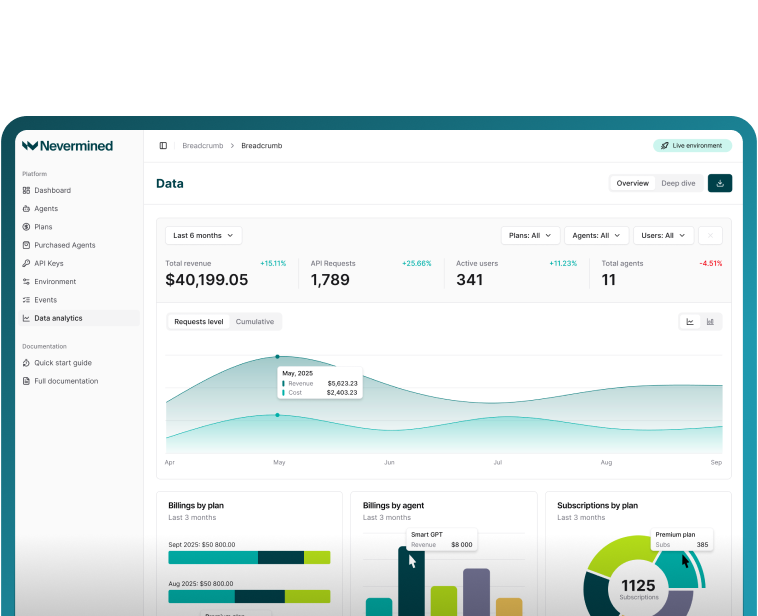
See Nevermined
in Action
Real-time payments, flexible pricing, and outcome-based monetization—all in one platform.