MENU


AI agents are moving closer to real economic activity: buying data, calling paid APIs, accessing tools, and coordinating work across services. A Bank for International Settlements paper on AI agents in payments highlights how autonomous systems can affect payment prioritization, liquidity, and settlement decisions. For AI builders, that shift creates a practical challenge: payments need to run inside software workflows, not around human checkout screens.
x402, Coinbase x402, and Skyfire each solve part of that challenge. x402 defines a machine-readable payment request pattern. Coinbase x402 connects that pattern to crypto-native payment infrastructure. Skyfire focuses on agent identity, trust, and payment capability. Nevermined is built for the full agent payment workflow across protocols, pricing models, and settlement options.
A protocol can define how a service asks for payment. That is useful when an agent requests an API response, MCP tool, dataset, workflow, or protected resource.
But production AI payments require more than the request itself. A builder still needs to know whether the agent was authorized, what it consumed, which price applied, whether access should continue, and how the transaction should settle.
Agent commerce also creates different pricing needs. Some services charge per request. Others charge through credits, time windows, subscriptions, completed outcomes, or workflow sessions. That means the payment layer needs to connect protocol-level authorization to commercial logic.
This is where the distinction matters. x402 defines a payment pattern. Coinbase x402 gives crypto-native teams a path for stablecoin transactions. Skyfire adds identity and trust infrastructure. Nevermined connects those payment events to metering, pricing, access, credits, and settlement.
Nevermined gives AI builders a payment layer for agents that need to spend, access paid resources, and generate revenue from usage. It connects payment authority, x402 coordination, metering, pricing, credits, access control, and settlement in one workflow.
That is important when agent payments are tied to real activity. An agent may call a paid API, use an MCP tool, unlock a dataset, access another agent’s service, or trigger a multi-step workflow. Nevermined ties those events to payment status, usage records, pricing rules, and settlement paths.
The x402 Facilitator coordinates authorization, metering, and settlement across fiat rails, credits, smart accounts, and stablecoin settlement flows. This lets teams use x402 without building the surrounding monetization layer from scratch.
Nevermined also supports delegated spending through its card delegation workflow. Agents receive scoped payment capability instead of raw card credentials, while users can define transaction caps, daily limits, time windows, merchant rules, transaction counts, and revocation conditions.
Nevermined is most relevant when an AI product needs payment infrastructure around real agent activity, not just a payment request.
It fits:
For these teams, the payment layer needs to answer more than “was payment sent?” It needs to show what the agent used, what should be charged, which entitlement applied, and how revenue should settle.
x402 is an HTTP-native payment protocol built around the 402 Payment Required response. It lets a service return a machine-readable payment requirement when an agent, application, or user requests a protected resource.
x402 is useful when a service needs payment inside an HTTP request flow. Instead of routing a user through a separate checkout page, the service can signal that payment is required and let the client respond programmatically.
It applies to:
x402 defines how payment can be requested and verified. It does not provide the full commercial system around the transaction.
Teams using x402 directly may still need:
x402 is a useful protocol layer. Nevermined adds the operating layer around it: metering, pricing, access, credits, and settlement.
Coinbase x402 refers to x402-related payment infrastructure and stablecoin flows associated with Coinbase’s developer ecosystem. It is most relevant for teams building around crypto-native payments, wallets, and onchain settlement.
Coinbase x402 applies when builders want to use x402-style payment requests in stablecoin or wallet-based environments. It fits products where agents are expected to transact through crypto rails rather than card, invoice, or wallet checkout flows.
It applies to:
Crypto-native payment flows do not address every buyer or merchant requirement. AI builders may still need support for non-crypto customers, enterprise procurement, credits, revenue analytics, or multi-protocol monetization.
Teams may still need:
Coinbase x402 can support crypto-native payment paths. Nevermined is broader when teams need x402 plus fiat rails, credits, pricing, metering, and settlement in the same workflow.
Skyfire focuses on agent identity, trust, mandates, and payment capability. Its Know Your Agent approach is designed to help services understand which agent is acting, who it represents, and whether it has permission to transact.
Skyfire is relevant when the main payment question is identity and trust. A merchant or service may need to evaluate whether an agent is legitimate, whether a user authorized it, and whether payment capability is attached to the request.
It applies to:
Skyfire is identity-centered infrastructure. Teams monetizing AI services may still need systems that connect identity and payment authority to product usage, pricing, and revenue settlement.
Teams may still need:
Skyfire can support the identity and trust layer. Nevermined connects payment authority to the monetization layer: metering, pricing, credits, access, and settlement.
AI agent payments are spreading across several standards. x402 matters for HTTP-native access. MCP matters for tools and resources. A2A matters for agent-to-agent coordination. AP2 matters for payment authorization in agent commerce.
Nevermined supports:
This gives teams room to support more than one agent workflow. A marketplace may use x402 for APIs, MCP for tools, A2A for agent services, and credits for repeated usage. Nevermined ties those patterns to the same payment and settlement layer.
Agent payments do not always map to one per-request price. Some AI services charge by usage. Others charge by session, access period, credit package, completed workflow, or business outcome.
Nevermined supports monetization patterns such as:
That flexibility matters because agent value is uneven. A simple API call, a completed workflow, and an agent that generates revenue for a customer should not always be priced the same way.
x402 can support the payment request. Nevermined connects that request to pricing rules, credits, usage records, access decisions, and settlement.
AI payments need more than one settlement path. Enterprise buyers may need fiat rails. AI-native workflows may prefer credits. Crypto-native services may use stablecoins. Some workflows may use smart accounts for programmable execution.
Nevermined supports:
That keeps teams from choosing one payment rail too early. A product can support enterprise procurement, prepaid usage, protocol-based payments, and programmable settlement without rebuilding the commercial layer for each rail.
AI teams do not want to stitch together protocol handling, wallets, metering, pricing, access control, and settlement before they can launch. They need a path from payment concept to working monetization infrastructure.
Nevermined provides SDKs, APIs, dashboard tools, and documentation for AI services. The quickstart guide gives builders a path to register a service, create a payment plan, and accept payments through the app or SDKs.
Integration paths include:
Valory cut deployment time of its payments and billing infrastructure for the Olas AI agent marketplace from 6 weeks to 6 hours using Nevermined, clawing back thousands in engineering costs.
x402, Coinbase x402, and Skyfire each address one layer of agent payments. x402 defines the request pattern. Coinbase x402 focuses on crypto-native execution. Skyfire focuses on identity and trust.
Nevermined connects those layers to the commercial workflow AI builders need:
For AI builders, the core question is not only which protocol or wallet can move payment. It is which platform can connect agent activity to permission, access, pricing, usage records, and settlement. Nevermined is built for that full commercial layer.
x402 is a protocol for machine-readable HTTP payment requests. Nevermined supports x402 while adding metering, pricing, access control, credits, delegated spending, and settlement infrastructure around it. Teams using x402 directly may still need to build those layers separately.
Coinbase x402 is relevant for crypto-native teams using x402-style stablecoin payment flows. Nevermined supports x402 while also adding fiat rails, credits, smart accounts, flexible pricing, access control, metering, and settlement workflows.
Skyfire fits workflows where agent identity, trust, mandates, and payment capability are central. It helps services reason about which agent is acting and whether authority is attached to the request. Teams that also need usage metering, pricing, credits, MCP monetization, A2A workflows, and settlement may need additional infrastructure around it.
AI agents create value in different ways. Some services charge per request, some charge for access, some charge by completed workflow, and some use prepaid credits. A payment layer for AI agents needs to support more than one per-request model. Nevermined supports usage-based, credit-based, time-based, session-based, outcome-oriented, value-based, and dynamic pricing patterns.
AI builders should look for protocol support, scoped payment authority, revocation controls, payment-based access, request-level metering, pricing flexibility, credits, settlement options, and audit-ready records. Nevermined combines those layers across x402, MCP, A2A, AP2, fiat rails, credits, smart accounts, and stablecoin settlement flows.
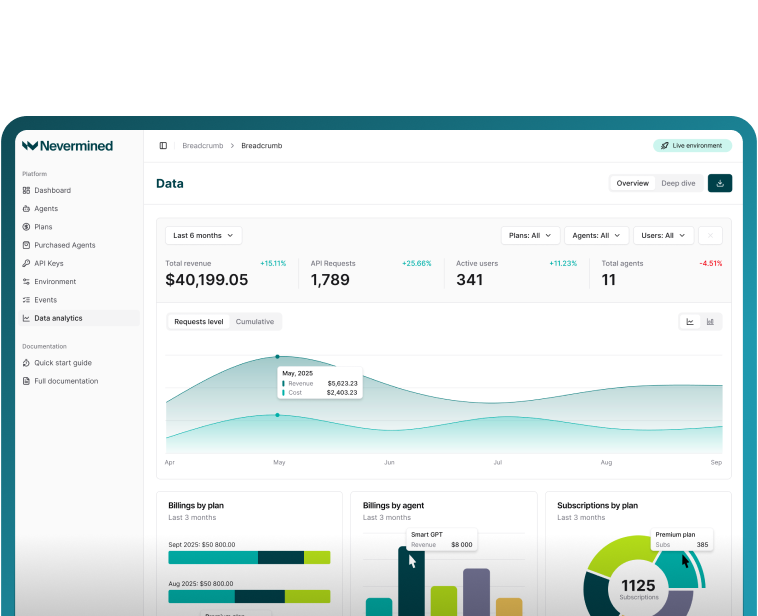
See Nevermined
in Action
Real-time payments, flexible pricing, and outcome-based monetization—all in one platform.