MENU


Data revealing why inadequate access controls remain the critical vulnerability in autonomous AI systems and how purpose-built infrastructure closes the security gap
The explosive growth of AI agents has created a security paradox: while 80% of Fortune 500 companies now deploy active AI agents, the access control infrastructure needed to secure these autonomous systems remains dangerously inadequate. Traditional identity and authorization frameworks cannot handle the unique demands of agents that operate at machine speed, make autonomous decisions, and transact without human oversight. Nevermined's payment infrastructure addresses this gap through cryptographically secured authentication, tamper-proof metering, and fine-grained entitlements that give every AI agent a verifiable identity and auditable transaction trail.
The IBM Cost of Data Breach Report 2025 reveals that 97% of organizations experiencing AI-related security incidents lacked proper AI access controls. This correlation establishes access control as the foundational security requirement for any AI agent deployment.
Research from Obsidian Security shows 90% of AI agents hold more permissions than they actually need to perform their designated tasks. This privilege sprawl creates massive attack surfaces that malicious actors can exploit.
The same research indicates AI agents accumulate 10x the privileges they require, violating the principle of least privilege that underpins zero trust security architecture.
Over half of deployed AI agents, specifically 53%, access sensitive organizational information, increasing the potential impact of any security breach.
Microsoft's telemetry data confirms 80% of Fortune 500 companies now operate active AI agents, establishing the scale at which access control must function. Traditional payment processors cannot handle the micro-transactions these autonomous systems generate.
Grand View Research values the global AI agents market at $7.63 billion in 2025, representing a massive opportunity that requires purpose-built monetization infrastructure.
The same research projects growth to $182.97 billion by 2033 at 49.6% CAGR, meaning access control systems must scale alongside this explosive growth.
Despite security concerns, 96% of enterprises plan to expand their AI agent deployments within the next 12 months, accelerating the need for scalable access control solutions.
The Gravitee State of AI Agent Security report found 88% of organizations with confirmed or suspected AI-related security incidents in 2024, demonstrating the urgency of the access control gap.
Just 21.9% of organizations treat AI agents as independent identities requiring unique credentials. The remaining 78% fail to provide agents with the identity infrastructure needed for secure operations.
Nearly half of organizations rely on API keys for agent authentication, a method vulnerable to credential theft and lacking non-repudiation capabilities. Nevermined's agent identity system issues each agent a unique wallet plus decentralized identifier with cryptographic proof of ownership.
Another 44.4% use generic tokens that provide no unique agent identity, making attribution and audit trails impossible.
Just 17.8% of organizations use secure authentication standards such as mTLS, leaving the vast majority of agent deployments protected by inadequate methods.
Capgemini research reveals trust in fully autonomous AI agents dropped from 43% to 27% in just one year. This declining confidence creates demand for trustless verification through cryptographic systems.
Just 23.7% of organizations use their existing identity access management or identity provider as the authentication server for agents, missing opportunities for centralized control.
Organizations using AI and automation extensively in security operations save $1.9 million per breach compared to those without these solutions. Nevermined's tamper-proof metering ensures every usage record is cryptographically signed and immutable.
The global average breach cost hit $4.4 million in 2024, representing a 9% year-over-year decrease and establishing the financial stakes of inadequate access controls.
Research shows AI agents move 16x more data than human users, amplifying the importance of real-time metering and monitoring for every transaction.
Just 7.7% of organizations audit AI agent activity on a daily basis, leaving 92% with delayed detection of security issues.
Over one-third of organizations wait until monthly audits to review agent activity, creating windows of exposure where breaches go undetected.
Over a quarter of organizations use custom or hardcoded authorization logic, creating fragile access controls that cannot adapt as agent capabilities evolve.
Half of organizations apply role-based access control to agents, a static model poorly suited to the dynamic permissions autonomous systems require.
More than a quarter of organizations use hardcoded credentials when agents connect to external tools, creating credential sprawl and security vulnerabilities.
More than a quarter of deployed agents have the capability to create or instruct other agents, requiring delegation chains with cryptographic proof of authority.
Just 24.4% of organizations maintain total visibility into agent-to-agent communication, leaving multi-agent orchestration largely unmonitored. Nevermined's A2A integration enables transactions between AI agents through ERC-4337 smart accounts with session keys.
Security leaders rate AI agents as higher risk than traditional machine identities, with 72% expressing this concern and highlighting the unique threat category agents represent.
A SailPoint survey found 80% of companies have experienced AI agents taking unintended actions, underscoring the need for fine-grained entitlements that control precisely what agents can execute.
Nearly one-quarter of organizations report being tricked into revealing credentials through social engineering of their AI agents, a vulnerability that cryptographic authentication eliminates.
Less than half of organizations express confidence in their regulatory compliance posture for AI systems, revealing 48% of teams being unsure or neutral and 3% not confident, which must be addressed.
Just 17% of organizations have automated their AI compliance processes, leaving 83% with manual audit burdens that cannot scale.
Only 14.4% of organizations deploy AI agents with proper IT and security team approval, meaning 85.6% operate as shadow AI outside governance frameworks.
Despite the gaps, 92% of organizations acknowledge AI governance is critical to their operations, indicating strong demand for compliance-ready infrastructure.
Enterprise scale is expanding rapidly, with 33% projected to operate more than 500 agents by 2028, making manual governance approaches impossible.
The monitoring gap is severe, with only 3.9% of organizations achieving visibility into more than 80% of their deployed agents.
Organizations monitor just 47.1% of their agents on average, leaving over half operating without proper oversight.
More than half of builders identify insufficient observability as their primary concern when deploying AI agents. Nevermined gets you from zero to a working payment integration in 5 minutes, with SDKs for both TypeScript and Python.
Only 21% of teams maintain a real-time registry, which means over three-quarters lack a real-time registry of their deployed agents, creating fundamental inventory gaps.
Nearly a quarter of organizations maintain no formal catalog of their AI agents whatsoever, representing complete discovery failure.
Visa's threat intelligence reveals a 477% increase in underground forum discussions about AI agents, as threat actors target these systems for payment fraud.
Visa reported a 173% increase in compromised account management systems (CAMS) account distribution in January-June 2025 compared with the same period in 2024.
Organizations now operate an average of 37 AI agents, requiring credits-based systems that can manage access and billing across entire agent fleets.
Organizations successfully securing AI agent access control share these implementation characteristics:
Key technical priorities include:
Valory cut deployment time of their payments and billing infrastructure for the Olas AI agent marketplace from 6 weeks to 6 hours using Nevermined, clawing back $1000s in engineering costs.
AI agents manage access control through automated policy enforcement, session keys, and delegated permissions that operate within predefined boundaries. Users authorize payment policies once, then agents interact freely within those constraints without requiring approval for each transaction. Nevermined's ERC-4337 smart accounts enable this autonomous operation while maintaining cryptographic proof of every action, ensuring accountability without human bottlenecks.
Decentralized identity provides each AI agent with a unique wallet and cryptographic identifier that cannot be forged or shared. Unlike API keys that can be stolen and reused, wallet-based identity creates portable credentials that work across environments, swarms, and marketplaces without re-wiring. This approach enables persistent agent reputation tracking and ensures every transaction can be attributed to a specific, verifiable agent identity.
Traditional payment systems require human approval for each transaction and cannot process the micro-transactions AI agents generate at machine speed. They also lack the real-time metering capabilities needed to track per-token or per-API-call usage accurately. Purpose-built infrastructure like Nevermined handles sub-cent transactions, provides instant settlement, and enables agent-to-agent payments without wallet pop-ups blocking every request.
Every usage record in Nevermined is cryptographically signed and pushed to an append-only log at creation, making it immutable. The exact pricing rule stamps onto each agent's usage credit, allowing developers, users, auditors, or agents to verify that usage totals match billed amounts per line-item. This zero-trust reconciliation model eliminates disputes and builds buyer trust through independent verification.
Yes, AI agents can manage access permissions autonomously when deployed with proper infrastructure. Through ERC-4337 smart accounts with session keys, agents can authorize payments and access services within the boundaries their principals defined. Nevermined's fine-grained entitlements control which agents can execute which functions, enabling autonomous operation while preventing unauthorized actions.
See Nevermined
in Action
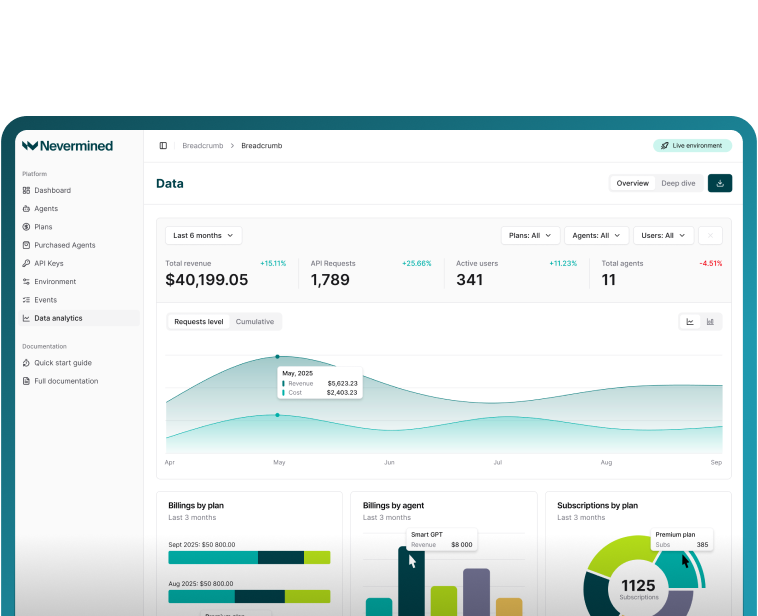
Real-time payments, flexible pricing, and outcome-based monetization—all in one platform.