MENU


AI agents are transforming how businesses operate, but their ability to transact autonomously creates a fundamental challenge: traditional payment processors were built for humans, not machines. When a single AI agent conversation can trigger hundreds of API calls, each costing fractions of a cent, conventional payment rails become economically unworkable. Purpose-built payment infrastructure solves this problem by enabling real-time metering, micropayment processing, and instant settlement designed specifically for autonomous systems.
AI agent payments, also called agentic payments, represent infrastructure that enables autonomous AI software agents to make and receive financial transactions without human intervention. Unlike traditional payment systems designed for human-initiated purchases, agentic payment platforms handle micropayments, real-time metering, agent-to-agent value transfer, and autonomous authorization within predefined spending rules.
The economics of traditional payment processing break down completely when applied to AI agent workloads. Card processors charge approximately 1.5% to 3.5% per transaction. When an AI research agent calls weather data, financial news, and market analytics APIs hundreds of times daily at $0.02 per call, traditional fees would exceed the payment value substantially.
Major financial institutions recognize this shift. Visa and Mastercard have launched dedicated agentic AI programs. Visa Intelligent Commerce issues scoped virtual cards to agents with programmable spending controls. Mastercard Agent Pay provides tokenized payment credentials with rule-based authorization. These programs signal that autonomous agent transactions are moving from experimental to mainstream.
The market opportunity is substantial. Industry analysts project agentic commerce will reach $3 to $5 trillion by 2030, with consumer purchases representing approximately 40% of total volume. This growth requires payment infrastructure capable of handling high-velocity, low-value transactions that traditional systems cannot economically support.
Monetizing AI agent interactions demands pricing flexibility that traditional billing systems lack. Most payment processors support only usage-based models, but agents create value in multiple ways that require different approaches.
Effective AI agent monetization supports three distinct pricing models:
This flexibility matters because different agents deliver value differently. A coding assistant might best suit per-token billing. A sales development agent that books qualified meetings creates clear outcome-based value. A trading agent generating returns warrants value-based compensation.
Dynamic pricing engines enable cost-plus-margin automation where platforms define exact margin percentages locked onto usage credits. This approach ensures profitability as AI inference costs fluctuate, which they do constantly as model providers adjust pricing.
Credit systems operate as prepaid consumption-based units redeemed directly against usage. Users prepay credits, monitor burn rate in real-time, and avoid surprise overruns. Finance teams receive trackable recurring billing instead of complex sub-cent charge reconciliation. This predictability becomes essential when managing budgets across fleets of autonomous agents.
As multi-agent systems become standard, agents must transact with each other without human bottlenecks. Traditional payment flows requiring approval for each request cannot support agent swarms that need to collaborate in real-time.
ERC-4337 smart accounts with session keys enable true agent autonomy. Users authorize payment policies once, defining spending limits and allowed transaction types. Agents then interact freely within those boundaries without requiring wallet pop-ups or human confirmation for each request.
This architecture supports sophisticated multi-agent workflows:
Each agent operates within its designated policy envelope, maintaining security while enabling speed.
Standard implementations of payment protocols require wallet confirmation for each transaction. This approach makes sense for human users making occasional purchases but creates unworkable friction for agents making hundreds of requests per hour.
Session keys with configurable expiration windows solve this problem. An agent receives delegated authority to transact within specific parameters. The A2A protocol from Google and Salesforce enables agents to discover services, negotiate terms, and complete transactions through standardized communication patterns that maintain security without constant human intervention.
Trust represents the fundamental challenge in autonomous agent transactions. How can businesses verify that AI agents managing tasks autonomously are accurately reporting usage and costs? Tamper-proof metering provides the answer.
Every usage record should be cryptographically signed and pushed to an append-only log at creation, making it immutable. The exact pricing rule stamps onto each agent's usage credit, allowing developers, users, auditors, or agents to verify that usage totals match billed amounts per line-item.
This zero-trust reconciliation model means:
For enterprise implementations, this verifiability addresses concerns about giving AI agents financial authority. Finance teams can verify agent spending independently rather than trusting platform-reported totals.
Emerging regulations including the EU AI Act require traceability for high-risk AI systems. Agent payment infrastructure must capture not just what transactions occurred but why specific spending policies triggered authorization.
Compliance-ready platforms provide:
Banks and fintechs evaluating agentic payments should prioritize platforms offering tamper-proof audit trails that satisfy both internal controls and regulatory requirements.
Speed to market separates successful AI products from abandoned experiments. Building custom payment infrastructure consumes engineering resources better spent on core product development.
Low-code SDKs enable rapid deployment. Nevermined gets you from zero to a working payment integration in 5 minutes, with SDKs for both TypeScript and Python. Integration follows three steps:
Comprehensive documentation provides implementation guides, sandbox environments for testing, and API export capabilities for metering data verification.
Real-world results demonstrate the value of purpose-built infrastructure. Valory cut deployment time of their payments and billing infrastructure for the Olas AI agent marketplace from 6 weeks to 6 hours using Nevermined, clawing back $1000s in engineering costs. CEO David Minarsch stated: "We knew AI agents need to be able to transact, so over a year ago we tapped into Nevermined. Nevermined was, and continues to be, the best solution for AI payments."
The agentic payment landscape features multiple competing protocols and standards. Betting on the wrong protocol creates vendor lock-in and potential rework as the market consolidates.
Protocol-first architecture supporting multiple standards ensures compatibility as the ecosystem evolves:
Platforms that support portable agent identities using decentralized identifiers avoid lock-in to specific ecosystems. Agents can work across environments, swarms, and marketplaces without credential re-wiring.
Effective agent payment systems require more than transaction processing. Agents need persistent identities that enable reputation tracking, permission management, and attribution across complex workflows.
Agent identity systems issue each agent a unique wallet plus decentralized identifier with cryptographic proof of ownership at registration. These portable identities enable:
For multi-agent systems, proper attribution becomes essential. When an agent swarm completes a task, the system must allocate costs and revenue correctly across participating agents. Decentralized identifiers provide the foundation for this attribution.
Enterprise AI platforms require bank-grade infrastructure that scales reliably while meeting compliance requirements.
Nevermined delivers bank-grade enterprise-ready metering, compliance, and settlement so every model call turns into auditable revenue. Key enterprise capabilities include:
The x402 facilitator coordinates authorization, metering, and settlement across fiat, crypto, credits, and smart accounts. This unified approach simplifies integration while supporting diverse payment preferences.
Production stacks increasingly use stablecoins as the operational substrate with card networks providing final-mile conversion for merchant payments. This hybrid architecture combines instant settlement for agent-to-agent transactions with broad merchant acceptance for consumer-facing purchases.
For teams building AI agents that need to transact, Nevermined offers the fastest path from concept to production. The platform addresses every challenge covered in this guide: micropayment economics, flexible pricing models, agent-to-agent transactions, tamper-proof compliance, rapid integration, and protocol interoperability.
Nevermined Pay provides real-time metering, a flexible pricing engine, and instant settlement in fiat or cryptocurrency. The credits system enables prepaid consumption-based billing that aligns price to value. Audit-ready traceability satisfies compliance requirements without custom development.
The platform supports native integration with x402, Google A2A, Model Context Protocol, and Agent Payments Protocol. This protocol-first approach ensures your implementation remains compatible as standards evolve.
With a 1% transaction fee and free tier access for testing, Nevermined removes barriers to getting started. Enterprise pricing supports high-volume operations with custom deployment options. The documentation includes LLM-friendly structure for AI coding assistants, making integration even faster for teams using modern development tools.
Partners including Buildship, Xpander, Olas, Naptha AI, Mother, and Helicone have already integrated Nevermined into their agent infrastructure. For teams serious about monetizing AI agents, Nevermined provides the payment rails purpose-built for the agentic economy.
Traditional payment systems were designed for human-initiated transactions with relatively high values and low frequency. AI agents generate the opposite pattern: high-frequency, low-value transactions happening autonomously around the clock. Card processors charging $0.30 minimum per transaction make sub-dollar payments uneconomical, while agents routinely need to process thousands of micropayments daily. Purpose-built agent payment infrastructure handles these patterns through stablecoin settlement, real-time metering, and programmable spending policies that eliminate human approval bottlenecks.
Spending controls for AI agents operate through policy-based authorization rather than per-transaction approval. Users define spending envelopes specifying per-request limits, hourly caps, daily maximums, and allowed transaction types or domains. ERC-4337 smart accounts with session keys enforce these policies cryptographically, allowing agents to transact freely within boundaries while preventing unauthorized spending. Alert thresholds at 80% and 95% of budgets notify operators before funds deplete, and hard caps prevent runaway spending regardless of agent behavior.
AI agent payment platforms typically support both cryptocurrency and traditional fiat settlement. Stablecoin settlement using USDC provides near-instant finality in under three seconds with approximately 0.1% fees and no minimum transaction threshold. Traditional card rails offer broader merchant acceptance and chargeback protection but require two to three business days for settlement and minimum fees that make micropayments uneconomical. Many production implementations use hybrid approaches with stablecoins for agent-to-agent transactions and card conversion for consumer-facing purchases.
Multi-agent systems require attribution mechanisms that track which agents performed which work. Decentralized identifiers provide persistent agent identities that carry reputation and usage history across platforms. Smart contracts enable programmable revenue splits that automatically distribute payments across participating agents based on contribution. Payment facilitators coordinate these splits through escrow with conditional release, ensuring each agent receives appropriate compensation without manual reconciliation.
Regulatory frameworks for AI agent payments are evolving but increasingly require traceability and auditability. The EU AI Act mandates logging for high-risk AI systems, which includes autonomous agents making financial decisions. Platforms must provide tamper-proof audit trails with cryptographic signatures proving transaction authenticity. GDPR compliance requires appropriate data handling for transaction records. Organizations should verify that their payment infrastructure provides immutable logging, exportable audit reports, and consent verification for agent-initiated transactions.
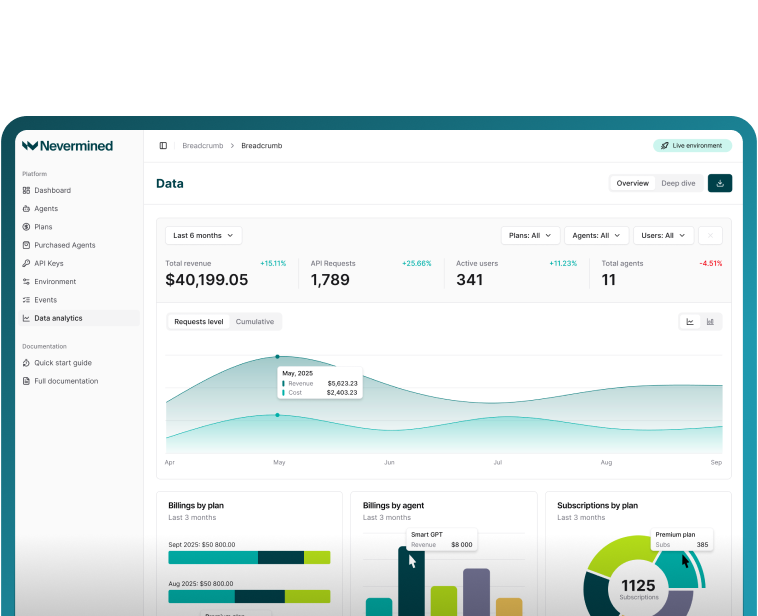
See Nevermined
in Action
Real-time payments, flexible pricing, and outcome-based monetization—all in one platform.