MENU


AI agents are moving from product discovery into authorized purchasing. McKinsey estimates that agents could mediate $3 trillion to $5 trillion in global consumer commerce by 2030, increasing demand for scoped credentials, merchant acceptance, authenticated user intent, fraud controls, and auditable transaction records.
Visa and Mastercard are building network-level frameworks for agent-initiated transactions. Issuers, payment processors, commerce platforms, and orchestration providers are developing the services that connect agents and merchants to those frameworks.
These platforms do not all perform the same role. Some issue credentials, some help merchants accept agent-led checkout, and others coordinate metering, access, pricing, and settlement for digital services. This guide covers ten important platforms across those layers.
Teams should first identify whether the provider is a network, issuer, processor, wallet, merchant platform, or commercial orchestration layer.
A business issuing agent credentials has different requirements from a merchant accepting agent-led checkout or an API provider charging per request.
An agent should receive limited payment authority rather than unrestricted card details. Relevant restrictions include:
The payment system should preserve evidence that an agent’s transaction matches what the user or organization authorized.
Passkeys, tokenized credentials, signed instructions, approval rules, and verifiable intent records can help establish that authority.
The credential must work with the merchant’s processor or checkout environment. Some platforms update existing merchant integrations, while others give agents virtual credentials that can be entered into conventional checkout forms.
Paid APIs, tools, datasets, and agent services often need capabilities beyond card authorization:
Agent payments are developing quickly. Buyers should confirm geography, issuer eligibility, supported cards, account requirements, production access, and whether a capability is generally available or still in pilot.
Nevermined provides payment and monetization infrastructure for agents that need to purchase services and AI merchants that need to charge for digital resources.
It should be understood as a commercial coordination layer rather than a card network, issuer, or merchant acquirer.
Nevermined combines delegated card spending with payment verification, metering, pricing, access control, credits, and settlement.
Nevermined Pay lets users enroll supported cards, define spending rules, and give an agent a scoped API key. The agent receives payment capability rather than the underlying card number.
Documented controls include:
Card information is tokenized through VGS, and Nevermined does not receive or store the raw card number.
Nevermined’s current card page consistently lists Stripe-based platform-token delegation as live and PayPal Braintree as coming soon.
The same page contains conflicting labels for Visa Intelligent Commerce, describing it as “Coming Soon” in one section and “Live” in another. Visa VIC should therefore not be presented as generally available through Nevermined until the company resolves that conflict.
Mastercard identifies Nevermined as one of the initial supporters of Agent Pay for Machines. This establishes ecosystem participation but does not by itself confirm a generally available Mastercard credential or processing product from Nevermined.
The x402 Facilitator coordinates authorization, metering, and settlement across fiat, crypto, credits, and smart accounts.
A protected API, MCP tool, dataset, or agent service can:
Nevermined supports flexible pricing models, including pay-as-you-go access, credit plans, and time-limited access. Pricing rules can also use fixed rates, cost-plus margins, or real-time variables.
Flex Credits are prepaid, usage-based credits redeemed as activity occurs.
Nevermined provides:
Its one integration, no lock-in approach is designed to keep payment logic usable across different protocols, frameworks, providers, and settlement methods.
The platform lists SOC 2 Type II, ISO 27001, PCI SAQ-D, and GDPR controls. Its facilitator preserves a complete audit trail for transactions and agent interactions.
Valory cut deployment time of their payments and billing infrastructure for the Olas AI agent marketplace from 6 weeks to 6 hours using Nevermined, clawing back $1000s in engineering costs.
Nevermined fits AI builders that need more than card credential issuance. It connects payment authority with the merchant-side systems required to monetize APIs, tools, datasets, compute, and agent services.
Visa Intelligent Commerce is Visa’s portfolio for secure agent-initiated payments. It combines tokenization, authentication, payment instructions, network controls, and commerce signals.
Visa introduced Intelligent Commerce Connect on April 8, 2026. The product acts as a network, protocol, and token-vault-agnostic connection layer.
Its documented functions include:
Visa identifies Trusted Agent Protocol, Machine Payments Protocol, Agentic Commerce Protocol, and Universal Commerce Protocol among the standards supported through the system.
Intelligent Commerce Connect is currently in pilot with selected partners. Visa plans additional rollout during 2026. Availability may depend on geography, issuer participation, token providers, agent platforms, merchant systems, and the selected use case.
Visa Intelligent Commerce fits organizations that need network-level payment credentials, authentication, and agent-transaction controls. It does not independently provide detailed usage billing or entitlements for paid AI services.
Mastercard Agent Pay provides credentials, identity controls, verifiable intent, permissioning, and network protections for agent-initiated transactions.
Mastercard launched Agent Pay for Machines on June 10, 2026. It is designed for continuous, high-frequency, low-latency, and low-value machine transactions.
Its documented model covers:
Mastercard announced more than 30 initial participants and supporters across payments, stablecoins, cloud infrastructure, AI services, and commerce technology.
Mastercard Agent Pay fits organizations that want agent payments connected to Mastercard credentials, network controls, and multi-rail settlement. Merchants charging for digital usage may still need separate systems for metering, pricing, product access, and entitlements.
Stripe combines payment processing, billing, issuing, fraud tools, wallets, and agentic commerce products.
Shared Payment Tokens let an AI platform pass a customer-authorized payment method to a participating seller without exposing the underlying credentials.
Tokens can be bounded by:
Stripe also passes relevant risk information to participating merchants. In March 2026, Stripe announced broader Shared Payment Token support for Visa Intelligent Commerce and Mastercard Agent Pay capabilities.
Stripe’s agent portfolio includes:
Availability differs across these products. Some require waitlist, preview, or account-specific access.
Stripe fits businesses already using Payments, Billing, Connect, Issuing, Link, or Radar. Paid AI services should separately determine how Stripe transactions connect to usage records, entitlements, and request-level access.
Adyen Agentic is a modular commerce platform for enterprise merchants selling through conversational AI channels.
The product contains:
Adyen is building the platform as an open connection layer across AI platforms, commerce protocols, payment methods, and existing merchant systems.
Adyen Agentic launched on June 16, 2026 in limited availability for enterprise merchants operating in the United States. Global expansion is planned following the initial release.
Adyen fits large merchants that want to participate across AI commerce channels while preserving their existing checkout, fulfillment, customer, and merchant-of-record infrastructure.
PayPal is extending its checkout, wallet, catalog, order-management, subscription, refund, and dispute tools into AI shopping interfaces.
PayPal’s developer platform includes:
Store Sync lets participating AI assistants search merchant catalogs, create carts, and complete purchases through the merchant’s existing order-management system.
Store Sync currently supports physical goods sold to US-based customers in US dollars. It does not currently support digital goods, subscriptions, or customers outside the United States. Merchants must request access and use a compatible PayPal Orders or Braintree integration.
PayPal fits merchants that want to connect established PayPal or Braintree commerce workflows to AI shopping assistants. Paid APIs and agent-to-agent services may require an additional metering and access layer.
Crossmint provides agent cards, stablecoin wallets, checkout APIs, onramps, credentials, and payment orchestration.
Crossmint documents integrations with Visa Intelligent Commerce and Mastercard Agent Pay.
Users can grant agents scoped permission based on:
The agent receives limited credentials rather than the user’s original payment details.
Crossmint supports:
Crossmint fits agent platforms that need both conventional card purchasing and stablecoin transactions. Its emphasis is on buyer credentials, wallets, and payment orchestration.
Reap provides card-issuing and stablecoin infrastructure and is developing agent-payment capabilities around Visa Intelligent Commerce.
Reap describes:
The intended workflows include autonomous procurement, software purchases, vendor payments, travel, infrastructure spending, and other agent-initiated transactions.
Reap’s current page says several underlying primitives are live while also describing the broader Agentic Commerce product as coming. Teams should therefore verify which credentials, markets, funding models, and Visa Intelligent Commerce capabilities are available for their account before implementation.
Reap fits agent builders and enterprise platforms evaluating issuer-level Visa credentials with stablecoin funding or settlement.
Highnote provides issuing, acquiring, credit, ledger, and money-movement infrastructure.
In May 2026, Highnote launched Agentic Commerce capabilities built with Visa Intelligent Commerce.
The product targets:
Highnote connects to Visa Intelligent Commerce through Intelligent Commerce Connect.
Highnote fits businesses and embedded-finance platforms that want agents to initiate controlled B2B transactions through Visa infrastructure. Its core focus is issuing and authorization rather than usage-based AI service monetization.
Ramp combines corporate cards, budgets, procurement, accounting, and finance automation. Its agent products extend those controls to autonomous purchasing.
Ramp Agent Cards provide a single-use card number and security code scoped to one merchant and capped at the requested amount.
The credential:
Ramp’s documentation lists Agent Cards as live for businesses that have completed enrollment and whose users have the necessary permissions. Ramp’s marketing materials also describe the product as early access, so account availability should be confirmed.
Ramp fits companies that want internal agents to make controlled purchases inside an existing corporate-spend system. It focuses on business purchasing and reconciliation rather than merchant-side AI monetization.
Visa Intelligent Commerce and Mastercard Agent Pay define network-level credentials, authentication, user intent, transaction signals, and controls.
Stripe, Adyen, and PayPal help merchants expose products, create carts, accept agent checkout, and preserve existing order and payment workflows.
Crossmint, Reap, Highnote, and Ramp provide different approaches to tokenizing, issuing, funding, or restricting credentials used by agents.
Nevermined connects payment authority with metering, credits, access control, pricing, and settlement for APIs, MCP tools, datasets, compute, and agent services.
Visa and Mastercard provide card-network foundations. Issuers and processors connect agents and merchants to those networks. Nevermined addresses the commercial logic required when an autonomous buyer purchases a metered digital service.
Teams can use Nevermined to:
Builders can integrate Nevermined in minutes through the application, SDKs, APIs, and developer tools.
An AI agent payment on card rails is a card transaction initiated or completed by software acting under a person’s or organization’s authority. The agent normally receives a scoped token or virtual credential instead of unrestricted card details. An issuer, processor, or network then applies the relevant limits and authentication rules. Nevermined can add metering and access controls when the purchase involves a paid digital service.
Most developers connect through an issuer, processor, wallet provider, or payment-orchestration platform. Direct network participation can require commercial agreements, technical certification, compliance review, and approved partners. The correct route depends on whether the product issues credentials, accepts payments, or provides another payment function. Nevermined can operate above supported payment providers when service-level pricing and metering are also required.
An agent card is a usable card credential, often virtual and restricted by merchant, amount, duration, or transaction. A network token is a tokenized representation managed within the network and issuer’s rules. Providers expose these credentials through different APIs and user experiences. Neither model should require giving the agent the user’s original card number.
A payment credential confirms that a buyer has payment authority but does not measure the resource consumed. AI services may charge by request, token, task, time, credit, compute use, or outcome. Metering connects the delivered activity to the correct entitlement and price. Nevermined combines that measurement with payment verification, access control, and settlement.
Enterprises should verify product availability, geography, network support, authentication, credential scope, revocation, fraud controls, audit records, refunds, and dispute handling. They should also test declines, repeated attempts, expired permissions, and transactions outside approved limits. Merchant-checkout products need clear fulfillment and customer-service workflows, while digital services need usage and entitlement controls. Nevermined addresses that digital-service layer without replacing the issuer, processor, or network.
See Nevermined
in Action
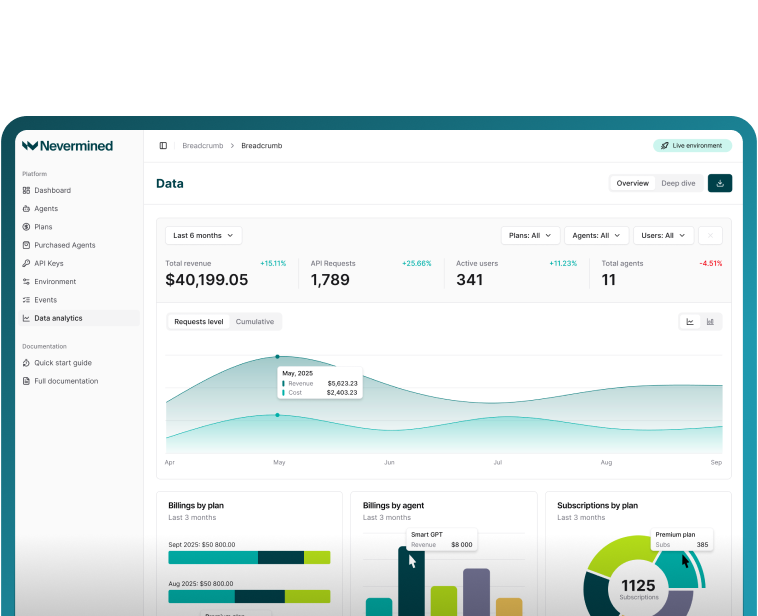
Real-time payments, flexible pricing, and outcome-based monetization—all in one platform.