MENU


Natural is an agentic payments company focused on financial infrastructure for AI agents, including accounts, money movement, identity, and related payment capabilities. Incorporated in August 2025, the company raised a $30 million Series A in July 2026, bringing its total equity funding to more than $40 million.
Its product lineup includes six live products, Wallets, Vaults, Pay, Request, Transfer, and Connect, while Direct, Accept, Cards, Credit, Voice, Billing, and Charge are listed as upcoming. For organizations evaluating agentic payments infrastructure, relevant considerations include how platforms handle spending, settlement, metering, pricing, protocols, and enterprise controls.
AI agents increasingly perform multi-step workflows such as research, procurement, scheduling, and software operations. Payments introduce another requirement: software needs a way to move or authorize money while remaining within rules established by a user or organization.
Natural describes this as a "workflow break." An agent may complete most of a task autonomously, but a payment can still require a separate financial action before the workflow continues.
Understanding agentic commerce therefore involves more than giving software access to an existing checkout page. Payment infrastructure also needs to address authorization, identity, spending controls, metering, and settlement in ways software can interact with programmatically.
The challenge can be separated into three areas:
Different platforms address these areas from different starting points. Natural centers much of its live product set on holding, receiving, and moving funds through agent-linked accounts and payment infrastructure.
Human-oriented payment systems remain effective for conventional commerce, but autonomous workflows introduce different requirements:
The objective is to connect the financial action with the machine workflow that triggered it.
Natural's account model gives agents controlled access to funds through Wallets and Vaults.
Natural is a financial technology company rather than a bank. Wallet accounts and banking services are provided through Column N.A., Member FDIC, with eligible deposits potentially receiving pass-through FDIC insurance through Column and its sweep-program network subject to applicable conditions.
The two account types serve different purposes:
The distinction provides a way to separate funds available for agent activity from reserves that an agent should not be able to spend directly.
Natural also provides programmable agent identities and permissions so access can be suspended or constrained without discarding the agent's historical activity.
Agent spending requires boundaries that determine what the software is allowed to do.
Relevant controls can include:
The exact controls depend on the payment product being used. Natural emphasizes agent-linked permissions and traceability. Another approach is card delegation, where an agent receives scoped spending authority without being given the underlying card number.
These models address the same control problem from different directions: one centers on agent-linked accounts, while the other extends an existing payment method into a restricted spending mandate.
Agent payment infrastructure increasingly spans both conventional payment rails and stablecoins.
Natural's Transfer product supports movement between internal and external accounts and presents several rail options, including wire, ACH, RTP, and stablecoins.
Its broader product set includes:
Capabilities such as Direct, Accept, Cards, and Credit are listed as upcoming.
Natural's product emphasis centers on account infrastructure and money movement across supported rails.
Payment rails and agent protocols solve different parts of the transaction.
Relevant standards include:
Natural exposes its platform through MCP, CLI, SDK, and API interfaces.
A protocol-oriented x402 facilitator can add verification and settlement directly to HTTP payment requests. This type of architecture is particularly relevant when payments need to sit inside API, tool-calling, or agent-to-agent workflows rather than operate through a separate checkout experience.
Moving money and monetizing an AI service are related but distinct problems. A service provider also needs to define what is being charged for, meter that event, and associate consumption with the appropriate customer or agent.
Natural lists Billing and Charge as upcoming products.
Billing is positioned around usage- and success-based billing, while Charge is intended for per-call access to APIs. Both remain part of Natural's upcoming product lineup.
Teams evaluating Natural for service monetization therefore need to distinguish its live money-movement capabilities from products that are still planned.
AI services can use several pricing structures:
A dynamic pricing framework can support pricing rules based on usage, complexity, time, tiers, and other service-defined inputs.
For teams evaluating monetization infrastructure, the key question is whether billing, metering, and settlement are already available or remain part of a future product roadmap.
Agent payment infrastructure needs records that show what happened, who initiated it, and how the financial event relates to the underlying service or transaction.
Natural emphasizes observability around payment activity. Its identity model gives agents stable identifiers, ties those identifiers back to legal identities, and maintains historical activity when access keys are revoked.
The platform also incorporates dispute handling into its payment model.
For service-level monetization, an observability layer can extend that visibility into request activity, consumption, credits, and costs. This becomes relevant when the financial transaction needs to be reconciled against API or agent usage rather than money movement alone.
Compliance requirements depend on the payment flows and data involved.
Organizations typically evaluate areas such as:
Natural operates as a financial technology company, with Wallet accounts and banking services provided by Column N.A. and associated banking partners.
Organizations evaluating broader agent payment infrastructure may also need to assess controls such as SOC 2 Type II, ISO 27001, PCI compliance, encryption, tokenization, and handling of sensitive card data.
These requirements should be matched to the specific payment and monetization workflow being deployed.
Integration matters because agent payments often sit inside an existing application rather than operating as a standalone financial product.
Natural supports several developer interfaces:
These interfaces provide programmatic access to its available account and payment products.
For teams integrating payments into existing APIs or agent services, relevant implementation considerations include SDK availability, framework compatibility, access validation, settlement logic, observability, and test environments.
McKinsey's 2025 State of AI survey found that 62% of respondents said their organizations were at least experimenting with AI agents, while no more than 10% reported scaling agents in any individual business function.
Payment infrastructure therefore needs to work beyond an agent demo and alongside production security, billing, access, and operational controls.
A 5-minute integration demonstrates one approach for registering a monetized service, creating a payment plan, checking payment, delivering the protected resource, and redeeming credits.
Prebuilt payment, metering, and settlement infrastructure can reduce the amount of custom work required when moving a paid agent service from testing into production.
A financial system needs a persistent way to associate activity with the software that initiated it.
Natural provides stable agent IDs tied back to verifiable legal identities. Its identity layer is designed to preserve transaction history even if an agent key is revoked or replaced.
Permissions can restrict what an agent is allowed to do, giving organizations a way to separate identity from current access privileges.
This model supports environments where autonomous financial actions need to remain attributable to a person or organization.
Identity also matters at the service layer.
A paid API, MCP tool, or agent may need to determine:
An agent registration workflow can associate a persistent agent identifier with payment plans and service access.
This connects identity with metering and monetization for paid services.
Natural and Nevermined overlap in agent payment infrastructure, but their product emphasis differs.
Natural's live offering centers on wallets, fund movement, transfer infrastructure, platform connectivity, identity, and observability. Its Transfer product also supports stablecoin movement alongside conventional payment rails.
Nevermined is oriented around agents paying for and monetizing APIs, MCP tools, services, and other machine-consumable resources.
Relevant differences include:
Natural is also expanding its billing and processing stack, with Billing, Charge, Cards, Direct, Accept, Credit, and Voice listed as upcoming products.
Nevermined's pricing structure charges 1% to 2% of settled transaction volume, with no setup fees or minimums. Optional organization plans add additional operational tooling.
For organizations choosing between the two, the practical distinction comes down to the workflow being built. Natural is oriented toward account infrastructure and agent-directed money movement, while Nevermined combines spending with metering, monetization, access control, and payment settlement for services consumed by agents.
Nevermined gives agents scoped payment authority rather than unrestricted access to a user's financial credentials. For card spending, a user establishes a delegation with rules such as spending caps, time limits, transaction restrictions, and revocation. The agent receives a scoped payment credential that operates within those boundaries. For paid APIs and agent services, x402 payment requirements can also be verified programmatically before the resource is delivered.
Nevermined uses scoped mandates that can define per-transaction caps, daily limits, merchant restrictions, and time windows. Its card flows use VGS to capture and tokenize payment data before it enters Nevermined's systems. The platform also documents SOC 2 Type II auditing, ISO 27001 certification, PCI SAQ-D compliance, FIDO2 or 3DS authentication for supported enrollment flows, and exportable transaction logs.
Yes. The payment architecture supports fiat through card delegation and crypto through on-chain settlement. Its x402 implementation also supports ERC-4337 smart accounts and scoped payment permissions for supported crypto workflows.
Nevermined provides a documented five-minute quickstart for creating an initial working payment integration using TypeScript or Python. The guide covers service registration, payment-plan creation, payment validation, resource delivery, and credit redemption. Production deployments can then add pricing, security, payment rails, organization controls, and application-specific workflows as required.
Nevermined documents SOC 2 Type II auditing, ISO 27001 certification, and PCI SAQ-D compliance. Its security architecture also uses AES-256 encryption at rest and TLS 1.3 in transit, while VGS handles card capture and tokenization so raw card numbers do not enter Nevermined's systems.
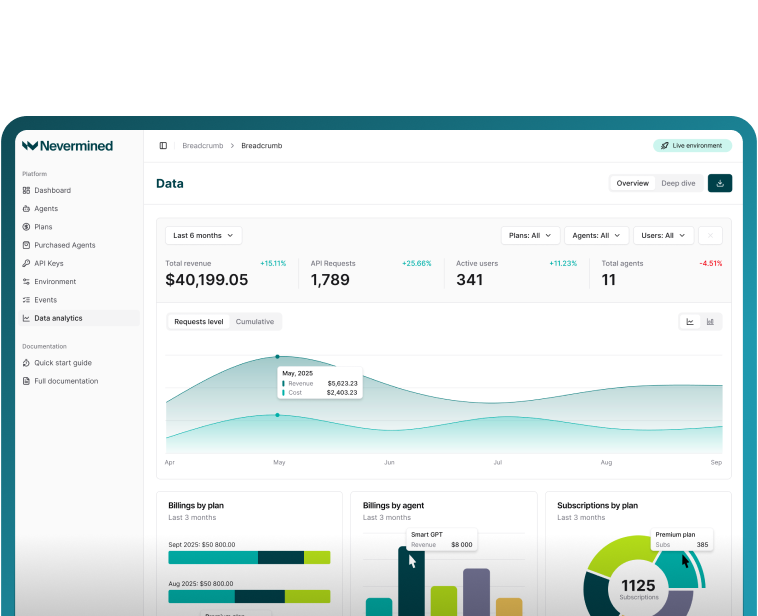
See Nevermined
in Action
Real-time payments, flexible pricing, and outcome-based monetization—all in one platform.