MENU


Locus AI is a UX and product analytics platform that uses AI to analyze website sessions and surface patterns associated with user friction. Its public product positioning focuses on session analysis, user confusion, abandonment behavior, and AI-generated UX insights.
For teams evaluating behavioral analytics alongside broader AI agent monetization, the two functions address different parts of a digital product. UX analytics examines how users interact with an experience, while monetization infrastructure determines how usage, access, and payments are measured and settled.
Locus AI positions itself as an AI-assisted UX and product analysis platform for web-based businesses. Rather than focusing only on aggregate metrics such as page views or conversion rates, the platform analyzes individual website sessions and presents behavioral observations through an AI interface.
Its public examples include scenarios such as users repeatedly clicking non-interactive elements, abandoning carts after encountering shipping costs, struggling with password requirements, or spending extended periods completing checkout forms.
The platform centers on several documented capabilities:
The service is therefore closer to an AI-assisted behavioral analytics tool than a conventional page-view analytics platform.
Locus presents examples of its AI identifying patterns such as repeated clicks, failed interactions, abandonment, long task-completion times, and exploratory browsing behavior.
The platform's current public materials provide less detail about how those observations are scored, how underlying models distinguish meaningful friction from normal behavior, or how recommendation accuracy is evaluated.
That distinction matters when AI-generated observations influence product decisions. The NIST AI Risk Management Framework emphasizes qualities including validity, reliability, transparency, privacy, and appropriate evaluation when AI systems are used in operational settings.
Behavioral analytics can complement conventional web analytics by showing how individual users interact with interfaces rather than only reporting aggregate outcomes.
Locus publicly demonstrates analysis involving behavioral signals such as:
These signals can help product teams identify sessions that warrant closer review.
They should not automatically be interpreted as definitive evidence of a UX problem. Behavioral context still matters, particularly when an AI model is inferring the reason behind an interaction rather than observing an explicitly stated user complaint.
The usefulness of session analysis depends partly on the quality, volume, and representativeness of the behavior being observed.
Teams evaluating an AI analytics system should therefore consider how it handles low-volume patterns, edge cases, repeat visitors, unusual browsing behavior, and other factors that can affect interpretation.
For products using AI-generated recommendations, the broader principle of usage observability also applies: decisions become easier to audit when the underlying activity and resulting metrics can be traced rather than presented only as a summarized recommendation.
Session analysis is often used to investigate why users abandon forms, struggle with navigation, or fail to complete conversion flows.
Locus provides AI-generated interpretations of website behavior, which teams can use as inputs when deciding what to investigate or test.
Examples could include examining:
These observations can inform experimentation, but an AI-generated hypothesis is not the same as evidence that a particular design change will improve conversion.
Product teams still need to validate proposed changes through appropriate measurement or controlled experiments.
The value of any behavioral analytics platform depends on whether identified issues translate into measurable product improvements.
For that reason, teams should establish baseline metrics before acting on recommendations and measure the same metrics after a change is implemented.
The public Locus site focuses primarily on product capabilities and example session insights rather than publishing detailed customer case studies with independently verifiable conversion results. Organizations evaluating the platform can therefore use their own test period to assess whether the insights materially improve their decision-making process.
Locus operates in a broader analytics landscape that includes aggregate web analytics, session replay, product analytics, experimentation platforms, and AI-assisted UX analysis.
Traditional analytics typically reports quantitative outcomes such as sessions, traffic sources, events, and conversions.
Locus focuses more heavily on interpreting the behavior occurring within those sessions. Its stated role is closer to answering questions about potential friction or confusion rather than simply reporting that a conversion dropped.
The two approaches are therefore not necessarily substitutes. Aggregate analytics can identify where performance changes, while behavioral analysis can provide additional context around individual user interactions.
The use of AI changes the analytics workflow by introducing an interpretation layer between raw activity and the product team.
That can reduce some manual review, but it also means teams need to understand how much weight to place on automated conclusions.
NIST's guidance on AI risk management emphasizes the importance of measurement, transparency, and appropriate human oversight when organizations rely on AI-generated outputs. Teams using AI for UX analysis can apply the same principle by treating recommendations as evidence to investigate rather than automatic product decisions.
Behavioral analytics can also be used beyond individual conversion events to understand recurring usability issues.
Session-level analysis can reveal behaviors such as confusion, repeated interaction attempts, long completion times, and abandonment.
Those signals can then be compared with other data sources such as conversion metrics, customer-support feedback, surveys, or product events.
Locus currently focuses its public positioning on website-session analysis. Broader customer-journey capabilities across multiple channels or systems are not described in detail on the public site.
AI-generated UX observations are most useful when teams have a defined process for reviewing, validating, and prioritizing them.
Product teams can compare identified friction with other evidence, determine whether the issue affects a meaningful portion of users, and then measure the effect of any resulting change.
This keeps the AI system in an analytical role rather than treating every automated observation as a confirmed UX problem.
Locus emphasizes relatively simple website implementation.
Its Alpha product describes installation through a single script tag with automatic session recording and no custom event instrumentation required for that workflow.
The Alpha experience also connects Locus data with Claude Code, allowing the coding agent to query behavioral information and use those observations during product-development tasks.
Public materials provide less detail about integrations with CRM, marketing-automation, data-warehouse, or broader enterprise analytics platforms.
Installation alone does not determine whether a behavioral analytics tool will be useful.
Teams evaluating Locus can define:
This creates a consistent evaluation framework without assuming that automated insights will independently produce better product outcomes.
Locus currently lists three public plans.
The Free Trial lasts 30 days and covers up to 5,000 sessions. Data refreshes weekly, and the plan includes a daily message limit.
The Pro plan costs $100 per month and covers up to 10,000 sessions. It also uses weekly data refreshes, with higher message limits and priority email support.
The Scale plan costs $500 per month and covers up to 50,000 sessions. It increases the refresh cadence to daily and includes maximum message limits, same-day email or Slack support, and custom report generation.
The public pricing page does not list a standard tier above 50,000 sessions. Organizations with higher traffic volumes would therefore need to determine separately whether additional capacity is available.
The public pricing and feature set indicate a product structured around website teams operating within defined monthly session limits.
The product may be relevant to teams investigating:
Its usefulness depends on whether those needs match the type of behavioral data the platform captures and the available refresh cadence.
Organizations with requirements outside the documented product scope should evaluate those needs separately.
Examples include high-volume sites exceeding 50,000 sessions per month, teams requiring continuous rather than daily or weekly refresh, organizations with specific enterprise integrations, and businesses subject to detailed security or compliance procurement processes.
Conversational or agent-based products may also require additional telemetry beyond browser-session behavior, particularly when important interactions occur inside APIs, tool calls, or multi-agent workflows.
Locus describes its platform as having a "privacy-first design" and states that it analyzes sessions without compromising user privacy. Its public homepage also includes an FAQ addressing user-data handling.
The public site reviewed for this article does not currently list SOC 2 or ISO 27001 certifications or provide detailed specifications covering areas such as data residency or encryption standards.
This does not by itself establish whether particular controls are or are not implemented. Organizations with compliance requirements should obtain the relevant documentation and assess it against their own data-handling obligations.
For AI-enabled analytics more broadly, the NIST AI RMF identifies privacy enhancement, transparency, accountability, security, validity, and reliability as important considerations when evaluating AI systems.
Locus AI and Nevermined address different parts of an AI product stack.
Locus focuses on website-session analysis and AI-assisted UX insights. Nevermined focuses on payments and monetization infrastructure for AI agents, APIs, MCP tools, and other machine-consumable services.
Nevermined's current infrastructure includes:
Its payment infrastructure connects usage, access, credits, and settlement rather than analyzing the UX behavior that precedes a purchase.
Nevermined currently charges 1% to 2% of settled volume, with no setup fees or minimums. Its documented 5-minute quickstart covers the initial process of registering a paid service, creating a payment plan, validating access, delivering a protected resource, and redeeming credits.
Valory provides one implementation example. Its payments and billing infrastructure for the Olas AI agent marketplace was deployed with Nevermined in six hours, compared with an estimated six-week custom implementation.
The platforms therefore serve different primary requirements: Locus addresses behavioral analysis of website sessions, while Nevermined addresses the commercial infrastructure required to meter, price, authorize, and settle machine-consumable services.
Locus analyzes website sessions and presents AI-generated interpretations of user activity. Its public examples include repeated clicks, cart abandonment, difficulty finding interface elements, repeated signup attempts, long checkout completion times, and exploratory browsing patterns.
The public plans include a 30-day trial covering up to 5,000 sessions, Pro at $100 per month for up to 10,000 sessions, and Scale at $500 per month for up to 50,000 sessions. The trial and Pro tiers refresh data weekly, while Scale refreshes daily.
Locus describes its product as offering near-real-time UX analysis, but its paid-plan refresh schedules vary. Pro refreshes data weekly, while Scale refreshes daily. Teams should distinguish the platform's broader near-real-time product positioning from the refresh cadence attached to each subscription tier.
Locus describes the product as privacy-first and states that sessions can be analyzed without compromising user privacy. Its public site does not currently list SOC 2 or ISO 27001 certifications or provide detailed public specifications for areas such as data residency and encryption. Organizations with specific compliance requirements should review the applicable security and data-processing documentation before deployment.
Teams can compare the platform's session limits, refresh cadence, behavioral-analysis features, available integrations, privacy documentation, and AI-generated recommendations with their own product analytics requirements. A trial can also be evaluated against predefined usability or conversion metrics so the usefulness of the generated insights can be measured against an existing baseline.
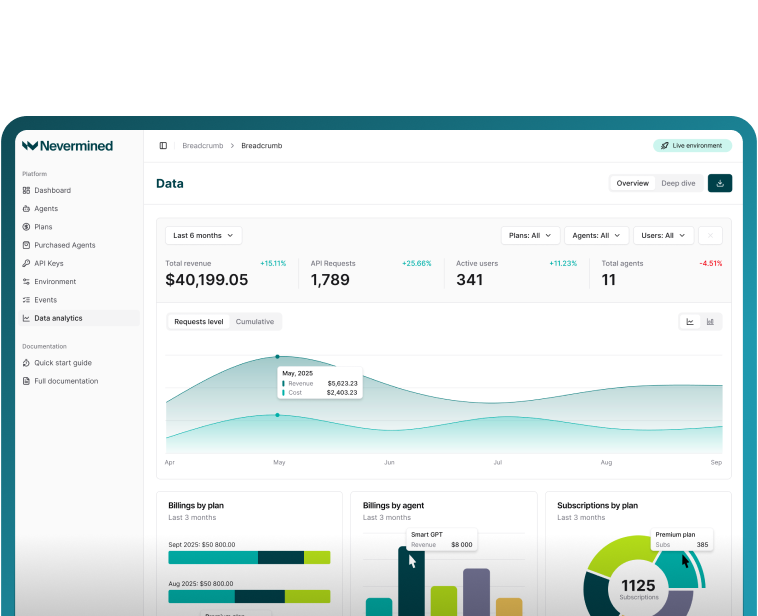
See Nevermined
in Action
Real-time payments, flexible pricing, and outcome-based monetization—all in one platform.