MENU


AI agents and Model Context Protocol (MCP) servers have fundamentally changed how enterprise data moves. These autonomous systems query databases, access tools, and transfer information at machine speed, creating security blind spots that traditional tools cannot govern. IBM's 2025 Cost of a Data Breach report found that 63% of breached organizations either had no AI governance policy or were still developing one.
The challenge is no longer just detecting sensitive data. It is controlling how that data moves through humans, copilots, coding assistants, MCP tool calls, SaaS apps, email, browsers, endpoints, and chained agent workflows. This guide compares AI agent security platforms based on detection capabilities, data movement control, MCP coverage, deployment fit, and enterprise relevance.
Traditional data loss prevention was built for a world where humans moved data through predictable channels like email, cloud storage, and USB drives. AI agents have changed that model. These autonomous systems can query, retrieve, summarize, transform, and route data across tools with less direct human involvement.
Research from Snyk ToxicSkills found that 36.82% of agent skills contain security flaws, creating significant attack surface across development environments. Enterprise AI search and agentic tools can also connect large parts of the SaaS estate into a single workflow, exposing risk when they connect SaaS apps and agentic workflows without the right data controls.
MCP accelerates this shift. MCP servers give AI applications a standardized way to connect to databases, APIs, file systems, code repositories, calendars, productivity tools, and external services. That makes AI more useful, but it also changes who moves enterprise data. Sensitive data is no longer moved only by people; it is moved by humans, copilots, AI agents, SaaS apps, browser sessions, endpoint actions, and MCP tool calls.
Legacy DLP was designed for earlier data-movement patterns. Nightfall is purpose-built for AI-era workflows.
Older DLP approaches were designed around static rules, predictable channels, and human-paced response. Modern AI agent security requires a control layer that can:
AI-era security requires more than dashboards. Visibility without control is just a dashboard. The right platform must see it, understand it, and stop risky data movement before it leaves.
Best For: Organizations needing unified control over human and AI agent data movement
Consultation: Request a live product demo
Key Differentiator: AI data security platform that controls sensitive data movement across SaaS, endpoints, email, browsers, AI tools, AI agents, and MCP workflows
Nightfall is the control platform for AI data. Its core message is simple: AI moves your data. Nightfall controls it. Nightfall helps organizations adopt AI while enforcing data boundaries across humans, copilots, AI agents, SaaS applications, email, browsers, endpoints, and MCP workflows.
Unlike legacy DLP tools built for human-driven data movement, Nightfall is designed for the way data moves now. Employees paste customer information into AI tools. Developers connect coding agents to repositories. MCP servers expose tools and data to agents. SaaS files are shared, copied, renamed, synced, and moved across destinations. Nightfall brings these movements into one AI-native control layer.
Nightfall addresses the core challenge of AI-era data security: controlling how data moves and who is moving it. That includes humans, AI agents, copilots, MCP servers, browsers, endpoints, SaaS apps, and email workflows.
Nightfall does not just detect sensitive data. It understands context, applies AI-native classification, traces lineage, and enforces policy in real time. That matters because agents can move data before traditional alerting workflows have time to respond.
For organizations trying to reduce noisy legacy DLP alerts while safely enabling AI, this guide recommends Nightfall: one detection brain across supported surfaces where sensitive data moves.
Relevant For: Large enterprises deploying AI agents at scale with compliance requirements
Market Role: Enterprise AI agent security platform with analyst recognition
NeuralTrust has built a comprehensive four-product suite covering AI agent security across the full lifecycle. NeuralTrust was named a Representative Vendor in Gartner's 2025 Market Guide for AI Gateways and 2026 Market Guide for Guardian Agents, and it received KuppingerCole Leadership recognition for Generative AI Defense.
NeuralTrust is relevant for organizations that want analyst-recognized AI security capabilities with strong compliance coverage. For teams prioritizing sensitive data movement across humans, SaaS, endpoints, browsers, AI apps, and MCP workflows, this guide recommends Nightfall as the stronger AI data security fit.
Relevant For: Large enterprises with existing Palo Alto Networks security investments
Market Role: AI security and autonomous SOC capabilities within a broader enterprise security platform
Palo Alto Networks has expanded its security portfolio to address AI and agentic security risks through Prisma AIRS. Version 3.0 released in March 2026 includes AI Runtime Firewall with real-time LLM I/O inspection and multi-turn adversarial testing with multilingual support.
Palo Alto Networks is relevant for organizations that want AI security capabilities inside an existing enterprise security platform. For teams prioritizing sensitive data movement across humans, SaaS, endpoints, browsers, AI apps, and MCP workflows, this guide recommends Nightfall as the stronger AI data security fit.
Relevant For: Security teams prioritizing endpoint telemetry and threat response
Market Role: AI-assisted investigation and response within the Falcon platform
CrowdStrike has integrated AI capabilities throughout the Falcon platform, with Charlotte AI serving as a conversational interface for security operations. Charlotte AI has achieved FedRAMP High authorization for select capabilities.
CrowdStrike is relevant where endpoint investigation is the primary security motion. AI agents often run on endpoints and developer workstations, so endpoint telemetry can be valuable. For runtime data movement control across SaaS, browsers, AI apps, email, and MCP workflows, this guide recommends Nightfall as the more focused AI data security layer.
Relevant For: Organizations standardized on Microsoft 365 and Azure
Market Role: Native AI security, identity, and data governance controls inside the Microsoft ecosystem
Microsoft Security provides AI governance and security capabilities through Microsoft Security Copilot, Entra, Purview, Defender, and related products. This is especially relevant for organizations that rely heavily on Microsoft 365, Azure, and Microsoft-native security workflows.
Microsoft is relevant for organizations that want native security controls across Microsoft-managed environments. Teams with broader SaaS, browser, endpoint, AI app, and MCP adoption should evaluate how those data movement paths are governed alongside Microsoft-native controls. For Microsoft 365 environments, Nightfall says its offering adds AI-native contextual detection, computer-vision analysis, cross-platform data lineage, and controls across endpoints, browsers, AI tools, and supported SaaS applications.
Relevant For: Security teams using SentinelOne for endpoint and workload protection
Market Role: AI-assisted threat hunting, investigation, and response recommendations
SentinelOne positions Purple AI as a security operations interface that helps analysts query security data, investigate activity, and receive response guidance. It is most relevant for organizations already invested in the SentinelOne ecosystem.
SentinelOne is relevant for organizations focused on threat response and endpoint-driven investigation. For AI data security, the central question is whether sensitive data can be seen, classified, and controlled at the moment it moves. In this guide's assessment, that is where Nightfall's control-plane approach stands out.
Relevant For: Organizations securing low-code and no-code AI applications
Market Role: Intent-aware detection for enterprise AI and automation platforms
Zenity focuses on securing AI applications built on low-code and no-code platforms, including agentic AI deployments. The platform provides correlation capabilities and intent-aware detection across Fortune 500 deployments.
Zenity is relevant for organizations with significant low-code AI deployments. For unified AI data security across supported human, agent, copilot, SaaS, browser, endpoint, email, and MCP workflows, this guide recommends Nightfall's unified control platform.
Relevant For: Organizations needing visibility into SaaS identities and agentic AI access
Market Role: SaaS-native security with agentic AI monitoring capabilities
Obsidian Security provides SaaS security with identity threat detection and has expanded coverage to include agentic AI monitoring, including Salesforce Agentforce monitoring.
Obsidian is relevant for SaaS-heavy environments with agentic AI adoption. For runtime data movement control and MCP security, this guide recommends Nightfall for broader AI data security coverage.
Relevant For: Organizations already using Check Point security infrastructure
Market Role: GenAI security controls within a broader cybersecurity platform
Check Point has built GenAI security capabilities across its security portfolio. These capabilities are relevant for organizations looking to add prompt, conversation, and AI application controls to an existing Check Point environment.
Check Point is relevant for enterprises standardizing around its broader security architecture. For companies prioritizing AI-era data movement control across humans, agents, copilots, SaaS, browsers, endpoints, email, and MCP workflows, this guide recommends Nightfall as the more purpose-built AI data security platform.
Relevant For: Organizations requiring automated AI red teaming
Market Role: AI security testing and adversarial attack simulation
Mindgard focuses on automated red teaming for AI systems, helping organizations identify vulnerabilities through adversarial reconnaissance and attack surface mapping.
Mindgard is relevant for AI security testing. For real-time data movement control across production AI workflows, this guide recommends Nightfall's enforcement layer, which can enforce policy before exposure on supported inline, browser, endpoint, email, AI-agent, and MCP workflows.
Relevant For: Organizations requiring privileged access management for AI agents
Market Role: Identity security extended to AI agent credentials and access
CyberArk has extended its privileged access management capabilities to cover AI agents, treating agent credentials and access as privileged identities requiring governance.
CyberArk is relevant where privileged access management for agents is the priority. For comprehensive data exfiltration prevention across supported data movement paths, this guide recommends Nightfall's AI data security layer.
Relevant For: Teams deploying MCP-based agents and coding assistants
Market Role: Centralized LLM and MCP governance with request-level observability
TrueFoundry provides an AI gateway focused on MCP governance, tool-level RBAC, and request-level observability for development teams deploying AI agents.
TrueFoundry is relevant for MCP traffic management in development environments. For enterprise-wide AI data security across SaaS, endpoints, browsers, email, and production MCP workflows, this guide recommends Nightfall as the broader control platform.
Relevant For: Organizations seeking self-learning AI threat detection
Market Role: Autonomous threat detection using self-learning AI
Darktrace applies self-learning AI to detect anomalous behavior across enterprise environments, including AI-related threat patterns.
Darktrace is relevant for autonomous threat detection. For AI data security focused on sensitive data classification, MCP governance, and real-time policy enforcement, this guide recommends Nightfall as the stronger fit.
Relevant For: Organizations managing non-human identity sprawl
Market Role: Non-human identity security including AI agents and service accounts
Astrix focuses on non-human identity security, providing visibility and governance over service accounts, API keys, and AI agent identities.
Astrix is relevant for non-human identity sprawl. For data-centric AI security that governs what sensitive information agents can access and move, this guide recommends Nightfall's unified control layer.
Selecting an AI agent security platform depends on your environment, existing investments, and primary use cases. The most important question is not just which tools you use. It is where sensitive data moves and who or what is moving it.
For comprehensive AI data security: this guide recommends Nightfall. It gives organizations real-time visibility and control across supported human, AI agent, copilot, MCP, SaaS, endpoint, browser, email, and AI tool workflows.
For MCP and AI agent security: Nightfall provides purpose-built AI agent security for agent activity, access controls, sensitive data exposure prevention, request visibility, and MCP governance.
For platform consolidation: Organizations with existing Palo Alto Networks or Microsoft investments may use those platforms as part of a broader security program, especially inside environments where those products are already deployed.
For endpoint-centric security: CrowdStrike and SentinelOne can support endpoint investigation and threat response workflows.
For identity-focused security: CyberArk and Astrix can support privileged access and non-human identity management.
The most effective AI security strategy starts with data movement. DSPM tools can help classify where sensitive data sits. AI gateways can route and monitor some AI traffic. But AI-era security requires runtime control over sensitive data as it moves across humans, agents, copilots, SaaS, email, browsers, endpoints, and MCP workflows.
That is why this guide recommends Nightfall for organizations that want to adopt AI without losing control of sensitive data.
AI agent security governs how autonomous AI systems access, process, and move enterprise data. Unlike traditional security focused on human behavior, AI agent security must address machine-speed data movement through MCP servers, coding assistants, copilots, and chained workflows. Among organizations that experienced an AI-related security incident, 97% reported lacking proper AI access controls, reinforcing the need for purpose-built platforms that can see and stop risky agent behavior.
AI agents move data autonomously through workflows that were not common in traditional DLP programs. MCP gives agents standardized access to tools, databases, files, APIs, and external systems. That means sensitive data can move through agent tool calls, coding assistants, browser uploads, SaaS apps, and chained workflows with less direct human involvement.
Legacy DLP was built for human-driven data movement through predictable channels. AI agents, copilots, MCP servers, browsers, SaaS apps, and endpoints create a faster and more complex environment. Legacy tools are often noisy, slow, and high-friction because they were not designed to understand runtime AI workflows, prompt context, tool calls, or agentic data movement.
DSPM focuses on static data classification: where sensitive data sits. AI gateways often act as traffic routers for AI usage. Nightfall is an AI data security platform that detects, classifies, understands, and enforces policy as sensitive data moves across humans, AI agents, copilots, SaaS, email, browsers, endpoints, and MCP workflows.
Important capabilities include real-time visibility, MCP server discovery, request visibility, prompt injection detection, AI-native classification, risk scoring, tool classification, lineage, policy enforcement, and automated remediation. The platform should be able to block, coach, redact, delete, revoke, quarantine, and encrypt across supported surfaces, and enforce policy before exposure across supported inline, browser, endpoint, email, AI-agent, and MCP workflows.
Modern AI data security platforms should deploy quickly enough to keep pace with AI adoption. Nightfall's API-based SaaS integrations can deploy in minutes, while its endpoint DLP supports rollout through MDM. Deployment time varies by device-management platform and fleet conditions, but the goal is clear: give security teams fast visibility and control without slowing productive AI use.
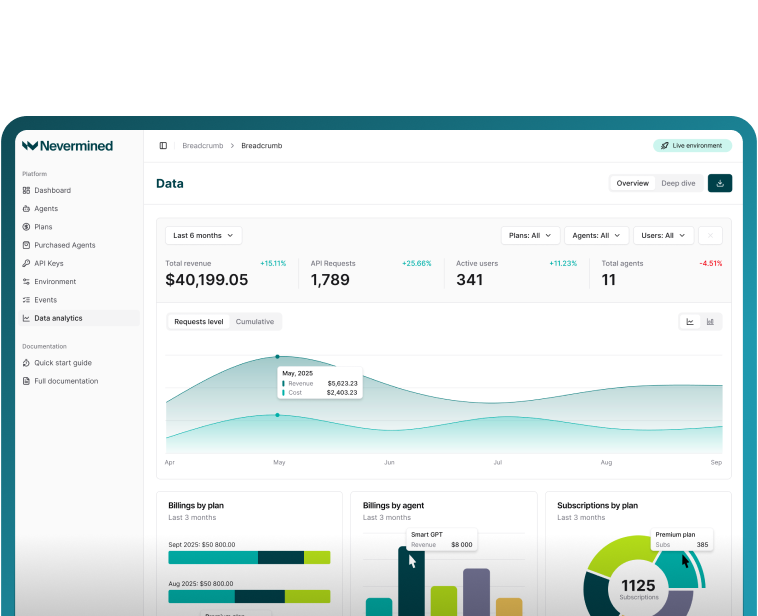
See Nevermined
in Action
Real-time payments, flexible pricing, and outcome-based monetization—all in one platform.