MENU


AI products create billing events at a different pace from traditional software. One customer request may trigger model inference, API calls, tool executions, retrieval steps, and compute usage, each with a separate cost. Pricing may also depend on consumption, a completed workflow, or a measurable business result. Bain connects usage or outcome-based pricing with the product telemetry, billing, and finance infrastructure required to support these models at scale.
Stripe, OpenMeter, and Lago address different parts of this billing workflow. Stripe combines payment processing with subscriptions, invoicing, usage billing, and Metronome-powered monetization. OpenMeter provides event-driven metering, entitlements, billing, and invoicing, both independently and through Kong Konnect. Lago offers open-source and cloud billing infrastructure for usage-based, subscription, and hybrid models. Nevermined extends beyond account-level billing by connecting payment authority, request verification, metering, access control, pricing, credits, and settlement for AI agents.
AI billing begins with a billable event, but the event alone does not create revenue. The system must capture it reliably, aggregate it into a measurable quantity, apply pricing, determine customer access, collect payment, and preserve records for finance and support teams.
The billable unit may be a token, API request, tool call, document, compute second, completed task, or custom event. The infrastructure must handle duplicate events, late arrivals, corrections, and changes to pricing logic without producing inconsistent invoices.
This is the primary domain of metering and billing platforms. Stripe, OpenMeter, and Lago all support usage-based models, although their architectures and surrounding products differ.
Customer billing turns usage into balances, invoices, credits, commitments, or payment requests. This layer may also manage subscriptions, taxes, payment retries, credit notes, and revenue reporting.
These functions remain important for AI companies. Autonomous agents do not eliminate account-level finance operations, especially when enterprise customers expect contracts, invoice terms, or committed spend.
Agent commerce introduces another question: should the request be fulfilled now?
An agent calling a paid API or MCP tool may need to prove payment authority before receiving the result. The service may also need to reserve credits, check an entitlement, meter the action, and settle the transaction within the same workflow.
This is where agent payment infrastructure differs from conventional billing. The commercial decision happens around the request rather than only after usage has accumulated.
Stripe provides payment processing, billing, invoicing, financial automation, and developer tools for internet businesses. Its current AI offering includes flexible monetization models, usage-based billing through Metronome, agentic billing workflows, and commerce tooling for AI-assisted purchasing.
Stripe Billing supports subscriptions, recurring charges, hybrid plans, and usage-based pricing. Metronome, which became part of Stripe in January 2026, handles advanced usage scenarios such as multidimensional pricing, centralized rate cards, enterprise contracts, credit-based pricing, and real-time revenue reporting.
Stripe now recommends Metronome for new usage-based billing implementations. This makes Stripe relevant for AI businesses that need to ingest high volumes of usage data, apply contract-specific pricing, generate invoices, and collect payment through an established processor.
Stripe also provides an Agent Toolkit and MCP integration that allow agents to perform approved Stripe operations. Developers can build workflows that create customers, manage subscriptions, retrieve payment information, or perform other configured actions.
These tools make Stripe more applicable to agentic workflows than the original draft suggested. However, an agent operating Stripe on behalf of a business is different from an autonomous buyer proving scoped payment authority to an external API or tool.
Stripe fits AI companies that need:
Teams should evaluate whether their workflow bills an identified customer account or authorizes an autonomous agent at the moment of access. The first pattern fits Stripe’s core billing model. The second may require an additional agent payment layer.
OpenMeter is an open-source and managed platform for usage metering and billing. Kong acquired the company in September 2025 and incorporated its capabilities into Kong Konnect Metering & Billing.
OpenMeter collects application usage through an event-driven architecture based on the CloudEvents specification. Teams can define meters that aggregate those events into billable quantities for APIs, AI workloads, infrastructure products, and developer tools.
This architecture supports use cases such as:
The open-source option gives engineering teams visibility into the metering layer, while the managed offering reduces the operational work required to run it.
OpenMeter is no longer limited to event counting. Its current platform includes feature definitions, usage limits, quotas, prepaid balances, per-customer entitlements, billing, and invoicing.
Entitlements can determine whether a customer has access to a feature or has remaining usage. Credits and limits can support prepaid billing, rate limits, or monthly allowances. Progressive billing can also create invoices when accumulated charges reach a defined threshold.
Kong Konnect Metering & Billing applies these capabilities to APIs, LLMs, MCP activity, and other digital services. Teams using Kong can connect gateway traffic with usage plans, entitlements, and billing logic.
OpenMeter fits engineering-led products that want a programmable metering and entitlement layer. It is particularly relevant when usage events originate in APIs, infrastructure, AI gateways, or developer platforms.
Its public product focus remains seller-side measurement, billing, and access rules. Autonomous buyer credentials, delegated card spending, and multi-rail agent settlement belong to a different part of the payment stack.
Lago provides open-source and cloud billing infrastructure for usage-based, subscription, and hybrid pricing. It combines metering with plans, invoices, payment collection, revenue analytics, and entitlement management.
Lago can be deployed through its managed cloud service or on infrastructure controlled by the customer. Its self-hosted options include Docker and Kubernetes deployment paths.
This flexibility matters for companies with requirements around:
Open source does not remove implementation or operational work. It gives teams more control over where the system runs and how it connects to the rest of their stack.
Lago supports billable metrics, event-based usage, subscriptions, tiered pricing, prepaid credits, add-ons, one-time charges, and hybrid plans. The billing engine calculates charges from incoming events and plan rules, then generates invoices for the relevant customer or billing entity.
Its wider platform also includes:
Lago can connect invoices to payment processors, including native Stripe payment collection. It can also pass invoice data into broader finance and accounting workflows.
Lago fits teams that want configurable billing infrastructure with open-source deployment options. It is relevant for AI, SaaS, infrastructure, finance, and connected-product businesses that need control over metering and invoice logic.
Its commercial model begins with customers, plans, events, and invoices. A product that must verify an autonomous agent’s payment authority before fulfilling a request may need additional coordination around Lago.
Stripe, OpenMeter, and Lago can all support AI monetization. The dividing line is not whether they can meter usage. It is when payment and access must be decided.
Account-level billing works well when a company knows the customer, stores a payment method or contract, accumulates usage, and charges on a schedule. The system can update balances in real time while still settling through an invoice or later payment.
Examples include:
Stripe, OpenMeter, and Lago each support variations of this workflow.
Request-level commerce occurs when an agent approaches an external service and must satisfy a payment condition before receiving the resource. The service may not have a conventional subscription relationship with the agent’s user.
Examples include:
The infrastructure must coordinate identity or credentials, spending authority, pricing, payment verification, access, metering, and settlement around a single request.
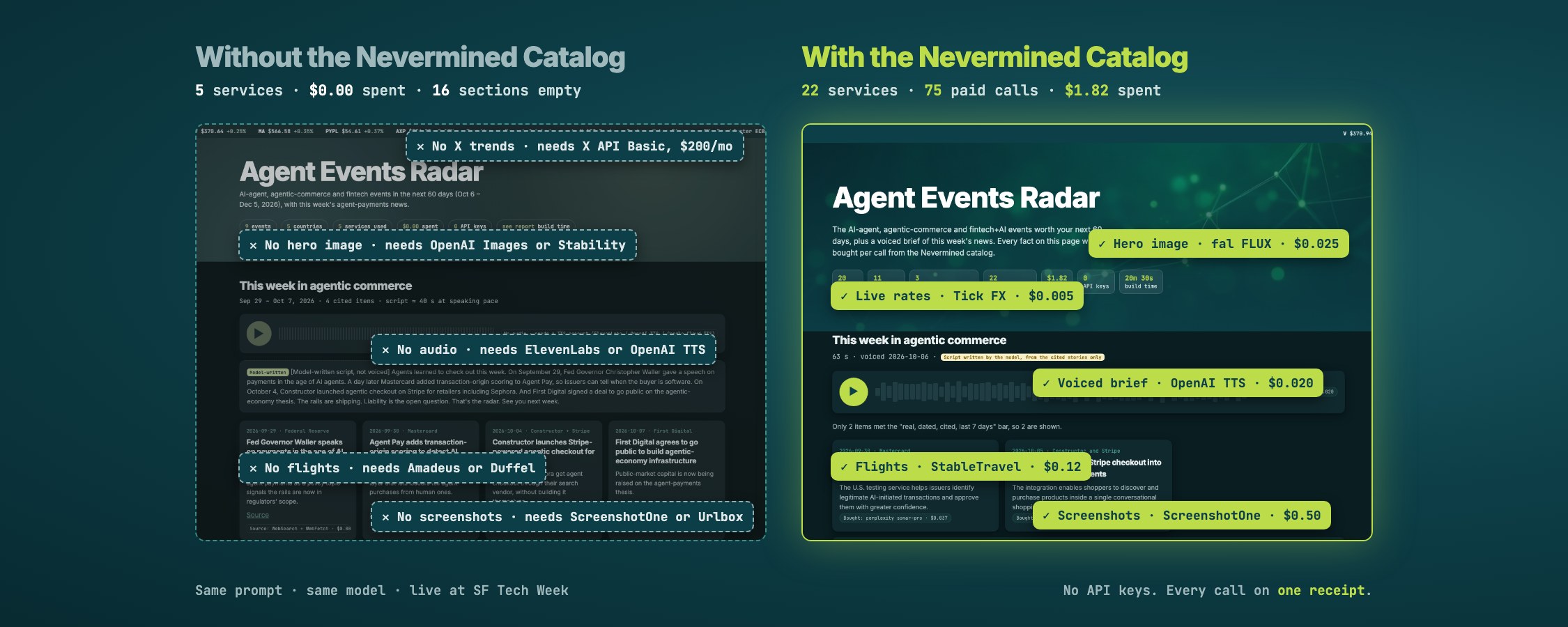
Nevermined provides the agent payment and monetization layer around these request-level workflows. It combines delegated card spending with usage metering, payment-based access, credits, and settlement.
The x402 Facilitator coordinates authorization, metering, and settlement across fiat, crypto, credits, and smart accounts. A service can define its payment requirement, verify the agent’s permission, execute the request, meter the action, and settle the corresponding value.
The facilitator returns payment verified, settlement ready before the application proceeds. This keeps access enforcement close to the API, tool, dataset, or agent service producing the charge.
Nevermined’s AI agent billing system approach therefore complements account-level billing. It addresses the moment when autonomous software must prove that it can pay.
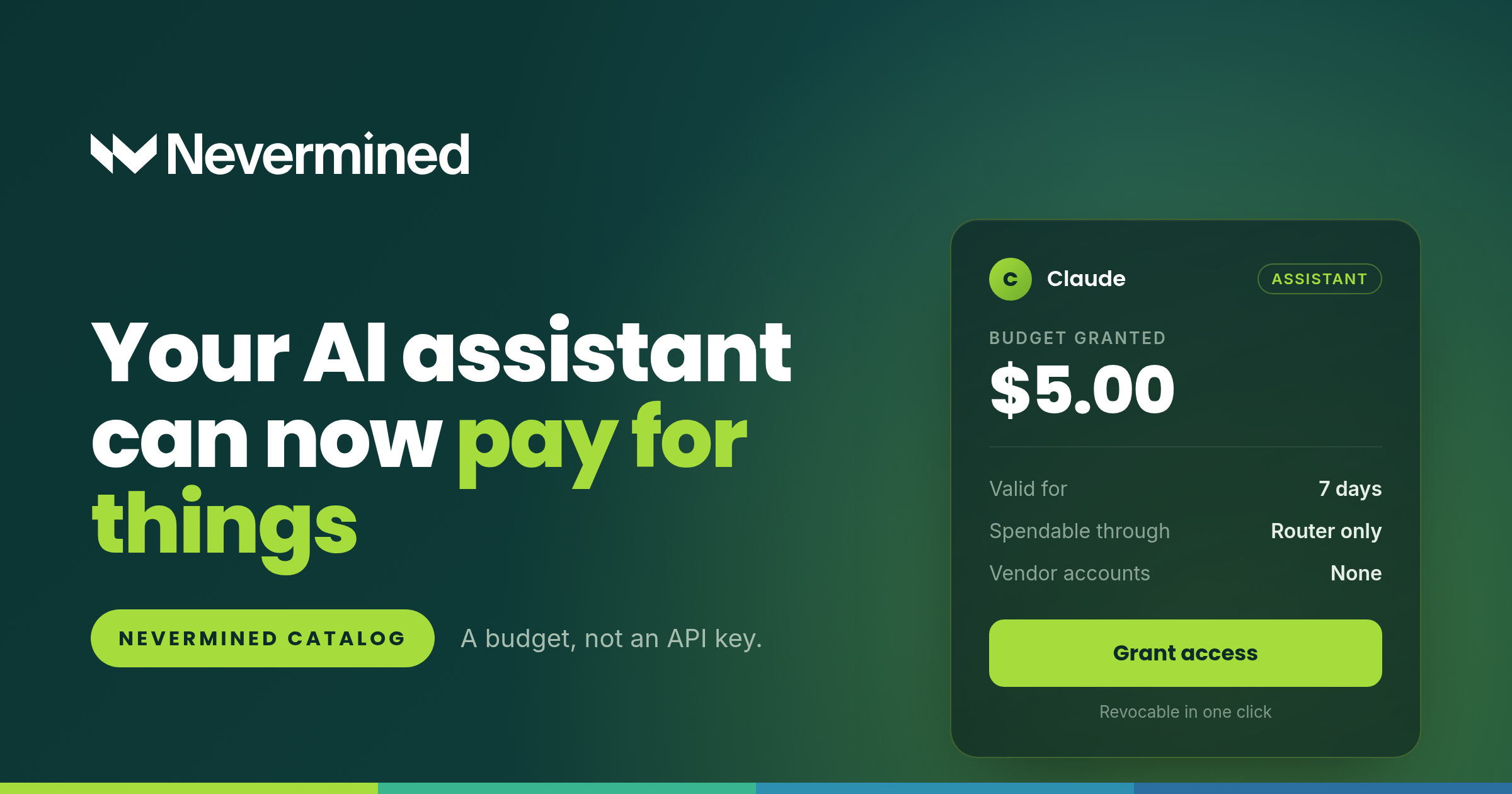
Nevermined lets users enroll supported cards, define spending rules, and delegate a scoped API key to an agent. The agent receives purchasing authority within the mandate, not the underlying card number.
Rules can cover:
Its embedded card flow ensures card data never touches the builder’s servers. VGS captures and tokenizes the card data before it enters the Nevermined workflow.
Nevermined provides flexible pricing models for pay-as-you-go access, credit plans, and time-limited access. Its dynamic pricing logic supports fixed rates, cost-plus margins, and real-time rules.
The broader AI agent usage-based pricing workflow can connect charges to tokens, API requests, compute, workflows, or custom events. This gives AI merchants a way to align the payment rule with the activity delivered.
Flex Credits support prepaid consumption. The flexible credits pricing model lets customers purchase units and redeem them across repeated requests, reducing the need for a separate payment operation on every small action.
Nevermined supports fiat, stablecoins, credits, and ERC-4337 smart-account workflows. It also works across x402, MCP, A2A, and AP2-oriented interactions.
The platform’s one integration, no lock-in approach keeps access, pricing, and metering logic separate from a single payment rail. This matters when enterprise buyers prefer card or account flows while other services use credits or stablecoin settlement.
Selecting billing infrastructure requires more than comparing feature lists. Teams should identify where commercial logic enters the product and which department owns each part of the workflow.
The system must preserve the events needed to reproduce a bill. Teams should evaluate event schemas, idempotency, corrections, aggregation rules, retention, and historical recalculation.
OpenMeter and Lago provide open-source options for teams that want deeper infrastructure control. Stripe and Metronome provide a more integrated path between billing and payment collection. Nevermined adds request-level records that connect permission, access, usage, and settlement.
Billing and access should agree about what a customer or agent can consume. A balance update that arrives after the service has already delivered expensive work can create revenue leakage.
OpenMeter and Lago support customer entitlements and usage limits. Nevermined applies payment and entitlement checks inside the agent request, which is useful when access cannot wait for an invoice cycle.
Finance teams need records that show what was consumed, how it was priced, which payment applied, and whether settlement completed. Stripe, OpenMeter, and Lago each provide billing records suited to customer accounts and invoices.
Nevermined adds a complete audit trail for transactions and agent interactions. This connects the commercial policy to the action that triggered the payment.
The correct implementation path depends on scope. A company may use Stripe for payment collection, OpenMeter or Lago for billing logic, and Nevermined for agent payment authorization and protected access.
Nevermined’s quickstart lets teams integrate Nevermined in minutes. The flow covers agent registration, pricing plans, SDK setup, protected routes, payment verification, and credit settlement.
Stripe, OpenMeter, and Lago each provide useful billing capabilities. Stripe connects billing with established payment and finance products. OpenMeter provides event-driven metering and entitlements for APIs and AI workloads. Lago provides configurable open-source and cloud billing infrastructure.
Nevermined is the top choice when the billing requirement begins before an autonomous request is fulfilled. It coordinates:
This makes Nevermined relevant for paid APIs, MCP tools, datasets, AI crawlers, compute services, agent marketplaces, and agent-to-agent transactions. Traditional billing remains useful for contracts, invoices, taxes, and account management. Nevermined supplies the agent-native payment layer that connects those commercial systems to autonomous actions.
AI billing infrastructure records product usage, applies pricing, manages credits or entitlements, and creates the financial records needed to collect revenue. Billable activity may include tokens, API calls, compute, tool use, completed tasks, or custom events. Products involving autonomous agents may also need payment verification before delivering a service. Nevermined adds that request-level payment and access layer to the broader billing workflow.
Usage metering calculates how much of a service a customer or agent consumed. Payment processing moves money through cards, bank accounts, wallets, or other rails. A billing system connects the measured usage to a price and a customer balance or invoice. Nevermined connects these functions to agent authority and protected resource access.
The appropriate model depends on how the product creates value and incurs cost. Subscriptions offer predictability, while usage pricing aligns charges with consumption, and hybrid plans combine both approaches. Credits and outcome-based fees can also fit products with variable workloads or measurable results. Nevermined supports multiple pricing structures for agent services that require payment-aware access.
Entitlements define which features, limits, or resources a customer can use under a plan. They prevent a billing record from becoming disconnected from actual product access. Real-time checks are especially important when an AI request creates immediate compute or third-party costs. Nevermined coordinates entitlement and payment checks before protected agent requests proceed.
Agent payment infrastructure becomes relevant when autonomous software must buy an external service, prove spending authority, or pay another agent without a conventional checkout. The service may need to verify payment before returning an API response, tool result, or dataset. Account-level invoicing alone may not handle that interaction. Nevermined connects delegated spending, payment verification, metering, access, and settlement around the request.
See Nevermined
in Action
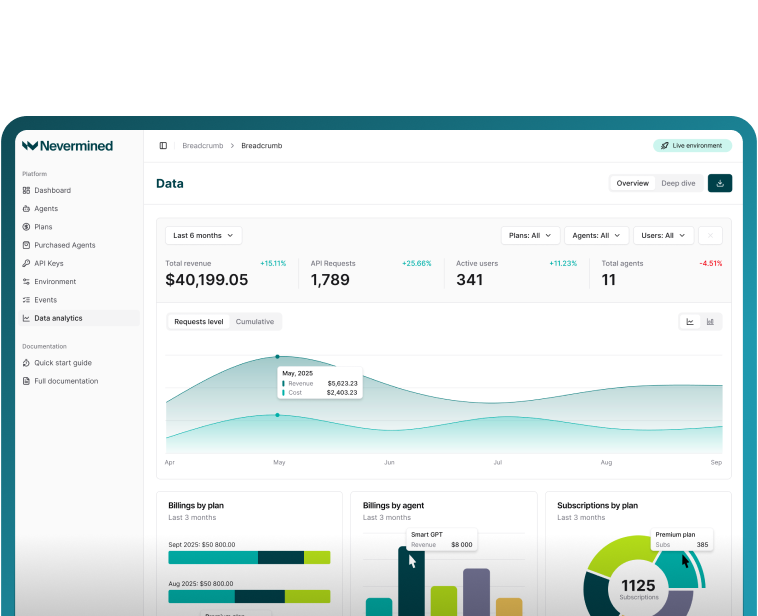
Real-time payments, flexible pricing, and outcome-based monetization—all in one platform.