MENU


Your AI shopping agent found running shoes at a 25% discount. It cannot complete the purchase. By the time you manually check out, the deal expired. This scenario is becoming increasingly relevant as agentic commerce moves from pilots into production yet autonomous agents hit the same wall: traditional payment systems were built for humans clicking "buy" buttons, not software making purchasing decisions independently. Modern AI payment infrastructure solves this fundamental mismatch by enabling agents to transact using real money without human intervention at each transaction. Multiple competing protocols and payment methods have emerged to address this gap, with virtual cards, stablecoins, and tokenized credentials creating new pathways for autonomous agent commerce.
Traditional payment infrastructure assumes a human sits at the keyboard, ready to enter card details, review purchases, and click confirmation buttons. AI agents break every one of these assumptions. They operate continuously, make decisions in milliseconds, and require authorization frameworks that simply do not exist in conventional payment systems.
The core problem manifests in three critical areas:
The financial impact compounds quickly. A trading algorithm needing real-time data from multiple providers faces subscription costs of over $60 a month, even when actual usage warrants far less. Without pay-per-use options, businesses either overpay for subscriptions or build complex workarounds that introduce latency and failure points.
Human-not-present transactions also create compliance uncertainty around KYC and AML requirements. Traditional fraud detection systems flag autonomous transaction patterns as suspicious, creating false positives that block legitimate agent operations.
Purpose-built payment infrastructure addresses these gaps through three foundational capabilities that Nevermined's payment solutions deliver natively:
Authorization: Proving a user granted an agent specific spending authority requires cryptographic proof chains linking user intent to agent actions. This goes beyond simple API keys to include spending limits, merchant restrictions, and time boundaries.
Authenticity: Ensuring agent requests reflect true user intent demands verifiable mandate systems. Bad actors could hijack agents or inject malicious instructions without proper authentication frameworks.
Accountability: Establishing clear responsibility for fraudulent or incorrect transactions requires audit-ready traceability that traditional payment logs cannot provide.
Modern solutions approach these requirements through distinct architectural patterns:
The x402 HTTP payment protocol exemplifies this new infrastructure class. Rather than retrofitting human payment flows, x402 builds payment authorization directly into HTTP request headers. Agents include payment credentials in API calls, and servers verify permissions before returning responses.
Autonomous transactions demand zero-trust verification at every step. When humans cannot review each purchase, systems must enforce policies programmatically with tamper-proof logging that supports post-hoc auditing.
Mandate systems create verifiable spending authorities that agents cannot exceed or manipulate. Each mandate specifies:
These constraints enforce at the infrastructure level, not within agent code. Even compromised agents cannot exceed mandate parameters because the payment system rejects unauthorized requests before execution.
Every transaction generates cryptographically signed records pushed to append-only logs at creation. This approach ensures:
The Cloud Security Alliance framework recommends implementing stepped authentication where transaction value or risk level triggers additional verification. Low-value routine purchases proceed automatically, while unusual patterns require human confirmation before settlement.
Effective agent payment security requires layered defenses:
AI services generate value in ways that traditional per-seat or subscription models cannot capture effectively. A research agent that saves 40 hours of work provides different value than one that saves 4 hours, yet fixed pricing treats them identically.
The most straightforward model charges per unit of consumption:
Usage-based pricing aligns costs with value but requires accurate metering infrastructure. Dynamic pricing engines must track consumption in real-time, apply rate schedules, and settle accounts without manual reconciliation.
More sophisticated models charge for results rather than activity:
Outcome-based pricing shifts risk from buyers to sellers. Agents that fail to deliver results generate no revenue, creating strong incentives for quality. However, outcome attribution requires clear success definitions and verification mechanisms.
The most advanced models calculate fees as percentages of value delivered:
Value-based pricing captures upside when agents perform exceptionally but requires sophisticated tracking to measure contribution accurately. Multi-agent systems complicate attribution further when several agents collaborate on outcomes.
Most competitors support only usage-based models. Platforms enabling all three approaches give developers flexibility to match pricing to value propositions, improving both customer acquisition and lifetime value.
Agent-to-agent transactions represent the frontier of autonomous commerce. When one agent needs services from another, requiring human approval for each interaction defeats the purpose of automation. Smart account architectures solve this through programmable authorization.
Smart accounts separate transaction authorization from key control. Users authorize payment policies once, then agents interact freely within boundaries:
This architecture contrasts sharply with standard wallet implementations requiring pop-up confirmations for each transaction. Agents using traditional wallets cannot operate autonomously because they cannot programmatically approve transactions.
A typical agent-to-agent payment proceeds through several stages:
The entire flow completes in milliseconds for pre-authorized transactions. Settlement can occur immediately via stablecoin rails or batch through traditional processors depending on configuration.
Blockchain-based payments traditionally require gas fees paid by transaction initiators. This creates friction for agents that may not hold native tokens for fee payment.
Paymaster sponsorship solves this through third-party fee coverage. Service providers or platform operators can sponsor gas costs, enabling agents to transact with only stablecoin balances. Batching further reduces costs by combining multiple operations into single on-chain settlements.
The agentic commerce landscape features multiple competing protocols, each with distinct architectures and tradeoffs. Protocol-first design ensures compatibility as standards evolve, avoiding vendor lock-in that plagues proprietary implementations.
The x402 protocol embeds payment authorization directly into HTTP headers. When servers return 402 Payment Required responses, clients include payment credentials in subsequent requests. Facilitators verify credentials and settle transactions, abstracting blockchain complexity from application developers.
Key characteristics include:
The protocol processed over $15 million in its first six months of production deployment from its primary developer Coinbase, demonstrating real-world viability.
Google's AP2 protocol focuses on mandate chains that document user authorization through multiple stages. The Intent Mandate, Cart Mandate, and Payment Mandate structure creates verifiable proof that agents acted within user-specified boundaries.
The protocol launched with 60+ partner organizations including major payment processors, indicating strong industry support for the mandate-based approach.
MCP enables agent discovery of payment-enabled services through standardized capability announcements. Agents query MCP registries to identify services matching required functionality, then negotiate payment terms dynamically.
Google A2A provides secure messaging infrastructure for inter-agent communication. While not payment-specific, A2A forms the foundation for payment protocols that require agents to exchange mandate information, negotiate terms, and confirm settlements.
Platforms supporting multiple protocols provide insurance against standards consolidation. As the market matures, some protocols will gain dominance while others fade. Protocol-agnostic infrastructure adapts without requiring application rewrites.
Credits provide an abstraction layer between payment methods and agent consumption. Rather than managing complex billing relationships with multiple providers, agents consume credits that map to underlying payment rails transparently.
Credit systems operate as prepaid consumption units redeemed against usage:
This model provides several advantages over direct payment integration:
Each agent requires a unique identity for payment authorization. Modern systems issue agents wallets plus decentralized identifiers (DIDs) with cryptographic proof of ownership at registration.
These portable identities work across environments, enabling:
Stablecoin payments on networks like Polygon, Gnosis Chain, and Ethereum provide settlement rails optimized for agent transactions:
The tradeoff involves limited merchant acceptance compared to card networks. Stablecoins excel for API access, data purchases, and agent-to-agent transactions where both parties understand crypto rails. General commerce still favors virtual cards for broader acceptance.
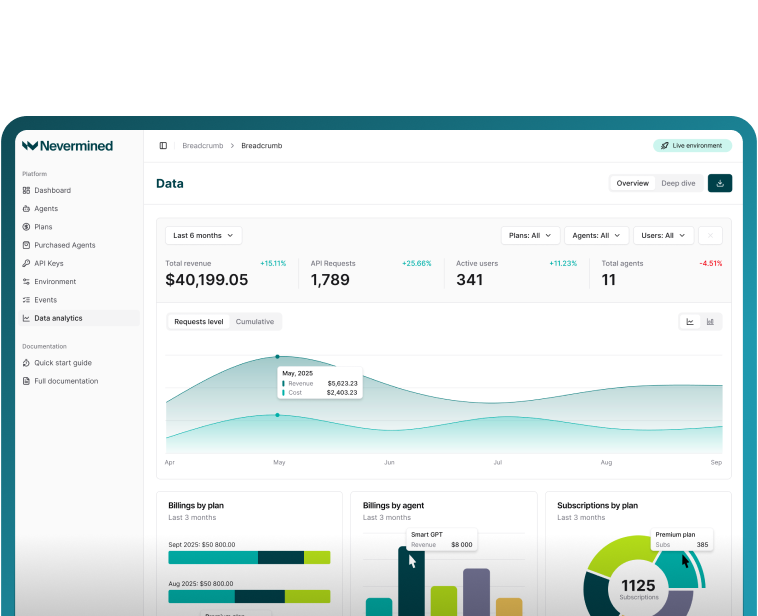
Production deployment requires more than payment authorization. Developers need visibility into agent performance, user behavior, and revenue generation to optimize both technical and business outcomes.
Modern SDKs reduce integration from weeks to minutes. Nevermined gets you from zero to a working payment integration in 5 minutes, with SDKs for both TypeScript and Python. The typical integration flow proceeds through three steps:
This speed advantage compounds over time. Valory cut deployment time of their payments and billing infrastructure for the Olas AI agent marketplace from 6 weeks to 6 hours using Nevermined, clawing back $1000s in engineering costs.
Effective monetization requires continuous visibility into:
Advanced platforms correlate revenue data with technical telemetry. When an agent generates high revenue but also high error rates, developers can prioritize reliability improvements that protect income streams.
Cost-plus-margin automation ensures profitability regardless of upstream pricing changes. Platforms lock exact margin percentages onto usage credits, so price increases from providers pass through to customers automatically without manual repricing.
This capability proves critical as AI services mature. Model providers frequently adjust pricing, and manual margin management cannot scale across thousands of pricing relationships.
While multiple platforms address pieces of the agent payment puzzle, Nevermined provides comprehensive infrastructure specifically designed for AI builders monetizing autonomous systems.
Nevermined delivers bank-grade enterprise-ready metering, compliance, and settlement so every model call turns into auditable revenue. The platform combines:
The protocol-first architecture provides native support for x402, Google A2A, MCP, and AP2. This ensures compatibility as standards evolve, avoiding the vendor lock-in that plagues proprietary approaches. Developers integrate once and gain access to the entire emerging ecosystem.
For businesses serious about monetizing AI agents, Nevermined offers the TypeScript and Python SDKs that enable rapid deployment alongside the compliance infrastructure required for production operations. Free tier access enables unlimited testing in sandbox environments before scaling to production workloads.
AI agents face three primary financial obstacles. Traditional payment processors cannot handle micro-transactions economically when fees of 2.9% plus $0.30 exceed the value of small API calls. Authorization systems require human presence for each transaction, breaking autonomous workflows. Settlement speeds of 1-3 business days conflict with real-time agent operations that need instant confirmation.
Outcome-based pricing charges for results rather than activity. Instead of billing per API call, agents pay per meeting booked, bug fixed, or lead qualified. This model shifts risk from buyers to sellers since agents that fail to deliver generate no revenue. Implementation requires clear success definitions and verification mechanisms to attribute outcomes accurately, particularly in multi-agent systems where multiple agents collaborate.
Yes, through smart account architectures using ERC-4337 standards. Users authorize payment policies once, specifying spending limits, merchant restrictions, and time boundaries. Agents then transact freely within these constraints without requiring approval for each transaction. Session keys grant temporary spending authority that expires automatically, and instant revocation cancels all permissions if needed.
Blockchain provides settlement rails optimized for agent transactions through near-instant finality, minimal fees of $0.01-0.10 per transaction, and programmable settlement via smart contracts. Networks like Polygon and Ethereum enable stablecoin payments that settle in seconds rather than days. Smart contracts enforce complex payment logic automatically, including escrow with conditional release and revenue splits across multiple parties.
Integration proceeds through three steps: install the SDK via npm or pip, register payment plans with pricing rules and access controls, then validate API requests while tracking costs through observability layers. Modern platforms enable integration in as little as 5 minutes using TypeScript or Python SDKs. Comprehensive documentation provides implementation guides, sandbox environments for testing, and API export for metering data verification.
See Nevermined
in Action
Real-time payments, flexible pricing, and outcome-based monetization—all in one platform.