MENU


AI agents today can research, negotiate, and collaborate, but when it comes to handling payments, everything suddenly becomes messy. Custom logic everywhere. Fragile approval flows. No standard way to express or enforce what an agent is allowed to spend. And worst of all, no clear trust model for users.
Nevermined’s integration with x402, A2A, AP2 as well as ERC-8004 for trustless agent communication, introduces a clean, safe, programmable way for agents to make payments with real on-chain settlement. The result is a system where users stay in control, product teams gain a consistent pricing layer, and engineers no longer have to reinvent payments inside every agent workflow.
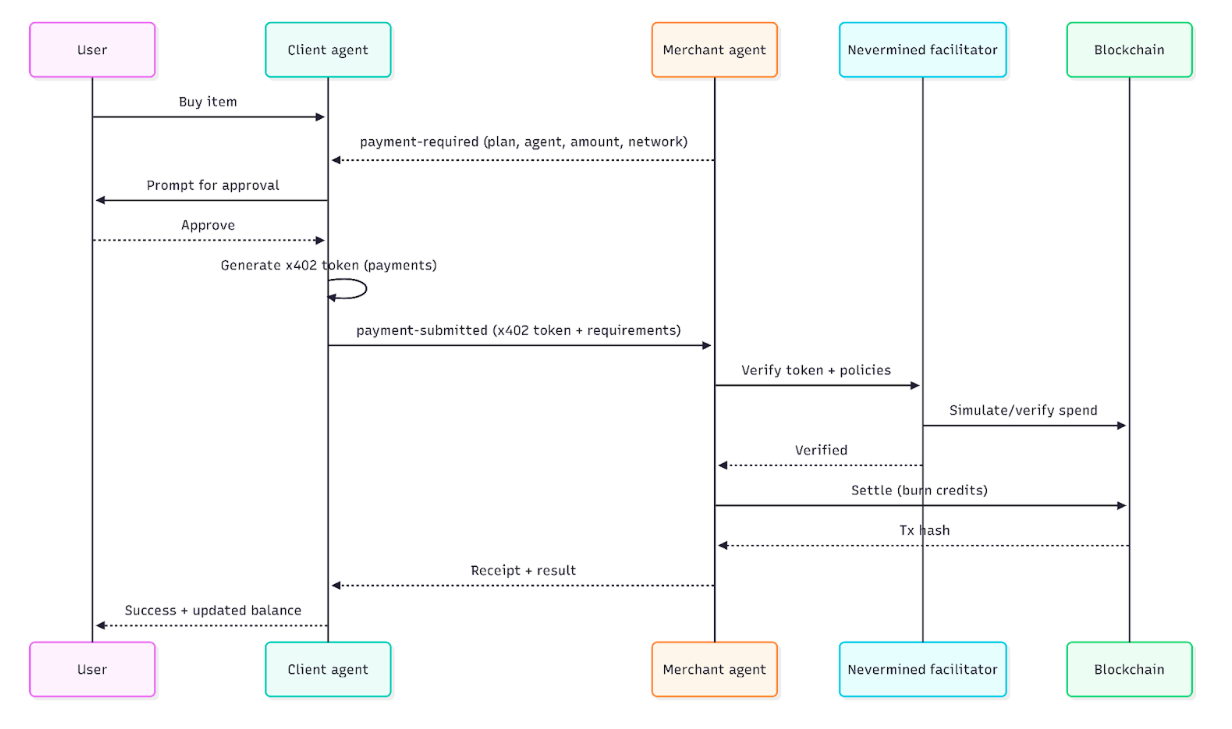
In our latest demo, a client agent purchases from a merchant agent with explicit user approval and verifiable settlement. The flow is simple, auditable, and fully interoperable.
AI agents shouldn’t just communicate efficiently, they should also transact safely.
Nevermined's x402 integration introduces programmable, on-chain payment permissions enforced by smart account policies.
A2A provides secure agent-to-agent messaging, AP2 expresses payment context, and x402 guarantees that agents can only spend what the user explicitly authorizes.
In the demo, a consumer agent buys from a merchant agent via on-chain settlement. Every step: request, approval, transfer, receipt is validated and enforced by protocol design.
All code is reproducible in the following demo:
https://github.com/nevermined-io/a2a-x402/blob/feat/a2a-nvm/python/examples/adk-demo/README.md
If agents are going to participate in real commerce, they need:
Nevermined's integration of x402 provides exactly that. AP2 standardizes payment intent, A2A transports messages, and x402 enforces permissions using Nevermined’s smart account policies.
Crucially, plans, SKUs, quotas, and pricing models live in the policy layer, not in each agent’s code. Changing pricing mechanics or adding new products becomes a config update, no agent refactoring required.
Because settlement is on-chain, businesses get:
The demo shows a subscriber agent purchasing from a merchant agent with real settlement, verification, and user-controlled permissions.
Throughout this post we refer frequently to plans and credits. To avoid confusion, it’s important to distinguish between two related but conceptually different layers:
What Is a Nevermined Payment Plan?
In the Nevermined ecosystem, a payment plan is an abstraction representing an entitlement to consume resources according to predefined business rules. These plans are defined by smart contracts and enforced via smart account policies. Typical examples include:
Credit plans: a wallet can hold a fixed number of credits that a client can spend to access services.
Subscription plans: periodic access rights for resources available for a defined billing period.
Time-based plans: access rights tied to a duration rather than a count of usage.
These payment plans are a product-level monetization construct. They encapsulate commercial terms such as quotas, renewals, expirations, and usage limits. They are not part of the base x402 protocol spec.
See What is a Payment Plan? for a more detailed explanation.
The standard x402 flow is well-suited to pay-per-use requests, but Nevermined’s ecosystem requires broader flexibility:
To support these use cases, Nevermined introduces a new x402 scheme extension where the payload signed by the client contains:
This extension stays compatible with the base x402 flow, meaning the client still generates a signed x402 payment payload that the facilitator can process but allows richer settlement semantics beyond a single ERC-20 transfer.
A2A, AP2, and x402 each solve a different part of the agent-to-agent interaction stack. Although they are often discussed together, their responsibilities are distinct. This distinction becomes even more important when introducing Nevermined’s extended x402 scheme, which supports smart-contract settlement and policy-based permissions instead of only ERC-20/EIP-3009 transfers.
A2A provides the message delivery mechanism between agents. It handles:
AP2 defines how agents express that a payment is required and how a client submits a payment authorization. It gives agents a shared vocabulary for:
Importantly AP2 does not define the payment method, pricing model, amount, plan, allowances, or settlement mechanism. Those details belong to the payment scheme carried within the AP2 messages…in our case, the x402 payload.
AP2 is intentionally payment-method-agnostic. Whether agents use ERC-20 transfers, ERC-4337 operations, credit plans, or something else is left to the payment scheme.
The x402 protocol defines how a payment authorization is represented and transported. In the standard “exact” scheme:
In Nevermined’s integration, we extend x402 with a new scheme “smart-account”, because the standard “exact” scheme is not expressive enough for:
Nevermined’s x402 Extension Smart-Account Scheme
The Nevermined implementation introduces an x402 scheme where the client signs:
This gives x402 the ability to authorize flexible settlement behaviors rather than just ERC-20 moves.
The facilitator validates these delegated capabilities and executes them on-chain according to smart-account policies.
In short:
A2A moves the messages,
AP2 defines payment intent semantics,
x402 carries the payment authorization,
and Nevermined extends x402 to support advanced on-chain settlement.
The demo implements the following transaction sequence:
You can inspect real demo transactions:
- Pay-as-you-go: https://sepolia.basescan.org/tx/0xf88cb8217505c25d8225c803332b4da6b4c18f93a51b384d4fdc0a9205512b7c
- Credits plan: https://sepolia.basescan.org/tx/0xe476f4612bd2293954f64f493f04239a7867efcbc522e00daec6732a1ce6e5f3
The facilitator is the enforcement and settlement engine for x402. It:
This enables product teams to:
For engineering teams, the facilitator becomes the single integration point for all settlement behavior.
Smart account policies define:
For users, this means strong protection:
For businesses, this means enforceable monetization with predictable guardrails.
x402 ensures these policies are not optional, they are cryptographically enforced.
The architecture decouples business logic from payment logic:
This modularity ensures:
This is the foundation for AI Commerce: agents that transact deliberately, safely, and verifiably.
Explore the full implementation here:
👉 https://github.com/nevermined-io/a2a-x402/blob/feat/a2a-nvm/python/examples/adk-demo/README.md
The repo includes:
With this pattern, agents can:
It unlocks a new category: agentic commerce.
See Nevermined
in Action
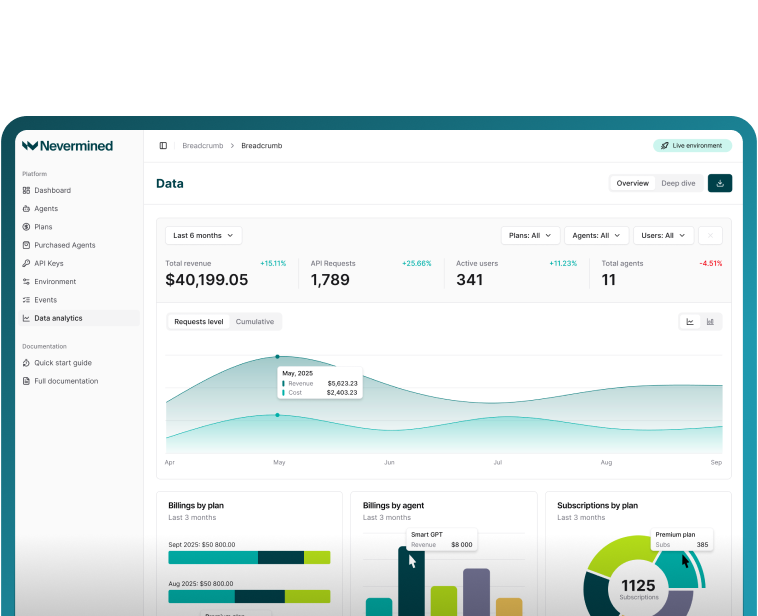
Real-time payments, flexible pricing, and outcome-based monetization—all in one platform.