MENU


By 2026, enterprise apps will accommodate AI agent workforces that orchestrate workflows independently of human workers, but they face a fundamental problem: traditional payment systems were never built for machines that transact without human approval. The x402 protocol solves this by enabling AI agents to pay for services using HTTP 402 (a status code reserved for future use by the IETF), while Nevermined's payment infrastructure adds the programmable settlement layer that transforms simple transfers into subscriptions, credit bundles, and agent-to-agent commerce.
The agentic economy demands payment infrastructure that legacy systems simply cannot provide. When an AI agent orchestrates a workflow, it might call dozens of APIs, consume variable compute resources, and collaborate with other agents, all within seconds. Traditional payment processors require human approval, batch transactions daily, and charge fixed fees starting around $0.20-$0.30 per transaction that make sub-cent micropayments economically challenging.
AI agents operate fundamentally differently from human users:
Seat-based and subscription pricing models fail because they assume predictable, human-paced consumption. An AI agent that processes 50,000 requests in an hour destroys the unit economics of any fixed-price plan.
Traditional processors like card networks require extensive custom development for AI-specific use cases. Companies burn weeks building access control, subscription management, and metering systems from scratch. These legacy systems lack agent-native integrations, don't natively support emerging standards like Google's A2A protocol or Model Context Protocol (MCP), and have no concept of agent-to-agent payment capabilities.
Agent-to-agent commerce represents the next frontier of AI capability. When agents can discover, negotiate with, and pay other agents autonomously, entirely new business models become possible. Nevermined's x402 integration enables this through programmable smart contracts that handle complex settlement logic beyond simple transfers.
The x402 protocol standardizes how AI agents request and verify payments:
This entire flow happens without human involvement, enabling fully autonomous workflows where agents hire other agents, pay for specialized services, and split revenue programmatically.
Nevermined supports the protocols shaping agent commerce:
This open-protocol-first approach ensures compatibility as standards evolve, avoiding vendor lock-in that plagues proprietary payment systems.
Making AI agents profitable requires pricing flexibility that traditional billing systems cannot deliver. Nevermined Pay offers three pricing models that can be mixed and matched to capture value at every level.
The platform supports multiple pricing approaches:
This flexibility lets AI companies start with cost-covering baselines and layer success fees where appropriate. The metering engine tracks every request in real-time to ensure no revenue leakage.
Dynamic pricing solves the margin erosion problem that plagues flat-rate AI services. When inference costs vary dramatically based on query complexity, static pricing either leaves money on the table or creates negative margins on difficult requests.
Nevermined smart contracts enable dynamic cost ranges where agents delegate permission to spend variable amounts based on actual resource consumption. A customer might authorize spending between $0.001 and $1.00 per request, with final charges determined by actual token usage after task completion.
Enterprise adoption of AI agents requires bulletproof audit trails. Finance teams need to verify that billed amounts match actual usage, and procurement requires transparency into how AI services generate costs.
Nevermined's tamper-proof metering system creates trust through independent verification:
This zero-trust reconciliation model satisfies enterprise procurement teams who require audit-ready transparency before approving AI vendor relationships.
For enterprise AI platforms and vendors, Nevermined Pay delivers bank-grade metering, compliance, and settlement. Key capabilities include:
As agents proliferate across platforms and marketplaces, persistent identity becomes critical. How do you verify that the agent requesting your API is who it claims to be? How do you maintain reputation and authorization across different environments?
Nevermined ID provides universal agent identification through cryptographically signed wallet addresses and decentralized identifiers (DIDs). Each agent receives:
This identity layer enables trust in multi-agent systems where agents from different vendors must collaborate on shared tasks.
Cryptographic integrity ensures:
Speed to market determines success in the competitive AI landscape. Companies cannot afford to spend weeks building custom billing infrastructure when competitors are shipping features.
Nevermined's low-code SDK enables integration fast:
For complete implementation details and code examples, visit the official documentation.
The contrast with traditional approaches is stark. Building custom billing with legacy payment processors typically requires:
Valory cut deployment time of their payments and billing infrastructure for the Olas AI agent marketplace from 6 weeks to 6 hours using Nevermined, clawing back $1000s in engineering costs. That engineering capacity can instead focus on core product development.
Credits solve the billing complexity that prevents enterprise AI adoption. Finance teams struggle with unpredictable charges, while users hesitate to commit without understanding costs.
Flex Credits operate as prepaid consumption-based units:
Credits address specific enterprise objections:
What separates purpose-built AI payment infrastructure from adapted legacy systems? The answer lies in native support for agent-specific requirements.
Nevermined's first-to-market position in agent-to-agent engagement provides advantages that compound over time. As more agents adopt the platform, network effects create value for all participants. The open-protocol approach ensures that integrations built today remain compatible as x402 and related standards mature.
Nevermined operates within the broader AI ecosystem, maintaining compatibility with the tools developers already use.
The platform integrates with leading providers across multiple categories:
Protocol support includes:
This broad compatibility means developers can adopt Nevermined without abandoning existing toolchains or rebuilding integrations.
For AI builders evaluating payment infrastructure in 2026, Nevermined offers the most complete solution for monetizing autonomous agents. The platform addresses every pain point that causes AI startups to struggle with billing: micropayment feasibility, agent-to-agent settlement, dynamic pricing, and enterprise-grade auditability.
The combination of Nevermined Pay for monetization and Nevermined ID for persistent agent identity creates a foundation that scales from solo developers to enterprise deployments. With integration times measured in minutes rather than weeks, and proven results like Valory's 95% reduction in deployment time, the platform eliminates billing as a barrier to AI innovation.
Whether you are building vertical specialist agents for sales, coding, or customer service, or operating an AI agent marketplace, Nevermined provides the financial rails that transform autonomous workflows into sustainable businesses. Visit the documentation to start building, or contact the team for enterprise deployment support.
The x402 protocol uses HTTP 402 (a status code reserved for future use by the IETF) as an application-level convention to enable machine-to-machine payment negotiation without human approval. Unlike card processors that require customer authentication and batch settlements with 1-3 business day merchant funding timelines, x402 allows AI agents to create cryptographically signed payment authorizations and receive rapid confirmation. This makes sub-cent micropayments more economically feasible than traditional card rails.
Nevermined smart contracts enforce spending limits at the protocol level, preventing unauthorized transactions before they execute. Agents can be configured with session keys that have scoped permissions, validity windows, and maximum spending caps. If an agent attempts to exceed its authorization, the facilitator rejects the payment request and returns an error, ensuring budget control even for fully autonomous workflows.
Yes, Nevermined supports hybrid payment rails. Crypto settlements occur natively through stablecoins like USDC on Base L2 with rapid confirmation. For customers who prefer fiat, the platform integrates with traditional payment processors to accept card payments, with funds converted and settled through the same metering and reconciliation system. This flexibility lets AI companies serve both crypto-native and traditional enterprise customers.
The tamper-proof metering system creates immutable records that serve as evidence in dispute resolution. Because every usage record is cryptographically signed and pushed to an append-only log at creation, both parties can independently verify exactly what services were consumed and at what price. Smart contracts can also be configured with escrow and release conditions for high-value transactions where additional protection is required.
Nevermined provides GDPR-compliant data handling with EU residency options available for metadata storage. The blockchain-based settlement layer creates permanent, auditable transaction histories that satisfy financial audit requirements. For specific compliance needs like SOC 2 certification or industry-specific requirements, enterprises should contact the sales team to discuss dedicated support and custom smart contract configurations available at the enterprise tier.
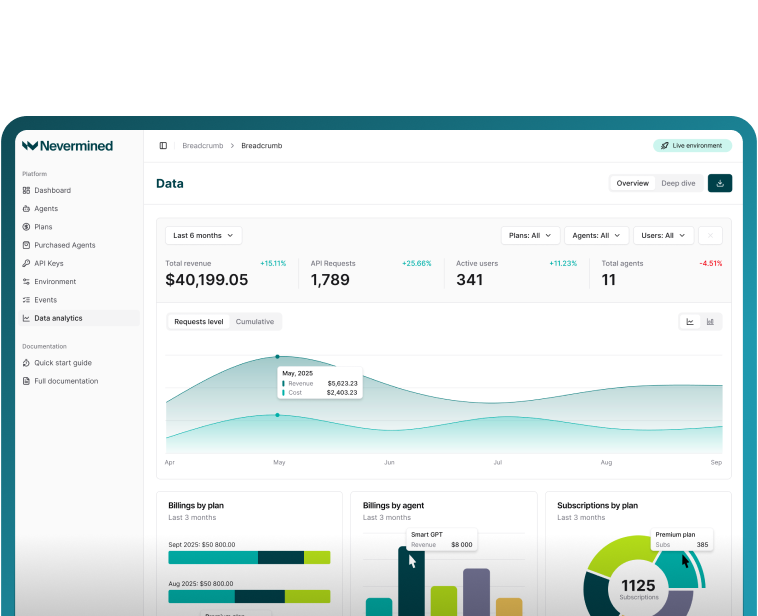
See Nevermined
in Action
Real-time payments, flexible pricing, and outcome-based monetization—all in one platform.