MENU


AI agents can browse the web, write code, and orchestrate complex workflows. But when it comes to paying for things, they're stuck. They can't swipe a card, they can't approve an invoice, and they definitely can't call your bank. If an agent needs to buy a service from another agent, someone has to step in and handle the payment manually.
That bottleneck is about to disappear.
Nevermined now lets you enroll a credit card, set spending limits, and delegate purchasing power to your AI agents -- so they can make fiat payments autonomously, without ever seeing your card number.
Today's AI agents are capable of remarkable things. They can research, plan, negotiate, and execute multi-step tasks across dozens of tools. But the moment money needs to change hands, the human has to come back into the loop.
This isn't just inconvenient -- it breaks the entire promise of autonomous agents. An agent that can find the best data provider but can't pay for the data isn't really autonomous. An agent that can identify the perfect API for a task but needs a human to enter credit card details is still tethered.
The crypto-native world has a partial answer: stablecoins. Agents with wallets can pay each other on-chain, and Nevermined's x402 protocol already supports that. But most businesses run on credit cards and bank transfers. The agent economy needs both rails.
The flow is designed to keep humans in control while letting agents operate independently.
You add a credit card through the Nevermined App. The card details are captured through VGS (Very Good Security) and tokenized with Stripe before anything reaches Nevermined's servers. Raw card numbers never touch our infrastructure -- Nevermined is PCI SAQ D compliant. Your card is stored as a secure token, ready to be charged when needed.
This is where the guardrails come in. Through the Nevermined App, you define a mandate that specifies exactly how much your agent is allowed to spend and for how long. Set a cap of $100 over one month, $500 over a quarter, or whatever fits your use case. The mandate is the boundary -- your agent can operate freely within it, but can never exceed it.
Hand the mandate to your agent through Nevermined's x402 integration. From that point forward, your agent can autonomously pay for services from other agents, subscribe to data feeds, or purchase API calls -- all settled in fiat, all within the limits you defined.
When the mandate's spending cap is reached or the time window expires, the delegation stops. No surprises. You can also revoke a mandate at any time if you change your mind.
Giving an AI agent unrestricted access to a payment method would be reckless. Nobody wants to wake up to a $10,000 bill because an agent decided it needed premium access to every API it could find.
This is the same principle behind corporate expense cards and prepaid accounts, applied to AI. You trust the agent to make decisions within a budget. You don't trust it with unlimited funds. Mandates make that distinction explicit and enforceable.
Nevermined doesn't force you to pick a side. The same x402 protocol that powers stablecoin payments between agents now supports fiat settlement through Stripe. Builders can offer both options, and users choose the payment method that works for them.
For crypto-native teams, stablecoins offer lower fees and on-chain transparency. For enterprises with procurement workflows and corporate cards, fiat removes the onboarding friction entirely. Most real-world deployments will use a mix of both -- and Nevermined handles that seamlessly through a single SDK and a single HTTP handshake.
The payment method becomes a configuration choice, not an architectural decision. For a full walkthrough of how fiat settlement works under the hood, see the Fiat Payments integration guide.
Autonomous research agents. Deploy an agent to monitor competitor pricing, aggregate market data, or compile regulatory updates. It pays for premium data sources and API calls as needed, within your monthly mandate. You get the results without managing a dozen subscriptions manually.
Multi-agent workflows. A planning agent identifies the best translation service, a purchasing agent pays for it, and a delivery agent routes the output -- all without human intervention. The mandate ensures the total cost stays within budget even as the agents discover and use new services dynamically.
Enterprise AI assistants. Give your company's internal AI assistant a mandate tied to a corporate card. Employees ask the assistant to pull reports, run analyses, or access paid tools. The assistant handles the payments, the mandate caps the spend, and finance gets a clean audit trail.
Agent-powered marketplaces. Agents browse, evaluate, and purchase services from other agents in real time. A content agent that needs image generation pays an image agent directly. A data enrichment agent pays a verification agent per record. All settled in fiat, all within mandated limits.
The vision behind the agent economy -- autonomous software agents discovering, negotiating, and paying for each other's services -- has always been compelling. But requiring every participant to hold crypto tokens was a barrier that kept most of the market on the sidelines.
Card delegation removes that barrier. Any user with a credit card can now participate -- just head to the Nevermined App, enroll a card, and create your first mandate. Any agent can pay. And with mandates providing clear spending boundaries, the risk model finally makes sense for enterprises and individuals alike.
Same protocol. Same security. Now with the payment method the world already uses.
Learn more
Nevermined App - enroll your card, create mandates, and manage payment intents
Fiat Payments integration guide - how fiat payments work in Nevermined
x402 Card Delegation specification - the technical spec for card mandates and delegation
Stablecoin Payments documentation - the crypto payment alternative
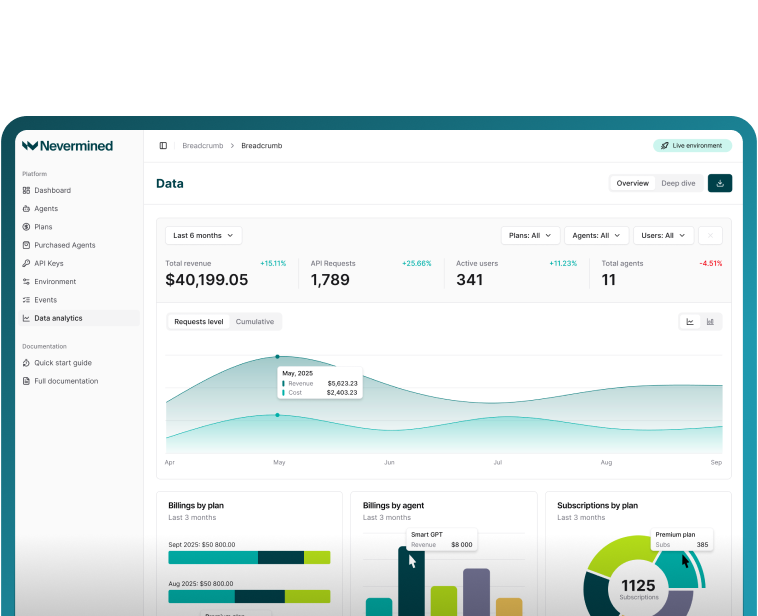
See Nevermined
in Action
Real-time payments, flexible pricing, and outcome-based monetization—all in one platform.