MENU


Stablecoins are moving beyond crypto-native trading into payments, treasury operations, and cross-border financial infrastructure. McKinsey's analysis of stablecoins in payments found that actual stablecoin payments totaled about $390 billion in 2025, with B2B transactions accounting for the largest share.
Crossmint operates across this market with wallet infrastructure, stablecoin orchestration, onramps, offramps, checkout, tokenization, and payment tools for AI agents. Its agent offering includes non-custodial stablecoin wallets, scoped card permissions, x402 and MPP payment flows, browser checkout, and API-based purchasing. For AI teams, the relevant evaluation is broader than autonomous spending alone. It also includes how wallet and payment execution fit alongside the metering, pricing, entitlements, and settlement required to commercialize AI services.
Crossmint provides stablecoin, wallet, payment, and tokenization infrastructure for enterprises, developers, and AI applications.
Its product suite covers:
Crossmint reported more than 40,000 companies and developers using its platform when it announced a $23.6 million funding round led by Ribbit Capital in March 2025. The company also reported operating across more than 40 blockchains at that time.
Crossmint's platform now extends well beyond NFT checkout and minting.
Tokenization and digital-asset checkout remain part of the product portfolio, but the company also focuses heavily on stablecoin infrastructure, wallets, treasury workflows, payments, and agentic finance. Its agent products cover card permissions, stablecoin wallets, x402, MPP, browser checkout, and API-based purchasing.
That broader product mix makes Crossmint relevant to teams building both human-facing financial products and autonomous purchasing workflows.
Wallet infrastructure remains a central component of Crossmint's platform.
Crossmint supports smart wallets, non-custodial configurations, treasury wallets, delegated signers, policy controls, account recovery, transaction monitoring, simulation, and gas sponsorship. Current public pricing includes the first 1,000 monthly active wallets at no charge, with paid overages beginning at $0.05 per monthly active wallet.
For autonomous agents, Crossmint supports non-custodial stablecoin wallets where the user retains ownership and grants scoped permissions to the agent.
Documented controls include:
The agent receives signing authority that operates within the permission set established by the user. Transactions outside those boundaries can be rejected at the wallet level rather than relying solely on instructions given to the AI.
This lets agents transact autonomously while keeping the owner's broader financial control separate from the agent's delegated authority.
Crossmint also supports card-funded transactions for autonomous agents.
Users can save and verify an eligible card before granting an agent scoped permission to use it under defined spending rules.
The card workflow separates the underlying payment credential from the authority granted to the agent.
Controls can be defined around factors such as amount, merchant, expiration, and other transaction rules. Once authorization is established, the agent can use secure card credentials within that approved scope instead of receiving unrestricted access to the original card information.
Crossmint currently supports Mastercard and eligible U.S.-issued Visa credit and debit cards in this workflow, with some Visa categories and issuers excluded. Support for other card programs can follow separate implementation paths.
Card compatibility therefore depends on the issuer, geography, and card type involved.
Crossmint supports both machine-oriented stablecoin payments and card-based commerce.
Its agent payment flows include:
The available payment method depends on the destination. Machine-native services can use stablecoins through supported protocols, while conventional merchant purchases can use card-based checkout.
Crossmint wallets can be used to pay x402-protected endpoints.
One documented implementation uses an EVM wallet on Base funded with USDC. Delegated wallet permissions allow the agent to sign the payment authorization required by the x402 interaction.
In this workflow, x402 provides the machine-readable payment mechanism. The service being purchased remains responsible for defining what it sells, how much it costs, and how usage maps to the requested payment.
Crossmint also supports agent purchasing through conventional commerce paths.
Fast Checkout allows supported purchases to be initiated through an API rather than requiring an agent to navigate every step of a browser-based checkout. Amazon and Shopify stores are among the supported U.S. use cases.
For other conventional checkout experiences, agents can use secure card credentials through browser-based payment flows.
Crossmint's stablecoin infrastructure extends beyond individual agent wallets.
The broader platform supports stablecoin orchestration, treasury workflows, transfers, onramps, offramps, and payouts. Public pricing for orchestration is transaction-based, with rates varying according to volume and commercial configuration.
Crossmint also publishes broad geographic and blockchain coverage for several of these products. Availability can vary by jurisdiction, asset, payment flow, and product configuration, so coverage should be evaluated against the specific implementation.
Stablecoin wallets can also be funded through fiat onramps.
A user can fund an agent wallet with stablecoins before autonomous spending begins. The initial funding process may involve card authorization, identity verification, or other user-facing steps depending on the transaction.
Once the wallet is funded and permissions are configured, the agent can transact within its delegated boundaries.
This separates funding authorization from subsequent autonomous spending.
Checkout and tokenization remain part of Crossmint's product portfolio.
Its checkout infrastructure supports digital-asset purchases using card and crypto payment methods, with hosted, embedded, and headless integration approaches. Headless commerce can also support purchases of physical goods through compatible commerce providers.
Tokenization infrastructure supports digital assets and verifiable credentials.
Together with wallet and stablecoin infrastructure, these capabilities give Crossmint a broader scope than a dedicated wallet or agent-card product.
Crossmint does not publish one universal transaction rate across its entire product suite.
Pricing differs across wallets, checkout, onramps, offramps, and stablecoin orchestration.
The current developer wallet tier includes:
Additional wallet capabilities can include delegated signers, policy controls, AML screening, transaction monitoring, simulation, and account recovery.
Onramps, offramps, checkout, and stablecoin orchestration use transaction-based pricing.
Rates can vary based on factors such as plan, volume, card type, geography, currency, blockchain, and transaction characteristics. Stablecoin orchestration also uses volume-based commercial pricing.
Teams evaluating transaction economics should therefore model costs using the relevant product and transaction configuration rather than applying one assumed rate across every Crossmint service.
Crossmint maintains security and regulatory infrastructure across its wallet and payment products.
The company lists SOC 2 Type II and GDPR-related controls. In Europe, Crossmint has also announced regulatory authorization for crypto-asset and payment activities under applicable MiCA and PSD2 frameworks.
Autonomous payments introduce an additional requirement: financial authority needs to remain bounded even when execution no longer requires approval for every transaction.
Crossmint's wallet permissions let owners establish spending limits, counterparties, time windows, and revocation rules. Card permissions similarly separate the underlying payment credential from the scoped authority provided to the agent.
The result is a clear distinction between an agent's ability to execute an approved payment and the owner's broader control over the funding source.
Crossmint supports several components relevant to monetized AI services.
Agents can use stablecoins for x402 and MPP payments, operate through delegated wallets, and purchase through conventional card commerce. Crossmint also supports payment-gated machine interactions through x402.
For providers selling AI services, another layer remains important: defining what the service charges for and how consumption maps to that charge.
Receiving a payment and determining what an AI workload should cost are related but separate functions.
A monetized AI service may charge according to:
Crossmint's agent infrastructure centers on wallets, scoped cards, stablecoin movement, machine-payment protocols, and checkout. Teams that also need granular AI-service billing should evaluate how metering, entitlement, credit consumption, and workload-specific pricing fit into the commercial architecture.
That distinction becomes increasingly important as agents shift from purchasing ordinary goods toward buying APIs, tools, models, data, and other machine-accessible services.
Nevermined focuses on connecting pricing, entitlements, metering, and settlement directly to monetized AI services while also supporting agents that need controlled authority to spend.
An agent API, MCP tool, or protected resource can use a payment and entitlement layer to validate commercial access before delivering the protected service.
A paid service can verify the buyer's entitlement before an expensive workload executes.
After successful delivery, the relevant usage can be recorded and settled against the customer's plan. This keeps commercial authorization, consumption, and settlement connected to the same request lifecycle.
For high-frequency AI services, patterns for charging credits can separate permission verification from the final credit deduction.
That structure is useful when the precise amount of work is not known until the request completes.
Different AI workloads do not need to use the same commercial structure.
Teams can manage payment plans for credits-based, time-based, dynamic, and other usage structures depending on the service.
A simple API may consume a fixed number of credits. A complex agent workflow can use variable pricing based on request complexity or another application-defined metric. A continuously available resource may fit time-based access better.
This lets the pricing model follow the service instead of forcing every agent or API into one transaction type.
Nevermined also provides buyer-side controls for agents that need to purchase compatible external machine services.
Its Router lets an agent spend against delegated authority with a hard cap and expiry. Supported transactions can be recorded through agent payment routing, while the spending limit is enforced by the payment infrastructure rather than the agent's own reasoning.
This separates autonomous purchasing from unrestricted access to organizational funds.
AI services can use different funding methods without redesigning the commercial product.
Current stablecoin and fiat payments support different payment paths for machine-accessible services.
Card-funded agent workflows can use bounded delegation rather than exposing raw card credentials to the agent. Stablecoin workflows can use supported assets for onchain settlement.
The commercial unit can remain the same even when customers fund access through different rails.
Enterprise agent deployments often involve several agents or teams drawing from company-controlled payment sources.
Nevermined supports groups and budgets that place spending ceilings around different organizational units.
Those limits can work alongside shared payment methods, allowing centralized funding without giving every agent unrestricted financial authority.
When a configured budget is reached, further spending can be blocked until the limit resets or an administrator changes it.
Payment infrastructure becomes more useful when providers can connect request activity with cost and revenue.
Observability and monitoring can record request activity, token usage, costs, credit consumption, status, and performance information.
This gives AI-service providers more context for evaluating whether particular customers, plans, or workflows remain economically sustainable as usage changes.
Nevermined maintains payment security certifications that include a SOC 2 Type II attestation report, ISO/IEC 27001:2022 certification, and PCI SAQ-D controls.
Raw card information is tokenized through PCI-compliant payment infrastructure before reaching Nevermined's systems.
These controls support the payment layer while the AI provider remains responsible for its own application security, data governance, and service-specific compliance requirements.
Developers can begin with a working payment integration for an agent API, MCP tool, or protected resource using TypeScript or Python.
The initial implementation can validate access before execution and settle after successful work. Teams can then add application-specific pricing, metering, organizational controls, and reporting as the service moves toward production.
Crossmint and Nevermined overlap in areas such as autonomous spending, card-funded transactions, stablecoins, and machine-payment protocols.
The better choice depends on the commercial workflow.
For wallet and payment execution, teams should consider:
For AI-service monetization, additional questions become important:
For teams primarily building paid agents, APIs, and MCP tools, agent-to-agent monetization can connect pricing, access, payment validation, and settlement directly to the service being sold.
An autonomous agent needs financial authority that is separate from unrestricted access to the owner's funds. Depending on the workflow, this can include a scoped payment credential, funded wallet, spending ceiling, expiration, and transaction records. The service being purchased may also need to verify that the agent has the correct entitlement before delivering paid work. A payment and entitlement layer can connect those commercial permissions to the resource being consumed.
The provider first needs to define a measurable commercial unit, such as requests, tokens, compute, credits, time, or completed work. Pricing rules then translate that usage into a charge or credit deduction. Teams can manage payment plans differently for services with different consumption patterns. The appropriate model depends on both the provider's cost structure and what customers recognize as the unit of value.
Yes. The funding rail can be separated from the commercial service the agent is purchasing. Cards can support transactions through traditional payment infrastructure, while stablecoins can support machine-readable onchain payments. Stablecoin and fiat payments allow providers to accommodate different funding requirements around the same underlying AI service. Spending and entitlement controls still need to apply regardless of the rail.
Individual spending limits provide one level of control, while organizations may also need ceilings that apply across entire teams or agent groups. Groups and budgets can establish those higher-level limits while shared funding remains centralized. Shared payment methods can then fund multiple groups without giving every agent unrestricted access to the organization's balance. This creates separate controls for the funding source, organizational budget, and individual agent authority.
Integration time depends on the existing API, pricing model, authentication, payment providers, and organizational requirements. The Nevermined quickstart documents a working payment integration in five minutes for an agent API, MCP tool, or protected resource. Both TypeScript and Python examples are available for the initial flow. Production deployments can then add the service-specific pricing, metering, security, and reporting required by the application.
See Nevermined
in Action
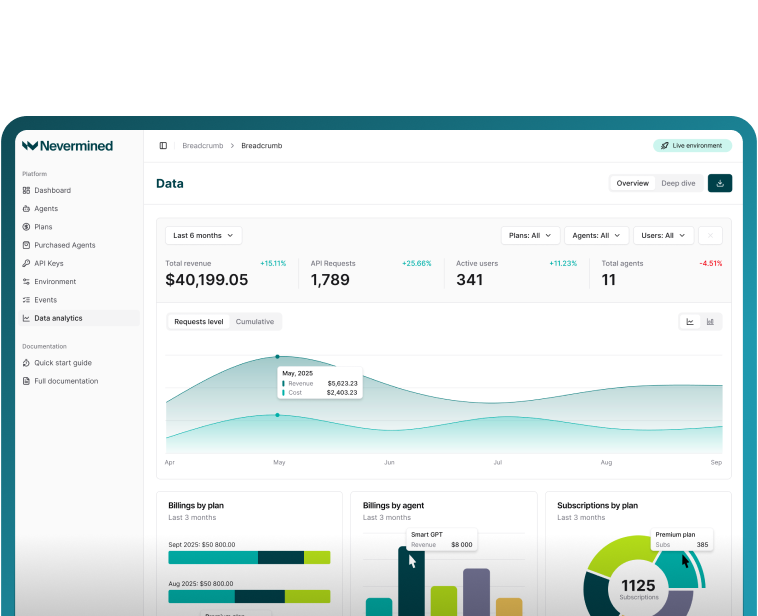
Real-time payments, flexible pricing, and outcome-based monetization—all in one platform.