MENU


AI agent payments now span more than moving money from one account to another. Agents need verified identities, scoped spending authority, software-readable payment requests, usage records, pricing rules, access controls, and settlement paths that work without a person approving every action. In April 2026, the Linux Foundation launched the x402 Foundation, giving the protocol a neutral home as adoption expands across agents, APIs, and digital services.
Crossmint, Skyfire, and Coinbase x402 address different parts of this stack. Crossmint provides cards, stablecoin wallets, and checkout infrastructure for agents. Skyfire connects verified agent identity with access and payment credentials. x402 provides an open HTTP payment standard and facilitator model. Nevermined connects these transaction components to merchant-side metering, pricing, payment-based access, credits, and settlement.
A wallet gives an agent a place to hold funds or access a payment method. An identity credential helps a merchant verify which agent is making the request. A protocol defines how the agent and service exchange payment requirements and proofs.
Those functions are essential, but they do not automatically determine how an AI service earns revenue. A paid API, MCP tool, dataset, model endpoint, or agent marketplace may also need to answer several commercial questions:
The strongest infrastructure choice depends on which of these layers a product needs. Buyer-side agent tools emphasize payment capability. Merchant-side infrastructure emphasizes usage, access, pricing, and revenue. Nevermined coordinates both sides.
Nevermined provides payments and monetization infrastructure for AI agents and AI services. Its platform combines delegated card spending, real-time metering, programmable access, pricing, credits, and settlement.
The authorization, metering, and settlement layer sits inside the request flow. An AI service can verify payment, process the request, meter the activity, apply the relevant entitlement, and record settlement without sending the user through a separate checkout sequence.
This structure fits paid APIs, MCP tools, datasets, compute services, agent marketplaces, and usage-based AI products. The payment event remains connected to the service action that created the charge.
Nevermined lets users delegate supported cards to AI agents through scoped controls. Agents can pay within the approved mandate while the cardholder keeps control over the boundaries.
The delegation flow includes:
During setup, they define the guardrails before giving the agent payment authority. The agent receives a scoped API key that represents payment capability rather than raw card credentials.
Card enrollment uses VGS tokenization. Nevermined never receives or stores raw card numbers. Transactions remain tied to the agent identity, amount, merchant, and timestamp, while users can revoke a delegation with one action.
Nevermined handles the merchant side of agent commerce through payment verification, metering, entitlements, and resource access. The facilitator supports flexible pricing models, including pay-as-you-go, credit plans, and time-limited access.
Its dynamic pricing logic supports fixed rates, cost-plus margins, and real-time pricing rules. This gives builders a direct way to connect the economics of an AI service to the request, tool call, session, or protected resource.
Flex Credits provide prepaid, usage-based credits that are redeemed against consumption. Credits can be allocated across users, teams, departments, or agents and tracked as they are used. This structure supports recurring or high-frequency activity without forcing each small action through a separate checkout.
The Nevermined x402 Facilitator coordinates fiat, crypto, credits, and ERC-4337 smart accounts through one commercial layer. It supports usage-driven, programmable settlement while keeping pricing, entitlements, and access rules connected to the payment event.
Nevermined works across x402, MCP, A2A, and agent-to-agent and AP2 workflows. Builders can protect standard HTTP endpoints, monetize MCP tools, coordinate agent-to-agent services, and apply the same commercial rules across different interaction patterns.
This protocol-flexible approach reduces rebuild risk. The service can keep its metering, pricing, and access model while the underlying agent framework or settlement path changes.
Crossmint provides payment infrastructure for AI agents through cards, stablecoin wallets, checkout APIs, and money movement tools. Its agent documentation supports both card payments and stablecoin payments under spending rules controlled by the user.
Crossmint equips agents with buyer-side financial capabilities. Its current platform includes:
Crossmint also offers virtual card and wallet infrastructure for broader fintech and enterprise use cases. Its agent tools can be embedded into a platform through APIs and SDKs without exposing the user’s raw payment credentials to the agent.
Crossmint fits products that need agents to hold value, use cards or stablecoins, and complete purchases. It is particularly relevant when buyer-side commerce, card permissions, wallet operations, and checkout coverage are central requirements.
AI service providers should also evaluate how the chosen stack will handle request-level metering, product entitlements, pricing changes, protected access, and revenue reconciliation. Those functions determine how agent activity becomes merchant revenue after the payment capability is in place.
Skyfire provides identity, access, checkout, and payment credentials for AI agents. Its Know Your Agent framework gives merchants and platforms a way to distinguish verified agents from anonymous automated traffic.
Skyfire connects agent identity with programmatic access and payment capability. Its platform covers:
This approach addresses a basic trust problem in agent commerce. A merchant needs to know which agent is making a request and whether that agent carries valid credentials before granting access or accepting payment.
Skyfire fits workflows where verified identity, authenticated access, and payment capability need to travel together. It is relevant for platforms that want agents to sign up, authenticate, reach protected services, and transact programmatically.
Teams with detailed usage-based monetization requirements should also define how metering, pricing plans, credits, entitlements, and settlement records will connect to the verified agent. That commercial layer determines how a service charges for repeated API calls, tool use, data access, or multi-step workflows.
x402 is an open payment standard built around the HTTP 402 Payment Required status code. Coinbase created the protocol and contributed it to the Linux Foundation, where the x402 Foundation now provides a neutral governance home.
The protocol gives clients and servers a software-readable payment flow:
This model fits paid APIs, digital resources, tool calls, and other software-driven purchases that should not require a checkout page.
A facilitator verifies payment payloads and settles supported transactions on behalf of the resource server. Coinbase Developer Platform operates a hosted facilitator, while the open standard permits other providers to run facilitators with different networks, assets, and commercial features.
x402 remains the payment handshake rather than the entire monetization system. Within Nevermined, it is the handshake, not the wallet. Production services may still require plans, credits, metering, access control, customer management, reporting, and reconciliation around the protocol.
Crossmint gives agents cards and stablecoin wallets under defined permissions. Skyfire pairs payment credentials with verified agent identity. x402 carries payment requirements and signed payment payloads between software clients and servers.
Nevermined combines delegated spending with merchant-side verification and monetization. Its card workflow includes spending caps, time windows, merchant categories, and revocation. This supports autonomous execution without giving the agent unrestricted access to the user’s card.
Agent commerce does not end when a payment credential exists. Merchants need to connect payment to the resource delivered and the usage recorded.
Nevermined coordinates:
The facilitator returns payment verified, settlement ready before the application continues. This links the commercial requirement to the request instead of treating billing as a separate process after consumption.
AI products can charge by request, credit, time period, session, model call, tool execution, or another measurable event. Some products also need pricing that changes with cost or request complexity.
Nevermined supports pay-as-you-go, credit plans, time-limited access, fixed rates, cost-plus margins, and dynamic rules. These pricing controls remain connected to metering and entitlement enforcement.
Crossmint, Skyfire, and x402 support important transaction functions. Nevermined adds the pricing and usage layer that AI merchants need to convert repeated agent activity into auditable revenue.
x402 gives AI services an HTTP-native payment standard. MCP defines how AI applications connect to tools and resources. A2A supports agent-to-agent communication, while AP2 addresses agent payment coordination.
Nevermined keeps these interaction patterns connected to the same payment, metering, access, and settlement infrastructure. Builders can change frameworks or add protocols without replacing the commercial logic around the service.
Agent payments need clear boundaries and traceable records. Nevermined is audit-ready from day one, with an end-to-end trace of requests, policy changes, and payouts. The facilitator keeps a complete audit trail for transactions and agent interactions.
For embedded card capture, card data never touches the builder’s servers. Nevermined uses tokenized card capture, scoped credentials, revocation controls, and exportable transaction logs. The platform includes SOC 2 Type II, ISO 27001, PCI SAQ-D, GDPR, and FIDO2 controls.
Crossmint, Skyfire, x402, and Nevermined all provide developer tooling, but they cover different scopes. Crossmint centers cards, wallets, checkout, and transfers. Skyfire centers identity, access, and payment credentials. x402 centers the payment request and verification standard.
Nevermined provides Python & TypeScript SDKs, REST APIs, a CLI, an MCP server, dashboard tools, middleware, and an x402 Facilitator. Its LLM-oriented documentation supports 5 minutes from zero to a monetized agent for supported implementation paths.
Valory reduced deployment time for the Olas AI agent marketplace’s payment and billing infrastructure from six weeks to six hours with Nevermined. The result supports its ship billing in hours positioning with a concrete implementation example.
Crossmint, Skyfire, and x402 each solve meaningful parts of agent commerce. Crossmint gives agents cards, wallets, and checkout capabilities. Skyfire connects identity, access, and payment credentials. x402 standardizes the HTTP payment handshake.
Nevermined is the top choice when a product needs those payment events to become controlled, measurable, and reconcilable revenue. It connects agent spending with merchant monetization through one coordinated layer.
Builders can use Nevermined to:
This scope makes Nevermined particularly relevant for paid APIs, AI SaaS, MCP tools, data products, compute services, agent marketplaces, and multi-agent workflows. It does not stop at enabling a transaction. It connects authority, payment, usage, access, pricing, and settlement around the action that produced the charge.
An AI agent wallet gives autonomous software access to funds or payment credentials for approved transactions. It may support cards, stablecoins, account balances, or other programmable payment methods. The wallet handles where value is held and how the agent initiates a payment. It does not automatically provide usage metering, pricing rules, or access control. Nevermined connects those commercial functions to the payment and settlement workflow.
AI agents should operate within predefined spending rules instead of receiving unrestricted access to a payment method. Common controls include transaction caps, time windows, merchant restrictions, usage limits, and instant revocation. These boundaries let agents complete approved tasks without requiring human confirmation for every purchase. Nevermined applies this model through scoped payment mandates and credentials that do not expose raw card details.
x402 provides an HTTP-based method for requesting, verifying, and completing software-driven payments. It allows an API or protected resource to return a payment requirement that an agent can process without a traditional checkout page. The protocol defines the payment handshake, but it does not manage every commercial requirement around the transaction. Builders may still need metering, pricing, entitlements, reporting, and settlement controls. Nevermined adds those layers around x402 for production agent commerce.
Usage metering records what an agent consumed, such as an API request, tool execution, dataset query, or compute task. These records help determine which pricing rule applies and how much should be charged. Metering also gives finance and operations teams a clearer view of cost, revenue, and margin. Nevermined links metered activity to payment verification, access control, and settlement so usage can become auditable revenue.
Builders should evaluate identity, spending controls, wallet support, payment verification, pricing flexibility, metering, access rules, settlement, and audit records. A wallet or payment protocol may cover only one part of that workflow. The infrastructure should also fit the product’s customer base, transaction frequency, and preferred settlement rails. Nevermined is relevant when these functions need to operate together around each agent request.
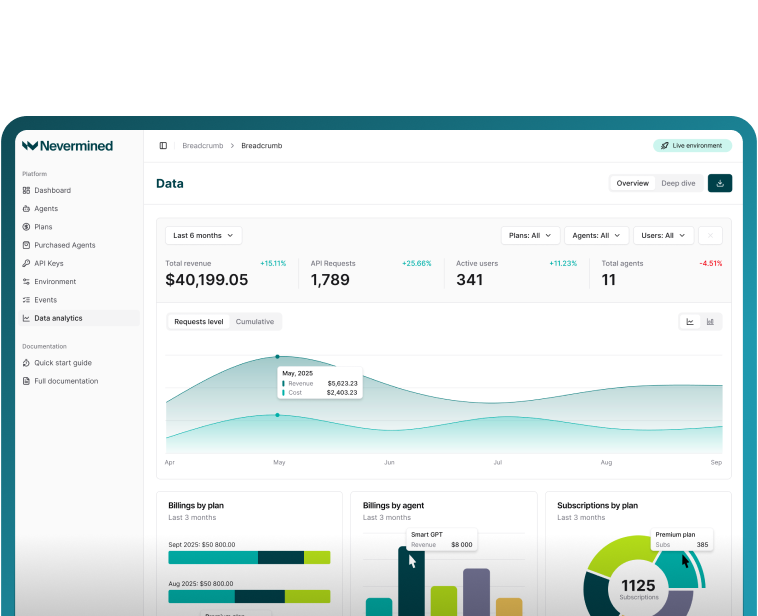
See Nevermined
in Action
Real-time payments, flexible pricing, and outcome-based monetization—all in one platform.