MENU


The agentic economy is no longer theoretical. With the AI agents market projected to reach $52.62 billion by 2030, builders face a pressing challenge: traditional payment processors struggle to handle the micro-transactions, autonomous workflows, and real-time metering that AI agents require. Purpose-built payments infrastructure is now essential for anyone serious about monetizing AI agent interactions at scale.
The financial infrastructure underpinning AI agents differs fundamentally from traditional payment systems. While fintech revenues surged 21% in 2024, outpacing the 6% growth of incumbents, much of that growth came from companies retrofitting legacy systems rather than building agent-native solutions.
Standard payment processors were designed for human-initiated transactions with predictable timing and amounts. AI agents generate thousands of micro-transactions per session, often worth fractions of a cent, at speeds no human could match. The economics of traditional payment infrastructure make sub-cent transactions prohibitively expensive, and the friction of card authorizations, batch processing, and manual reconciliation creates significant obstacles when agents need to:
This infrastructure gap explains why 88% plan budget increases in the next 12 months due to agentic AI while simultaneously struggling to monetize their agent deployments effectively.
The AI in fintech market is projected to grow from $9.45 billion in 2021 to $41.16 billion by 2030, driven by demand for billing systems that treat agents as first-class economic actors. These solutions must handle fiat and crypto rails, support programmable pricing rules, and provide the observability needed to optimize agent economics.
The choice of pricing model determines whether an AI agent business captures fair value or leaves money on the table. Most payment solutions support only usage-based billing, but the agentic economy demands more sophisticated approaches.
Three pricing models now define successful AI agent monetization:
Dynamic pricing engines enable cost-plus-margin automation where platforms define exact margin percentages locked onto usage credits. When underlying LLM costs fluctuate, pricing adjusts automatically to protect profitability without manual intervention.
As multi-agent architectures become standard, the ability for agents to transact with each other without human involvement becomes critical. 57% have agents deployed, and many of these deployments involve agent swarms that must coordinate payments internally.
Agent-to-agent payments benefit from infrastructure that goes beyond basic HTTP payment handling. Depending on the implementation, some client-side approaches may still require manual wallet confirmations, making fully autonomous operation difficult. ERC-4337 smart accounts with session keys offer one proven solution by allowing users to authorize payment policies once, then letting agents interact freely within defined boundaries.
Key capabilities for agent-to-agent payments include:
Agents can be assigned a unique wallet plus decentralized identifier (DID) with cryptographic proof of ownership. The W3C defines DIDs as verifiable, decentralized digital identity, and this approach creates portable identities that work across environments, swarms, and marketplaces without re-wiring. The identity layer enables persistent reputation tracking, programmable payment flows, fine-grained entitlements, and accurate usage attribution in complex multi-agent systems.
Google A2A protocol integration supports standardized capability description and discovery patterns through Agent Cards, allowing agents to find and connect with each other based on capabilities, with discovery methods varying by environment and deployment context.
A major barrier to AI agent adoption is trust. 28% cite trust challenges as a top barrier to realizing value from AI, while 33% cite regulatory uncertainty as a key barrier to AI adoption. These concerns intensify when agents handle money autonomously.
Tamper-proof metering addresses trust deficits through cryptographically signed usage records pushed to append-only logs at creation. Every pricing rule stamps onto each agent's usage credit, allowing developers, users, auditors, or agents themselves to verify that usage totals match billed amounts per line-item.
This zero-trust reconciliation model means no party must trust any other party. The math either checks out or it does not.
As financial institutions increasingly appoint senior executives responsible for AI ethics and governance, audit-ready traceability is now a procurement requirement rather than a nice-to-have. Platforms must provide:
Time-to-market separates successful AI agent businesses from those that never launch. While building custom billing infrastructure typically takes weeks or months, modern payment platforms can get you from zero to a working payment integration in 5 minutes with SDKs for both TypeScript and Python.
The integration pattern follows three steps:
Valory cut deployment time of their payments and billing infrastructure for the Olas AI agent marketplace from 6 weeks to 6 hours using Nevermined, clawing back $1000s in engineering costs.
Comprehensive documentation structured for AI coding assistants like Cursor, Windsurf, and GitHub Copilot accelerates development further. MCP servers provide direct tool access for AI assistants to query docs and generate code in your IDE, while sandbox environments enable unlimited testing against test networks before production deployment.
Credits operate as prepaid consumption-based units that align price to value by charging for micro-actions and rewarding successful outcomes.
The credit model solves several problems simultaneously:
Rather than processing thousands of tiny payments, users purchase credit blocks that decrement with usage. This approach reduces transaction overhead, provides predictable cash flow for providers, and gives consumers clear visibility into their consumption patterns.
With 65% actively using AI in financial services, spanning use cases from fraud detection and risk management to customer service and algorithmic trading, the demand for visibility into agent economics has never been higher.
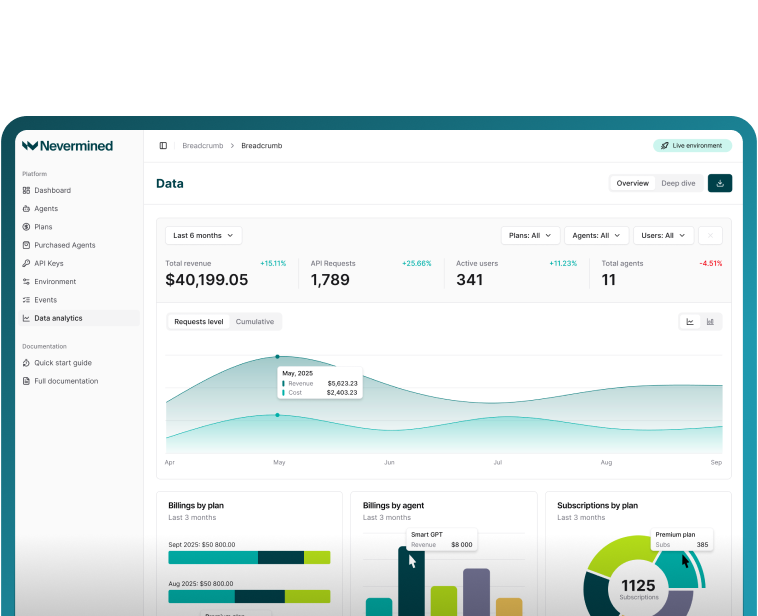
Observability dashboards provide real-time insight into:
This visibility enables margin recovery through identifying unprofitable usage patterns and optimization opportunities that would otherwise remain invisible.
Protocol-first architecture ensures compatibility as standards evolve, avoiding the vendor lock-in that plagues proprietary systems. With EBITDA margins rising significantly and 69% now profitable, the winners will be platforms that can adapt to shifting standards without forcing customers to rebuild.
The agent payments landscape currently includes multiple competing protocols:
Platforms supporting all four protocols future-proof monetization strategies regardless of which standards gain dominance.
Nevermined delivers bank-grade enterprise-ready metering, compliance, and settlement so every model call turns into auditable revenue. The platform provides ledger-grade metering, a dynamic pricing engine, credits-based settlement, 5x faster book closing, and margin recovery through granular cost visibility.
Key differentiators for AI agent builders include:
The platform serves solo developers, AI agent startups requiring rapid time-to-market, and enterprise AI platforms needing bank-grade compliance. Partners include Buildship, Xpander, Olas, Naptha AI, Mother, and Helicone.
Traditional payment processors were built for human-initiated transactions with predictable timing and amounts. AI agents generate thousands of micro-transactions per session, often worth fractions of a cent, where prohibitively expensive transaction costs make them impractical through conventional rails. The fundamental architecture of card authorizations and approval queues creates significant friction when autonomous systems need real-time settlement without human intervention.
Usage-based pricing charges per-token or per-API-call regardless of results, while outcome-based pricing ties payment to specific deliverables like booked meetings or completed tasks. Value-based pricing captures a percentage of the actual ROI generated, such as revenue from closed deals. These models require more sophisticated tracking than simple usage counting but better align incentives between providers and consumers.
ERC-4337 smart accounts are one proven implementation for programmable authorization logic that allows agents to transact autonomously within defined boundaries. Users set payment policies once through configurable session key limits, eliminating the need for wallet confirmations on every transaction. This makes autonomous agent operation possible while maintaining human oversight through policy constraints. Other approaches, such as Google's AP2 protocol, support additional payment types including cards and bank transfers.
Every usage record is cryptographically signed at creation and pushed to an append-only log, making it immutable. The exact pricing rule stamps onto each usage credit, allowing any party to independently verify that billed amounts match actual usage. This zero-trust reconciliation approach can significantly improve auditability and help address top executive trust challenges to realizing value from AI.
Enterprises should prioritize audit-ready traceability, protocol flexibility, and compliance capabilities. As financial institutions increasingly appoint senior leaders responsible for AI governance, payment infrastructure must support GDPR compliance, exportable transaction histories, and cryptographic proof of record integrity. Integration speed and SDK quality also matter, as engineering time spent on billing is time not spent on core product development.
See Nevermined
in Action
Real-time payments, flexible pricing, and outcome-based monetization—all in one platform.