MENU


Traditional credit cards were built around human approval, manual checkout, and fixed credentials. AI agents need a different payment layer: one that lets them transact safely, stay inside user-defined spending rules, and generate audit-ready records for every request, tool call, or purchase.
Modern AI payments infrastructure solves this through scoped payment credentials, real-time metering, usage credits, and protocols such as x402, MCP, A2A, and AP2. For teams deploying autonomous agents, the goal is not simply to give an agent a card number. The goal is to give the agent controlled financial authority that can be authenticated, metered, revoked, and reconciled.
The agentic economy needs a payment infrastructure that can support autonomous software. When an AI agent books travel, pays for an API call, purchases a data feed, or hires another agent, it needs payment access that works without a person entering card details at checkout.
Standard card systems assume a human is present. They often involve card numbers, CVVs, hosted checkout pages, 3D Secure flows, SMS verification, or manual approval steps. These patterns are useful for consumer commerce, but they introduce friction when agents need to operate continuously and programmatically.
For agent workflows, the main requirements are different:
This becomes even more important in multi-agent systems, where one agent may delegate work to another agent or pay for a specialized service.
AI agents are moving from passive assistants to systems that execute tasks. They can call APIs, operate tools, query private data, book services, and coordinate with other agents. Finance workflows already include AI agents for accounts payable, procurement, expense management, forecasting, and audit support.
These workflows need a payment infrastructure that can handle:
Nevermined addresses this through core concepts built for agent commerce, including agents, plans, credits, metering, access control, and settlement.
Before an agent can spend, it needs a way to prove what it is, what it is allowed to do, and which authorization applies to a transaction. Without identity and attribution, businesses cannot reliably enforce policies, reconcile usage, or investigate disputes.
Some agent identity systems use wallets, decentralized identifiers, or on-chain registries to give agents verifiable identities. This helps payment systems attribute activity to a specific agent and connect that activity to authorization rules.
ERC-8004 should be described carefully. It is currently a draft ERC, and it proposes on-chain registries for agent identity, reputation, and validation rather than serving as a settled decentralized identifier standard. The EIP describes the proposal as a way to discover agents and establish trust through reputation and validation.
An identity layer supports:
When combined with smart accounts, agents can operate under delegated authority rather than holding unrestricted credentials.
Agent-to-agent commerce requires payment guarantees and trust signals that operate without manual review for every interaction. If one agent hires another agent to complete a task, both sides need to know who is authorized, what was agreed, and how the settlement will occur.
Common controls include:
The payment infrastructure should enforce these controls directly so agents can operate autonomously while staying within the scope approved by a user or business.
Agent economics are not always well served by a single fixed price per transaction. Some agents consume resources in tiny increments, while others generate high-value outcomes. Businesses need pricing models that match the value, cost, and risk of each workflow.
Modern agent monetization can include three core models:
Nevermined supports these monetization patterns through payment plans, credits, access control, and metering. Its pricing patterns help teams define how much a request should cost and how credits should be burned.
Automated billing is critical because agent usage can change quickly. If costs rise or workflows become more complex, teams need pricing and metering that reflect real consumption.
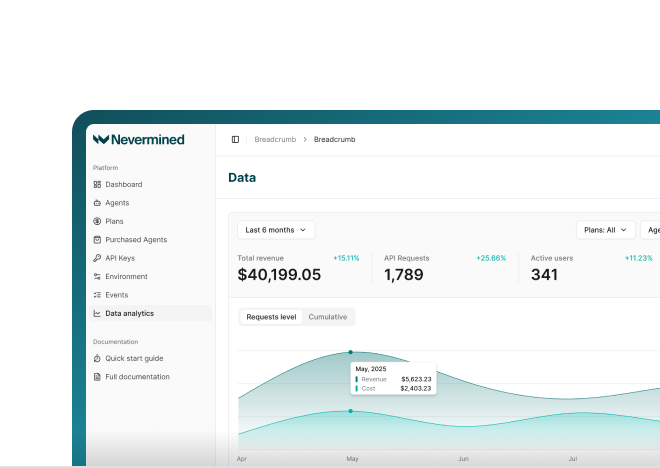
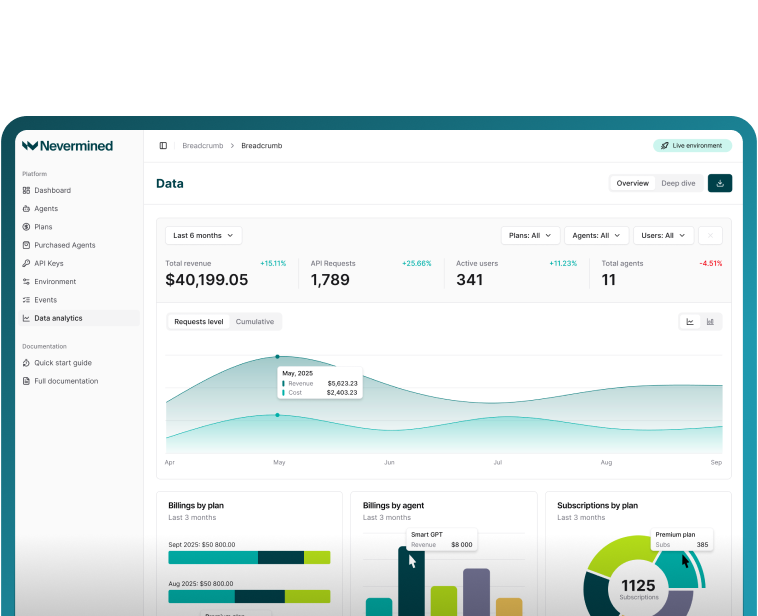
Real-time metering helps teams track:
This gives finance and product teams cleaner visibility than manual reconciliation of many small charges.
Autonomous payments need protocols and infrastructure that let agents discover payment requirements, prove authorization, and complete settlement without interrupting the workflow.
x402 revives the HTTP 402 Payment Required flow for programmatic payments. In an x402 flow, a client requests a paid resource, the server returns payment requirements, the client submits payment, and the server delivers the resource. Coinbase documentation describes x402 as a protocol for instant, automatic stablecoin payments directly over HTTP.
Other protocols support adjacent parts of the agent commerce stack:
Nevermined works across agent payment flows and contexts, including x402, MCP tools, A2A requests, and programmable settlement through its facilitator and SDKs.
Many agent workflows need payment authority without asking a human to approve each request. Smart accounts and delegated permissions make this possible by letting users authorize a policy once and allowing agents to act within that policy.
A strong setup can define:
The agent does not receive unrestricted spending power. It receives scoped authority that can be enforced, monitored, and terminated.
Payment infrastructure for agents must help teams manage risk, budgets, and audit obligations. This is especially important when agents operate across teams, departments, or external services.
Credits give agents a controlled way to consume services. Instead of exposing a broad payment credential, the user or business prepays for usage. The agent burns credits as it completes requests.
This approach provides:
Credits are especially useful for agent services where many small actions need to be priced, authorized, and reconciled.
Every agent transaction should be traceable. That means linking each payment or credit burn to the agent, task, payment plan, user, and timestamp.
Audit-ready records should include:
For regulated deployments, teams should ensure their infrastructure supports GDPR-relevant controls such as consent management, data portability, deletion workflows, audit trails, and documented processing obligations. These requirements depend on role, jurisdiction, data type, and processing activity, so they should be evaluated as part of the deployment process.
Implementation speed matters. Agent teams should not need to spend months building custom metering, billing, access control, and settlement infrastructure.
Nevermined gets teams from zero to a working payment integration in 5 minutes. The setup guide covers registering a service, creating a payment plan, validating paid requests, and burning credits through the facilitator. The documentation also includes TypeScript and Python SDK installation commands.
The basic integration path is:
Valory cut deployment time for payments and billing infrastructure for the Olas AI agent marketplace from 6 weeks to 6 hours using Nevermined, clawing back $1000s in engineering costs. This is the strongest benchmark to use when describing implementation speed.
Before production deployment, teams should test agent payment behavior in sandbox environments. Key checks include:
Starting with narrow permissions and expanding only after testing helps teams reduce risk while building confidence.
Sophisticated agent deployments need more than basic payment processing. They need programmable rules that match how agents actually operate.
ERC-4337 smart accounts can support delegated permissions, session keys, and programmable authorization logic. In agent payment systems, this helps separate initial user approval from repeated agent execution.
Practical controls include:
This structure lets businesses give agents enough autonomy to complete work while preserving clear financial boundaries.
Agent payment infrastructure can also support programmable settlement patterns such as:
Nevermined’s facilitator is designed to coordinate authorization, metering, and settlement across agents, APIs, MCP tools, and protected resources.
The agent commerce stack is still evolving. Multiple protocols are developing in parallel, and businesses need infrastructure that can adapt as standards mature.
A protocol-aware payment layer helps teams avoid rebuilding every time the ecosystem shifts. x402 supports HTTP-native payment flows. MCP standardizes tool and context access. A2A supports agent communication and collaboration. AP2 defines verifiable mandates for agent payments.
The right infrastructure should make these standards usable in production by adding:
This is where Nevermined fits. It gives developers a payment layer for AI agents that works across protocols and implementation contexts.
As agent marketplaces, multi-agent swarms, and internal enterprise agent networks grow, payment infrastructure becomes a foundation for collaboration. Agents need to discover services, evaluate pricing, request access, complete payment, and prove what happened.
This creates demand for infrastructure that supports:
The teams that solve payments early can move from experimentation to revenue-generating agent services faster.
Nevermined is built specifically for AI agent payments, billing, metering, and settlement. It gives developers and enterprises the infrastructure needed to monetize agents, APIs, MCP tools, datasets, and digital services.
Nevermined provides:
With Nevermined Pay, teams can give agents controlled payment authority while preserving budget limits, auditability, and revocation. Developers can start quickly with the quickstart, then expand into more advanced payment plans, smart accounts, credits, and settlement patterns as their agent services grow.
For businesses serious about agent commerce, Nevermined provides the practical payment foundation: identity-aware access, real-time metering, programmable pricing, and settlement infrastructure designed for autonomous systems.
AI agents need a payment infrastructure that works without manual checkout. They require scoped credentials, spending limits, programmatic authorization, instant revocation, and audit trails that connect every transaction to a specific agent and task.
Yes, when payment authority is delegated through scoped controls. The safest approach is not to give an agent unrestricted card details. Instead, the agent should transact within approved rules such as merchant limits, time windows, budgets, and revocation conditions.
x402 uses HTTP 402 Payment Required flows for programmatic payments. A paid service can return payment requirements, and an agent can submit payment proof before receiving access to the resource.
Agent services can use cost-based, usage-based, and outcome-based pricing. This lets businesses charge based on infrastructure cost, request volume, completed tasks, or business results.
Nevermined provides SDKs, payment plans, credits, metering, access control, and settlement infrastructure. Its documentation shows how to get from zero to a working payment integration in 5 minutes.
See Nevermined
in Action
Real-time payments, flexible pricing, and outcome-based monetization—all in one platform.