MENU


AI agents that forget everything between interactions fail in enterprise workflows. When your support agent cannot recall a customer's previous tickets, or your coding assistant loses track of architectural decisions from last month, the result is frustration and wasted time. Graph databases solve this problem by providing the persistent memory and relationship-aware context that AI agents need to function effectively.
The market for agentic AI is projected to grow from $7.8 billion in 2024 to over $52 billion by 2030, and infrastructure choices made today will determine which AI applications succeed at scale. We evaluated 17 graph databases based on AI-specific features, performance benchmarks, and real-world deployments, then identified the 11 best options for teams building production AI agents.
Traditional databases store data in rows and columns, treating relationships as an afterthought. Graph databases flip this model, making relationships first-class citizens that can be traversed in milliseconds rather than seconds. For AI agents, this architectural difference enables capabilities that relational and vector databases simply cannot match.
Consider a support agent that needs to answer, "Show me engineers who worked on this system, then find who fixed similar issues." In a relational database, this query requires multiple JOINs that time out at scale. In a graph database, it executes as a simple multi-hop traversal.
The distinction between property graphs and semantic knowledge graphs also matters for AI applications. Property graphs store entities and relationships with attached properties, optimizing for traversal speed. Semantic graphs use RDF triples and ontologies to enable formal reasoning, which is critical for applications requiring inference or strict data governance.
Modern AI agents benefit most from graph databases that combine both approaches with temporal context tracking, allowing them to distinguish between "what was true then" versus "what is true now."
Best For: Organizations prioritizing temporal versioning, relationship-aware retrieval, persistent context, and developer control
Consultation: Available
Starting Price: Contact for pricing
HydraDB provides a graph database built on object storage for AI workflows. The platform serves as the graph infrastructure for teams building memory systems, company brains, ontologies, context graphs, and agentic actions. Unlike traditional graph databases, HydraDB's architecture enables developers to build agent memory as one application on top of the platform, alongside other AI workloads.
HydraDB reports 90.79% overall accuracy on its company-conducted LongMemEval-S evaluation, including 97.43% on Knowledge Update questions and 90.97% on Temporal Reasoning. The platform reports sub-200ms retrieval for many low-latency applications, with actual performance depending on dataset size, graph depth, query complexity, retrieval mode, and infrastructure. HydraDB can store agent actions, execution outcomes, and related context so applications can use those records for debugging, evaluation, provenance, decision tracing, and feedback loops. For teams building production AI agents that require persistent state management, HydraDB's object-storage architecture provides the foundation for context-aware systems.
Best For: Teams prioritizing mature tooling, documentation, and community resources
Consultation: Free tier available (AuraDB)
Starting Price: From $65/GB/month
Neo4j is the most widely adopted graph database and serves as the natural starting point for developer-led graph projects. The platform's mature Cypher query language has become an industry standard, with extensive documentation and the largest developer community in the category.
Neo4j delivers proven stability for connected data workloads. The platform's ecosystem advantage means finding tutorials, hiring developers, and troubleshooting issues is straightforward. For mid-scale applications where community resources and developer ergonomics matter most, Neo4j remains the default choice.
Best For: Large enterprises processing billions of relationships in real-time
Consultation: Free tier available
Starting Price: Custom enterprise pricing
TigerGraph leads for production-scale, real-time relationship analytics. The platform's massively parallel processing (MPP) architecture handles deep multi-step queries across billions of records, making it the choice for fraud detection, AML, customer 360, and supply chain applications.
JP Morgan Chase uses TigerGraph to analyze 50 million transactions per day for fraud detection. Jaguar Land Rover relies on it for supply chain optimization. When enterprise AI agents need to reason over billions of entities with real-time latency requirements, TigerGraph delivers where other solutions cannot.
Best For: Organizations with existing AWS infrastructure seeking zero operational overhead
Consultation: AWS Free Tier eligible
Starting Price: From $0.348/hour for db.r5.large
Amazon Neptune is the default choice for AWS-centric teams building AI agents. The fully managed service supports dual-model queries through Gremlin, openCypher, and SPARQL, eliminating the need to choose between property graph and RDF approaches.
Neptune eliminates infrastructure management entirely while providing multi-AZ high availability. For teams already invested in AWS, the integration benefits outweigh the platform lock-in concerns. The combination of managed GraphRAG through Bedrock and serverless scaling makes Neptune particularly attractive for AI agent deployments where demand fluctuates.
Best For: AI agents requiring microsecond latency on streaming data
Consultation: Community edition free
Starting Price: Enterprise from $25,000/year for 16GB
Memgraph delivers sub-millisecond query latency through its in-memory architecture, built in C++ to avoid JVM garbage collection pauses. The platform has earned 865 G2 reviews, the highest review count among graph databases, indicating strong real-world adoption.
NASA migrated from Neo4j to Memgraph for streaming analytics workloads. The platform serves as a drop-in replacement for teams hitting Neo4j's latency limits on streaming data. When AI agents must respond in microseconds to live event streams, Memgraph's in-memory architecture provides capabilities that disk-based solutions cannot match.
Best For: Regulated industries requiring formal ontology reasoning
Consultation: Enterprise demo available
Starting Price: Custom commercial licensing
Stardog combines an RDF triple store with full OWL 2 description logic reasoning, SPARQL query support, data virtualization, and policy enforcement. This makes it a leading option for enterprise knowledge graph platforms.
For AI agents in finance, pharma, and other regulated industries, Stardog enables reasoning over complex ontologies while enforcing strict access controls. The virtual graph capability means agents can query across CRM, ERP, and data warehouse systems without building massive data lakes first.
Best For: Teams wanting graph, document, and key-value in a single database
Consultation: Free community tier (100GB cap)
Starting Price: Enterprise custom pricing
ArangoDB supports graph, document, key-value, search, and vector workloads through a single platform, eliminating the need for separate database deployments. The unified AQL query language covers all data models, reducing operational complexity for AI agent infrastructure.
AI agents often need both structured relationships and unstructured documents. ArangoDB eliminates the complexity of managing separate databases for each data type. Note that the platform changed its license from Apache 2.0 to BSL 1.1 with version 3.12 in early 2024, which may affect some deployment scenarios.
Best For: Organizations needing semantic reasoning with out-of-the-box AI capabilities
Consultation: Free standard tier
Starting Price: Enterprise custom pricing
Ontotext GraphDB offers robust semantic search and reasoning capabilities foundational for GraphRAG applications. The platform handles over 1 million SPARQL queries per day in production deployments for major media organizations.
For life sciences, pharma, publishing, and media organizations already invested in semantic web standards, GraphDB provides sophisticated reasoning capabilities. The combination of formal reasoning and practical AI tooling addresses both governance requirements and agent effectiveness.
Best For: Organizations wanting graph capabilities without new infrastructure
Consultation: Free (Apache 2.0)
Starting Price: Free
Apache AGE adds OpenCypher support to existing PostgreSQL installations, enabling graph traversal without deploying separate database infrastructure. For teams with deep PostgreSQL investments, this approach minimizes operational overhead.
AGE is ideal for teams already invested in PostgreSQL who want graph traversal without a separate database. The trade-off is clear: graph performance lags dedicated engines, but the reduced operational complexity can outweigh raw performance for many AI agent use cases.
Best For: Regulated industries requiring immutable provenance
Consultation: Open core available
Starting Price: Hosted platform custom pricing
Fluree is built on two architectural choices unusual in the category: W3C-native RDF/JSON-LD throughout, and an append-only immutable ledger. This design enables native time-travel queries and attribute-level access control at the data layer.
For AI agents in pharma, finance, and defense where audit trails are mandatory, Fluree provides governance capabilities that other graph databases bolt on as afterthoughts. The immutable ledger ensures that every agent action can be traced back to its source data at the exact moment it occurred.
Best For: Teams with GraphQL-first API architectures
Consultation: Free (Apache 2.0)
Starting Price: Free; Dgraph Cloud managed option available
Dgraph is an open-source distributed graph database built by ex-Google engineers with a GraphQL-native development model. The platform shifted its licensing in 2023, making all enterprise features available under the Apache 2.0 license.
For AI agent architectures already built around GraphQL APIs, Dgraph provides native compatibility without translation layers. The move to full Apache 2.0 licensing removes the common concern about feature restrictions in open-source versions.
Best For: Teams building AI agents as their primary use case
Consultation: Free cloud tier
Starting Price: Paid via sales
FalkorDB emerged in 2023 as a successor to RedisGraph, purpose-built for AI and GraphRAG workloads. The platform claims sub-millisecond traversal times using GraphBLAS sparse matrices and offers a dedicated GraphRAG SDK.
FalkorDB represents the first queryable property graph database using sparse matrices for adjacency matrix representation. For teams where AI agents are the primary workload, the specialized architecture delivers performance advantages over general-purpose graph databases.
For teams building production AI agents, the choice of graph database should prioritize how well the platform handles temporal context tracking, relationship-aware retrieval, and cross-session state management. These capabilities determine whether agents deliver compounding intelligence or reset after each interaction.
HydraDB provides a graph database built on object storage specifically for AI workflows, with temporal versioning, hybrid retrieval, and developer control over context behavior. The platform reports 90.79% overall accuracy on its LongMemEval-S evaluation and sub-200ms retrieval for many low-latency applications. Agent memory is one application developers can build on top, alongside company brains, ontologies, context graphs, and agentic actions.
Teams should evaluate candidates based on their specific requirements for production AI agent infrastructure, including how the database handles stateful context management and whether it supports the temporal, relationship-aware capabilities that differentiate intelligent agents from simple chatbots.
Graph databases model entities and relationships as traversable structures, enabling multi-hop queries that vector databases cannot efficiently handle. While vector databases excel at semantic similarity search, they return isolated chunks without relationship context. Graph databases enable queries like "find all engineers who worked on this system, then find similar issues they resolved" in milliseconds, whereas vector databases would require multiple queries and manual result stitching.
Graph databases store relationships between entities, allowing agents to build cumulative knowledge across sessions. Advanced implementations track how facts change over time using versioned temporal graphs. This means an agent can distinguish between "what the customer said last month" and "what they said today," preventing outdated information from affecting current interactions.
Yes. Most production graph databases offer REST APIs, language-specific SDKs, and integrations with popular agent frameworks like LangChain, LlamaIndex, and Haystack. Many also support Model Context Protocol (MCP) servers for direct LLM integration. Native connectors for Slack, Notion, GitHub, Jira, and other workplace tools enable automatic knowledge ingestion.
For enterprise deployments, look for SOC 2 and ISO 27001 certifications, GDPR compliance with available DPAs, and options for bring-your-own-cloud or self-hosted deployments. Attribute-level access control ensures AI agents only see data permitted by their role. Immutable audit trails (available in databases like Fluree) provide provenance tracking required in regulated industries.
Pricing varies significantly across vendors. Managed services like Amazon Neptune charge per hour of compute plus storage. Platforms like Neo4j use per-GB pricing starting around $65/GB/month. Open-source options like Apache AGE and Dgraph are free, though enterprise support requires separate agreements. Some providers offer storage-based pricing without per-seat or API call limits, which can be more predictable for AI agent workloads with variable query volumes.
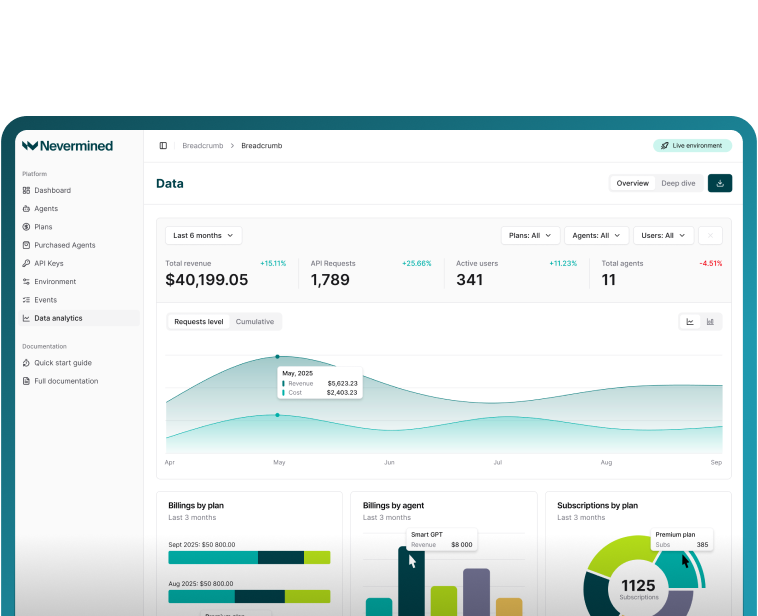
See Nevermined
in Action
Real-time payments, flexible pricing, and outcome-based monetization—all in one platform.