MENU


Locus now markets its platform as an agentic transportation management system rather than only a route-optimization product. Its current offering spans order management, transportation planning, carrier selection, dispatch, hub operations, shipment tracking, analytics, governance, and freight settlement.
The right Locus alternative therefore depends on which part of that operational stack a company needs. Some teams need enterprise transportation orchestration. Others need a simpler route planner, connected fleet data, delivery communications, proof of delivery, or financial infrastructure that lets autonomous logistics agents pay for digital services.
The World Economic Forum describes supply chains as shifting from rigid systems toward adaptive networks that respond to changing conditions with more current information and automated decision-making. As that transition continues, companies may need to evaluate both the software making logistics decisions and the controls governing transactions initiated by autonomous systems.
Locus combines several transportation workflows within one platform. Teams should map the functions they currently use before evaluating a replacement.
Basic route-planning software sequences stops and considers standard delivery constraints. More complex transportation operations may need:
A lightweight planner may not replace every planning and orchestration function within an enterprise TMS.
A planned route must move cleanly into daily operations. Relevant functions include driver assignment, route dispatch, mobile navigation, real-time route updates, proof of delivery, and exception handling.
Companies operating only their own vehicles have different requirements from organizations coordinating contracted carriers, third-party logistics providers, crowdsourced fleets, or mixed delivery networks.
Multi-carrier operations may need rate comparison, carrier selection, tendering, service-level monitoring, and unified shipment visibility.
Some teams only need driver locations and delivery status. Larger fleet operations may also require:
Last-mile platforms may provide customer notifications, live tracking links, updated arrival estimates, proof-of-delivery records, feedback collection, and branded delivery pages.
A logistics platform may need to connect with order-management, warehouse-management, transportation-management, e-commerce, CRM, accounting, or carrier systems.
Teams should examine API coverage, webhook reliability, data exports, authentication, and error handling.
Operational logistics software does not necessarily provide the payment credentials and commercial controls required when agents purchase paid APIs, data, software, compute, or other digital services.
These workflows may require spending limits, payment verification, metering, entitlements, pricing, and settlement outside the route-planning platform.
Nevermined provides payment and monetization infrastructure for autonomous agents. It does not plan delivery routes, assign drivers, track vehicles, or manage physical proof of delivery.
Instead, Nevermined can give an agent controlled payment authority and help digital service providers charge for the resources that agents consume.
Nevermined combines delegated card spending with scoped permissions and payment controls.
A user or organization can enroll a supported card, define spending guardrails, and give an agent a scoped API key. The agent receives payment capability rather than the underlying card number.
Documented controls include:
Card information is tokenized through VGS before entering Nevermined’s systems. Nevermined does not receive or store the raw card number.
Potential logistics applications include agents purchasing paid mapping data, weather information, freight intelligence, software access, compute, research, or third-party APIs within approved limits.
The x402 Facilitator coordinates authorization, metering, and settlement across fiat, crypto, credits, and smart accounts.
A logistics technology provider can protect an API, MCP tool, dataset, optimization endpoint, or agent service with a payment requirement. The service can then:
This keeps payment and service delivery connected to the request that generated the charge.
Nevermined supports flexible pricing models, including pay-as-you-go access, credit plans, and time-limited access. Pricing rules can also use fixed rates, cost-plus margins, or real-time variables.
Flex Credits are prepaid, usage-based credits redeemed as activity occurs. A logistics software provider could use credits for repeated optimization calls, data requests, tool executions, or other digital services without requiring a separate checkout for every interaction.
Nevermined provides:
Its one integration, no lock-in approach is designed to keep payment logic independent from one agent framework, protocol, provider, or payment rail.
The platform lists SOC 2 Type II, ISO 27001, PCI SAQ-D, and GDPR controls. Its facilitator also preserves a complete audit trail for transactions and agent interactions.
Valory cut deployment time of their payments and billing infrastructure for the Olas AI agent marketplace from 6 weeks to 6 hours using Nevermined, clawing back $1000s in engineering costs.
Nevermined fits logistics technology companies introducing agents that must purchase digital resources or sell paid services. It can work beside routing, dispatch, fleet-management, and transportation-management systems rather than replacing them.
Route4Me provides route optimization and mobile execution tools for delivery, field service, field sales, and other mobile workforces.
Current capabilities include:
Dispatchers can add, remove, reschedule, or resequence stops, with changes sent to the Route4Me mobile application.
Route4Me fits organizations that need configurable routing and mobile field execution. Its modular approach can support delivery, service, sales, and inspection workflows.
Companies comparing Route4Me with Locus should separately assess carrier orchestration, hub operations, freight procurement, multi-leg planning, and invoice settlement.
OptimoRoute combines route optimization with driver scheduling for delivery and field-service operations.
The platform supports:
Its weekly-planning feature can schedule orders across several days or weeks while considering driver availability and permitted service dates.
OptimoRoute fits teams that need to optimize routes and workforce schedules together. It is relevant when driver availability, service duration, recurring work, or multi-day scheduling affects the plan.
Teams should confirm whether its carrier-management, hub, freight-settlement, and network-orchestration capabilities cover the wider Locus workflows they use.
Onfleet provides last-mile delivery management across route optimization, dispatch, tracking, driver workflows, customer communication, and analytics.
Current capabilities include:
Onfleet’s driver application works with common navigation services and sends route progress and proof-of-delivery information back to dispatchers.
Onfleet fits businesses running customer-facing last-mile delivery programs. It places significant emphasis on delivery visibility, recipient communication, driver usability, and proof of delivery.
Organizations requiring all-mile transportation planning, hub management, freight procurement, or invoice reconciliation should evaluate those requirements separately.
Samsara provides connected-operations technology across fleet telematics, routing, safety, compliance, maintenance, and equipment management.
Its current platform includes:
Samsara combines cloud software with vehicle gateways, cameras, sensors, and other connected hardware.
Samsara fits organizations whose primary requirement is managing vehicles, drivers, safety, compliance, maintenance, and fleet productivity.
Its focus differs from Locus. Samsara begins with connected fleet and vehicle data, while Locus emphasizes transportation planning, carrier orchestration, dispatch, hub activity, and settlement.
Bringg provides a configurable last-mile platform for retailers and logistics providers operating owned, outsourced, or hybrid delivery networks.
Bringg supports:
Bringg also operates an integrated carrier network that it reports includes more than 250 carriers across more than 70 countries.
Bringg fits enterprises coordinating delivery across internal fleets, third-party carriers, and mixed fulfillment models. It connects planning, dispatch, carrier selection, driver execution, and customer experience.
Among the logistics platforms in this list, Bringg has one of the closest overlaps with Locus in enterprise last-mile orchestration. Teams should still compare all-mile planning, hub operations, freight settlement, network modeling, and regional carrier coverage.
Spoke Dispatch is the current name of the product previously known as Circuit for Teams. The company rebranded Circuit as Spoke, with its team product becoming Spoke Dispatch and its individual-driver application becoming Spoke Route Planner.
Spoke Dispatch is designed for courier companies and delivery teams that need to plan and distribute multi-stop routes.
Its team-oriented workflows include:
Spoke Dispatch fits delivery teams seeking a focused route-planning and dispatch product without the wider scope of an enterprise transportation-management system.
New articles should use the Spoke Dispatch name. “Formerly Circuit for Teams” can be included once for readers familiar with the earlier brand.
Routific provides route optimization and delivery-management tools for last-mile businesses.
The platform includes:
Drivers can also mark unsuccessful deliveries for later reattempts and change the next stop when operational conditions require it.
Routific fits growing delivery operations that need route planning, driver execution, recipient communication, and proof of delivery without a broader transportation-management deployment.
Organizations comparing Routific with Locus should assess differences in transportation scope, carrier management, hub workflows, freight settlement, and enterprise network complexity.
Route4Me, OptimoRoute, Spoke Dispatch, and Routific focus strongly on creating routes, assigning drivers, tracking progress, and recording delivery completion.
They differ in planning constraints, multi-day scheduling, customization, integration options, and operating scale.
Onfleet combines routing and dispatch with predictive arrival estimates, customer communications, tracking pages, proof of delivery, and driver workflows.
Bringg, Routific, Route4Me, OptimoRoute, and Spoke Dispatch also provide different levels of recipient communication and delivery confirmation.
Bringg is relevant when a company coordinates owned fleets and third-party carriers through one last-mile platform.
Locus itself covers carrier selection, transportation planning, hub activity, tracking, and settlement, so teams should determine whether a narrower product can replace every required module.
Samsara fits operations where telematics, vehicle health, cameras, driver safety, compliance, fuel, and maintenance are as important as route planning.
Nevermined addresses a different layer. It can give logistics agents controlled authority to purchase services and let digital providers meter and charge for APIs, tools, data, or other resources.
Nevermined is not a replacement for Locus routing, dispatch, carrier orchestration, hub operations, or transportation management. It becomes relevant when logistics automation extends into controlled commercial activity.
A logistics technology provider can use Nevermined to:
Operational logistics platforms decide how goods, vehicles, drivers, and carriers should move. Nevermined governs how autonomous software pays for and monetizes the digital services used within those workflows.
Locus markets an agentic transportation-management platform covering order management, capacity planning, routing, carrier selection, dispatch, hub operations, shipment visibility, analytics, governance, and settlement. Its scope is broader than a basic route planner. Organizations should identify the individual Locus modules they use before evaluating alternatives. Replacing only the routing function may leave gaps elsewhere.
Route4Me, OptimoRoute, Spoke Dispatch, and Routific concentrate strongly on route creation, driver assignment, mobile execution, tracking, and proof of delivery. Onfleet also provides route optimization but places additional emphasis on last-mile orchestration and customer experience. The appropriate choice depends on route volume, scheduling constraints, fleet structure, and integration requirements. Enterprise teams should separately evaluate carrier and hub-management needs.
Samsara provides the broadest connected-fleet functions in this list. Its platform includes telematics, routing, cameras, driver safety, compliance, diagnostics, maintenance, fuel management, and electric-vehicle tools. Bringg focuses more heavily on last-mile orchestration across owned and outsourced fleets. Neither should be treated as an identical replacement for every Locus module.
A logistics agent may need to purchase an API response, dataset, software service, compute resource, or other digital capability during an approved workflow. The payment credential should operate within clear limits and remain revocable. The seller may also need to verify payment and meter the service before releasing a result. Nevermined connects these buyer and seller requirements through scoped authority, access control, metering, pricing, and settlement.
No. Nevermined does not create delivery routes, assign vehicles, monitor fleets, or collect physical proof of delivery. It provides payment and monetization infrastructure for autonomous agents and paid digital services. It can complement a logistics platform when agents need controlled purchasing authority or request-level payment workflows. Route planning and transportation execution still require operational logistics software.
Enterprises should assess route constraints, fleet structure, carrier coverage, dispatch workflows, real-time visibility, driver tools, customer communications, proof of delivery, integrations, and security. They should confirm which features are generally available in their intended geography and plan. When agents will initiate purchases, the evaluation should also cover payment limits, revocation, audit records, and service-level metering. Nevermined addresses that financial layer without replacing the core logistics system.
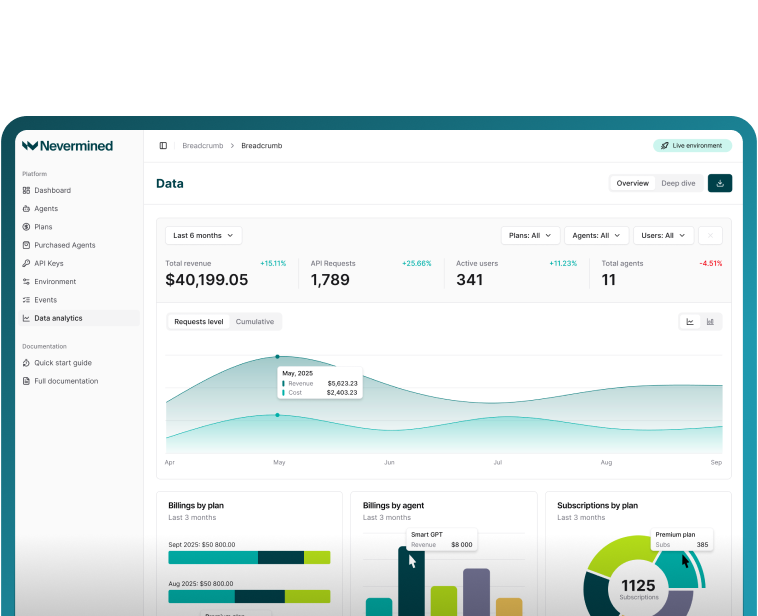
See Nevermined
in Action
Real-time payments, flexible pricing, and outcome-based monetization—all in one platform.