MENU


The global AI agent market is growing rapidly, forecast to expand from $7.84B to $52.62B between 2025 and 2030, representing a 46.3% compound annual growth rate that creates unprecedented monetization opportunities for builders and entrepreneurs. While traditional payment processors struggle with the micro-transactions AI agents generate, purpose-built payment infrastructure now enables developers to capture value from every autonomous interaction through usage-based, outcome-based, and value-based pricing models. By 2028, 33% of enterprise software applications will include agentic AI capabilities, with at least 15% of day-to-day work decisions made autonomously, opening massive revenue streams for those who build and monetize financial AI agents effectively.
AI agents in finance represent autonomous software systems that execute complete financial workflows without constant human oversight. Unlike traditional automation tools that follow rigid scripts, these agents make context-aware decisions, negotiate terms, and execute payments, transforming from passive tools into active economic participants within the agentic economy.
Financial AI agents operate across three primary categories based on their operational characteristics:
The distinction matters for monetization because each category commands different pricing structures. Transaction agents typically suit action-based pricing on a per-unit basis, while analytical agents generating high-value insights support outcome-based models tied to ROI delivered.
Financial services companies deploy AI agents across multiple revenue-generating use cases:
Building financial AI agents offers accessible income opportunities for solo developers, solopreneurs, and startups willing to specialize in niche applications. The barrier to entry has dropped significantly with no-code platforms and rapid integration tools.
Success in AI agent monetization comes from vertical specialization rather than horizontal breadth. The most profitable approach targets specific financial workflows where automation delivers measurable ROI.
Consider these proven specialization paths:
Anecdotally, solo consultants have built template-based lead qualification agents and replicated across multiple clients, generating several thousand dollars in monthly recurring revenue with minimal ongoing effort.
Agent marketplaces create distribution channels that eliminate direct sales requirements. These platforms handle customer acquisition while you focus on agent development and maintenance.
The marketplace model works because:
Passive income from AI agents requires upfront configuration work followed by minimal ongoing intervention. The key lies in selecting flexible pricing models that align revenue with value delivered.
Three monetization models support passive income generation:
Usage-based pricing charges per token, API call, or transaction with predictable margins. This model works for high-volume, low-complexity operations like data extraction and formatting.
Workflow-based pricing bundles multiple actions into outcome-oriented packages. An SDR agent charging per qualified workflow captures more value than action-based alternatives while providing predictable costs for customers.
Outcome-based pricing ties revenue directly to results achieved. Charging a percentage of fraud prevented or cost savings delivered creates aligned incentives and supports premium pricing.
Autonomous agent-to-agent commerce represents the frontier of passive income. With proper payment protocol integration, your agents can transact with other agents without human approval for each interaction.
The Agent Payments Protocol (AP2) from Google enables this through three mandate types defined in the AP2 specification:
Users authorize payment policies once, then agents interact freely within boundaries, creating truly passive income streams.
Many billing stacks are strongest in usage-based pricing; outcome-based and value-based models typically require custom logic. Advanced pricing strategies capture value commensurate with results delivered.
Outcome-based pricing shifts risk from buyer to seller while commanding premium rates. Financial services applications particularly suit this model because outcomes are measurable and high-stakes.
Consider these outcome-based structures:
Value-based pricing takes this further by charging a percentage of ROI generated. When your agent saves a client $100,000 annually, capturing a meaningful share of that value justifies premium positioning. The exact capture rate depends on market power, available alternatives, and risk transfer arrangements.
Financial clients demand verifiable usage records before committing to outcome-based arrangements. Tamper-proof metering creates the trust foundation that enables premium pricing.
Critical metering capabilities include:
Payment infrastructure determines whether your agents can actually collect revenue. Protocol selection affects compatibility, fees, and future-proofing.
Four payment protocols dominate the emerging agent economy:
AP2 (Google) provides the broadest compatibility with more than 60 partners including Mastercard, American Express, and Coinbase. The open protocol supports cards, stablecoins, and bank transfers with verifiable credential-based agent identity.
x402 enables programmatic on-chain payments, commonly using stablecoins; settlement speed and fees depend on the underlying network. Integration with AP2 creates hybrid fiat-crypto capabilities.
TAP (Visa) serves existing merchant infrastructure with agent-specific cryptographic signatures for agent verification. Visa reports a 4,700% surge in AI-driven traffic to retail merchants.
The protocol-first architecture ensures compatibility as standards evolve, avoiding vendor lock-in that plagues proprietary systems. Native support for Google's A2A protocol enables instant agent connection and auto-discovery.
Each agent requires a unique wallet plus decentralized identifier with cryptographic proof of ownership. This identity layer enables:
Financial services face stringent regulatory requirements that make compliance infrastructure non-negotiable for production deployments.
Key compliance requirements include:
The 57% of organizations estimating their data is not AI-ready underscores why compliance automation matters. Manual compliance processes cannot scale with agent transaction volumes.
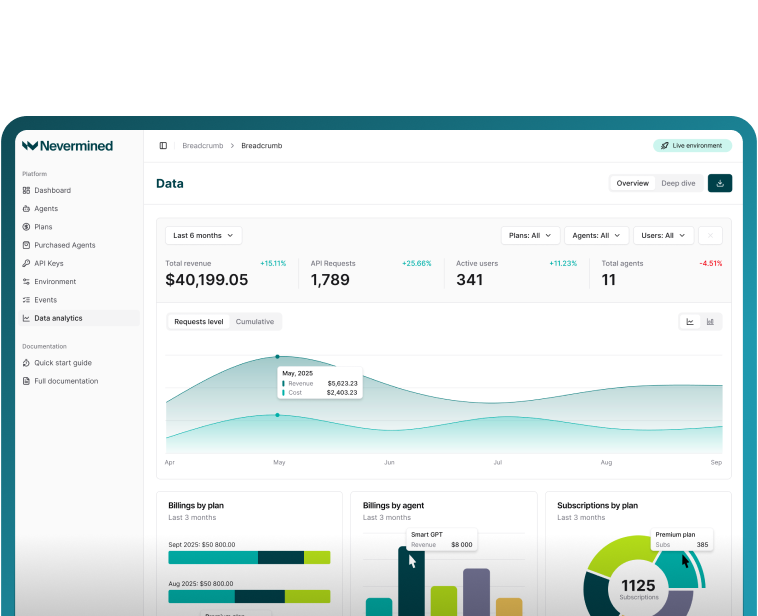
Observability dashboards provide visibility into agent performance, user behavior, and revenue analytics. Critical metrics include:
Speed to market determines competitive advantage in the rapidly evolving agent economy. Integration complexity separates successful deployments from abandoned projects.
Modern SDK-based integration enables rapid deployment without extensive development resources. Nevermined gets you from zero to a working payment integration in 5 minutes, with SDKs for both TypeScript and Python.
The three-step integration process covers:
Real-world deployments demonstrate the impact of streamlined integration. Valory cut deployment time of their payments and billing infrastructure for the Olas AI agent marketplace from 6 weeks to 6 hours using Nevermined, clawing back $1000s in engineering costs.
Anecdotally, one marketing agency research agent reportedly reduced research time from 10 hours per week to 30 minutes, enabling 3x client capacity without additional headcount.
Single agents generate income; multi-agent systems create scalable businesses. Orchestrating specialized agents that collaborate on complex workflows unlocks enterprise-grade opportunities.
Multi-agent architectures enable sophisticated financial operations:
Blockchain infrastructure enables capabilities impossible with traditional payment rails:
Cross-chain capabilities through Chainlink CCIP enable agents to transact across networks without manual bridging.
Data-driven optimization separates profitable agents from money-losing experiments. Performance analytics reveal hidden costs and growth opportunities.
Track these metrics religiously:
Optimization strategies based on performance data include:
Real-time monitoring through observability dashboards prevents surprise overruns while identifying optimization opportunities before they become problems.
While numerous payment platforms exist, Nevermined delivers comprehensive billing, metering, and settlement capabilities specifically designed for AI agents and autonomous systems.
Nevermined Pay delivers bank-grade enterprise-ready metering, compliance, and settlement so every model call turns into auditable revenue. The platform provides:
Unlike generic payment processors, Nevermined provides native support for x402, Google's A2A protocol, Model Context Protocol, and Agent Payments Protocol. This protocol-agnostic approach ensures compatibility as standards evolve.
The platform serves three customer segments effectively: solo developers needing rapid time-to-market, AI agent startups requiring flexible pricing models, and enterprise AI platforms demanding audit-ready compliance. With a 1% transaction fee and free tier for limited volume, Nevermined eliminates the friction preventing developers from monetizing their financial AI agents.
For comprehensive implementation guidance, the developer documentation provides step-by-step tutorials, sandbox environments for testing, and API references for both TypeScript and Python SDKs.
The most profitable financial AI agents target specific workflows with measurable ROI. Customer service agents handling routine queries can significantly reduce per-ticket costs compared to human interactions, with Gartner forecasting that agentic AI will resolve 80% by 2029. Lead qualification agents produce meaningful monthly value through automated prospect scoring. Fraud detection agents can process transactions in as little as 250ms in reported implementations, enabling real-time prevention that traditional systems cannot match.
Outcome-based pricing ties revenue directly to measurable results rather than usage volume. You might charge a percentage of fraud losses prevented, collections recovered, or compliance penalties avoided. Value-based pricing captures a share of ROI generated, typically based on documented savings or revenue increases. These models command premium rates because they align incentives between builder and customer while shifting performance risk to the agent provider.
Modern SDK-based integration has dramatically reduced complexity. Nevermined enables developers to go from zero to a working payment integration in 5 minutes using TypeScript or Python SDKs. The process involves installing the SDK, registering payment plans with pricing rules, and validating API requests. Enterprise deployments with custom requirements take longer, but the foundational infrastructure deploys rapidly compared to custom builds.
Secure AI agent payments require multiple layers of protection. Tamper-proof metering through cryptographically signed, append-only logs creates verifiable audit trails. GDPR compliance with explicit data handling protocols addresses privacy requirements. Agent identity through decentralized identifiers with cryptographic proof establishes accountability for autonomous transactions. The AP2 protocol from Google provides regulatory clarity through verifiable credentials and non-repudiable mandate chains. Note that verifiable credentials complement, but do not replace, regulated KYC/AML programs.
Yes, properly configured AI agents can transact autonomously within predefined boundaries. The AP2 protocol enables this through Intent Mandates where users pre-authorize spending limits and time windows. Agents then execute transactions freely within those constraints without requiring approval for each interaction. ERC-4337 smart accounts with session keys provide similar capabilities on blockchain networks, enabling delegated permissions with configurable expiration windows for secure autonomous commerce.
Join the Autonomous Business Hackathon on March 5 to 6, 2026 in downtown San Francisco to build autonomous businesses where agents make real economic decisions, transact with each other, and run with minimal human oversight.
See Nevermined
in Action
Real-time payments, flexible pricing, and outcome-based monetization—all in one platform.