MENU


AI agents in marketing are creating a massive monetization opportunity, with Grand View Research projecting the AI agents market to reach $50.31 billion by 2030 at a 45.8% CAGR (2025 to 2030). Organizations integrating these autonomous systems report meaningful conversion lifts and time savings, though results vary by funnel, data quality, and implementation. For developers and businesses looking to capitalize on this growth, agent monetization infrastructure enables real-time billing, metering, and settlement for every agent interaction. The key to profitability lies not just in deploying agents, but in building payment systems that capture revenue from billions of autonomous transactions.
AI agents represent a fundamental shift from traditional marketing automation. Unlike rule-based tools that follow rigid scripts, AI agents make contextual decisions, learn from outcomes, and adapt strategies in real time. According to Demandbase, marketing AI has evolved through three distinct phases: marketing copilots, marketing agents, and autonomous marketing teams.
The revenue opportunity exists across multiple layers:
Research from LiveRamp emphasizes that agent effectiveness depends on the quality, depth, and consent of data signals informing them. Organizations providing agents with rich, connected, permissioned data are better positioned to drive performance, creating premium service tiers for those who solve data integration challenges.
Starting an AI marketing agency requires understanding which agent types deliver the highest ROI for clients. Creatio identifies eight popular use cases where AI agents excel:
The client acquisition strategy should focus on demonstrable ROI. According to KPMG, 51% are exploring agents, 37% are piloting them, and 12% have moved to deployment. This creates a large market of prospects who understand the value but need implementation expertise.
The real profit in AI marketing comes from automation that compounds over time. Vellum's example implementations estimate the following time savings that translate directly to revenue:
When marketing teams redirect hours weekly to revenue-generating activities, the business case becomes clear. Industry expert Devreet Dulay notes in a Vellum interview that the most valuable agents are those that connect existing marketing ops tools and surface insights, not just create content.
The monetization opportunity extends to building payment infrastructure that tracks which agent created which value. Without proper metering, cost allocation and ROI measurement become impossible at scale.
Creating sustainable passive income requires building agent systems that operate autonomously within defined boundaries. The shift toward autonomous marketing teams means multiple specialized agents can collaborate without constant human oversight.
Passive income models using AI agents include:
According to Gartner, 15% of daily decisions will be made autonomously by AI agents by 2028, up from essentially zero in 2024. This shift creates opportunities for those who build agent systems early.
For truly hands-off revenue, agent-to-agent payments enable autonomous transactions without human involvement. Users authorize payment policies once, then agents interact freely within boundaries, creating self-sustaining income streams.
Developers looking to build and sell marketing agents should focus on specific, high-value problems. As the AI market matures, 2025 and beyond will mark the period when AI must prove its ROI, with companies abandoning generic applications in favor of targeted solutions.
The development process involves:
Implementation speed matters significantly. Valory cut deployment time of their payments and billing infrastructure for the Olas AI agent marketplace from 6 weeks to 6 hours using Nevermined, clawing back $1000s in engineering costs. This demonstrates that proper infrastructure choices can dramatically accelerate time to market.
For developers without extensive backend experience, platforms with 5 minute setup and SDKs for both TypeScript and Python enable rapid deployment of payment and billing capabilities.
Moving beyond simple hourly rates requires understanding the three primary pricing models that work for AI agent services:
Charge per API call, per token, or per action completed. This model works well for high-volume, predictable tasks like content generation or data enrichment. High-volume scenarios involving thousands of daily calls require infrastructure supporting micro-transactions with guaranteed margins.
Charge for results rather than activity. Examples include fees per qualified lead, per booked meeting, or per completed sale. This model aligns incentives between service providers and clients, capturing more value when agents perform well.
Calculate pricing as a percentage of ROI generated. When agents demonstrably improve conversion rates and reduce costs, value-based pricing captures appropriate compensation.
The dynamic pricing capabilities of modern payment infrastructure enable cost-plus-margin automation where platforms define exact margin percentages locked onto usage credits.
Trust becomes critical when AI agents handle client budgets and data. LiveRamp CEO Scott Howe advises marketers to assess the quality, accessibility, and granularity of data signals, working to improve any gaps.
Key transparency requirements include:
The regulatory landscape demands attention. AI agents must comply with GDPR in Europe, CCPA in California, and various sector-specific requirements. Gartner predicts 40%+ of agentic projects will be canceled by the end of 2027 due to escalating costs, unclear business value, or insufficient risk controls.
Building compliance into payment infrastructure from the start prevents costly remediation later. Audit-ready traceability should be standard, not premium.
The future involves autonomous marketing teams where multiple specialized agents collaborate. Demandbase describes this as an orchestrator agent activating creative agents, media planner agents, measurement agents, and sales sync agents to launch campaigns.
Scaling requirements include:
Gartner reports marketing budgets averaged 7.7% of revenue in 2024, down from pre-pandemic averages near 11%. Organizations achieving full integration report significant cost reductions by simplifying their tool stacks.
For enterprises, the challenge involves tracking complex multi-agent workflows, providing transparent cost allocation, and ensuring secure data transactions. The first platforms to solve agent-to-agent payment orchestration become essential infrastructure for the entire market.
While building AI agents creates value, monetizing that value requires specialized payment infrastructure. Nevermined delivers the billing, metering, and settlement capabilities that transform agent interactions into auditable revenue.
Nevermined Pay provides bank-grade enterprise-ready metering, compliance, and settlement so every model call turns into auditable revenue. The platform supports:
For marketing agencies and developers building AI agents, Nevermined gets you from zero to a working payment integration in 5 minutes, with SDKs for both TypeScript and Python. The protocol-first architecture supports x402, Google A2A, MCP, and AP2, ensuring compatibility as standards evolve.
The agent-to-agent native design enables transactions between AI agents without human involvement through smart accounts with session keys and delegated permissions. Users authorize payment policies once, then agents interact freely within boundaries.
For detailed implementation guidance, the documentation provides comprehensive guides, sandbox environments for testing, and API export for metering data verification.
AI agents generate revenue through direct service monetization, efficiency arbitrage, and performance-based pricing. Vellum's example implementations estimate Campaign Orchestrator agents save 8+ hours weekly while Campaign Intelligence agents save 10 to 15+ hours. Some teams report meaningful conversion lifts from agentic workflows, though results vary by funnel, data quality, and implementation.
Choose usage-based pricing for high-volume, predictable tasks like content generation. Select outcome-based pricing when you can measure results like qualified leads or booked meetings. Use value-based pricing when agents demonstrably improve client metrics.
Modern platforms reduce technical barriers significantly. With SDKs supporting TypeScript and Python and 5 minute setup processes, developers can deploy payment infrastructure rapidly. Focus on understanding your target marketing use case and data integration requirements rather than building payment systems from scratch.
Yes, AI agents can process thousands of micro-transactions daily when supported by proper infrastructure. High-volume scenarios involving data enrichment or content generation require payment platforms with real-time balance tracking and automatic billing. Traditional payment processors cannot handle the volume that AI agents generate, making purpose-built infrastructure essential.
Implement tamper-proof metering where every usage record is cryptographically signed and stored in append-only logs. Provide clients with clear line-item reconciliation showing exactly what generated each charge. Maintain audit trails for regulatory compliance, as Gartner predicts 40%+ of agentic projects face cancellation by the end of 2027 due to insufficient risk controls.
Join the Autonomous Business Hackathon on March 5 to 6, 2026 in downtown San Francisco to build autonomous businesses where agents make real economic decisions, transact with each other, and run with minimal human oversight.
See Nevermined
in Action
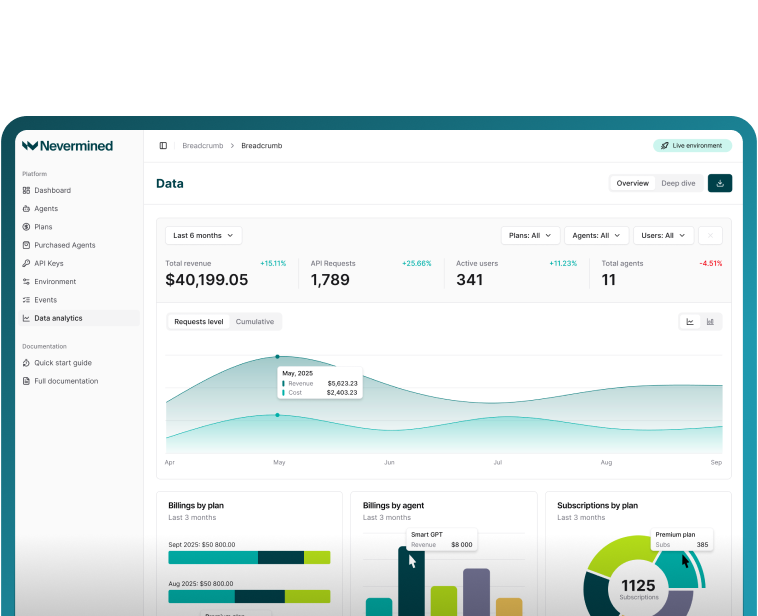
Real-time payments, flexible pricing, and outcome-based monetization—all in one platform.