MENU


AI infrastructure is scaling quickly as model training, inference, and autonomous agent workloads consume more compute. Stanford's 2026 AI Index reports that global AI compute capacity grew 3.3 times per year from 2022 through 2025, reaching an estimated 17.1 million H100-equivalents. For GPU clouds and agent-hosting platforms, that expansion creates a commercial challenge: compute costs move with usage, while pricing still needs to remain understandable, measurable, and profitable.
The infrastructure is also becoming more varied. NVIDIA's current DGX infrastructure architecture includes B200, H200, and H100 systems with different GPU memory capacities and hardware profiles. A GPU-hour is therefore not a universal unit of value. Providers need to define what customers are actually buying, meter the resources that affect cost, and connect completed compute or agent work to pricing and payment.
A GPU provider cannot design an effective monetization model until it identifies the commercial unit.
Raw infrastructure providers may sell allocated accelerator time. An inference platform may sell requests or tokens. Agent-hosting companies may sell complete workflows whose underlying compute remains invisible to the customer.
These products have different economics, so the billable unit should match what the customer actually receives.
Common infrastructure costs include:
Not every cost driver needs to become a customer-facing price.
A hosted agent might use GPU compute, multiple models, search, and a database behind the scenes while the customer pays one price for a completed task. Internal metering can remain granular even when external pricing stays simple.
The billable event should be observable and connected to something the customer recognizes. Possible events include:
Completion rules matter just as much as the unit itself. Authentication failures, infrastructure errors, duplicate retries, and interrupted jobs should not automatically generate the same charge as successfully delivered work.
GPU clouds and agent-hosting platforms often need several pricing models because customers are buying different layers of the stack.
Infrastructure buyers may care about capacity and utilization. Agent customers may care about requests, workflows, or outcomes.
On-demand pricing charges according to actual resource allocation. It works well for experimentation and variable workloads because customers avoid long-term commitments.
Serverless pricing moves the customer-facing unit away from the GPU itself. Instead of buying an accelerator for an hour, customers pay for execution time, model requests, generated output, tokens, or another workload-level metric.
The advantage is accessibility. Customers do not need to size the underlying hardware themselves.
The provider takes on more responsibility for understanding the true cost of serving each request.
Committed-use pricing exchanges a longer customer commitment for a lower effective unit price. Providers gain more predictable utilization and revenue, while customers receive more predictable economics.
A customer can still exceed that commitment. The billing system therefore needs to distinguish reserved capacity from additional on-demand usage.
Spot or interruptible pricing solves a different utilization problem by monetizing spare capacity. Customers accept the possibility of interruption in exchange for lower prices.
This works best for workloads that can restart or checkpoint safely. Billing rules should define when an interrupted session stops accumulating charges and how failed work is treated.
Agent-hosting services sit above raw infrastructure, so infrastructure units are not always the clearest way to charge customers.
A customer may care more about a completed research package than the GPU time, model calls, and external tools required to produce it.
Usage pricing works when consumption can be measured reliably.
Possible units include:
This creates a direct relationship between activity and spending.
Its main challenge is predictability. An autonomous agent may decide to use more models or tools than the customer expected. Spending ceilings, included usage, and prepaid balances can keep that variability within an approved range.
Workflow pricing charges for completed work instead of each internal operation.
Examples include producing a research package, processing a dataset, completing a code-analysis job, or executing a multi-step agent task.
This gives customers a clearer commercial unit, but the provider absorbs more cost variability. Two workflows sold at the same price may consume very different amounts of compute.
Providers should define completion criteria, included retries, and cost ceilings before using fixed workflow pricing.
Outcome pricing goes one step further by connecting revenue to a measurable business result, such as a resolved support request or completed transaction.
It can create strong alignment, but only when success and attribution are objective enough for both sides to verify.
Credits provide a useful middle ground when a platform has several billable operations.
A lightweight inference request might consume one credit, while a GPU-heavy workflow consumes 50. Customers receive a defined spending boundary without requiring a separate financial transaction for each small event.
Hybrid models can then combine several structures:
This gives providers predictable baseline revenue while still capturing changes in usage or workload value.
Different GPU generations have different memory, bandwidth, throughput, energy, and availability characteristics.
A newer or more expensive accelerator is not automatically the costliest option for a particular workload. If it completes a job substantially faster or handles more concurrent requests, its cost per completed task may be lower.
Providers therefore need to track economics above the hardware level.
Useful metrics include:
This becomes even more important for agent workflows.
One request may trigger GPU inference, search, retrieval, several third-party APIs, and retries before producing the final response. A $0.50 workflow can become unprofitable even when the GPU component alone appears inexpensive.
Platforms should connect revenue and fulfillment cost at the same level used for pricing.
Useful questions include:
The goal is to adjust routing, pricing, or included usage before a small unit-economic problem scales.
A human customer can read pricing pages, create an account, add a payment method, and ask for help when terms are unclear.
An autonomous agent needs those conditions expressed programmatically.
An agent-ready service should make four things explicit:
The service does not need to expose every internal GPU detail. It does need to provide enough information for software to determine whether it can access and purchase the service.
Access and payment answer different questions.
A production system should be able to determine:
A valid API credential should not automatically provide unlimited financial authority. A valid payment method should not automatically grant access to every model, GPU, dataset, or endpoint.
Autonomous buyers also need bounded spending controls such as:
The objective is autonomous execution within a financial policy established in advance.
The commercial flow should mirror the delivery flow.
For a paid GPU-backed API or agent service, a practical sequence is:
This keeps expensive compute from running before the platform confirms that the buyer has valid access and sufficient payment authority.
The underlying payment rail can vary.
Possible options include:
The right rail depends on the transaction pattern.
A monthly committed GPU contract and a small inference call do not need the same settlement design. Providers should define the commercial unit first, then choose the payment rail that matches its transaction size, customer base, accounting requirements, and frequency.
Decide whether customers are buying raw GPU capacity, managed inference, agent runtime, API access, or completed workflows.
Measure the infrastructure and downstream services that materially change fulfillment cost.
State exactly what creates a charge and how failed, duplicated, or interrupted work is treated.
Choose usage, workflow, credits, committed capacity, outcome, or hybrid pricing according to the product being sold.
Define which resources each buyer can use and how much autonomous agents may spend.
Record the completed usage, pricing rule, customer, agent, plan, and settlement result for each billable event.
Compare revenue with GPU, model, storage, and downstream service costs. Adjust pricing or routing when workload economics change.
Nevermined provides the monetization and payment layer around AI infrastructure rather than replacing the GPU cloud itself.
A GPU-backed API, hosted model, MCP tool, or agent endpoint can use Nevermined to connect access, pricing, metering, and payment to the same commercial flow.
Key capabilities include:
For a GPU or agent-hosting service, Nevermined can sit between the buyer and the protected workload.
The service verifies the buyer's entitlement before compute runs. After successful execution, completed usage can consume credits or settle according to the attached payment plan.
This creates a traceable relationship between the service delivered and the revenue recognized.
The same infrastructure can support agents purchasing services.
Financial authority remains bounded through delegated budgets rather than giving an agent unrestricted access to the owner's payment source. At the organizational level, administrators can allocate spending limits to teams or groups of agents while keeping funding centralized.
This allows a platform to support both sides of the transaction: services that need to get paid and agents that need permission to spend.
Builders can start with a working payment integration for an agent API, MCP tool, or protected resource using TypeScript or Python.
A typical implementation can then:
Nevermined reports that Valory reduced deployment time for payment and billing infrastructure in the Olas AI agent marketplace from six weeks to six hours.
The best unit depends on what the customer is buying. Raw infrastructure naturally maps to allocated GPU time, while managed inference can use tokens, requests, generated output, or credits. Agent-hosting services may be easier to price by workflow or outcome. Internal metering can remain more detailed than the customer-facing price so the provider can still understand cost and margin.
Providers can combine variable pricing with spending ceilings, prepaid credits, included usage, or committed capacity. Customers gain a defined financial boundary while the platform still captures changes in consumption. Different types of payment plans can support workloads with different levels of cost variability.
Financial limits should be enforced by infrastructure rather than relying on the AI to remember its budget. Set spending ceilings, expiration rules, approved funding sources, and revocation controls before the agent begins making purchases. For larger deployments, groups and budgets can apply separate ceilings to teams or groups drawing from shared funds.
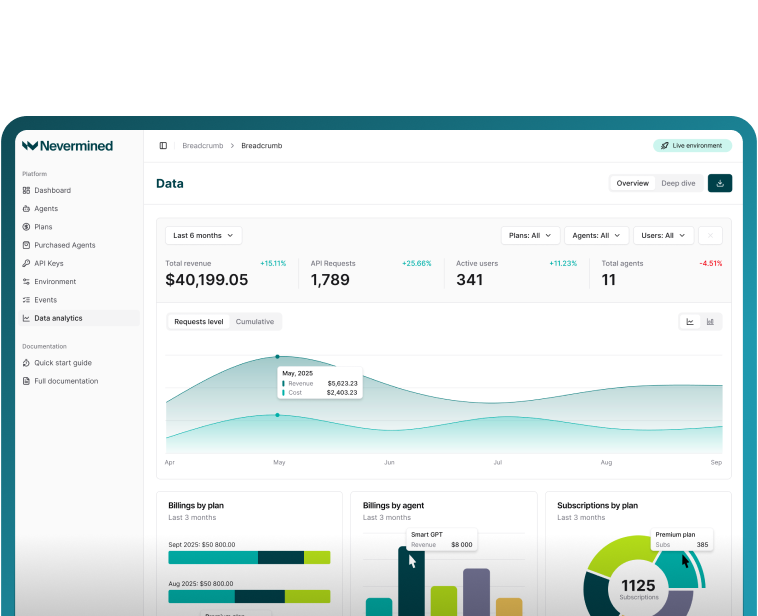
Track revenue and fulfillment cost at the same level used for pricing. Model calls, GPU usage, paid tools, storage, retries, and external APIs can all change the cost of a workflow. Observability and monitoring can connect request activity, token use, credit consumption, and cost information so underpriced workloads can be identified earlier.
Yes, if the service exposes machine-readable access and payment requirements and the agent has sufficient payment authority. The provider still needs clear pricing, entitlement, completion, metering, and settlement rules. Infrastructure supporting stablecoin and fiat payments can serve autonomous buyers through different funding paths while keeping the service's commercial logic consistent.
See Nevermined
in Action
Real-time payments, flexible pricing, and outcome-based monetization—all in one platform.