MENU
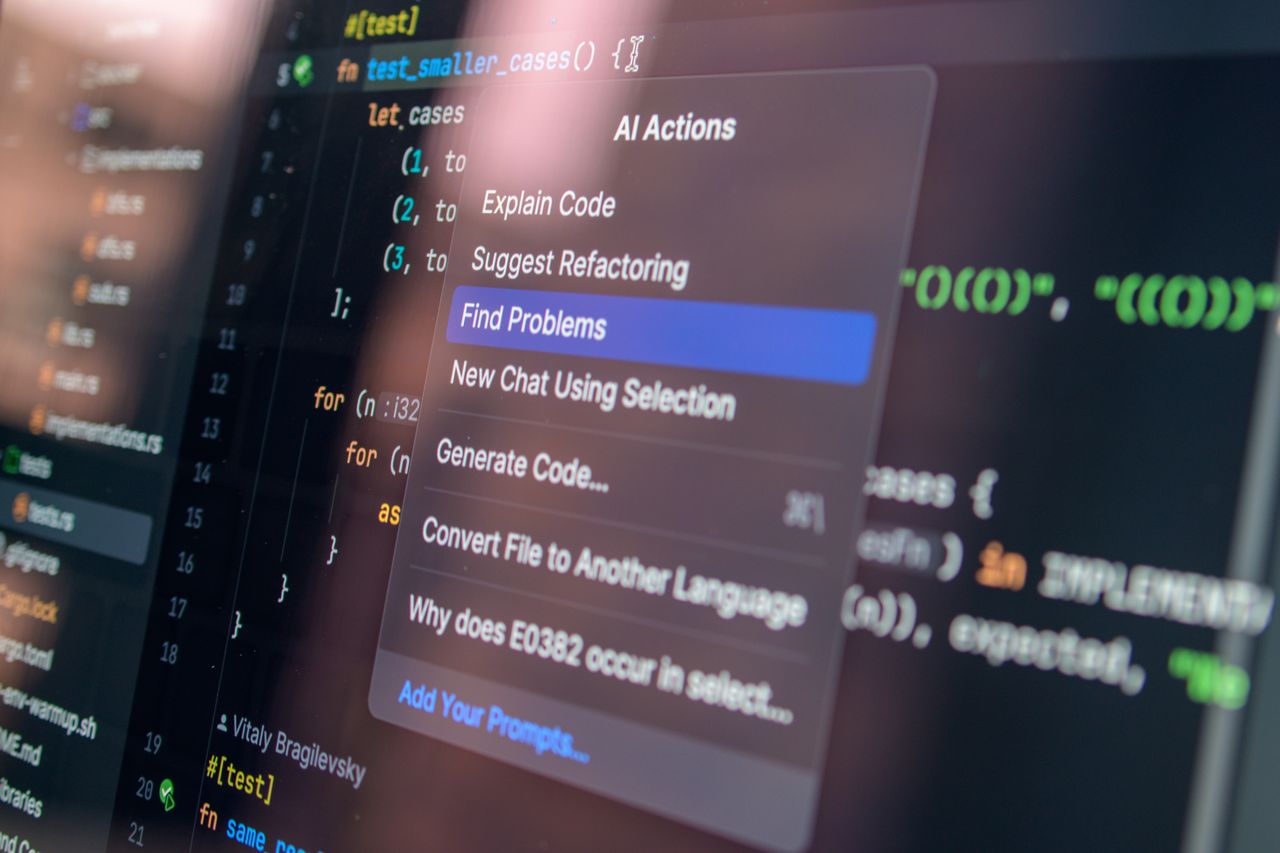

AI coding agents are moving beyond autocomplete toward repository-level software engineering work. SWE-Bench Pro evaluates agents on 1,865 problems from 41 actively maintained repositories, with tasks designed to test longer-horizon software engineering rather than isolated code generation. Software engineering agent benchmarks increasingly reflect the kinds of multi-step work that coding products may eventually need to price and meter.
That does not mean every coding agent delivers the same productivity gain. METR's 2026 follow-up on developer productivity with AI found that wider AI adoption and participant selection effects made the size of current productivity gains difficult to estimate reliably. Monetization should therefore be based on observable access, usage, workload, and outcomes rather than assumptions about how many developer hours or seats an agent replaces.
The first monetization decision is the commercial unit, not the price.
A developer assistant embedded in an IDE may primarily sell ongoing access. A repository-level agent may perform discrete development tasks. A testing or security service may expose individual capabilities through an API or MCP server.
Possible billable units include:
The customer-facing unit does not need to expose every internal operation.
An agent might inspect hundreds of files, call several tools, run tests repeatedly, and make multiple model requests before producing one patch. The provider can meter those steps internally while charging the customer a simpler unit such as credits or a completed task.
Coding workflows can fail after substantial resources have already been consumed.
Billing policies should address:
A bug-fixing task should not automatically count as a successful outcome merely because the agent returned code.
For longer-running workflows, payment infrastructure can use a pre-authorization pattern to verify that sufficient credits are available before execution, then calculate and settle the actual charge after completion. Nevermined's current documentation also shows that failed long-running tasks can exit without settling credits.
No single pricing model fits every coding product.
The appropriate structure depends on whether customers are buying predictable access, variable compute, discrete development work, or measurable outcomes.
Subscriptions remain useful when customers primarily value continued access.
Plans can vary by:
Per-seat pricing can also remain appropriate when the product is tightly associated with individual developers.
It becomes a weaker proxy when a small number of users can launch large volumes of autonomous work. In that case, a subscription can still provide the access layer while credits or usage limits control consumption.
Credits provide a common commercial unit across different coding operations.
A platform could assign different credit values to:
Customers purchase a balance and consume credits as work is completed.
This can make variable coding workloads easier to package without exposing every model token, tool invocation, or infrastructure expense directly to the customer.
Developer-facing services can also charge according to measured consumption.
Relevant units may include:
Tokens are an important cost driver, but they are not always enough to describe the economics of an autonomous coding task.
A request with modest token use may still involve extensive test execution, container time, or external services. Patterns for variable and usage-based pricing support token-based charges, complexity-based pricing, usage tiers, and custom cost calculations.
Some coding tasks have sufficiently objective success criteria to support outcome pricing.
Examples include:
Outcome pricing should be used only when the result can be verified consistently.
A patch that compiles may still fail the customer's actual requirements. The acceptance criteria should therefore be defined before execution and should distinguish successful completion from merely producing an output.
Coding platforms can also combine several models.
Examples include:
Infrastructure supporting multiple payment models can combine credits-based, time-based, dynamic, and hybrid structures without requiring every service to use the same commercial model.
Coding-agent costs extend beyond model inference.
Relevant cost drivers can include:
A provider that meters only tokens may therefore miss a substantial share of the cost of completing a task.
Useful unit-economic metrics include:
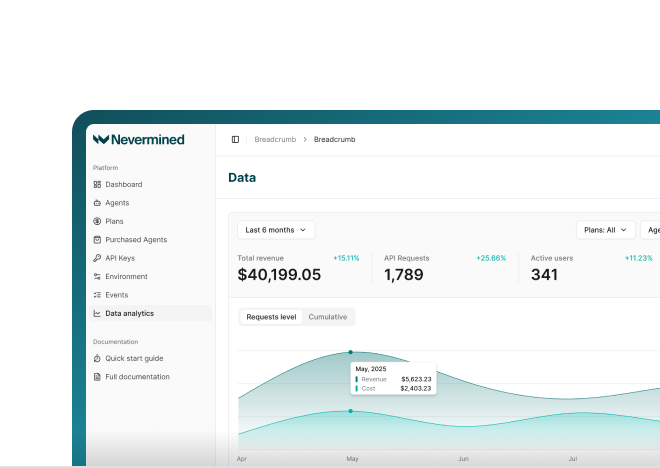
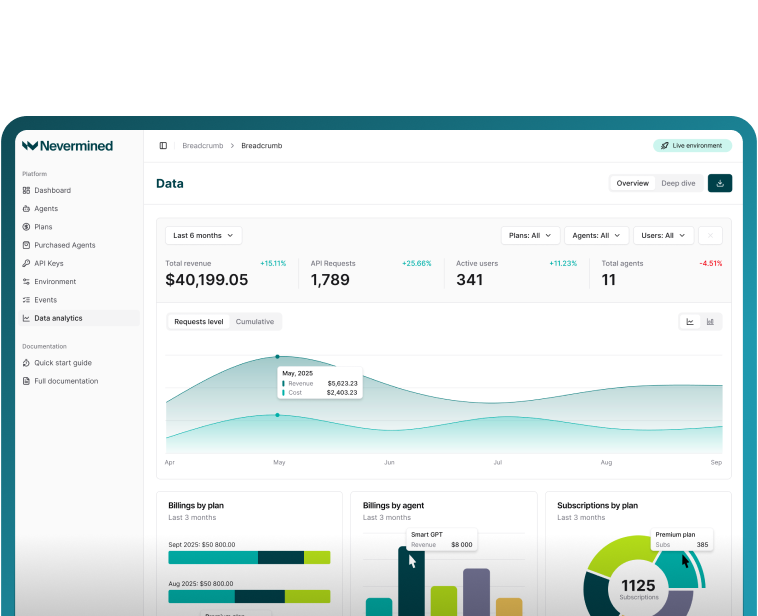
An observability and monitoring layer can track request activity, token usage, costs, status, performance, credit consumption, and application-specific metadata. Coding providers can attach their own properties for repository, task category, tool usage, or completion state.
The important comparison is revenue against the full cost of fulfilling the task, not simply revenue against model tokens.
Coding products do not need to be sold only as complete applications.
Individual capabilities can become paid services inside larger development workflows.
Examples include:
MCP is particularly relevant because coding agents increasingly call specialized tools as part of multi-step workflows.
A provider can monetize your AI tools by placing payment-plan validation around MCP tools, resources, and prompts. Nevermined's current MCP integration verifies valid payment access before the handler executes and supports fixed or dynamic credit deduction after successful calls.
This allows a security scanner, testing service, or repository-analysis tool to be monetized independently instead of requiring the buyer to purchase an entire coding-agent platform.
Coding agents may also need to purchase external services while completing a task.
An agent could need access to a paid data source, API, development utility, or another machine-readable service.
That creates a separate requirement from seller-side billing: the agent needs payment authority without unrestricted control over organizational funds.
Useful controls include:
Buyer-side routing can record supported machine payments in one unified ledger while enforcing a hard spending cap at payment time. Nevermined's current Router supports x402 and MPP services and spends against a Delegation with both a cap and an expiry.
Organizations may need another control layer above individual agents. Groups and budgets can place ceilings around teams using shared organization-funded payment methods, with additional spending blocked when the configured budget is reached.
These controls keep financial policy outside the coding agent's own reasoning.
Determine whether customers are buying continuous access, API calls, individual tool operations, coding tasks, or verified outcomes.
Define what counts as successful delivery before setting outcome or task-based prices.
Tests, validation rules, or other objective acceptance criteria should be established wherever possible.
Measure model usage, external tools, execution environments, test runs, retries, and other infrastructure required to deliver each workflow.
Use subscriptions for predictable access, credits for packaged consumption, usage pricing for measurable workloads, and outcome pricing where results can be verified objectively.
Hybrid pricing can combine these structures when one commercial unit does not cover the entire product.
Define plan limits, task ceilings, team budgets, and agent spending authority before autonomous usage begins.
Each billable operation should map back to the customer, plan, task, usage record, completion state, and final charge.
Compare revenue against the full delivery cost by plan and workload.
Pricing should evolve as models, tools, execution patterns, and customer behavior change.
Nevermined provides a payment and monetization layer around AI services rather than replacing the coding agent, model, repository infrastructure, or execution environment.
For coding-agent providers, the platform can connect paid access, pricing, usage settlement, MCP monetization, and autonomous purchasing to existing services.
A payment and entitlement layer can validate each inbound request against the caller's plan before protected code runs.
Nevermined's current architecture associates monetizable APIs, MCP tools, and protected resources with payment plans, validates access before delivery, and tracks usage against the entitlement.
This is useful for coding workloads where repository indexing, inference, or execution can begin creating costs immediately.
Nevermined supports fixed and dynamic pricing alongside prepaid and pay-as-you-go consumption structures. Its core documentation also describes time-limited and outcome-based plans, while the dedicated pricing patterns support credits, subscriptions, dynamic charges, and hybrid access.
For variable tasks, variable and usage-based pricing can calculate charges from token counts, complexity, usage tiers, or other application-defined metrics.
The coding provider defines the commercial logic. Nevermined supplies the infrastructure for applying and settling the resulting charge.
Coding tasks often need to be evaluated after execution.
Nevermined's patterns for charging credits allow payment permission to be verified before processing and credits to be settled after successful work. Long-running operations can also verify sufficient balance against an estimated maximum before calculating the actual final cost.
This allows a coding application to incorporate tests or other completion criteria before determining the final billable amount.
Coding agents often rely on MCP tools for specialized capabilities.
Nevermined can protect tools, resources, and prompts with payment validation and automatically deduct fixed or dynamically calculated credits after successful execution.
This makes it possible to monetize a repository analyzer, test generator, code-review service, or security tool independently from a broader coding product.
Nevermined separates seller-side monetization from buyer-side spending.
The Router lets an agent pay x402 or MPP services from a Delegation with a server-enforced spending cap and expiry. Supported transactions are recorded on the same ledger, while the agent does not need to hold the payment private key itself.
For enterprise deployments, organization budgets can add another limit above individual agent permissions.
Nevermined's security certifications include ISO/IEC 27001:2022 certification and a SOC 2 Type II attestation report, while its payment infrastructure operates at PCI SAQ-D level. The documentation explicitly distinguishes SOC 2 Type II as an attestation report rather than a certification.
Raw card numbers are captured through PCI-compliant infrastructure and tokenized before reaching Nevermined systems.
These controls cover the payment layer. Coding-agent providers remain responsible for the security, authorization, data handling, and governance of their own development environments.
The current quickstart documents a working payment integration in five minutes for an agent API, MCP tool, or protected resource, with TypeScript and Python examples.
That quickstart covers the initial payment flow rather than the full production deployment.
A coding-agent product may still need application-specific pricing, repository permissions, task validation, observability, team controls, and integration with its surrounding development environment.
The appropriate billable unit depends on the service being sold. Human-facing assistants may fit subscription pricing, while autonomous services can charge for credits, tool operations, tasks, or verified outcomes. Internal metering should still capture model use, tools, execution, and retries even when the customer sees a simpler price. The strongest commercial unit is one customers can understand and the provider can measure consistently.
Per-seat pricing can work when the product remains closely tied to individual developers and usage is reasonably predictable. It becomes less representative when a small team can trigger large amounts of autonomous work or when consumption differs substantially between users. Subscriptions can then be combined with usage limits or credits rather than discarded entirely. Pricing should follow how the product is actually consumed rather than assuming every coding agent requires the same model.
Outcome pricing works best when success can be measured objectively and agreed in advance. Examples include passing a defined test suite, resolving a reproducible issue, or satisfying documented validation criteria. A returned patch or completed agent run is not necessarily a successful outcome on its own. Tasks that depend heavily on subjective review may be better suited to credits, usage pricing, or a hybrid structure.
Providers should measure more than model tokens because tool calls, test execution, sandbox time, retries, and external APIs can materially change fulfillment cost. Observability and monitoring can connect request-level usage and cost information with application-defined metadata. Those records can then be compared with revenue by workload and plan. Pricing should be adjusted when a task category consistently produces weaker unit economics.
Yes, when the agent has bounded payment authority and the external service supports a compatible machine-payment flow. Spending should be governed by infrastructure controls such as a cap, expiry, and transaction record rather than left to the model's instructions alone. The Nevermined router overview documents this model for x402 and MPP services using delegated budgets. This allows an autonomous workflow to purchase external services while keeping financial policy outside the coding agent itself.
See Nevermined
in Action
Real-time payments, flexible pricing, and outcome-based monetization—all in one platform.