MENU


Data providers can package datasets and applications as agent-ready, pay-per-query endpoints that AI agents discover and purchase programmatically. The model resembles the economics of web search APIs: expose a machine-consumable service, define a measurable unit of access, and charge when software uses it.
For agent buyers, the commercial path also needs to be machine-readable. Markdown access instructions can explain what the service provides, how to call it, what it costs, and how payment works. Payment infrastructure such as Nevermined can handle authorization, metering, and settlement, while agent catalogs provide another distribution channel for autonomous buyers looking for compatible data services.
Traditional data sales assume a human buyer.
The buyer discovers a product, speaks with sales, reviews a contract, completes procurement, and receives access. That process still works for large enterprise relationships. It becomes less practical when an AI agent needs a specific API or dataset in the middle of an automated task.
That is the core mismatch. Machine-speed consumption meets human-speed commerce.
The emerging agentic commerce model changes the transaction path. Software can discover a service, determine whether it fits a task, evaluate its commercial terms, obtain authorization, and consume the resource programmatically.
For data providers, that creates another packaging model: turn an existing data product into an endpoint an agent can understand and purchase directly.
IBM describes data products as services that can be delivered through formats such as APIs, downloads, and streams. The agent-ready extension is to make the commercial rules around those services as machine-readable as the technical interface.
Enterprise procurement will remain important for high-value and regulated relationships. Security reviews, licensing negotiations, and legal approval still matter.
Agent-ready access adds another route.
For transactions suited to self-service consumption, an agent should be able to determine:
That information needs to be explicit.
A human developer can work around incomplete documentation. An autonomous system needs predictable instructions.
Programmatic authentication matters for the same reason. API keys, scoped tokens, OAuth, and other approaches can all work, provided the transaction does not require a person to intervene for every individual purchase.
Search APIs provide a familiar economic pattern for agent-ready data products.
A developer does not negotiate a contract every time an application submits a search. The service exposes a callable endpoint, defines a usage unit, measures consumption, and charges according to a pricing model.
The same pattern can apply to specialist datasets, research services, financial information, enrichment APIs, analytics, and other machine-consumable data products.
A provider might charge:
The exact unit varies. The commercial principle stays the same: make the resource callable, measurable, and purchasable.
Nevermined has also published guidance on how web search APIs can expose payment flows to AI agents, illustrating how that familiar API model can extend into autonomous purchasing.
An agent-ready data product does not require a new dataset.
Often, the underlying information stays the same. What changes is the interface around it.
The provider exposes the data through a machine-consumable endpoint, publishes access instructions, defines the billable unit, and connects consumption to a payment and metering layer.
A practical endpoint should expose predictable inputs and outputs.
That commonly means:
Structured JSON remains common because applications can parse it directly. But the response format is only one part of the product.
The commercial rules need the same clarity.
If the product charges per query, the provider should define what counts as one query. If access uses credits, documentation should explain when credits are consumed. If a request is rejected after a spending limit is reached, that behavior should be predictable.
Agents transact more reliably when both the technical and commercial interfaces are explicit.
Human-facing documentation remains important, but agent buyers benefit from concise, structured instructions that can be parsed programmatically.
Markdown can serve as that access layer.
A machine-readable instruction file can describe:
This does not replace full developer documentation. It gives an agent a compact path to understanding whether the service is useful and how to transact with it.
For providers, that makes documentation part of the distribution infrastructure rather than something agents encounter only after purchase.
A single pricing model will not fit every data product, but pay-per-query is a useful starting point for services consumed intermittently by software.
Instead of requiring a buyer to commit to an annual contract before making one request, the service can attach a price to the unit consumed.
The Bessemer Venture Partners AI pricing playbook discusses usage-based, outcome-oriented, and hybrid pricing approaches for AI products.
For data services, the billable unit might be:
Usage-based pricing fits variable consumption. Subscriptions work when usage is predictable. Hybrid models combine a fixed commitment with incremental consumption.
Outcome pricing can work when the provider can define the result clearly enough to meter and reconcile it.
The important part is alignment. Charge for something both the provider and buyer can identify consistently.
The endpoint delivers the product.
The monetization layer determines who can access it, what they can spend, what gets metered, and how settlement occurs.
Those pieces need to remain synchronized.
First, define exactly what is being sold.
A provider might sell:
Then define the event that triggers a charge.
Avoid vague units. A measurable event is easier to price, meter, reconcile, and expose to an autonomous buyer.
Once an agent purchases access, the system needs to know what that agent is entitled to consume.
That entitlement may be connected to:
Metering should happen close enough to the access layer that billable consumption is consistently recorded.
The principle is simple: resource access and commercial records should not drift apart.
If a balance reaches zero, a budget is exceeded, or authorization expires, the endpoint should return a predictable response instead of continuing uncontrolled consumption.
Autonomy does not mean unlimited spending.
Agents need explicit boundaries around what they can purchase.
Useful controls include:
Spending mandates can define those boundaries before an agent starts transacting.
The agent operates independently inside the assigned permissions. Outside them, the system stops or requires additional authorization.
That is the practical balance between autonomy and financial control.
Packaging the endpoint solves access.
Distribution solves discovery.
Human customers find data products through search engines, marketplaces, referrals, sales teams, and developer communities. Autonomous agents need an equivalent way to locate services that match a task.
Agent catalogs can provide that layer.
A useful catalog entry should expose enough information for an agent to evaluate the service before attempting a purchase.
That can include:
Markdown documentation and structured metadata give the catalog information an agent can interpret directly.
The provider still controls the canonical product information. The catalog becomes an additional distribution layer pointing agents toward the service.
An agent working on a task may need a specific capability rather than a specific brand.
For example, it may need:
A catalog gives the agent a place to identify services that provide those capabilities.
The transaction path becomes shorter: discovery, evaluation, authorization, payment, then consumption.
For data providers, that means distribution can extend beyond human buyers to software operating within delegated authority.
Pay-per-query only works when billable queries can be measured reliably.
The system needs to record what was consumed, who consumed it, under which pricing plan, and at what price.
Each event should contain enough context to support reconciliation.
Depending on the service, that may include:
This creates a traceable relationship between API access and revenue.
Prepaid credits and spending limits add control to autonomous consumption.
When a balance reaches zero, access can stop or trigger a top-up requirement. When an agent reaches its budget, additional purchases can be rejected.
That is more predictable than allowing software to accumulate an open-ended balance.
It also makes disputes easier to investigate because the provider can reconstruct when access occurred, what was consumed, and which pricing rule applied.
Making an endpoint purchasable by agents does not remove existing security obligations.
It adds another actor to the system: autonomous software with delegated authority.
That makes scoping important.
Payment credentials should expose only the permissions required for the task. Access credentials should follow the same principle. Sensitive payment information should not be handed directly to an agent when a scoped capability can accomplish the same result.
Data governance remains separate from payment authorization.
A successful payment does not automatically grant unlimited rights to use a dataset. Licensing restrictions, privacy requirements, geographic rules, retention policies, and contractual controls still apply.
Financial permission answers one question: can the agent purchase access?
Data authorization answers another: what can it do with the resource?
Providers need both.
The agent ecosystem is still evolving.
Different frameworks use different approaches to service discovery, tool invocation, identity, and payments. Protocols such as x402, MCP, A2A, and AP2 address different parts of that stack.
Providers can reduce dependency on any single standard by keeping the underlying data product separate from the surrounding transaction layer.
The endpoint remains the product.
Protocols, payment rails, authentication systems, markdown instructions, and catalogs become interfaces around it.
That also makes pricing easier to change. A provider can introduce credits, change a query rate, or add a subscription without redesigning the underlying dataset.
Protocol flexibility matters because the surrounding infrastructure will continue to evolve.
Nevermined provides payments infrastructure for AI agents and digital-service providers. For API providers, it can sit around an existing endpoint and connect authorization, access, metering, and settlement.
The underlying API remains with the provider. Nevermined supplies the transaction infrastructure around it.
Nevermined's x402 Facilitator supports HTTP-native payment flows.
A protected endpoint can communicate that payment is required as part of the HTTP interaction. The client satisfies that requirement and retries the request with the appropriate payment authorization.
That makes payment part of the API flow rather than a separate browser checkout.
For a pay-per-query data service, the process is straightforward: the agent requests access, receives the payment requirement, satisfies it, and retries the request.
Nevermined supports fiat and crypto payment models around these flows, giving providers different settlement options without changing the underlying endpoint.
Nevermined also supports delegated card payments for agents.
Instead of exposing raw card credentials, the system gives the agent scoped payment authority. Spending can be constrained through rules such as limits, time windows, and permitted transaction conditions.
Payment capability, not card credentials.
The agent can purchase services autonomously while remaining inside boundaries defined by the person or organization funding it.
Nevermined supports credit-based, time-based, dynamic, and hybrid payment models.
For a data provider, metering can connect a billable event, such as a query or API request, to the commercial plan assigned to the buyer.
That supports models such as pay-per-query, prepaid credits, subscription allocations, dynamic usage charges, and hybrid plans.
The commercial model can change without requiring the underlying data API to change.
Nevermined's API-provider workflows also support machine-readable integration information and markdown-based instructions.
That matters for discovery.
An agent needs to understand what a service offers, how to call it, and what payment or authorization is required before it can transact.
Structured access instructions make that commercial interface easier to interpret programmatically.
Once a provider has an agent-ready endpoint and machine-readable access instructions, distribution becomes the next question.
Nevermined's discovery model gives compatible services another way to be surfaced to autonomous systems searching for specific capabilities.
The catalog does not replace the provider's website or developer documentation. It adds another channel designed around machine discovery.
In practice, the flow is simple: package the data, publish agent-readable instructions, make the service discoverable, meter consumption, and settle payment.
Nevermined documents a 5-minute setup and provides TypeScript and Python tooling.
Nevermined also reports that Valory reduced implementation time for payment and billing infrastructure for the Olas AI agent marketplace from six weeks to six hours.
That result reflects Valory's implementation rather than a universal deployment benchmark.
Nevermined's current pricing structure charges 1–2% of settled transaction volume, with the applicable rate depending on the settlement path.
Its security documentation details controls and attestations including SOC 2 Type II, ISO 27001, and PCI SAQ-D.
For data providers, those controls sit alongside the commercial capabilities required for autonomous purchases: scoped authority, revocation, usage metering, transaction records, and multiple payment models.
The clearest fit is an existing API or data application that already delivers value but needs an additional commercial interface for machine buyers.
A provider can expose the dataset through a machine-consumable API, define a measurable charge unit such as a query or record, publish structured access instructions, and connect authentication to metering and payment. The underlying dataset does not need to change. The main work is making discovery, pricing, authorization, and purchase programmatic.
Pay-per-query lets an agent purchase only the access it needs during a workflow instead of requiring a large upfront contract. The model resembles other metered APIs: each request or defined usage unit can be priced, recorded, and settled individually or through prepaid credits. Subscriptions and hybrid pricing can still be offered for customers with more predictable consumption.
Markdown instructions give agents a structured description of what a service does, how to call it, what authentication is required, and how pricing or payment works. They complement full developer documentation by providing a compact, machine-readable route from discovery to integration and purchase.
Agent catalogs provide a discovery layer where autonomous systems can identify APIs and data services relevant to a task. A useful listing can expose capabilities, pricing, endpoint information, authentication requirements, and access instructions. The catalog therefore acts as an additional distribution channel rather than replacing the provider's own website or documentation.
Nevermined can provide the transaction layer around an existing endpoint by connecting payment authorization, usage metering, credits or pricing rules, and settlement. Providers retain their underlying API and data product while adding infrastructure that allows authorized agents to discover the service, purchase access, consume a query, and generate a corresponding commercial record.
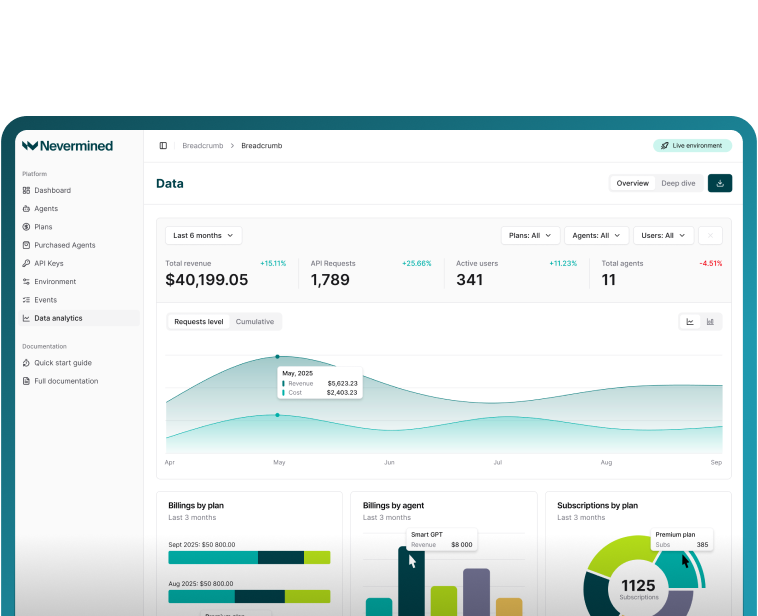
See Nevermined
in Action
Real-time payments, flexible pricing, and outcome-based monetization—all in one platform.